Legal-Systems-Class-Notes.docx
Characteristics of the State
What Is A Legal System?
Legal systems are the systems of rules emerging every time humans enter into forms of cohabitation or coexistence (Ubi Societas, Ibi Ius)
Constitutive elements of a legal system:
- A plurality of individuals coexisting
- Shared criteria to evaluate behavior
- Rules making some behaviors illicit and rewarding others
- An authority within the group with some form of law-making power and the power to enforce rules
Different Theories:
- Normativist: emphasizing the formal and State element: Hans Kelsen
- Institutionalist: emphasizing the sociological element: Plurality of Legal Systems by Santi Romano
Classification of Legal Systems
Fluid v. Concentrated Legal Systems:
- Fluid: no central authority 🡪 E.G. International Law
- Concentrated: strong central authority (last decider) 🡪 E.G. The State
Voluntary v. Necessary Legal System
- Voluntary: people come together out of common will, interest, need, or belief
- E.G.: political parties, clubs, associations, professional organizations (voluntary but often obligatory...???)
- Mostly Non-Territorial
- Necessary: people cannot opt out of the system
- E.G. Residents in a Town, Citizens in a Nation State
- Mostly Territorial
Specialist v. General Legal Systems
- Specialist: rules governing only specific sets of relations
- E.G. WTO, The Church
- General: pursuing general aims – aspiration to govern all spheres of life
- E.G. The State, The European Union?
Non-Sovereign v. Sovereign Legal Systems
- Non-Sovereign: require authorization and legitimation by a sovereign to exercise power:
- E.g. Regions, local councils, government agencies, but also the European Union – their power is not sovereign because it is derived from the State.
- Sovereign: sovereign power is self-sufficient– it does not need external legitimation
- E.G. The State
The State
The State is a legal system having general ends and objectives which exercises sovereign power over a specific territory, to which the subjects or participants belonging to such system are necessarily subject and subordinated
- The State is a concentrated, necessary, territorial, general, and sovereign legal system.
- Founded to actively pursue general goals or ends
- The state as an original or non-derived entity can be distinguished from derivative entities.
- It is independent
- 4 key attributes (Montevideo Convention 1933):
- Sovereignty
- The sole existence of a single political power to which all in that territory are subject becomes the unifying element which binds together the participants in a given legal system.
- This is internal sovereignty
- Territory – each state has its own territorial area of jurisdiction
- People (permanent population)
- Capacity to enter into relations with other states (capacity to conduct international relations)
- Sovereignty
Sovereignty
Sovereignty is the ultimate form of political authority
- External Dimension: each sovereign state has equal rights and recognizes no superior authority
- Westphalian Sovereignty: principle in intl law that each state has exclusive sovereignty over its territory
- Internal Dimension: the State has supreme authority over subjects/citizens/other entities or legal systems that may claim authority within it.
- This sovereign power is chiefly exercised through Law – it is law-making power
- The concept of sovereignty profoundly changes with Constitutionalism – with the ideas of Rule of Law, Human Rights – and also with International Law.
The legitimisation of sovereign power (supreme authority of the State) is based on theories of Sovereignty:
- Theocratic theories: divine (Godly) nature of authority
- Legitimisation theories: historical roots of royal institutions
- Contractualist theories: a social contract is at the basis of State authority, thus consent is governed
- Theories basing sovereignty upon the idea of the Nation
- Nationalism – coincidence of ethnically or culturally defined nations within the State
- Theories that attribute sovereignty to the public legal personage of the State
- Democratic constitutionalist theories: it is the will of the people that grants power to the State
- Most modern Constitutions adopt this notion – Sovereignty belongs to the people
Territory
The authority of the State is exercised over geographically defined state borders – a distinct territory, normally contiguous
- N.B. difference with Medieval organization – fuzzy borders, frequently changing (acquired through marriage or inheritance), overlapping authorities
- Role of International law and international conventions in determining state borders
- Territory comprises: Dry Land /Territorial Seas (12miles)/Continental Shelf (a depth of 200 meters)/Airspace/Subsoil.
The People
- Doctrinal debate that has led to the formulation of four separate theories regarding the nature and content of the concept of the “people” itself:
- The theory of the people as a constitutive element of the state
- The theory of the people as the object of State sovereignty
- The theory of the people as subjects of rights towards the State
- Theory of the people as creator of the State’s will
- Contemporary Constitutions conceive the people as holders of sovereignty who exercise it through the institutions of representative and direct democracy.
- E.G. Italian Constitution, art. 1: “Sovereignty belongs to the people and is exercised by the people in the forms and within the limits of the Constitution.”
- Citizenship is a concept identifying the condition of being bound to a given State, from which the individual:
- Receives certain rights
- To which he or she owes certain obligations
- Is forced to respect certain duties
- For EU citizens there is also European citizenship
- Ius sanguinis (citizenship determined/acquired by one/both parents) and ius soli (anyone born in territory)
- Citizenship can be
- Acquired by birth (ius sanguinis, ius soli)
- Acquired later in life:
- Marriage right (ius connubii)
- Obtained by law
- Naturalisation by the President of the Republic
- Revoked (UK Shamina Begum Case)
- She was in a camp in Syria both pregnant and wanting to return to the UK but because of her involvement with IS militants, her British citizenship was revoked
1933 Montevideo COnvention on Rights & Duties of States
Article 1 – The state as a person of international law should possess the following qualifications:
- A permanent population
- A defined territory
- A government
- The capacity to enter into relations with other states (conduct international relations)
Article 2 – The federal state shall constitute a sole person in the eyes of international law.
Article 4 – States are juridically equal, enjoy the same rights, and have equal capacity in their exercise. The rights of each one do not depend upon the power which it possesses to assure its exercise, but upon the simple fact of its existence as a person under international law. (all states are equal in the eyes of int. law)
Historical Evolution Of The State
- Forerunners of the State:
- Greek Polis, Roman Civitas and Medieval Kingdoms were also legal systems with general ends
- But, the State system as we know it only affirms itself with the end of the Middle Ages.
- Conventional date is the Peace of Westphalia ending the religious wars and solidifying dynastic states across Europe.
- These states become sovereign in the modern sense.
Historical Evolution
- Medieval Europe
- Complex and overlapping jurisdictions of towns, lords, kings, emperors, popes and bishops, professional organizations.
- No clear hierarchies, nor an ultimate political authority, or a unitary system of law.
- Modern State System
- State has continuity in time and Space – States survive changes in leadership and last over time.
- Centralization of power administered through different institutions.
- Sovereignty: the State has the ultimate authority.
Beyond the State
- Classic constitutionalism is centered on the idea of the nation State
- Globalization – new phenomenon that creates a world marketplace where goods, workers, capital and ideas move freely across national borders – growing interconnectedness.
- Due to interconnectedness more and more activities are regulated at the supranational level.
Multi-Level Governance
- Transfer of powers to supranational organizations
- EU, IMF, WTO, NATO, UN
- Multi-level governance: supranational organizations are involved in the exercise of public power and the production of norms at the supranational level.
- N.B. These norms apply to individuals as much as States and they coexist and interact with national law.
- Multi-level constitutionalism: supranational organizations are subject to checks and balances as much as the State and have to respect human rights.
- E.G. Supranational diffusion of judicial review and international courts.
Recent Trends: Backlash against Globalization?
- States and global economy
- Economic nationalism
- Dani Rodrick ”Has Globalization Gone too Far?”, “The Globalization Paradox”
- “we cannot simultaneously pursue democracy, national determination, and economic globalization” (D.Rodrick)
- Brexit
- Withdrawal from international organizations
Forms of State
Introduction
Form of State = Relationship between the State and its citizens
- Vertical Relationship
- Relationship between holder of power and subjects of that power
- It can be seen as the relationship between authority and liberty
Form of Government = distribution of power among different branches of government
- Horizontal relationship
- Relationship between constitutional bodies – organs with same level of sovereignty and independence
- E.g., Parliament, head of state, head of government
- Italy, UK, US, France all respect separation of powers
- In Italy, the president of the republic is not in the “threesome”
Comparative method
- Diachronic – use to classify forms of state
- Synchronic – use to classify forms of government and the territorial organization of the State
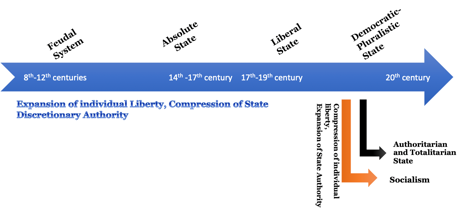 Diachronic Classification of Forms of State
Timeline
- 8th-12th century – Feudal system
- 14th-17th century – Absolute system
- 17th-19th century – Liberal state
- 20th century – Democratic Pluralistic state
Feudal System
No State strict sensu yet (not a proper form of State), because:
- Total identification of the feudal lord (or King) with the land
- Power over vast territories exercised by the King through private Ks with feudal lords (vassals)
- Feudal Lords had power to collect taxes and administer justice
- They have to defend the lord during war
- The sole aim was the protection of the land and its related possessions from external attacks
- Problem: no proper and established tax system in place
- Patrimonial State – its aim was not to fulfil the general interests of the people but to meet the needs of the lord
- Role of public power was limited to protecting the land and the possessions of the lord (including peasants) from external attacks
Absolute System
Origin
- From 14th century on through gradual consolidation of dynastic States
- Unification of territories under power of single rulers (first in England, France and Spain)
- Ultimately formalized as main Form of State in Europe by Peace of Westphalia 1648
- 2 power shifts
- From feudal lords to the King – stabilization of monarchial authority
- From land to money – seeds for emergence of urban bourgeoisies
Characteristics
- King has supreme authority (sovereignty established)
- Unrestricted rule
- But to different extent in France v UK (Magna Carta – limited powers of King John)
- While absolute, this state has an aspiration to fulfil the general interest of the people
- State becomes more interventionalist:
- Growing involvement in the economy
- Eg., Mercantilism under Louis XIV in France (typical absolute state)
- A command economy
- Protectionism
- Growing public functions exercised through large, centralized bureaucracies
- Growing colonial aspirations require large standing armies
- Financed with growingly complex tax systems
Enlightened Absolutism
- Royal rule inspired by principles of Enlightenment:
- Efforts to improve life of their subjects (education, moral campaigns)
- Limited recognition of rights:
- Freedom of speech
- Right to property
- Religious toleration
- But these kings still believe they have the right to govern by birth:
- Rights revocable
- No permanent constitutions granted
- E.g., Frederick II of Prussia (1740-86), Maria Theresa (1745-65), and her eldest son Joseph II of Austria (1764-90)
In England there was no fully-fledged absolutism.
- The liberal state developed quite early on following the victories of parliament against the Stuart kings in the XVIII century
- Civil war and the glorious revolutions
- The pivotal movement is in 1215 and the magna carta
- Clause 12: in order to implement a tax, the king needed the approval of a common council.
- Clause 39: no freeman can be deprived of its personal liberty, except by lawful judgement or by the law of the land (cannot imprison someone because he wants to)
- Clause 40: Rights and justice may not be bought nor sold
- Passage to the liberal state:
- Gradual (UK)
- Violent (France)
- Top-Down (Germany and Italy)
Crisis of Absolute State
- Financial problems
- Overextension of armies and bureaucracies
- Socio-economic transformations
- Industrial revolution
- Middle classes ask for more power and better representation of their interests
- Country-specific political developments
- England – English Civil War
- France – French revolution 1789
- US – civil war
- Italy & Germany – top-down unification
Liberal State
Characteristics
- Rule of law: permanent limitation of power of the Sovereign through Constitutions
- Prevalence of individualism and protection of rights and freedoms (first generation rights)
- Representative government, but,
- Still mono-class representation
- Census-based suffrage
- Only people with certain education or rent or income could vote
- Threshold on how many taxes you pay to decide who can vote. Progressive lowering of the threshold (easier for less wealthy people to vote)
- Minimal state (limited number of functions)
- End of mercantilism
- Market economy and free trade
- Strong separation state/society
Democratic Pluralistic State
- Emerges as a result of the gradual transformation of the liberal state
- At different times and to different degrees in various countries
- Passage from mono to multi-class representation
- Universal suffrage
- Causes?
- Industrial revolution
- People moving from rural areas to cities
- The working class emerged during this time – push for alternative to DPS
- Pluralistic because it recognizes and protects a plurality of groups, interests, ideas, and values that are allowed to coexist in society and are represented in Parliament
- The State is not everything – closer contacts between State and Society
Characteristics of the DPS:
- Mass political parties
- Supported by millions of voters
- Elected bodies as the place of discussion and confrontation of diverging interest groups
- Recognition not only of liberal, first generation rights, but also second generation social and economic rights
Welfare State 🡪 Particular form of the DPS
- State provides support to individuals through social security, healthcare and education
- “From cradle to grave” – high degree of intervention by State
- Especially after WW2 some countries adopted the welfare state
- The first constitution committed to social and economic rights was the Weimar constitution of 1919. It was highly detailed and had advanced provisions
- Art 119 (3) maternity protected by the state
- Art 121 equal opportunities for illegitimate children
- Art 165 cooperation between workers/employees and employers
- After WW2 the model was the UK system founded in the Beveridge report of 1942
- Social insurance is only one part of a “comprehensive policy of social progress”. The five giants on the road to reconstruction were Want, Disease, Ignorance, Squalor and Idleness
- Policies of social security “must be achieved by cooperation between the state and the individual” with the state securing the service and contributions
- The first constitution committed to social and economic rights was the Weimar constitution of 1919. It was highly detailed and had advanced provisions
- E.g., Britain
- William Beveridge: Social Insurance and Allied Services Report 1942
- E.g., Britain’s National Health Service (NHS)
Alternatives to Democratic Pluralistic State
Totalitarian & Authoritarian State
- In totalitarian states there is:
- a strong, one-party system that is ideologically-based
- an official ideology
- charismatic leader
- In authoritarian states:
- the party system is extremely weak
- is driven by the lust for power of the individual leader
- no strong ideology
Socialist State
- The constitutional model was based on:
- the abolition of private property
- the monopoly of the state with regard to the means of production
- was thus characterised by strong central government
- Many features of a totalitarian state
- A very important socialist state is China.
- The basic task of the nation is to concentrate its efforts on social modernization by following the road of Chinese- style socialism. They strive to build a socialist market economy and citizens’ lawful private property is inviolable
Waves of Democratisation
- Immediately after WW2 in Japan (1947) Italy (1948) and Germany (1949) as well as decolonisation of India in 1950.
- Then in the Mediterranean area (Greece 1974, Portugal 1976, Spain 1978)
- Then in south America (Argentina 1983, Chile 1988)
- Followed by eastern Europe, arab spring and asia
- “Sintatra Doctrine” of Gobachev
- Chile new constitution – failed after 3 years *EXAM?*
Forms of Government
- Parliamentary executive
- Presidential executive
- Semi-presidential executive
- Directorial executive
- Ex. Switzerland
- Robert Elgie’s three Dispositional Properties: *EXAM*
- First, whether there is both a head of state and a head of government or whether just one institution is to be found
- Example: India (has both head of state and head of government (parliamentary republic)) USA (just one) – Presidential executive/ Switzerland - Directorial executive as it’s a committee
- Second whether or not the incumbents of these institutions are popularly elected
- Popularly / directly, ex. In USA the directoral college elects the president
- Popular doesn’t mean the popular vote (ex. Bush got less votes than Algore)
- Popular is more about the perception – example in USA people vote for the President and VP
- Third whether the incumbents serve for a fixed term or variable term
- Example: US is a 4 years fixed term (unless there is death where they are replaced with a VP which doesn’t shorten the term)
- If its fixed term there is no dissolution
- Death, Stepping Down, impeachment are the 3 ways
- Vote of no confiendence VS Impleachemnt (know the difference)
- First, whether there is both a head of state and a head of government or whether just one institution is to be found
Synchronic Classification of Forms of State
Synchronic Method: Relationship between the central government and sub-national entities
- Unitary state 🡪 where only the central government has legislative power (e.g. UK)
- Decentralised state 🡪 e.g. US
Unitary vs. Decentralized States
Unitary 🡪 Implies that only the government has legislative power
Decentralized 🡪 Implies that sub-national entities also have legislative powers
- Powers devolved to other sub-state levels (ie., municipality)
- Have ‘local government’ which is given administrative powers
- Bring the principle of subsidiarity – significant power given to local government to make decisions that closely affect local citizens
- Offer services at level closest to the citizen; this might not always be possible, which is when it moved up to intermediary government
- Italy has 3 forms of government – local, regional, national
- What if local administration acts outside of their given power (ultra vires)? 🡪 dealt with by administrative courts (has legitimate expectation been violated?)
- In decentralized state, can distinguish between:
- Federal states
- Regional states: any form of decentralization we don’t consider to be a federal system
- Distinction between federal and regional states:
- Extent of the legislative power exercised by the sub-state entities
- Existence of a separate branch of judiciary at sub-state level
- Presence of a second chamber of the parliament that represents the sub-state entities
- Involvement of sub-state entities in constitutional amendment
- US Constitution Art. V (Mode of Amendment)
- The Congress, whenever two thirds of both Houses shall deem it necessary, shall propose Amendments to this Constitution, or, on the Application of the Legislatures of two thirds of the several States, shall call a Convention for proposing Amendments, which, in either Case, shall be valid to all
- Art 79 (Amendment of the Basic Law)
- (1) This Basic Law may be amended only by a law expressly amending or supplementing its text. In the case of an international treaty regarding a peace settlement, the preparation of a peace settlement, or the phasing out of an occupation regime, or designed to promote the defence of the
- Federal Republic, it shall be sufficient, for the purpose of making clear that the provisions of this Basic Law do not preclude the conclusion and entry into force of the treaty, to add language to the Basic Law that merely makes this clarification
- US Constitution Art. V (Mode of Amendment)
Exam question: unitary state vs decentralized state?
- Unitary: legislative power exercised solely by national parliament (ie Sweden, Ireland, Israel)
- At the most, in that country legislative power belongs to central government
- Decentralized: state, in one way or another, has devolved legislative powers to a sub-national level
- Separated vs integrated model (textbook)
EXAM: difference between rulers and those ruled over, difference between constitutional bodies, return to idea of horizontal separation of powers
- Presidential, semi presidential
- Textbook: focus on particular scholars way of doing this – talk about dispositional properties
- 1) whether we have both head of state and head of government
- Textbook: focus on particular scholars way of doing this – talk about dispositional properties
Federalism & Regionalism
Federalism
2 federalizing processes:
- Bottom up which is more conventional as seen in the USA, Canada, Aus, Mexico, Germany
- Top down which is more recent as seen in Belgium
Federal Systems
- Constitution contains a list of subject matters which are of exclusive competence of the central government
- The member states have their own judiciary system
- The second chamber of parliament is a chamber of sub-national entities (equal vs weighted representation)
- Member states take part in the constitutional amendment procedure
- Member states have their own constitutions only for systems whose federalizing process is bottom-up
- US Constitution:
- Sec. 3: the senate of the United States shall be composed of 2 senators from each
- Art V: The Congress, whenever two thirds of both Houses shall deem it necessary, shall propose Amendments to this Constitution, or, on the Application of the Legislatures of two thirds of the several States, shall call a Convention for proposing Amendments, which, in either Case, shall be valid to all
- 2/3 vote required to propose amendments
- Art 79 [Amendment of the Basic Law]
- (1) This Basic Law may be amended only by a law expressly amending or supplementing its text. In the case of an international treaty regarding a peace settlement, the preparation of a peace settlement, or the phasing out of an occupation regime, or designed to promote the defence of the Federal Republic, it shall be sufficient, for the purpose of making clear that the provisions of this Basic Law do not preclude the conclusion and entry into force of the treaty, to add language to the Basic Law that merely makes this clarification.
- (2) Any such law shall be carried by two thirds of the Members of the Bundestag and two thirds of the votes of theb Bundesrat.
- (3) Amendments to this Basic Law affecting the division of the Federation into Länder, their participation on principle in the legislative process, or the principles laid down in Articles
- 1 and 20 shall be inadmissible.
Regionalism
- Examples: Italy, France, Spain, UK
- Constitution contains a list of subject matters which are of exclusive competence of Regions
- Regions do not have their own judiciary system
- The second chamber of parliament does not represent sub-national entities
- Regions do not take part in the constitutional amendment procedure
- Italy:
- Art. 57: the senate of the republic is elected on a regional basis
- Art 17: legislative powers shall be vested in the state and the regions in compliance with the constitution and EU legislation and international obligations. The state has exclusive legislative powers, and the regions have legislative powers in all subject matters that are not expressly covered by state legislation
- Art 125: administrative tribunals of the first instance shall be established in the region in accordance with the rules established by the law of the republic
- Art. 138: laws are submitted to a popular referendum when such request is made by a pre-defined number of people
- With federal and regional systems there is a problem of fiscal autonomy.
- Some argue that there is no true federalism without raising taxing powers so there is the Barnett Formula made in the UK
The Italian Regions
- The republic is one and indivisible (Art.5)
- There is a 5-level system of autonomous territorial areas
- Municipalities
- Provinces
- Metropolitan cities
- Regions
- The state
- Due to historical reasons not all regions are equal. There are ordinary regions (15) and special regions (5)
- The classification of the regions depends on the adoption procedures used for the individual regional statutes, and therefore of their hierarchical position as a source
- The main reforms of the title V of the constitutions
- 1999 reform
- The regional reform of the government
- In the statutory powers held by the ordinary region
- 2001 Reform
- Allocation of legislative powers between state and region
- 1999 reform
Forms of Government
Definition of Form of Government:
- How power is distributed among constitutional values.
- Head of state
- Head of government
- Parliament
- Electoral formula
- Mathematical formula that transforms votes into party seats
- Elgie’s three dispositional properties (EXAM)
- Whether there is both a head of state and a head of government
- Whether or not the incumbents of these institutions are popularly elected
- Whether the incumbents serve for a fixed term
Note: the form of government, the political system and the electoral system can all have an influence on one another
Parliamentary Executive
Historical Evolution
- The origins of the parliamentary form of government are to be found in Great Britain, although the office of the Prime Minister and the Cabinet has evolved as a matter of political expediency and constitutional practice rather than by law given that the country does not have a codified constitution
- 1782: considered an important moment in the evolution from a constitutional to parliamentary monarchy 🡪 Britain had just lost US colonies
- Up until 1782, the King had the power to appoint and to dismiss the Prime Minister and the rest of the Cabinet (reform deal)
- Resignation of Lord Neath (PM) after losing a vote of confidence
- First time a Prime Minister resigns following a vote of no confidence, which was against the will of the King
- King George III realised he had no choice but to appoint a Prime Minister with a majority in Parliament
- This ended up being Charles Watson-Wentworth who was the leader of the largest group in Parliament, called the Whigs
- First time King depended on Parliament to decide who to elect as PM
- 1832: Approval of the Reform Act
- Struggle between Parliament and Monarch came to a head
- 1834 King William IV decided to dismiss the then PM Lord Melbourne and replace him with the Tory, Robert Peel
- King was forced to reappoint Lord Melbourne
- Last time a monarch will dismiss a Prime minister of his own acord
Structure of Parliamentary Executive
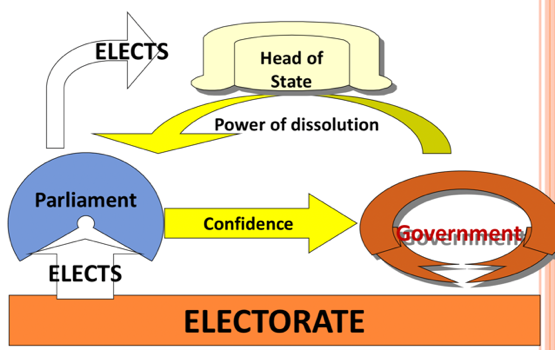
Electorate elects 🡪 Parliament, which elects 🡪 Head of State, which appoints 🡪 Head of Government.
- Parliament must give confidence to the Head of Government – must be supported by majority of MPs
- Distinguishing feature is relationship of confidence between Executive and Parliament
- Head of State has power of dissolution over Parliament
- Also enjoys a small discretionary power when appointing the head of government
- In a parliamentary monarchy the Head of State will be determined on a hereditary basis, while in parliamentary republics the president is elected by Parliament: in either case he/she is not popularly elected
- The term of office:
- Head of State: for life (parliamentary monarchy), or for fixed term (parliamentary republic)
- Head of Government: no fixed term
- In the UK, the leader of the majority party must be the PM (head of government), appointed by the Queen (head of state).
- Germany also operates using vote of confidence system
- Rarely have vote of confidence in parliament – when MPs make it clear they won’t support PM, PM will typically resign before formal vote of no confidence
Italian Case: Head of State
- Vagueness of the constitution’s context. Therefore, the president of the republic’s position as developed throughout the history of the republic, has been heavily influenced by the interpretation given to the role by the presidents of the republic
- Requirements
- 50 years old
- Enjoy full political and civil rights
- Have Italian citizenship
- Election
- Parliament in joint session (two houses of parliament sit together)
- Three delegates for each region
- The first three ballots cast, a vote of 2/3 of the electors
- From the forth ballot onwards an absolute majority
- Term of office
- 7 years
- Possible re-election (only once)
- Tripartition of presidential acts
- Formally presidential acts which are substantially governmental
- Formally presidential acts which are also substantially presidential
- Substantially complex acts
- Irresponsibility of the president (ministerial countersignature)
- Presidential offences
Constructive Vote of No Confidence
- Article 67 German Basic Law
- (1) The Bundestag may express its lack of confidence in the Federal Chancellor only by electing a successor by the vote of a majority of its members and requesting the Federal President to dismiss the Federal Chancellor
- Unless the Chancellor themself asks for and loses a vote of no confidence then the Federal President cannot dissolve the Bundestag
- If a majority of members of the House have no confidence in the Chancellor in office, they must be capable of electing a successor to replace the Chancellor in office
- This was used only 2x in Germany.
- In 1982 – Liberals decided to replace Social-Democratic Chancellor Helmut Schmidt with Helmut Cole
- This is also offered in Spain & Israel
- The very limited resort to the constructive vote of no confidence in both Germany and Spain should not lead one to think that it is of limited importance.
- On contrary, the existence of the CVONC has had at least one paramount consequence
- It has worked as a strong deterrent.
- The knowledge that a government could be replaced exclusively according the above-described procedure has prevented the appearance of what Italians would call “crises in the dark”, that is, governmental crises started by some parliamentarians and some parties willing to overthrow a government without knowing if, when, and by whom and by which parties a new government could be formed
- A similar provision is contained in the Spanish Constitution and was used in 2018 when Pedro Sánchez of PSOE replaced Mariano Rajoy of the Spanish People’s Party as Prime Minister
- To what extent can we take something that works in one country and apply it to another?
US Presidential Executive
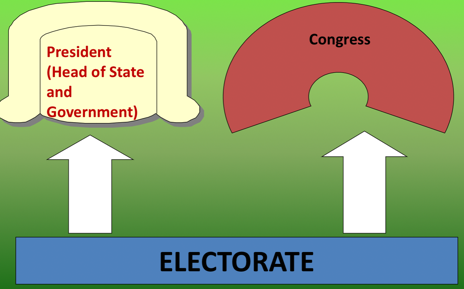
The electorate votes both the President (head of state & government combined into one institution) and Congress.
- The president is popularly elected, not directly.
- He serves for a fixed 4-year term and can be re-elected once (2-term tradition)
- Someone who fills an unexpired presidential term lasting more than 2 years is also prohibited from being elected president more than once.
- There is no relationship of confidence between the POTUS and the Congress
- Electoral college
- 538 electors; not a place, but a process – electors never meet in joint session at federal level, only at state level
- Each state as a number of electors equal to the number of congressmen (i.e., its Senators (always 2) plus its Representatives)
- A State’s delegation in the House of Representatives is determined by its population
- E.g., California has 53 representatives and 2 senators, so it is allocated 55 electors. Wyoming has one representative and 2 senators, so 3 electoral votes.
- However, California has a population 50x the size of Wyoming, but only 18x as many electoral college votes.
- E.g., California has 53 representatives and 2 senators, so it is allocated 55 electors. Wyoming has one representative and 2 senators, so 3 electoral votes.
- Congress cannot be dissolved
- However, the Congress can impeach the POTUS
- Impeachment finds origin in British system, where impeachment transformed itself into relationship of confidence between government and Parliament
- In US, impeachment has remained in original form. It is a legal, not political, tool.
- Grounds of treason, bribery or other high crimes and misdemeanours
- The house of representatives impeaches the POTUS by approving articles of impeachment through a simple majority vote
- The impeachment trial takes place in the senate. There, conviction on any of the articles requires a 2/3 majority vote and results in the removal from office
- Impeachment finds origin in British system, where impeachment transformed itself into relationship of confidence between government and Parliament
Executive branch (president carries out laws)
- Checks on the legislative branch
- Can propose or veto laws
- Can call special sessions of congress
- Makes appointments
- Negotiates foreign treaties
- Checks on the judicial branch
- Appoints federal judges
- Can grant pardons to federal offenders
Legislative branch
- Checks on the executive branch
- Can override the presidents veto
- Confirms executive appointments
- Ratifies treaties
- Can declare war
- Appropriates money
- Can impeach and remove president
- Checks on judicial branch
- Creates lower federal courts
- Can impeach and remove judges
- Can propose amendments to overrule judicial decisions
- Approves appointments of federal judges
Judicial branch
- Checks on executive branch
- Can declare executive actions unconstitutional
- Checks on legislative branch
- Can declare acts of congress unconstitutional
Caucuses and Primaries
- Presidential candidates are selected through:
- Primaries which are run by state governments
- Caucuses which are run by political parties
- Primaries can be closed, semi-closed or open
- 11 states use caucuses
The Electoral College
- It’s the system through which the president is elected
- 270 electoral votes needed out of 538
- Otherwise, the so called 1824 scenario where none of the candidates received a majority
- Except for Maine and Nebraska, electors are elected on a winner-take-all basis
- The faithless elector problem
- Does not vote for presidential or vice-presidential candidates but someone else
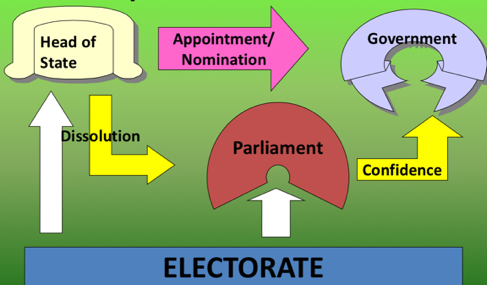 Semi-Presidential Executive
Electorate elects the president directly, which in turn appoints the head of government, and can dissolve the parliament. (Electorate elects the head of state & the parliament, but head of state can dissolve parliament)
- Combines element of both presidential and parliamentary forms of government
- There is a Head of State and Head of Government
- President is elected directly
- Head of Government is appointed by the President, but he must have the confidence of the majority of members of the National Assembly
- The term was used to describe the executive that was introduced in France in 1958.
- However, it was adopted for the first time in the Weimar constitution of 1919 and already existed in Finland, Austria, Ireland and Iceland.
- It is a bicephalous executive
- Subclassification of semi-presidential systems:
- Semi-presidential systems where the prime minister prevails (Austria and Ireland)
- Semi-presidential systems which are based on a diarchy or clear separation of competences between the prime minister and his government, on one hand , and the president of the republic on the other (Finland and Portugal)
- Semi-presidential systems where the president plays a central role (France)
France – good example of this
- The present constitution was enacted in 1958, during the Algerian crisis
- 4th republic, constant coalitions which made it difficult to make decisions... constant conflict of interests
- De Gaulle founded the fifth republic with a strong presidency and he was elected president
- He introduced the direct election of the president of the republic in 1962 with a presidential referendum
- The amendment procedure was in breach of the 1958 constitution
- However, the conseil constitutional ruled that since a referendum expressed the will of the sovereign people there was no breach of the constitution
- Cohabitation: France
- Cohabitation occurs when the president is from a different political party than the majority of the members of parliament.
- Cohabitation occurs because of the duality of the executive
- Since 1958, France has experienced cohabitation 3 times
- When in cohabitation, the balance of powers changes
- Constitutional reform of 2000 (presidential term) and 2002 (election calendar)
Virtues & Vices of Semi-Presidentialism: Case of Poland
- It was October 2008 when the Polish delegation to the European Council seemed to be cramped for space. The Prime Minister Donald Tusk had to deal with President Kaczinsky’s pretension to take part in the meeting. Fortunately, despite the cost of this whim for the Polish taxpayers (40000 euro to rent a Boeing 737 from the national airline company LOT), the situation was eventually resolved by the finance minister who wisely decided to cede his seat to the head of the state in order to avoid further awkwardness on the international stage.
- The problem was that the Polish semi-presidential constitution is ambiguous as to which of the two heads of the executive is competent in the matter of representation in the European Council. Since there was a substantial difference of view between the pro-European Union, Mr Tusk, and the Euro skeptical, Mr Kaczynsky, the other members of the assembly did not know the official position of Poland.
- This episode brought to the fore the issues concerning the coordination of national policies at European level in the case of semi-presidential forms of governments. It is not a minor problem as, to date, there are twelve out of twenty-seven states who have adopted this hybrid system.
Directorial Executive
Contemporary and historical form of government
- Most prominent case is in Switzerland.
- In this government, the voters elect the government which elect a collegial body which is both the head of state and the head of government
Non-parliamentary executive
- Drafted by a scholar and the purpose was to try to fix the main criticalities of the parliamentary executives (unstable)
- The voter elects the government as well as the head of government. These two both give confidence and power of dissolution to both of them. The government formed will then elect the head of state.
- The head of state and government serve the same fixed term since they stand together and fall together. Vote of no confidence both dissolves the head of government and the parliament.
- This did not work in Israel
- Israel allowed a split vote meaning that people got 2 different ballot papers... one for the prime minister and one for the party. (voted for a candidate of a different candidate)
- Another reason was that if the prime minister decided to step down, then only the prime minister had to be re-elected rather than the parliament as well.
Electoral Systems
Electoral System
Electoral System = set of rules that govern elections and the translation of votes into seats in parliament (or for the presidency).
- An electoral system is made of:
- Electoral Laws: all rules and regulations dealing with elections (franchise, timing, oversight, electoral campaigns)
- Electoral Formula: the mechanism through which votes are translated into seats
Electoral Laws
All legislation concerning elections
- Active suffrage / political franchise: who can vote
- Limitations based on capacity, age, citizenship, etc.
- Passive suffrage: who can be elected
- Different requirements in Italian constitution for Senate and Chamber
- Regulations of other aspects of elections
- Electoral campaign & campaign financing, media coverage, voter registration, voting methods, etc.
Electoral Formalities
The formalities through which the members of parliament are elected
- Political rights
- Right to vote
- Right to stand for office
- Freedom of expression
- Freedom of association (e.g. political party)
- Freedom of peaceful assembly
- Relationship between democracy/election
- Election is a prerequisite of a democracy but in the absence of these rights, elections do not serve a purpose of real democracy
- Electoral integrity
- Good elections
- Elections that meet the international electoral standards
- Notion of electoral integrity covers all stages of the election process from registration of candidates and voters through to voting itself
- Electoral malpractices, such as the violations of electoral integrity:
- Ballot-box manipulations
- Vote-buying
- Voter intimidation and pressure
- Misuse of public resources
- Media bias
- Restrictive ballot access
- Unfair campaign/campaign finance rules
Electoral Formula
Electoral formula = mechanism through which votes are translated to seats & the basis for categorization of electoral systems
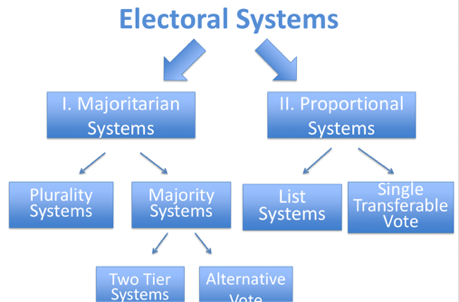 3 main families of electoral systems:
- Proportional Representation (PR) Systems: each party is assigned a number of seats proportional to the votes obtained
- Majoritarian Systems: the candidate obtaining more votes than the others gets the seat
- Mixed: combination of majoritarian and proportional components
Factors affecting the choice of electoral system
- Encouraging political parties (candidate vs party-centered electoral systems)
- Level of education
- Making a stable government
- Interests of political parties
- External pressure (imposed by the groups responsible for post-conflict reconstruction)
- Historical reasons (systems inherited from colonial administration
- Ethnic/minority accommodation etc.
Majoritarian Systems
What is a Majority System?
- The candidate who obtains the majority of votes wins
- Majority systems are usually connected to uninominal districts
- Majority systems have a selective effect on the political system
2 Main Majority Systems:
- PLURALITY (relative majority) SYSTEMS – Relative majority of votes is enough to get the seat
- Single Member Constituencies
- Each constituency elects only one MP
- Each Party presents only one candidate for each constituency
- E.g. UK House House of Commons, US House of Representatives, Parliament of Ghana
- i) First Past the Post (FPTP)/Single-Member District Plurality (SMDP)
- One of the most popular majoritarian systems in the world
- Voters cast a single vote for a candidate in a single-member constituency
- The candidate with the most votes is elected 🡪 absolute majority is not necessary
- Candidates are elected with just a relative majority (UK)
- Can get a high pop vote but very few seats or other way around
- Creates an incentive to vote strategically rather than sincerely
- There is a potential for disproportionate translation of votes into seats.
- Encourages two-party systems rather than multi-party
- Disadvantages minority parties whose support is spread around the country
- System very resistant to extreme parties
- Advantages:
- Simplicity
- Governability
- Coherent Parliamentary Opposition
- Excludes extremist parties (unless they are territorially concentrated)
- Strong link of the MP with the territory: Geographical Representation
- Accountability
- It encourages plural political parties (discourages sectorial divisions)
- Disadvantages:
- Excluding minority parties from fair representation
- Wasted Votes
- Regional Fiefdoms
- May encourage development of ethnic, or independentist parties
- Open to the manipulation of electoral boundaries: gerrymandering
- Far less likely to give representation to racial, ethnic minorities or women: s.c. Most-broadly acceptable candidate syndrome
- Slow response to major change in support
- ii) Single non-transferable vote (SNTV) (not on exam)
- Single Member Constituencies
- ABSOLUTE MAJORITY SYSTEMS– to be elected candidates need an absolute majority of votes
- i) Majority run-off (two-round system) (France)
- If no one receives a majority in the first round, then all candidates that receive over a threshold (in france 12.5% for legislative) will go to a runoff election/second ballot
- For the presidential election in France, the two most voted candidates go to a second ballot (runoff)
- Second chance for voters whose candidates were eliminated
- Significant costs on administration of elections
- Less incentives for strategic voting
- If no one receives a majority in the first round, then all candidates that receive over a threshold (in france 12.5% for legislative) will go to a runoff election/second ballot
- ii) Alternative vote (instant runoff/preferential voting) (Australia)
- Electors must express preferences for all the candidates (1st,2nd,3rd choices)
- A candidate wins the seat if it obtains an absolute majority after the first preferences of all the candidates have been counted for the first time
- It’s a one round system, if there is no absolute majority then the votes of the least voted candidate are redistributed by their second choices (next in order of preference)
- This process continues until one candidate receives more than the others
- Proximity between voters and representatives
- Greater opportunity to convey info about voters’ preferences
- No wasted votes and strategic voting is possible.
- iii) Supplementary vote system (Sri Lanka) (not on exam)
- i) Majority run-off (two-round system) (France)
Proportional Representation
Multimember districts
- Constituencies typically correspond to subsections of the country – e.g. regions
- If a country is not divided into electoral districts, one country is one multimember district
- A quota or divisor is used to determine the cost of one seat: how many votes a candidate or party needs to win a seat
Proportional System Specifics:
- Produces more accurate translation of votes into seats (vis-à-vis) majoritarian systems
- Better representation of minorities: small parties are able to get into parliament
- Weaker incentives for strategic voting
- Less wasted votes (however, it may depend on other features of electoral systems such as thresholds, size of constituencies etc.)
- PR systems are good for divided societies?
Types of Proportional Systems: List Proportional System
- Each party nominates a list of candidates
- Closed party lists: the order of candidate selected is determined by parties
- Open party lists: along with the preferred party, voters may also indicate their favorite candidate within the party
- Free party lists: voters have multiple votes that they can allocate either within one party list or across different party lists
- Methods based on dividers (Total number of votes is divided by a series of divisors)
- D’hondt method: helps larger parties since it has a lower division
- When allocating seats according to this formula, the first seat goes to the party obtaining more votes
- Then the number of votes of that party is divided by a divisor equal to s + 1 (where s is the number of seats already allocated to that party)
- N = total # votes / (# of seats already allocated) + 1
- The process is repeated until all seats are allocated
- Sainte-lague: systems normally include minimum thresholds (only parties obtaining more than 5% of votes get seats) and therefore helps smaller parties.
- Similar to the D’Hondt Method but with a higher divisor = 2s +1 (1,3,5,7)
- N.B. With this method the divisors are always odd
- N = # votes / 2(# seats already allocated) + (odd #)
- Similar to the D’Hondt Method but with a higher divisor = 2s +1 (1,3,5,7)
- N.B. Systems are rarely purely proportional: majoritarian correctives such as majority bonuses are growing more common
- D’hondt method: helps larger parties since it has a lower division
Advantages of PR:
- Faithful translation of votes into seats
- Minority parties are adequately represented
- More diverse list of candidates (good for minorities & women)
- No regional fiefdoms
- Visible Power-Sharing Important for new democracies
Disadvantages of PR:
- Complexity
- Inefficient coalition governments
- Destabilizing fragmentation of party system
- Blackmailing power of small parties
- They allow an entry point into parliament to extremist parties
- Lack of link between candidate and territory
- Gives too much power to party leadership
Single Transferrable Vote (STV)
- Similar to alternative vote but applied in multimember districts
- Candidate centred system (voters rank candidates)
- Preferential voting
- Candidates must obtain a particular quota to win the seat
- Only PR system not based on PR lists
- Voters have an opportunity to convey a lot of information through their ballots
- Coting for candidates from different parties is possible
- Number of wasted votes is minimized
- Candidates depend on transfer votes – incentive for campaigning on broad platforms
- Proportional outcome but still strong link between candidates and constituencies
- Effort of system depends on district magnitudes
Mixed Electoral Systems
Attempts to combine positive attributes of proportional and majoritarian systems
- Voters elect their representatives through 2 different systems
- Votes are translated into seats at different levels (electoral tiers)
- E.g., District level, regional level, national level
- Majoritarian system is usually used at the lower tiers while proportional system at the higher tiers (e.g., national level)
- Features of proportional systems influencing allocation of seats
- District magnitude
- A number of seats is distributed in one district
- The smaller the magnitude, the less proportional the results will be
- Electoral thresholds
- Natural threshold – Always exist, by product of any proportional electoral system (Netherlands)
- Formal threshold – Written into electoral law (10% in Turkey)
- District magnitude
- Independent mixed systems: majoritarian and proportional components are implemented independently
- E.g. Ukraine – parliament is composed of 450 members for 5 years. Half based on proportional (5% min) system. Other half elected through single member district plurality system in a single round with FPTP
- Dependent mixed systems
- Aka mixed proportional system – proportional component is used to compensate for disproportionalities produced by a majoritarian formula
- Therefore, application of proportional formular depends on distribution of seats through majoritarian formula.
Italy as a Case Study
In Italy 🡪 electoral system of Parliament is not provided for in the Constitution, but is governed by ordinary laws.
- As for the system actually adopted, from 1948 to 1993, it was markedly proportional
- Proportional representation systems:
- Multimember districts
- Constituencies typically correspond to subsections of the country – e.g. regions
- If a country is not divided into electoral districts, one country is one multimember district
- A quota or divisor is used to determine the cost of one seat: how many votes a candidate or party needs to win a seat
- Multimember districts
Legge Truffa – The Fraud Law n. 148/195
- The most significant attempt to introduce majoritarian reforms was in 1953 (often referred to as the Legge Truffa – the Fraud Law n. 148/1953) which assigned 65% of the seats in Parliament to the coalition that obtained 50%+1 of the popular vote
- However, in the elections of 1953 the DC and its allies obtained 49.8% and the law was subsequently repealed
The Referendum and the Mattarella Law
- A clear-cut reform of the electoral system was made in 1993, following a direct popular referendum promoted by Mario Segni to repeal the provisions of the Unified Electoral Law that provided for proportional election of Senators.
- The result was the adoption of a new electoral system (know as Mattarellum named after the inventor of this system Sergio Mattarella) which was a mixed system, under which 75% of total seats were to be assigned with FPTP
- The remaining 25% were instead to be assigned using PR.
- Plurality Systems: Single-Member District Plurality (SMDP) (First Past the Post (FPTP))
- Voters cast a single vote for a candidate in a single-member constituency
- The candidate with the most votes is elected – absolute majority is not necessary
2005: Return to PR but with Majoritarian Correctives
- In December 2005 the centre-right majority in Parliament approved a new electoral law.
- This law reintroduced PR based on block lists, to be compiled by the leaders of the various parties, but there were some important «majoritarian correctives»
- A bonus of extra seats for the coalition that obtained the greatest number of votes was introduced in order to strengthen the stability of the parliamentary majority.
- The bonus was assigned at national level for the Chamber and at regional level for the Senate
- Constitutional Court Intervenes
- With decision (1/2014) delivered on January 13, 2014, the Italian Constitutional Court struck down two very contested aspects of the electoral law for both Houses of Parliament (no. 270/2005):
- The long closed-list of party candidates running for election
- The bonus of seats without a minimum threshold
- With decision (1/2014) delivered on January 13, 2014, the Italian Constitutional Court struck down two very contested aspects of the electoral law for both Houses of Parliament (no. 270/2005):
The Italicum
- The Italian Parliament approved a new electoral law, that came into effect on 1st July 2016
- It only applied to the Chamber of Deputies because the Renzi Administration also presented a reform to the Constitution to eliminate the “perfect bicameral system”
- Distinguishing features:
- Voting system:
- Proportional distribution of seats at national level 100 constituencies divided into 20 electoral districts
- Lists with a blocked first candidate who may be presented in up to 10 different constituencies
- 2 preferences with gender “zipper list”
- Single threshold of 3%
- Bonus of seats to the PARTY who gets 40% in the first round or the most votes in the second round
- Coalitions disappear!
- Voting system:
- Italicum also unconstitutional
- In December 2016 the Constitutional Referendum was defeated and Renzi resigned
- In January 2017 the Constitutional Court declared the Italicum partially unconstitutional. In particular it struck down the run-off election (Judgment 35/2017)
- The 40% threshold in the first round however remained
- At this point, Italy had 2 different laws for the Chamber and the Senate
- The electoral law for the Senate is the one resulting from Judgment 1/2014 (de facto a system of PR) while the electoral law for the Chamber of Deputies is the result of Judgment 35/2017
The Rosatellum 🡪 the new Italian electoral law
- 26 October 2016 – Italian Parliament approves the Rosatellum
- Features:
- Chamber of Deputies (400 seats, after constitutional reform)
- 147 seats shall be assigned from single-member constituencies
- 245 seats shall be assigned from plurinominal electoral districts
- 8 Seats from foreign constituencies
- Senate (200 seats, after constitutional reform)
- 74 seats shall be assigned from single-member constituencies
- 122 seats shall be assigned through plurinominal electoral districts
- 4 seats shall be assigned from foreign constituencies
- Thresholds:
- 3% on a national basis, in both Houses
- Exception: electoral lists referring to linguistic minorities (in that case, the threshold is 20% in the corresponding region where the minority is located)
- Minimum threshold for coalitions: 10% (at least one list must have passed the 3% threshold: interesting example of Azione-Italia Viva)
- Lists & Constituencies
- The plurinominal electoral districts shall be formed by comprising different single-member constituencies.
- In the plurinominal electoral districts the lists are blocked (no conflict with the judgment of the Constitutional Court)
- Alliances & Coalitions
- Lists support a single candidate in the single-member constituencies
- But they can field different candidates in the plurinominal electoral districts
- Other features:
- Only one ballot paper
- Split voting is prohibited: it is not possible to vote for a candidate in a single-member constituency and then vote for a different list in the plurinominal electoral district.
- Chamber of Deputies (400 seats, after constitutional reform)
Now what happens?
- Giorgia Meloni will almost certainly be asked to form a government by President Sergio Mattarella, after the new parliament meets on October 13.
- After a series of consultations, the current premier Mario Draghi will hand over power sometime around the last week in October, to the FdL’s leader, Georgia Meloni, and her team
EU Law & Institutions
Defining the EU – International Organization or State?
Is the EU an international organization?
- Technically the EU is an international organization.
- This is because it is the product of an international agreement among States.
- However, it is a very avant garde international organization providing a new model for transnational relations.
- Its institutions are more powerful than those of conventional international organizations
- Its law has direct effects on individuals, while international law obligations are typically directed to states only
Is the EU a State?
- The EU is not sovereign like a state
- However, it has acquired some fundamental federal qualities:
- The enforcement of its law is unique among international organizations and more similar to that of a Federal State
- The Court of Justice of the EU (CJEU) established principles of Supremacy (EU Law hierarchically superior to national law) and Direct Effect (citizens can rely on EU Law directly before a national judge without need for implementation)
- It has exclusive jurisdiction on monetary policy in the Eurozone
- It has powers in areas of traditional state responsibility (Home Affairs and Foreign Policy)
- The enforcement of its law is unique among international organizations and more similar to that of a Federal State
- Hybrid between confederation and federation?
Does the EU have a Constitution?
- The EU does not technically have a Constitution (they tried in 2004)
- Dutch and French referenda rejected the EU Constitution, but the Lisbon Treaty replicates almost 90% of it
- However, the treaties have a Constitutional character.
- CJEW in Les Verts v. EU Parliament (1986): defines Treaty as “The Basic Constitutional Charter of the EU”
- Since the Treaty of Nice in 2001, the EU also has a Bill of Rights: European Charter of Fundamental Rights
Evolution of EU Treaties:
- 1952 - European coal and steel community (ECSC)
- 1958 – Rome Treaties: EEC (European economic community) and EURATOM (European atomic energy community
- 1987 - Single European act
- 1993 - Treaty of Maastricht: EEC becomes EC (European community)
- 1999 – Treaty of Amsterdam
- 2003 – Treaty of Nice
- 2009 – Treaty of Lisbon: TEU and TFEU (Treaty on the European union and treaty on the functioning of the EU)
- TEU contains general principle defining the EU (values and objectives)
- TFEU contains specific rules on the functioning of the EU institutions and policies
- EU went from 6-28 member states, now 27 lol Parliamentarism
Current Structure of the EU Treaties
- Currently based on two treaties:
- The Treaty on European Union (TEU) 🡪 general principle defining the EU (values, objectives)
- The Treaty on the Functioning of the European Union (TFEU) 🡪 specific rules on the functioning of EU institutions and policies
- And the Charter of Fundamental Rights of the EU (the Charter) 🡪 external to the treaties, but has the same legal value
Parliamentarism vs Presidentialism
- Parliamentarism: Head of state and head of government are separate institutions and neither of them are popularly elected.
- Head of government does not serve a fixed term because there is a relationship of confidence with parliament
- Presidentialism: Head of state is also head of government and is directly or popularly elected
- The president serves for a fixed term
- In a parliamentary executive, the people elect the government who elect the head of state. The head of state in turn has the power of dissolution over government and appoints the head of government to whom the government lends confidence.
- In the EU, the people elect the members of the European parliament who are part of the council of the European union alongside members states governments.
- Members states governments also make up the European council that appoint the European commission and propose the president of the commission.
- The president, who is approved by election in the European parliament, then selects the European commission and is given supervisory power by the European government
EU Form of Government
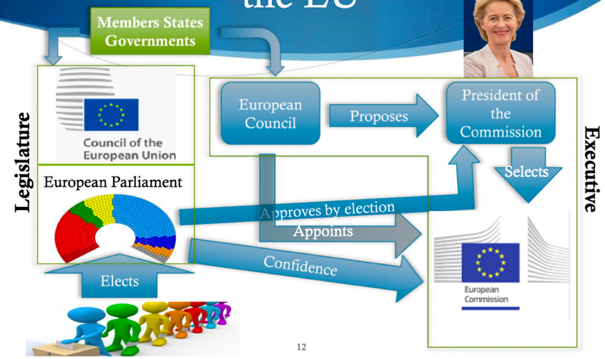
Population elects European Parliament 🡪 approves by election the President of the Commission and gives confidence to the European Commission
- The President of the Commission selects the European Commission
- The European Council (member state governments) proposes the President of the Commission and appoints the European Commission
- Council is very powerful as a result of these duties
- Legislature:
- European Parliament 🡪 approves President of Commission / 🡪 gives confidence to European Commission
- Member State Governments (form European Council) 🡪 appoints European Commission
- Executive branch: European Council 🡪 proposes President of the Commission 🡪 selects European Commission
What is the form of government of the EU?
- It has both a head of government and a head of state
- Since Lisbon Treaty these are 2 full-time separate roles
- Neither is popularly elected
- The President of the European Council serves for a fixed term; there is a relationship of confidence between them and the parliament
- These make the EU very similar to a parliamentary executive, but with special features derived by its own confederal nature
The Council of the European Union (AKA Council of Ministers)
Council of EU = Council of Minister
TEU Article 16(2): The council shall consist of a representative of each member state at ministerial level, who may commit the government of the member state in question and cast its vote
- Composition:
- There is one seat per member state, occupied by a politician (not a civil servant – they are typically national ministers)
- Variable composition depending on the kind of issue that is being decided
- E.g., when dealing with economic issues, the Council will be formed by all of the Ministers of Finance
- This is assisted by a committee of permanent representatives of the member states COREPER
- Presidency rotates semi-annually
- E.g., Italian Semester, French Semester, etc.
- NOTE: We are taking about the The Council of the European Union not the European Council (another EU body, see below) nor the Council of Europe which is the continent’s leading human rights organization.
- Council of Europe: includes 47 member states, 27 of which are members of the European Union. All Council of Europe member states have signed up to the European Convention on Human Rights, a treaty designed to protect human rights, democracy and the rule of law The European Court of Human Rights oversees the implementation of the Convention in the member states.
Functions of the Council of the European Union:
- Legislative powers
- The council is (together with the Parliament) one of the 2 legislative bodies of the EU: it votes on legislation proposed by the Commission
- Voting inside the Council went from Unanimity to Qualified Majority Voting (QMV)
- The council is (together with the Parliament) one of the 2 legislative bodies of the EU: it votes on legislation proposed by the Commission
- Policy-making Powers
- Setting the political direction of the Union
- This function was largely taken on by the European Council (see later)
- Setting the political direction of the Union
Decision-Making
- Decision making in the Council is one of the more debated issues in EU scholarship.
- It happens either by unanimity, by simple majority or by qualified majority
- Since the Lisbon treaty, the qualified majority is defined as:
- At least 55% of the members in the council +
- Representing member states comprising at least 65% of the population of the Union +
- Any blocking minority should include at least 4 member states (otherwise the three more populous member states could alone block a proposal)
What is the Council of the EU Really?
- If you analyse the EU as a proto/quasi federal state, the council can be seen as a federal state where state interests are represented; however, the double requirements of qualified majority detract from its federal nature.
- If you analyse the EU as an international organization similar to the UN, the council can be seen as the plenary where all states are represented – it is the quintessential intergovernmental body
European Parliament
History:
- Initially composed of representatives from national parliaments, since 1979 it is directly elected every 5 years by the European citizens
- Treaties now clarify that it is composed of “representatives of the Unions citizens” (Art 14(2))
- Initially its powers were minimal, but not are comparable to those of a national parliament (with exceptions)
Composition:
- Each Member State elects a number of EMPs degressively proportional to their national populations
- Attempt to balance the democratic principle (one person, one vote) which would require perfect proportionality, with the federal principle (one state, one vote) which would require equality of members
- E.g., Germany has 96 members, Malta has 6
- Degressive proportionality means that while the subdivisions do not each elect an equal number of members, smaller subdivisions are allocated more seats than would be allocated strictly in proportion to their population.
- Election of EMPs is organized at the national level through different electoral systems
- Parliament has a max size of 751 members
Functions:
- Legislative powers:
- The Parliament shares law making power with the Council of Ministers
- previously only consulted; today co-decision is the standard procedure
- The Parliament can informally propose legislation but does not have the formal power of legislative initiative
- The Parliament shares law making power with the Council of Ministers
- Elective powers:
- The Parliament votes confidence to the European Commission:
- it elects the President of the Commission
- it confirms the Commission as a whole
- It can also vote for a motion of censure and force the removal of the Commission
- The Parliament votes confidence to the European Commission:
- Supervisory powers:
- Parliament questions & investigates the Commission
Types of Legislative Acts
- At EU level, there is not one types of law, but various types of legislative act
- TFEU art. 288
- To exercise the unions competences, the institutions shall adopt regulations, directives, decisions, recommendations and opinions
- A regulation shall have a general application and shall be binding in its entirety and directly applicable in all member states
- A directive shall be binding as the to the result to be achieved upon each member state to which it is addressed, but shall leave to the national authorities the choice of form and methods
- A decision shall be binding in its entirety. A decision which specified those to whom it is addressed shall be binding only to them
- Recommendations and opinions shall have no binding force
- Regulations
- Equivalent to a law at the national level
- Generally applicable over all members of the union
- Directives
- A type of legislative act which is special to the unions confederal setting
- They lay down end results to be achieved in every member state but leave it up to national governments to decide how to achieve these goals
- Each directive specifies the date by which it needs to be implemented
- Decisions
- Sometimes they have specific addresses, or they can be generally applicable and used to complement directives & regulations
Scope of the Union Competence
- The 3 general principles that govern the Union legislative competence are conferral, subsidiarity and proportionality (Art. 5 TEU)
- The Union does not legislate in all subject matters, but only in those subject matters that the member states, through the treaties, have delegated to it – principle of conferral
- Each legislative act is adopted based on a specific legal basis, which determines the type of competence (shared or exclusive) and the type of legislative procedure
European Commission
Composition:
- 27 members – one per member state
- Members of Commission do not represent the Member States hence they do not seek or take instructions from any government (Art 17(3) TEU)
- Each Commissioner is assigned a Ministerial Portfolio (e.g. agriculture or competition)
- Members are chosen “on the ground of their general competence and European commitment from person whose independence is beyond doubt” (Art 17(3) TEU)
- One member is the President of the Commission
- Head of Government of the EU?
- Another member is the High Representative for Foreign Affairs and Security Policy
Functions of the Commission:
- TEU art. 17(1) – Function: “The Commission shall promote the general interest of the Union and shall take the appropriate initiatives to that end”
- The Commission is the successor of the High Authority of the Schuman declaration: it pursues the interest of the EU as a whole and can be seen as a motor of European integration
- Can the Commission be seen as the Executive of the EU?
- TEU art. 17(2) – Legislative Powers: “Union legislative acts may only be adopted on the basis of a Commission proposal except where the treaties provide otherwise”
- The Commission has monopoly of the power of legislation initiative
- It proposes legislation to Parliament and Council which can modify, approve, reject legislation but cannot propose themselves
- The Commission has monopoly of the power of legislation initiative
- Power of Oversight 🡪 The Commission ensures the respect of the treaties
- By the member states through infringement procedures
- The Commission investigates and prosecutes infringements of EU law by Member States and can thus take a Member State to court
- By firms through competition law
- The Commission investigates and prosecutes firms (private businesses) engaging in behaviour that violates the EU rules on competition (cartels and/or abuses of dominance)
- By the member states through infringement procedures
European Council
Separate institution from the Council of Ministers, developed informally outside of the treaties and was then formalized by the Lisbon treaty
Composition:
- 27 heads of state or government of the member states +
- The President of the Commission (but without voting right) +
- The President of the European Council (also without voting right)
- Since the Lisbon treaty, the President of European Council is a full-time role serving for a 2.5 years per term
- Elected by qualified majority by the European Council (& cannot be one of the HoS or HoG)
- Decisions are taken by consensus (there is no voting)
Functions:
- The European Council is charged with the definition of the EUs general direction and priorities, in cooperation with the Commission:
- It decides the questions of highest political salience that are difficult to decide within the council of Europe
- It can be seen as a part of the executive of the EU together with the Commission
- It does not have any legislative responsibility
- Its president is seen as the principal representative of the EU on the world stage
The appointment of the Commission
- The European Council proposes a potential president for the commission “taking into account the elections to the European Parliament” (Art 17(7) TEU)
- Parliament elects by a majority, the President of the Commission under proposal by the European Council
- The President of the Commission forms the list of Commissioners, in consultation with the member states. The list is then adopted by the Council.
- The proposed Commission is subject “as a body to vote for consent by the European parliament” (Art 17(7) TEU) – similar to a vote of confidence
- The European Council appoints the Commission, acting by a qualified majority
European Court of Justice
Judicial branch of the EU: a quasi-constitutional role
- Court of Justice of the EU: 28 judges, 11 advocate generals (6 years term)
- National courts, annulment and appeals
- General Court: 47 judges (56 in 2019)
- Annulment from individuals and undertakings
- Full Court, Grand Chamber (13), chambers
- Cases deemed to be exceptional v MS Request
- Language arrangements (translated in all languages)
Case Study: European Court of Justice (ECJ) and Italian Constitutional Court (ICC)
Juridical dialogue between the European Court of Justice and the Italian Constitutional Court. Some landmark decisions include:
- Decision no 14/1964 by the ICC
- “The treaty has been imported with a statute law”
- Therefore,
- Community acts and national laws are both to be considered to be primary sources of law.
- The chronological principle must be implemented
- Case no 6/64 Costa v Enel (ECJ)
- According to the ECJ, on the subject matters that are of competence of the EU, a member state cannot unilaterally derogate from community acts
- This is a question of international obligations that the MS has signed up for, fundamentally limiting its sovereignty on certain subject matters
- Here, Italy has limited its sovereignty in favour of supranational organization (being the EU)
- Case affirms principle of supremacy (of primacy) and of uniformity (cannot have a patch work of implementation of EU law – need uniform implementation, different countries cannot implement EU laws differently)
- According to the ECJ, on the subject matters that are of competence of the EU, a member state cannot unilaterally derogate from community acts
- Decision 232/75 (ICIC case) by the ICC
- According to the ICC, Regulations are in a higher position with respect to Domestic Statute Law, BUT in the case of contrast between the two, the National Judge (Judge a Quo) must appeal to the Constitutional Court and cannot repeal the domestic law
- ICC says that they recognize there is a principle of supremacy of EU law over domestic law – Italy voluntarily limited its sovereignty in certain subject matters.
- But what was the source of legitimization over this limitation of sovereignty? The constitution 🡪 art 11 of Italian constitution: Italy can limit its sovereignty in favour of international organizations that promote peace, etc.
- Reasoning: if there is a possible contrast between an Italian statute law and European regulation, if there is conflict, the Italian statute law is firstly breaching the constitution (it is through constitution that we allow supremacy of EU law WRT Italian law)
- The national judge must appeal to the constitutional court
- The national judge cannot repeal the domestic law
- Case 106/77 Amministrazione delle Finanze dello Strato v. Simmenthal (ECJ)
- Premise: Simmenthal SpA sued the Italian Finance Office for having applied a public health fee on beef exported from France to Italy
- On the basis of judgment 232/75 (ICIC case above), the Italian judge should have appealed to the Constitutional Court; instead, he asked for preliminary ruling from the ECJ
- ECJ says:
- Community Acts are directly binding for:
- State
- Citizens,
- Judges 🡪 those sitting on regular courts (not constitutional) must decide whether there is a conflict, and if there is, must put aside domestic law & directly apply the EU law [must directly apply community act]
- Community acts not only have the power to render ineffective any contrasting domestic law, but they can also prevent any contrasting law from being approved
- National judges must directly apply community acts in question
- Community Acts are directly binding for:
- 2 approaches to international law:
- Monist approach (legal system is one) 🡪 preferred by CJEU
- Dualist approach (separate legal systems) 🡪 national constitutional courts prefer this
- Decision no. 170/84 (Granital) by the ICC
- ICC accepts the supremacy clause established by the Simmenthal case – it is ordinary judges who will apply EU law
- BUT the Italian State did not transfer its sovereignty in regard to fundamental principles and inalienable human rights
- Ultimate barrier of EU law into legal system of Member States
National Resistance to the EU Approach to Supremacy
- Certain national constitutional courts resisted (and to an extent continue to resist) the CJEU approach to supremacy
- Some only accepted supremacy after a long judicial dialogue
- E.g., ICC:
- Decision 232/75, ICIC (1975)
- EU Law prevails over ordinary (not constitutional) national law, but still judges cannot simply disapply national law: they must refer to the Constitutional Court for its invalidation (use of the constitutional review procedure)
- This approach was overcome by Simmenthal II
- Italian Constitutional Court, Decision no. 170/84, Granital (1984)
- developing the theory of so-called “counter-limits” (national fundamental principles and human rights cannot be derogated by EU Law)
- Decision 232/75, ICIC (1975)
- E.g., ICC:
- Other courts sought to make their national constitutional law (especially human rights) supreme over EU law
- E.G. German Constitutional Court:
- Solange I: the Court affirmed that it would disapply EU law contrasting with German constitutional law so long as the EU did not provide itself with an effective system of human rights protection (1974)
- Solange II: the Court affirmed that it would not subject EU law to review by the standard of the fundamental rights protected by the German Constitution so long as the CJEU effectively protects such rights (1987)
- in view of the growingly effective human rights protection guaranteed by the CJEU
- Solange II accepts the absolute notion of supremacy, but only conditionally and temporarily; it is not a full acceptance
- E.G. German Constitutional Court:
- Another example of resistance is the Ultra Vires doctrine
- Certain Constitutional Courts, and in particular the German one, affirmed their power to review EU legislation and to declare it Ultra Vires i.e. beyond the scope of EU competence
- N.B. here the parameter of review is not the national constitution, but the EU Treaties
- Maastricht decision: the German Constitutional Court affirmed that if the European Union had to extend its law-making powers in areas “not covered by the Treaties”, the “resultant legislative instruments would not be legally binding within the sphere of German sovereignty” (confirmed and refined in the Honeywell decision)
- Certain Constitutional Courts, and in particular the German one, affirmed their power to review EU legislation and to declare it Ultra Vires i.e. beyond the scope of EU competence
- The German Constitutional Court affirmed such power, but in line with the Solange approach, it never (until recently) exercised it:
- many saw the Court as “a dog that barks, but never bites”
- but the Danish Constitutonal Court did apply the doctrine to the CJEU Mangold jurisprudence
- and then the Weiss decision came...
Ultra Vires Doctrine and the Weiss Decision
- After much threatening, the German Constitutional Court recently applied the ultra vires doctrine.
- In Weiss, at stake was the legitimacy of the European Central Bank’s Asset Purchase Program (APP) aka quantitative easing
- The German Const. Court asked the CJEU to decide whether the ECB program was within the ECB mandate (art 119 TFEU) and whether it violated the Treaty prohibition on financial assistance (art 123 TFEU)
- In practice, the Court was asking whether the quantitative easing program was ultra vires
- The CJEU (CJEU C-493/17, Weiss [2018]) confirmed the validity of the ECB program and dismissed the German Const. Court’s concerns
- The German Constitutional Court (2 BvR 859/15 and others of 5 May 2020) declared the CJEU C-493/17, Weiss [2018] ultra vires:
- In practice it did not accept the ECB interpretation of the program, and asked the CJEU to reconsider
Conclusion on EU
- The EU treaties establish the composition, functions and decision making procedures of EU institutions and the relationship between these various institutions
- Such relationship is what we call a form of government
- The EU form of government in its present form, presents many similarities with a parliamentary executive
- There is a relationship of confidence between the executive and parliament
- There is an endless debate in EU legal scholarship on whether the EU is democratic
Constitutional Justice
What is Constitutional Justice?
Why does a legal system need a supreme/constitutional court?
- Ensure certainty and equality
- Ensure rule of law
- Resolve conflicts between central and decentralized government
Definition of Constitutional review: When a jurisdictional body compares the rigid and codified Constitution (parameter of review) with legal sources which are subordinate to the Constitution (object of review) and – in the case of contrast – declares them unconstitutional
Selection of Constitutional Judges
- Appointment based system
- Judges are nominated (appointed) with limited intervention of the legislative body (Parliament)
- E.g., US: President shall appoint the Supreme Court judges by and with the advice and consent of the Senate
- In appointing each judge, the President must follow certain criteria that has the aim of safeguarding non-discrimination
- Must consider geographical origin, gender, religion, and race
- Candidates’ political orientation not taken into consideration – this is a LIE
- In appointing each judge, the President must follow certain criteria that has the aim of safeguarding non-discrimination
- Election based system
- Parliaments exert greater influence upon the election of constitutional judges in comparison with the election of judges of regular courts
- E.g., Germany 🡪 Judges exclusively elected by the legislative body (Parliament)
- Mixed system (e.g.., Austria, Italy, Spain)
- Some of the judges are elected by the legislative body, some are appointed by the non-legislative body
- Italy: The delay in setting up the Italian Constitutional Court was due, inter alia, to issues related to the appointment of the judges
- Austria
- The constitutional court consists of a president, a vice president, 12 additional members and 6 substitute members.
- The president, vice president, 6 additional members and 3 substitute members are appointed by the federal president on the recommendation of the federal government.
- These are selected among judges, administrative officials, professors of law.
- Remaining are appointed by the federal president on the basis of proposals by the national council etc.
- Spain
- The constitutional court shall consist of 12 members appointed by the king of which 4 are nominated by congress by a majority of 3/5 of its members.
- 4 shall be nominated by the senate with 3/5 majority and 2 shall be nominated by the government and 2 by the general counsel of the judicial power
- Pre-determined system
- Neither parliament nor the government are directly involved in the appointment of constitutional judges
- Greece
- The court shall be composed of the president of the supreme administrative court, the president of the supreme civil and criminal court and the president of the course of audit, 4 councillors of the supreme administrative court and 4 members of the supreme civil and criminal court chosen by lot for a 2-year term.
Historical Perspective
Dr Bonham’s Case, 1610
- Facts:
- Dr Bonham exercised the medical profession without the necessary license.
- The College of Physicians Act 1553 gave the College of Physicians a right to fine or imprison those being judged for practicing without a license.
- Bonham is fined and imprisoned and appeals to the court of common pleas.
- According to Sir Coke (the chief justice) the College, not only judge but were also party to the case.
- Since the college was both the judge and the suing party, they were not allowed to make the decision (bias existed)
- Reasoning:
- Coke: “in many cases, the common law will control acts of Parliament, and sometimes adjudge them to be utterly void; for when an act of Parliament is against common right and reason, or repugnant, or impossible to be performed, the common law will control it, and adjudge such act to be void”
- What is new?
- Supremacy of common law in England
- The prerogatives of Parliament were derived from and circumscribed by precedent
Marbury v Madison, 1803
- Facts:
- President Adams appointed a series of judges just 2 days before its term ended (one of them being Marbury).
- The Senate and President approves, but the new President (Thomas Jefferson) did not want the new judges to take office and asked his secretary of state (Madison) not to send the commissions (formal acts through which a judge could start exercising its mandate).
- Marbury brought a claim to the Supreme Court asking a Writ of Mandamus (a court order) requiring Madison to issue the commissions
- The Judiciary Act of 1789 in fact gave the Supreme Court original jurisdiction over writs of Mandamus to persons holding office under the authority of the US.
- Held: law struck down as unconstitutional (null & void)
- Supreme Court said yes, Marbury has a right to get the job and thus is entitled to a remedy, but the Supreme Court does not have the power to force Madison to hand over the commission
- The court said that the Act was unconstitutional because it gave the Supreme Court a power that it should not have according to art. 3 of the Constitution
- Reasoning:
- “In declaring in what shall be the supreme law of the land, the constitution itself is first mentioned and not the laws of the US generally but those only which shall be made in pursuance of the constitution, have that rank. “
- “The particular phraseology of the constitution of the US confirms and strengthens the principle, suppose to be essential to all written constitutions that a law repugnant to the constitution is void”
- What is new here?
- Judicial review: even though the idea of a judicial review of legislation was already part of the 13 colonies juridical culture
- The competence of all courts (in this case it was the Supreme Court who heard case) to verify if a law is in pursuance, or not, of the Constitution
- If a law is judged to be unconstitutional, the judge must eliminate it from the legal system
- Note: Simmenthal (ECJ)
- Community Acts are directly binding for Judges (supremacy clause) 🡪 judges sitting on regular courts must decide whether there is a conflict, and if there is, must put aside domestic law & directly apply the EU law [must directly apply community act]
The French Contradiction
- Rousseau 🡪 Judge is the bouche de la loi, therefore it would be inconceivable to give judges the power to strike down legislation
- Marbury wouldn’t work in France as a result
- Montesquieu 🡪 the Constitution safeguards the doctrine of separation of powers
- Art 16 French Declaration of Rights: any society in which no provision is made for guaranteeing rights or for the separation of powers, has no Constitution.
Hans Kelsen
- Who should be the guardian of the constitution?
- What is new here?
- The Constitution is the law of laws in a legal system conceived as a Stufenbau (step building)
- Guardian of the Constitution should be a “Court-like” body
- Review should not be a priori (preventative) but a posteriori (repressive)
- If a law is in contrast with the Constitution, the Court should strike it down
- Complaints should only be lodged by Constitutional bodies
Essential Components of Constitutional Review (EXAM)
WHO carries out the Constitutional review?
- Centralized (concentrated) review (Kelsen):
- Review is carried out exclusively by an ad hoc (specialized) Court-like body (often the Constitutional court/tribunal)
- Decentralized (diffused) review (Marbury v Madison):
- Review is carried out by any judge during regular court proceedings
WHEN is the review carried out?
- Preventative (a priori) review: carried out before the law has come into effect
- E.g., France – with reference to statute laws.
- E.g., Italy – with reference to regional laws before 2001 amendment.
- Repressive (a posteriori) review: carried out after the law has come into effect (E.g., Italy)
HOW can one lodge a constitutional claim?
- Principaliter (abstract / specific):
- Reason you go to constitutional court is because you are looking for constitutional review to be carried out
- May be lodged independently of the proceedings in a specific case by:
- Institutions (institutional petition) (abstract)
- I.e., Kelsen’s view – Constitutional bodies will lodge complaints
- Individuals (individual petition) (specific)
- Individuals (or group of individuals) can ask for judicial review directly to a Constitutional Court when a statute or an administrative act violates one of the Constitutional rights
- E.g., Recurso de Amparo (Mexico) – created to defend citizens from abuse of power of the State
- E.g., Verfassungsbeschwerde (Germany)
- Institutions (institutional petition) (abstract)
- Incidenter (specific):
- Review carried out during a regular proceeding before a regular Court
- Reason for asking for review is reason proceedings started in the first place
- In other words, when review is carried out:
- By judges sitting on ordinary court, or
- Constitutional review is raised during an ordinary court proceeding, in which case, if the country has an ad hoc Constitutional Court, the case in front of regular court will be suspended, and proceedings will go to Constitutional Court
- Constitutional court is not deciding on the case, but deciding on the law at issue in the case
- As such, the law must be relevant to case
- i.e., Marbury v. Madison – went to Supreme Court (principaliter), but weren’t asking for constitutional review, they were asking for issuance of court order (then got constitutional review of law that should’ve been applied in that case)
- Review carried out during a regular proceeding before a regular Court
What TYPES of decisions? (less important going down)
- Cassation 🡪 law is declared unconstitutional
- Effect of decision: annulment (ab initio) [formally revoke validity], or abrogation (prospectively) [annul by an authoritative act]
- Declaratory decision 🡪 no legal binding effect
- May also be preventative in character
- Appellate decisions 🡪 The Constitutional Court appeals to the legislature (explicitly or implicitly, with or without time limit) to adopt certain provisions, to make changes to legislation it deems to be in violation of the constitution
- Interpretive decision 🡪 The Constitutional Court secures with its own interpretation that in the future the implementation of the statute complies with the Constitution
What are the EFFECTS?
- Subjective effect
- Erga omnes – the decision is generally binding
- Inter partes – the decision binds only the parties of the controversy
- Temporal effect
- Ex tunc – from the moment a disputed provision took effect
- Ex nunc – from the moment the decision on unconstitutionality was taken
- Note: effects may change depending on whether the law is declared unconstitutional or not
Models of Constitutional Review
- American model: Judicial review is carried out:
- By all regular courts (decentralized review)
- Under the regular court proceedings (incidenter)
- After the law has come into effect (a posteriori)
- Austrian model: Constitutional matters are dealt with:
- By the specialized ad hoc constitutional court (centralized review)
- Under special proceedings (principaliter – abstract)
- Before and after the law has come into effect (a priori/a posteriori)
- Hybrid models: Constitutional matters are dealt with:
- By the specialized ad hoc constitutional court (centralized review)
- Special proceedings or under the regular court proceedings (principaliter or incidenter)
- Before and after the law has come into effect (a priori/a posteriori)
Other Functions of Constitutional/Supreme Courts
- Jurisdictional disputes between:
- Branches of Government
- State and regional or local entities
- Local or regional entities
- Courts and other government bodies
- Political parties (militant democracy):
- Constitutional Courts are given the power to declare a political party unconstitutional because of its manifesto or activities
- Referendum:
- Decision-making regarding admissibility of the referendum (conformity to the constitution)
- Elections:
- Decision-making regarding the conformity of proceedings with the Constitution and Statute Law
- Confirmation of elected members
- President of the Republic
- Other state representatives
- Capacity for Office:
- President of the Republic
- Other State representatives
- Impeachment:
- President of the State
- Other State representatives
System of Legal Sources
Sources of Law
Sources of law are constituted by regulations
- Sources of the production of law: competence & procedure
- Source of production: any act (written) or fact (unwritten) that can produce law (change legal system)
- Sources of cognizance: sources giving legal notice on laws
Hierarchy of legal sources:
- Constitution 🡪 Primary sources (decree, regulation) 🡪 Secondary sources 🡪 Customs
- NB: Violation of competence also becomes an issue of hierarchy
Sources of Law: Acts & Facts
Act: written sources of law, that are voluntarily adopted, that produce a legal effect because they satisfy 3 conditions:
- Existence: if it is adopted during the exercise of power conferred to a competent body by law
- Validity: if the body competent to adopt it followed the rules on procedure and substance, established by law for the correct exercise of legislative power
- Efficacy: if it has the requisites to produce its own effects
Fact: unwritten sources of law, produce legal effects IF the law recognizes that they have the ability to do so. 2 combined elements are needed:
- Objective: behaviour that has remained unchanged over the passage of time
- Subjective: certain social behaviour is obligatory and considered to be legally binding
Sources of Law: Civil Law & Common Law
In Western world, there are 2 main legal traditions:
- Civil law:
- The courts are considered la bouche de la loi, decisions are not legal sources
- Judges are selected through a public examination system
- Origin: corpus iuris civilis
- The Codification Era – the code as an ‘all-encompassing document’
- Expansive and purposive interpretive canons
- Common law:
- Court judgements are considered legal sources (the main source)
- Judges are often appointed by the executive branch or by election
- People subject to these traditions share the same concepts and institutions
- Outside of the western world, the civil law or common law often coexists with other legal traditions
The Constitution
The constitution is the law of laws, the top legal source
- Usually a constitution provides for:
- Frame of government
- The relation among the institutional bodies
- The relationships between the institutional bodies and the citizens
- Bill of rights: Fundamental rights of citizens
- Frame of government
- Characteristics (likely not on exam since unclear)
Codification? | Codified One single document e.g., Every state in the world except 🡪 | Uncodified Collection of written/unwritten sources e.g., UK, NZ, Israel, Saudi Arabia |
Length? | Long Containing frame of government and bill of rights e.g., Latin America | Short Containing only the frame of government e.g., US (but bill of rights in 1791), but he says long |
Ability to amend? | Rigid Formal & substantive limitations Various degrees:
| Flexible Formally equal to ordinary laws (the Constitution may be modified by ordinary law) e.g., Albertine Statute 1848,;UK |
Implementation? | Voted Drafted & voted by a constituent assembly/people e.g., France; South Africa (intermediate case) | Octroyée Granted by a monarch e.g., Albertine Statute of 1848 |
Legal effect? | Effective Actually binds the political system e.g., Canada, Europe | Ineffective/symbolic Does not describe nor bind the functioning of the political system |
Types of Constitutions
Constitutions as expression of political ideas:
- Liberal Democratic Constitution
- Liberal:
- Natural rights became legal limitations on the government
- Protection of property and contract
- Rule of law
- Democratic
- Democracy as the legitimizing principle of the state 🡪 popular election, accountability etc.
- Ex. US Constitution and Bill of Rights
- Declaration of independence (1776): life, liberty, pursuit of happiness
- US Constitution (1787)
- Bill of Rights (1791)
- Freedom of religion, press, speech, assembly
- Freedom from excessive fines and forfeitures and from double jeopardy, and the right to bear arms, and to due process
- Usually amending what is already existing, hard to add new things from scratch
- Liberal:
- Liberal Non-Democratic
- Napoleonic constitutions and other European Constitutions
- Non-democratic: Octroyée 🡪 self-limitation of the ruler (monarch)
- Still liberal but the rights are no longer natural human rights but citizen’s rights
- E.g., Italian Statuto Albertino
- Non-Liberal Democratic
- Radical democracy
- Only majority principle counts 🡪 majoritarian absolutism and potential for self-destruction
- Democracies with a penchant for moral perfectionism and political elitism 🡪 no respect for people’s own interests
- Many examples in Latin America
- Radical democracy
- Social Constitutions
- Problems in the redistribution of wealth and opportunities
- Correct the deficits of liberalism
- Characteristics
- Positive rights
- Programmatic nature of these rights that need concretization before being enforced
- E.g., French constitution (also education, freedom of labour and industry), Weimar Constitution, post-WW2 Constitutions
- Socialist Constitution
- E.g., People’s Republic of China
- Democratic centralism
- Legitimization by an absolute truth
- Abolition of capitalism
- E.g., People’s Republic of China
Constitutional Amendment
- Must adjust the constitution to the environment with which the political system operates
- To correct provisions that have proved inadequate over time
- To further improve constitutional rights or to strengthen democratic institutions
- However, the constitution must also be protected from short-sighted or partisan amendments
- The challenge, then is to design an amendment process that allows a constitutions to be changed for the public good, when necessary, when supported by a sufficient consensus, and after careful deliberation, but that prevents it from being changed for self-interested, partisan, destructive or short-term motives.
Amendment procedures:
- Legislative supermajority
- E.g., India: 2/3 of votes cast, which amount to at least an absolutely majority of the total membership
- Direct democracy/referendum
- E.g., Australia, Denmark, Ireland, Japan: referendum for all constitutional amendments
- Double decision rules
- Time delays
- Intervening general elections
- Double-decision rules and supermajorities
- Reference to States/Provinces/Regions: through State/Provincial legislatures OR Referendum
Main design considerations:
- Amendment vs total revision
- Power to initiate an amendment
- Alternative routes to an amendment
- A sliding scale of amendments
- Unnameability (perpetuity clauses)
- Time restrictions
The Italian Constitution is:
- Codified
- Long
- Voted
- Rigid (special amendment procedures)
- This procedure requires a double vote of each Chamber of Parliament
- The first round of voting: simple majority of both chambers
- There must be an interval between the votes of not less than 3 months
- Second round of voting:
- If 2/3 majority 🡪 promulgated
- Absolute majority 🡪 proper referendum can be requested
Fundamental Human Rights & Freedoms
What are Human Rights?
- They are Rights: a right is a claim protected by law against someone else
- They are Human:
- Belong to people by virtue of their humanity: everyone has them because they are human
- Also called individual rights, rights of mankind, unalienable rights, natural rights
Historical Perspective
In medieval times, the social classes and groups were protected rather than specific individuals
- Individuals have no rights, groups have rights (or better privileges)
- E.g., churches, guilds, corporations – to self-organize
Sparse but significant developments:
- Magna Carta in 1215: the first attempt to protect the writ of Habeas Corpus, freedom of movement and to restrict the power of the crown
- The liberal concept of rights began with the English Bill of Rights in 1689
- Protection of individual rights began to be seen as an eminent and non-renounceable function of state organisation
- Prohibition against cruel and unusual punishment
- Freedom of speech in Parliament
- 1789: Declaration of the Rights of Men and Citizen (France)
- Great influence around Europe through the Napoleonic Campaigns
- 1791: Approval in US of first 10 Amendments (Bill of Rights) a few years after adoption of the Constitution (1787)
- Freedom of religion, press, speech and assembly
- Freedom from excessive fines and forfeitures and from double jeopardy, as well as the right to bear arms, to be secure and to due process
- These freedoms were considered to be pre-existing conditions rather than rights sanctioned by the bill of rights.
- Natural law – human rights are linked to idea of Natural law
- Some principles not derived from State law, but precede it and are above it; as such, rights are recognized by, not established by, law
- Moral and religious roots
- Rulers are bound to respect and enhance these rights
- E.g., 1789: the Declaration of the Rights of Man and the Citizen (France)
- “Men are born and remain free and equal in rights”
- “Natural and inalienable rights of man; these rights are liberty, property, security and resistance to oppression”
- Fundamentally a declaration of intent.
- E.g., American Constitution:
- “all men are created equal… they are endowed by their Creator with certain unalienable rights; that among these are life, liberty, and the pursuit of happiness”
- E.g., Prussian Constitution 1850
- All personal freedoms guaranteed
- All homes are unassailable
- Property Is sacred
- Freedom of religious belief guaranteed
- Science and its instruction are free
- Freedom of verbal, written and painted speech
- Right to vote after 25
Generation of Rights
1st Generation Rights 🡪 negative freedoms, civil/political rights
- Negative freedoms: require State to stay out of an area of freedom of individual – no interference
- Formal notion of Equality: everybody is entitled to the same behaviour of the State – non-discrimination
- Typical of Liberal Constitutions
- The Liberal State – a state where the power of the sovereign is limited in the interest of freedom of citizens
- Focus on civil & political rights, including:
- Right to domicile
- Freedom of movement
- Habeas Corpus (right not to have certain things done to you)
- Protection from cruel and unusual punishment
- Privacy
- Freedom of religion
- Right to property (VERY important, many other rights stem from this)
- Freedom of speech, of the press, of assembly, of association
- Voting rights
- E.g., American Bill of Rights:
- Right of Religion – establishment clause, free exercise
- Freedom of press, speech, assembly
- Right to bear arms
- Freedom from excessive fines
- Protection from double jeopardy
- E.g., Art 4., Protocol no. 7 to the ECHR (essentially definition of double jeopardy)
- Para 1: No one shall be liable to be tried or punished again in criminal proceedings under the jurisdiction of the same State for an offence for which he or she has already been finally acquitted or convicted in accordance with the law and penal procedure of that State”
- How do courts enforce 1st generation rights?
- Coercive orders directed to the Government
- E.G. Free a prisoner; give back to someone his/her property
- Protective Duties:
- Courts growingly recognize the duty of the State to intervene in order to allow the free exercise of one’s rights which are threatened by other individuals
- E.G. The State may be ordered to stop protesters, in order to allow others to exercise their free speech or practice their religion
- Coercive orders directed to the Government
2nd Generation Rights 🡪 Positive freedoms, social/economic rights
- Positive rights: require intervention of the State
- Social & Economic rights
- Rights to certain states of affair, entitlements, rights to receive something from the government
- Typical of Democratic Pluralistic State/Welfare State: development of Post-War Constitutions
- E.g., Constitution of Italy 1948 – right to welfare benefits
- All citizens unable to work / cannot support their existence shall be entitled to private and social assistance
- Workers entitled to adequate insurance for their needs in case of accident, illness, disability and old age
- These responsibilities are entrusted to public bodies and institutions established and supplemented by the State
- E.g., Constitution of Kenya (2010) – social and economic rights (art 43)
- Every person has the right:
- To the highest attainable standard of health, which includes the right to health care services, including reproductive health care;
- To accessible and adequate housing, and to reasonable standards of sanitation;
- To be free from hunger, and to have adequate food of acceptable quality;
- To clean and safe water in adequate quantities;
- To social security;
- To education.”
- Every person has the right:
- E.g., Constitution of Italy 1948 – right to welfare benefits
- Substantive notion of equality
- State intervenes to remove obstacles to social equality – this means that different categories of people can be treated differently based on different starting points (give people what they need to be equal, not give everyone the same thing)
- 2nd Generation rights include:
- Right to Health
- Right to Adequate Standard of Living
- Insurance
- Unemployment benefits
- Pensions
- Right to Housing
- Right to Education
- Right to Employment
- How do courts enforce the rights?
- For a long time, there were doubts about the very enforceability of such rights
- Judges would have to order government things like:
- institute a shelter program
- provide free education
- provide that drug for free
- Concerns for the effects on State budgets
- Concerns for the limited specialist knowledge of judges
- Judges would have to order government things like:
- Courts now do enforce second generation rights through:
- Individual Remedies:
- e.g. Court order that appropriate shelter or medication be provided to a certain individual.
- Problem: who has the ability to bring these cases to Court?
- Systemic Remedies:
- e.g. the Court orders the Health ministry to redesign its system so as to avoid rights violation.
- Judges are involved in subsequent monitoring of public action
- Problem: judges are required a lot of specialist knowledge
- Individual Remedies:
- For a long time, there were doubts about the very enforceability of such rights
3rd Generation Rights 🡪
- Mostly rights with a group dimension
- Belong to individuals by virtue of their participation in a group
- Result of a critique of human rights as too individualistic
- E.g., right to language/culture, right to a clean environment
- Known as new rights or innovative rights, developed in more recent constitutions (1970s onward)
- They represent a broad spectrum of situations and include individual rights of a private nature as well as the collective rights of peoples
- More recently, also rights with an intergenerational dimension (4th gen rights)
- E.g., right to sustainable development
- Enshrined in the following constitutions:
- South African Constitution (1996) – Rights to culture (s. 235)
- The right of the South African people as a whole to self-determination does not preclude recognition of the notion of the right to self-determination of any community sharing a common cultural and language heritage, within a territorial entity in the Republic or in any other way determined by national legislation.
- Brazilian Constitution – right to a healthy environment (art 225)
- All persons are entitled to an ecologically balanced environment, which is an asset for the people's common use and is essential to healthy life, it being the duty of the Government and of the community to defend and preserve it for present and future generations.
- To ensure the effectiveness of this right, it is incumbent upon the Government to: preserve and restore essential ecological processes and provide ecological handling of the species and ecosystems
- South African Constitution (1996) – Rights to culture (s. 235)
- How do courts enforce rights?
- Sometimes individuals claim rights based on their belonging to a group:
- Here the kind of enforcement is similar to some rights of previous generations, e.g. Freedom of Religion
- Special Accommodation: Court orders government to allow members of a certain cultural group to behave a certain way in violation of the law
- Other times groups as such claim rights:
- E.G. a new development project threatens the habitat of Indigenous people
- E.G. commercial exploitation of popular music harms the culture of a local community:
- Problem: who represents the group?
- Do all group members agree that the exploitation is bad or that the project damages their habitat?
- Sometimes individuals claim rights based on their belonging to a group:
4th Generation Rights 🡪
- Rights include:
- Right to digital security
- Right to access one’s own digital data
- Emergence of surveillance capitalism?
- Multilevel protection of human rights
- Plurality of systems protects HRs: national, regional, and global levels
- NB. Now the EU has a Charter of Fundamental Rights and Freedoms (2009)
- Gives citizens rights not only vis a vis their MS, but also vis a vis the EU
- In Europe there are 3/4 systems: the States, the EU, and the ECHR + the Universal conventions
- These are distinguished from rights of the previous generations because their protection is intergenerational.
- Rights such as those of sustainable development or connected to new applications of research in biotechnology
MOCK EXAM QUESTIONS
*no question on fourth generation rights vs. third generation rights
- Closed question format – there will 9/10 questions, so that there can be only ONE answer to the question – this means that typos and spelling mistakes will not be tolerated because it will be marked WRONG because it is automatically written
- You have an HOUR to do the exam
- There may be ANSWERS TO PRIOR QUESTIONS IN ANOTHER QUESTION later on
Sample Questions
Q1 (5 points)
- “In a X [closed] party list, the order of [candidates] X is elected is determined by the [party] and voters are not able to express their preferences for a particular candidate. In an Z [open] party list, voters can indicate not just their preferred party but also their favoured candidate within that party. In a X [free] party list, voters have multiple votes that they can allocate either within a single party list or across different party lists.
- - we are talking about electoral systems
Q2 (1 points)
The child of a citizen’s father is also a citizen is an example of:
- Lus sanguinus
In which of ht efollowing cases the claim should be inadmissible:
b) the question of unconstitutionality is clearly unfounded
C) the object of the question of unconstitutionality…
sWITZERLAND IS AN EXAMPLE OF:
- Directorial executive (yes)
Select a characteristic of a majoritarian electoral system
- Single member constituencies (yes)
- Weak connection between voters and their representatives
- The use of divisors for the distribution of seats (that is typically of PR)
A proportional system with closed lists is the one of ht ebest ways to ensure proximity between voters and their representatives in parliament
- False (no)
The concept of population refers to a sum of individuals living in the territory of a state at a given time in history (true)
Social rights are the quintessential rights of liberal constitutions
- False
Canada is an exception to the allocation of power within federal systems because, despite being a federal state, allocates exclusive competences to the provinces
- True
Which of the following are the functions of the European parliament
- A legislative (yes)
- Supervisory (yes)