Trade Deficits and Barriers
In the last lesson, we discussed the benefits of voluntary trade and how the entire world can benefit when nations specialize in the areas in which they have a comparative advantage. Despite this, not everyone sees trade as a good thing. Many governments actually discourage trade in certain industries by implementing policies that create trade barriers. Over the next couple of lessons, we'll learn more about these policies and why governments enact them.

Deficits and Surpluses
Any foreign products that are bought from sellers in other nations are known as imports, and any domestic products that are sold to buyers in other nations are exports. Major imports in the United States include electronics and clothing. For example, most smartphones owned by Americans were manufactured outside of the country and then imported into the United States. Similarly, a lot of American clothing is imported from various nations like China, Vietnam, and Honduras. The United States exports a lot of products as well, especially agricultural products. Other major US exports include airplanes, cars, and pharmaceuticals.
In recent years, the United States has been importing more products than it exports. When a nation imports more goods than it exports, it has a trade deficit. Conversely, when a nation exports more goods than it imports, it has a trade surplus.
Exports Good, Imports Bad?

Export

Import
To many, the term trade deficit sounds bad, and the term trade surplus sounds good. A deficit doesn't sound like something we want to have, and having a surplus sounds like a good thing. That means we want trade surpluses, right? And having a trade surplus means exporting more goods than we import. Therefore, many people think exports are good, and imports are bad.
But this isn't necessarily the case. After all, an export is a product that we're sending to someone else so that they can use it—we don't get to use it. An import is something that someone else sends us so that we can use it. If we export more goods than we import, it means that we're sending more goods to other nations than we're getting in return!
To illustrate this idea, let's pretend we live in a nation named Exportica. Its national policy is to export as many goods as possible and never import anything. It wants a trade surplus above all else! To that end, it exports a full 10% of its national output; it ships one out of every ten products it makes to another country. What is the result of this? Well, first, it means that the citizens of Exportica are only able to use 90% of what they produce. For every ten bananas they grow, they can only eat nine of them; for every ten computers they build, they can only use nine of them. The extra banana and the extra computer get sent to another country. This means that the standard of living in Exportica is 10% lower than it would be if it didn't export anything.
But what do the citizens of Exportica get in exchange for exporting all those products to another country? Lots and lots of foreign money! Unfortunately, all that foreign money is only good for one thing: buying foreign products. For that money to be any good to them, they'll have to use it to buy foreign products and import them into Exportica. But then they would lose their trade surplus, and they don't want that! If the citizens of Exportica maintain their trade surplus and never use the foreign money they receive for their exports, they will have a lower standard of living than if they never exported anything at all.
Therefore, the idea that exports are good and imports are bad is logically flawed. Exports are only valuable because they allow you to import things. In the long run, exports and imports will be equal, unless people hoard the foreign cash they receive from exports (like the citizens of Exportica did).
This doesn't necessarily make trade deficits a good thing, at least in the long term. In the short term, a trade deficit does benefit a country. It means that the country has access to more goods than it's producing. For example, if the nation of Importica had zero exports but imported foreign goods equal to 10% of the nation's production, it would mean that Importica would have access to 110% of the amount of goods it produces.
In the long term, however, a large trade deficit can become an issue. It means that the nation is becoming increasingly indebted to other countries. For example, the United States currently has a large trade deficit. In the short term, that's not a problem. Because of it, Americans can access more goods than the nation produces. Another consequence of this trade deficit, however, is that America is becoming indebted to its trading partners. Those foreign trading partners are accumulating American dollars that they haven't yet used to buy American products. Eventually, they will use those dollars to buy American products, which will pull wealth out of the country. Because the United States already has such a large national debt problem, accumulating more debt through large trade deficits could become especially problematic.
Trade Barriers


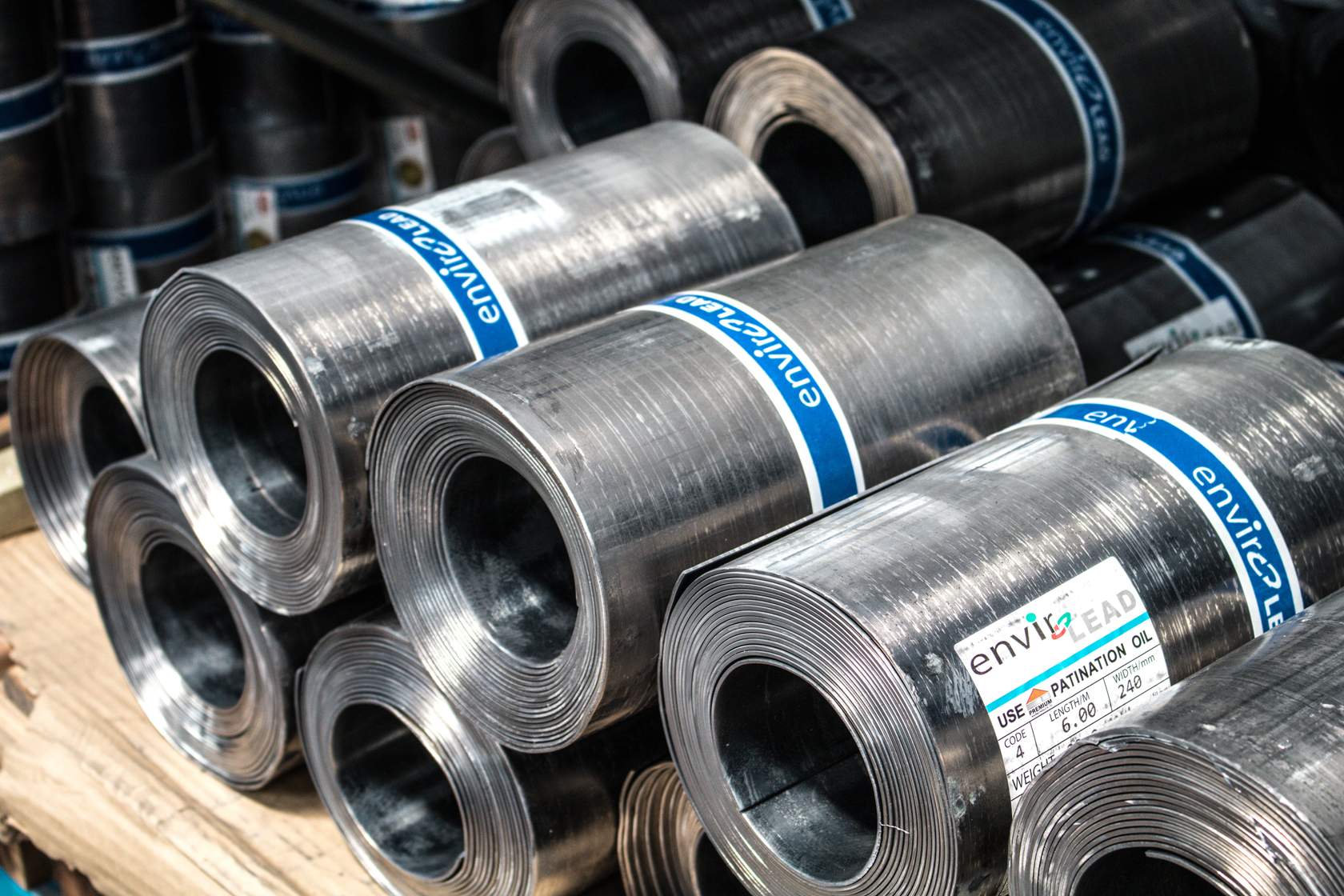
Many countries enact trade barriers that restrict the flow of imports and exports. The most common trade barrier is a tariff, a tax on imported goods. An American tariff on steel, for instance, will force foreign companies to pay the American government a tax every time they sell steel to the United States. This doesn't strictly limit the amount of steel that can be imported into America, but it does lessen the incentive for foreign companies to do so.
A quota, on the other hand, is a limit on the quantity of a product that's allowed into a nation. A quota on steel would set a maximum limit on the amount of foreign steel that could be brought into the United States.
The most extreme trade barrier is an embargo, which forbids buying or selling a certain good with a certain country. An American embargo on Chinese steel, for example, would prevent any Chinese company from selling Chinese steel in the United States.
Consequences of Trade Barriers
The chief consequence of trade barriers is reduced competition. This affects domestic producers and consumers much like any reduction in competition: it helps producers and hurts consumers.
For domestic producers in the affected industries, trade barriers are beneficial. Because competition is lower, producers can get away with charging higher prices for their goods. Let's say you own an American company that sells jeans. You'd like to sell your jeans for $50 a pair, but a Chinese company is bringing jeans into the country that it's selling for only $40 a pair. To compete, you also have to sell your jeans for $40. But if the government establishes a $10 tariff on every pair of jeans imported into the country, the cost of those Chinese jeans is going to rise. To make the same amount of profit, the Chinese company will have to pass on the cost of the tariff to the consumers, so it will start charging $50 for its jeans ($40 + $10 tariff). Now your American company can start charging $50 for your jeans again.
Obviously, these trade barriers hurt foreign companies. The Chinese company is going to lose sales because it will have to raise prices to compensate for the $10 tariff.
Consumers are another big loser when trade barriers are established. They'll have fewer choices and pay higher prices. The quality of the goods they buy might also go down. In our jeans scenario, they'll have to start paying $50 for each pair of jeans, when before they only had to pay $40.
Trade barriers usually have more costs than benefits but are advocated for by the people who have something to gain from them. As a domestic producer of jeans, you really want that tariff on jeans! It will help you make a lot more profit. You can get together with a lot of other jeans manufacturers to send lobbyists to the government, who will work to get the tariff passed, even though the tariff might not be in the interest of most Americans.
Politicians might be swayed by these lobbyists because they are incentivized to create policies that disperse costs over a large number of people but benefit small, powerful groups. Because the costs of trade barriers are spread over a large group of people, the costs on individuals may not be large enough for them to notice. Even if those individuals do notice, they might not connect the cost to the trade barrier. As a consumer, you may complain if you notice that your jeans have gone from $40 a pair to $50, but there's a good chance you might not connect that price increase with the newly enacted jeans tariff. Meanwhile, a specific industry or group (in our scenario, the American jeans manufacturers) will benefit greatly, and those producers can repay the politicians with political contributions or support.
Why Trade Barriers Are Established
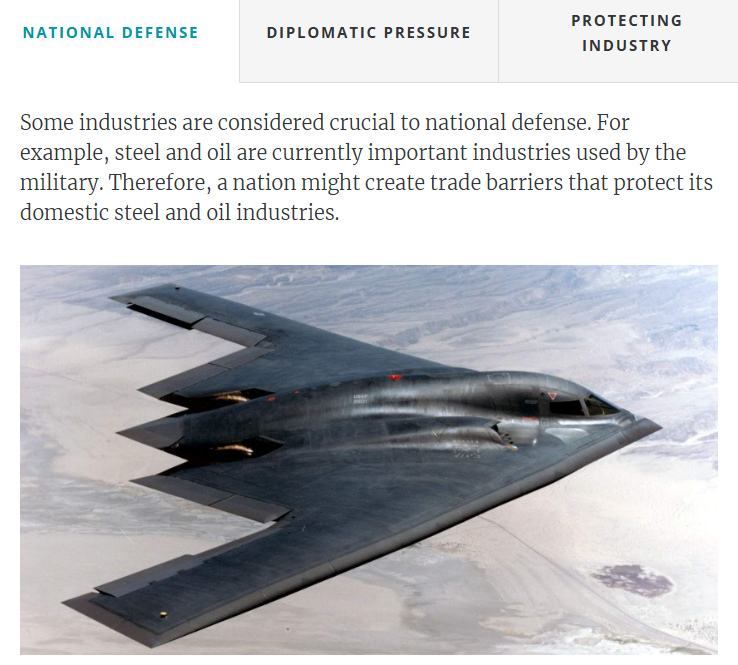
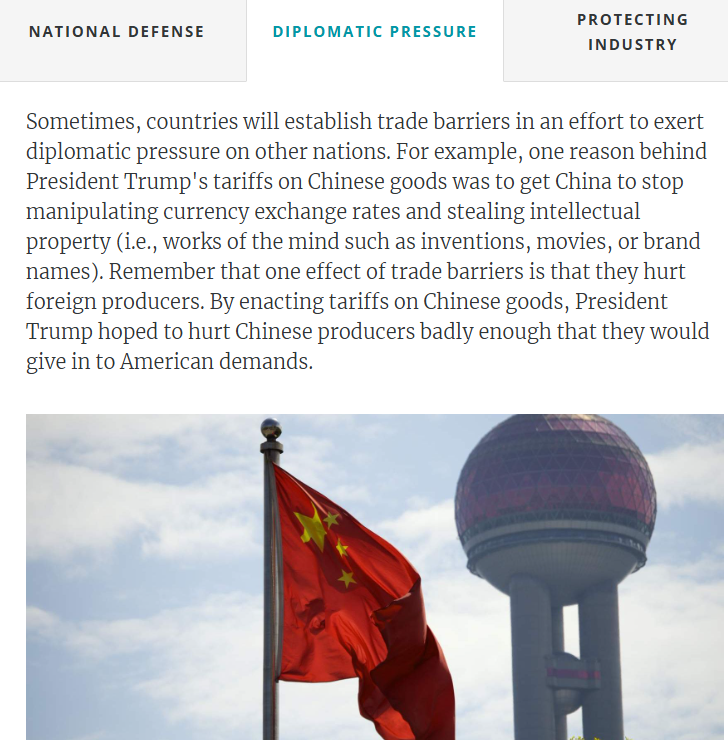
Trade barriers are often established for one of these three reasons: to strengthen national defense, to apply diplomatic pressure to a foreign government, or to protect domestic industries that would be hurt by free trade
 Review of Key Terms
imports: foreign products that are bought from sellers in other nations
exports: domestic products that are sold to buyers in other nations
trade deficit: occurs when a nation imports more goods than it exports
trade surplus: occurs when a nation exports more goods than it imports
tariff: a tax on imported goods
quota: a limit on the quantity of a product that's allowed into a nation
embargo: forbids buying or selling a certain good from/to a certain country
Very few tariffs are instituted to protect national defense or to apply diplomatic pressure; most are created to protect domestic industries. The problem is that, while these trade barriers help producers, they can be very damaging to consumers. Because consumers have to pay higher prices, they are not able to buy as many goods and services. Therefore, tariffs result in a lower standard of living for everyone in the country. In the next lesson, you'll read more about this idea in Economics in One Lesson.