Unit 3
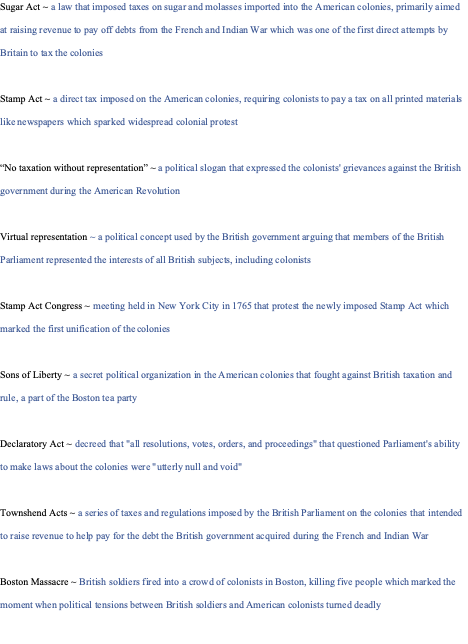
Sugar Act ~ a law that imposed taxes on sugar and molasses imported into the American colonies, primarily aimed at raising revenue to pay off debts from the French and Indian War which was one of the first direct attempts by Britain to tax the colonies
Stamp Act ~ a direct tax imposed on the American colonies, requiring colonists to pay a tax on all printed materials like newspapers which sparked widespread colonial protest
“No taxation without representation” ~ a political slogan that expressed the colonists' grievances against the British government during the American Revolution
Virtual representation ~ a political concept used by the British government arguing that members of the British Parliament represented the interests of all British subjects, including colonists
Stamp Act Congress ~ meeting held in New York City in 1765 that protest the newly imposed Stamp Act which marked the first unification of the colonies
Sons of Liberty ~ a secret political organization in the American colonies that fought against British taxation and rule, a part of the Boston tea party
Declaratory Act ~ decreed that "all resolutions, votes, orders, and proceedings" that questioned Parliament's ability to make laws about the colonies were "utterly null and void"
Townshend Acts ~ a series of taxes and regulations imposed by the British Parliament on the colonies that intended to raise revenue to help pay for the debt the British government acquired during the French and Indian War
Boston Massacre ~ British soldiers fired into a crowd of colonists in Boston, killing five people which marked the moment when political tensions between British soldiers and American colonists turned deadly
Tea Act ~ a British law that granted the East India Company a monopoly on the tea trade in the colonies, allowing them to sell tea directly to the colonies without paying certain taxes which raised tea prices for the colonists
Boston Tea Party ~ dozens of disguised men, some as Indigenous Americans, boarded the East India Company ships and dumped 342 chests of tea into Boston Harbor because of the newfound Tea Act
Coercive Acts/Intolerable Acts ~ a series of laws passed by the British Parliament in 1774 to punish the American colonies for their resistance to British rule
First Continental Congress ~ a gathering of delegates from twelve of the thirteen colonies that convened in Philadelphia to discuss grievances against British rule, ultimately deciding to boycott British goods in protest of the Intolerable Acts
Battles of Lexington and Concord ~ the first major battle of the American Revolutionary War resulting in an American victory
Olive Branch Petition ~ a document sent by the Continental Congress to King George III in July 1775 as a last attempt to avoid war between the British and American colonies (rejected)
Common Sense ~ written by Thomas Paine in 1776, which passionately argued for the American colonies to declare independence from Great Britain
Declaration of Independence ~ a document that established the United States as a nation, and outlined the principles that would guide its government
Militias ~ military organization of citizens who are available for emergency service
Continental Army ~ the military force that fought for the Thirteen Colonies and the United States during the American Revolutionary War
Hessians ~ German soldiers and civilians who fought for Great Britain against the American Revolution
Battles of Trenton/Princeton
Battle of Saratoga ~ a series of two battles fought in upstate New York in 1777 that were a turning point in the American Revolution resulting in an American victory
Valley Forge ~ the winter encampment site of the Continental Army, led by George Washington, during the American Revolutionary War, emerging as a more disciplined and cohesive fighting force under Washington's leadership
Battle of Yorktown ~ American victory with help from the French, effectively ending major combat operations in the colonies and paving the way for American independence through the Treaty of Paris
Treaty of Paris ~ agreement that officially ended the American Revolutionary War, formally recognizing the United States as an independent nation and establishing its borders, which allowed for significant westward expansion
Loyalists
Bill for Establishing Religious Freedom ~ written by Thomas Jefferson, it guaranted the right to practice any religion without government coercion and establishing the separation of church and state in Virginia
Lord Dunmore’s Proclamation
Abolitionism ~ a political movement that sought to end slavery and the transatlantic slave trade
“Remember the ladies”
Republican motherhood ~ an 18th century ideology that defined the role of women in the United States after the American Revolution
King George III ~ King of England during the period of the American Revolution
Patrick Henry ~ Founding Father of the United States, most recognized for his powerful and passionate speeches, particularly his famous "Give me liberty or give me death" declaration
Charles Townshend ~ British politician who is primarily remembered for introducing the Townshend Acts
Crispus Attucks ~ a sailor of mixed African and Native American descent who is historically recognized as the first person killed in the Boston Massacre
John Adams ~ an American Founding Father who served as the second president of the United States
Paul Revere ~ his "midnight ride" on horseback to warn colonial militia of an impending British attack before the Battles of Lexington and Concord, effectively alerting them to the British troop movements and sparking the Revolutionary War
Thomas Paine ~ wrote Common Sense
Thomas Jefferson ~ American Founding Father, best known for authoring the Declaration of Independence, serving as the third President of the United States
George Washington ~ led the Continental Army to victory in the Revolutionary War, helped create the U.S. Constitution, and served as the first president of the United States
Lord Cornwallis ~ a British military commander most famous for his surrender at Yorktown during the American Revolutionary War
Francis Marion ~ "Swamp Fox," was a prominent American Revolutionary War military leader from South Carolina, known for his guerilla tactics and surprise attacks against British forces
Marquis de Lafayette ~ a French aristocrat who played a significant role in the American Revolutionary War, serving as a major general under George Washington and becoming a key link between the American and French revolutions
Phillis Wheatley ~ an enslaved African American woman who became renowned as the first published Black poet in the United States
Abigail Adams ~ John Adam’s wife, considered important for her role as a political influencer, actively advising her husband on political matters, and for her advocacy for women's rights, most notably her famous plea to "remember the ladies" in a letter to John during the drafting of the new government laws