Comprehensive Notes on Alfred Adler and Individual Psychology
Introduction to Adlerian Theory
Core Principles:
The fundamental drive is striving for success or superiority.
Subjective perceptions shape personality and behavior.
Personality is unified and cohesive.
Human activities must be evaluated through the lens of social interest.
The individual’s personality structure embodies their unique style of life.
Style of life is formed by personal creative power.
Dynamics of Personality
Striving for Success:
Start: sense of inferiority →process: motivate to seek success or superiority→final goal:
Healthy individuals
aim for communal success
achieved through social interest.
unhealthy/neurotics
seek personal superiority.
based on exaggerated feelings of inferiority
Subjective Perception
People strive for superiority or success to compensate for feelings of inferiority, with their goals & behaviours shaped by their subjective perceptions of reality(fiction), or expectations of the future
Fictions are ideas that have no real existence, yet they influence people as if they were real
Physical Inferiorities
How people begin
begin: small, weak, inferior→ develop: fiction how to be big, strong, superior→ aftermath: achieving superiority but still act as inferior
*start at the age 4 or 5
The whole human race is “blessed” with organ inferiorities: Everyone has physical weaknesses or limitations which become important when they make a person feel inferior, thus motivating them to improve or achieve more
Unity and Self-Consistency:
Personality is viewed as an unseparated whole where thoughts, feelings, and actions align towards a consistent goal.
Organ Dialect:
both the body (physical aspects) and the mind (psychological aspects) work together to express and move a person toward their goals.
Body’s organs “speak a language which is usually more expressive and discloses the individual’s opinion more clearly than words are able to do”
→ A person’s body can reveal their true feelings and struggles more clearly than their words. Physical symptoms, posture, or movements often express emotions or personal challenges without the person even realizing it
unconscious is simply the part of a person’s goal that they don’t fully understand yet. conscious & unconscious work together as one system.
Conscious thoughts are the ones a person recognizes as useful for achieving success.
Unconscious thoughts are the ones they don’t see as helpful or don’t fully understand.
*Something becomes unconscious when we don’t understand it, and once we do understand it, it becomes conscious.
Social Interest:
Encompasses empathy and connection with humanity, essential for psychological health and communal survival.
Developed through familial relationships, particularly the mother-child bond.
person’s psychological health depends on their social interest(how much they care about and contribute to their community). social interest is the only true way to measure a person’s worth.
Psychologically healthy people have a strong sense of connection with others (Gemeinschaftsgefühl), focusing on cooperation and mutual support.
Immature people are self-centred, focused on gaining power over others, and lack this social connection.
how a person interprets their inferiority determines whether they pursue genuine success through social contribution or selfish superiority over others.
normal feelings of incompletion→social interest→success→clearly perceived final goal
exaggerated feelings of inferiority→focus on personal gain→ seek personal superiority→ have a dimly perceived final goal (self-centered and power-driven)
Style of Life:
An individual's unique blueprint is shaped by experiences and inherent creative power(shape their own life by interpreting experiences and making choices), reflecting their personal approach to life.
While the ultimate goal remains fixed, methods of achieving it may change/evolve
Creative Power:
people have the power to shape their own lives through creativity and personal choices. This means:
Freedom & Responsibility – Each person is responsible for who they become and the actions they take. They have control over their life path, goals, and contributions to society.
Life is About Progress – People are constantly moving toward their goals, and the direction they choose matters.
Personality as Architecture – Like architects design buildings, people design their own personalities and lifestyles, deciding whether to live in a socially useful or useless way.
The "Low Doorway" Analogy – If you face a challenge (like a doorway too small to walk through), you can:
Adapt and find a solution (bend down → healthy, successful response).
Keep repeating mistakes (bump your head → unhealthy, neurotic response).
*success depends on how flexible and creative a person is when facing life's challenges
Abnormal Development
people are what they make of themselves.
*neurotics: negative psychological patterns due to an excessive inferiority complex, which leads to maladjustment in life
one factor underlying all types of maladjustment(struggling to relate to others and adapt to life in a healthy way) is underdeveloped or lack of social interest > over concern with themselves
Neurotics also tend to (1) set their goals too high, (2) live in their own private world, and (3) have a rigid and dogmatic style of life.
External factors in maladjustment
Exaggerated physical deficiencies + accentuated feelings of inferiority
A pampered style of life, weak social interest but a strong desire to be pampered, parasitic relationship they originally had with one or both of their parents
A neglected style of life. Abused and mistreated children develop little social interest > lack of confidence, overestimate difficulty, distrustful, inability to cooperate
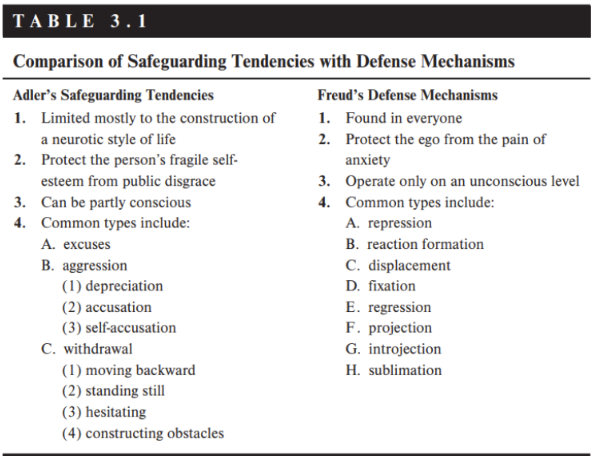
Safeguarding Tendencies:
Mechanisms to shield fragile self-esteem, often conscious and related to maintaining a sense of superiority.
Types include excuses, aggression, and withdrawal in response to perceived threats or failures.
Masculine Protest and Gender Perspectives:
Adler argued that societal pressures create exaggerated masculine roles, impacting both genders negatively.
He viewed women as equally capable, in contrast to Freud's deterministic view.
Application of Individual Psychology:
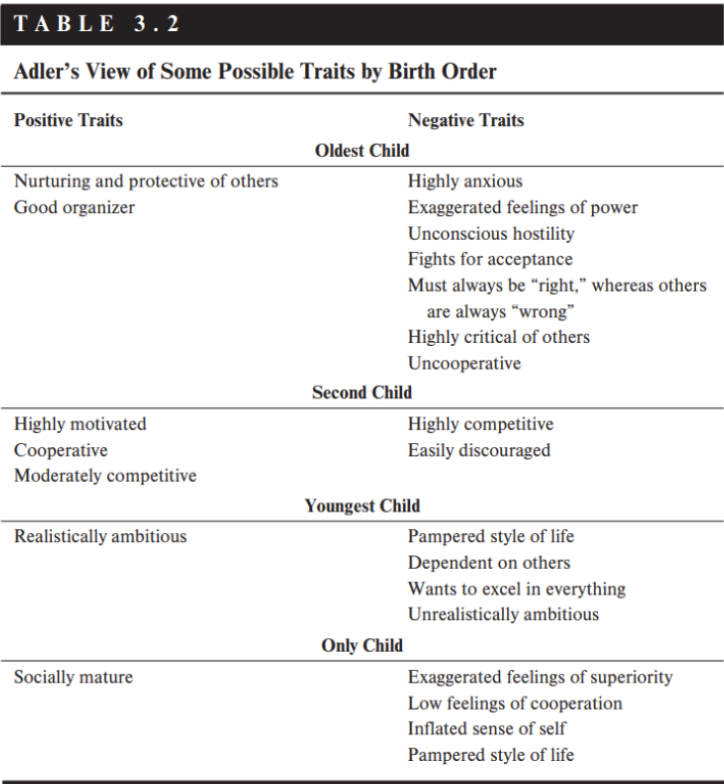
Family Constellation:
Birth order impacts personality traits and motivational styles.
Other applications:
Early Memories – The way people remember their childhood reflects their current personality and goals. These memories give clues about what they strive for in life.
Dreams – Most dreams trick the dreamer and are hard to understand. The more unrealistic a person’s goal is, the more they use dreams to deceive themselves.
Therapy – Adlerian therapy helps people become more confident, feel less inferior, and develop care for others.
Research Areas:
Adler believed that the careers people choose reflect their personality.
Early childhood memories can show patterns that connect to future career choices
Critique of Adler's Work:
Difficult to prove or disprove – Like Freud’s ideas, many of Adler’s concepts (e.g., striving for superiority, creative power) can’t be tested scientifically.
Vague definitions – His key terms don’t have clear, measurable definitions, making them hard to study in a scientific way.
Good for research – Some parts of his theory, like early memories, social interest, and life style, have inspired research.
Simple but poorly written – His theory is straightforward, but his writing style was messy and unorganized.
Useful in practice – Despite its flaws, the theory provides strong guidance for therapy and personal development
Concept of Humanity:
Free Choice > Determinism – Adler believed people are not controlled by fate or past experiences (determinism). Instead, they have the freedom to shape their own lives through creative power.
Optimism > Pessimism – His theory is hopeful (optimistic), emphasizing that people can grow, improve, and develop social interest rather than being stuck in negative patterns.
Teleology > Causality – Adler focused on future goals (teleology) rather than past causes. He believed people are guided more by their final goal than by past experiences.
Conscious > Unconscious – While some aspects of personality are unconscious, Adler emphasized that people are mostly aware of their goals and motivations.
Social > Biological Influences – He saw social relationships as more important than biological factors in shaping personality. Family, culture, and environment play key roles.
Uniqueness > Similarities – Adler stressed that each person is unique, with their own life style and goals, rather than focusing on universal traits shared by all.