Earth Science, Part 1
Module 1: Introduction— The Nature of Science
Question: What is empirical evidence?
things we know by doing repeated testing
things we know based on our feelings
things we know without observing them
things we know because we have faith in them
Answer: things we know by doing repeated testing
Question: True or false: In this course, you are encouraged to learn about the earth only through the scientific way of gaining knowledge—empirical evidence.
Answer: False
Question: If you tell your mom that you think her pie is dry because she baked it too long, your guess is called a ________.
theory
hypothesis
Answer: hypothesis
Question: Scientific laws describe ________, while scientific theories explain ________.
what happens; why things happen
why things happen; what happens
Answer: what happens; why things happen
Question: True or false: Scientific knowledge will always be true.
Answer: False
Question: Add the correct words to the definitions. Fill in the blanks correctly.
__________: a statement of your belief.
__________: the things you observe that prove your belief is either right or wrong.
__________: the explanation that connects your evidence to your conclusion.
Answer:
claim: a statement of your belief.
evidence: the things you observe that prove your belief is either right or wrong.
reasoning: the explanation that connects your evidence to your conclusion.
Question: (instructions: put the following phrases in order of the scientific method)
words: Make a conclustion using the evidence you recorded. Test your experiment. Record the evidence you observe in your experiment. Make a hypothesis to explain why you think that thing is happening.
order propt:
Observe something cool happening
___________________________________________
Create an experiment to test your hypothesis.
___________________________________________
___________________________________________
Change your experiment if it isn’t working.
___________________________________________
Answer:
1. Observe something cool happening
2. Make a hypothesis to explain why you think that thing is happening.
3. Create an experiment to test your hypothesis.
4. Test your experiment.
5. Record the evidence you observe in your experiment.
6.Change your experiment if it isn’t working.
7. Make a conclusion using the evidence you recorded.
Question: True of false: Science experiments should only be tested in a laboratory by a scientist.
Answer: False
Question: The process involves which of the following phrases? (select all that apply.)
Phrase options:
doing an experiment
making a model
doing research
asking a question.
Answer:doing an experiment
making a model
doing research
asking a question.
Question:You can never prove a theory 100% true because it is impossible to test every possible experiment for it.
Answer: True
Question: Science is the way humans try to answer questions and explain things that they ________. (Select all phrases that apply.)
Phrase options:
can test in a experiment
have knowledge through faith
observe through their senses
Answer: can test in a experiment, observe through their senses
Question: Which statement is true of scientfic knowledge?
statement options:
1. It is constantly changing because it is easy to convince others that something is true.
2. It is determined by empirical evidence, so it's always true and does not change.
3. It only changes if someone accidentally made the wrong conclusion before.
4. It changes often because people discover new evidence all the time.
Answer: It changes often because people discover new evidence all the time.
Question: Scientists use what items to explain things that happen in nature (phenomena)?
Answer: mechanisms, theories, laws, models
Review the vocabulary words from this module.
Knowledge: includes the facts, information, and understanding gained through education and experience.
Phenomena: are rare or unusual situations that are seen or experienced—particularly those that can't always be explained.
Theory: is the most plausible or scientifically acceptable explanation for something observed in our natural world.
Consensus: is when a theory is agreed on.
Misconception: The belief that science and religion always need to be in conflict.
Reconcile means to make something consistent, in harmony, or in agreement.
Observe means to look at, notice, or perceive something.
Evidence means the available facts or information that indicate whether a belief or idea is true.
Experiment is a scientific procedure used to make a discovery, test a hypothesis, or demonstrate a known fact.
Variables are things that are not consistent or can change.
Practice is a way of looking for and finding answers through certain actions.
Inquiry means to look at something in detail.
Anecdotal evidence comes from a person’s own experiences.
Empirical evidence comes from experiments that can be seen and repeated by many different people.
Module 2: Matter and Energy in Space— the Sun
Question: True or false: A scientific model is a physical, mathematical, or conceptual representation of something seen in nature.
Answer: True
Question: How does the sun have energy to stay big, bright, and hot?
Answer: The sun is made of hydrogen and helium. When two hydrogen atoms fuse together, it creates heat, light, and helium.
Question: What is needed for fusion reactions to occur? (Select all that apply.)
Options:
1. production of energy afterward.
2. hydrogen atoms.
3. two or more nuclei.
4. high temperatures to overcome the repulsion of protons.
Answers:
production of energy afterward
two or more nuclei
high temperatures to overcome the repulsion of protons.
Question: The outer layer of a star like our sun gives off electromagnetic radiation. Which types of electromagnetic radiation come from the sun? (Select all that apply.)
Options:
1. microwaves
2. heat
3. x-rays
4. visible light
5. radio waves
Answer:
heat
visible light
radio waves
Question: Fill in the blank
1. The _________ is the visible surface of the sun that emits light.
2. The _________ is right above the photosphere, and it is heated by the ________.
3. The _________ is the outermost layer of the sun that extends far into space and is called the "crown" of the sun.
4. In the __________ of the sun, nuclear fusion generates energy that moves throughout the rest of the sun.
Word options of filling in the blank are:
1. chromosphere
2. corona
3. photosphere
4. photosphere
5. core
Answer:
The photosphere is the visible surface of the sun that emits light.
The chromosphere is right above the photosphere, and it is heated by the photosphere.
The corona is the outermost layer of the sun that extends far into space and is called the "crown" of the sun.
In the core of the sun, nuclear fusion generates energy that moves throughout the rest of the sun.
Question: select all statements that are true about the sun.
Mentioned statements:
The light we see from the sun is from the sun's core.
The sun is made of plasma.
Nuclear fusion happens in the sun's core.
The sun is made of layers. You can see the sun's corona (crown of light) during a solar eclipse.
Answer:
You can see the sun's corona (crown of light) during a solar eclipse.
The sun is made of layers.
Nuclear fusion happens in the sun's core.
The sun is made of plasma.
Question: Sun spots are places on the sun that are hotter and darker and have lots of magnetic activity.
Answer: False
Q: True or false: Nuclear explosions are always occuring within the sun. Sometimes these explosions release solar winds (radiation) that escape the sun's gravitational field.
A: True
Question: Fill in the blank.
The amount of energy the sun radiates is _________.
The radiation of the sun increases and decreases again over a(n) __________.
When the sun is radiating more energy, sun spots and solar storms are ________ and more frequent.
The word options to fill in the blanks are
larger
variable
11-year cycle.
Answer:
The amount of energy the sun radiates is variable.
The radiation of the sun increases and decreases again over a(n) 11-year cycle.
When the sun is radiating more energy, sun spots and solar storms are larager and more frequent.
Question: There are 3 types of energy transfer that occur in the sun. Use the fill-in-the-blanks to define each kind.
Fill in the blanks with the following word options: Conduction, Radiation, Convection
1. __________ happens when atoms or molecules collide. This means items must be touching each other to move kinetic energy between them.
2. __________occurs in all matter except solids. It moves energy due to changes in pressure and density.
3. ____________is the transfer of energy through waves. There does not have to be direct physical contact.
Answer:
1. Conduction happens when atoms or molecules collide. This means items must be touching each other to move kinetic energy between them.
2. Convection occurs in all matter except solids. It moves energy due to changes in pressure and density.
3. Radiation is the transfer of energy through waves. There does not have to be direct physical contact.
Question: What do electromagnetic waves transport or carry?
Answer: energy
Question: Which type of wave requires a medium to travel through?
Answer: mechanical
Question: What do electromagnetic waves travel through?
Answer: mediums
Question: True or false: Scientists create models to make it easier to understand the complicated things that happen in nature.
Answer: True
Question. Fill in the blanks below.
The sun is a big hot ball of ____________.
One million ____________s could fit inside of the ________.
______ in the sun's core creates energy by fusing hydrogen atoms to make helium.
the word options for filling in the blanks are:
earth
sun
nuclear fusion
hydrogen gas
Answer: The sun is a big hot ball of hydrogen gas.
One million earths could fit inside of the sun.
nuclear fusion in the sun's core creates energy by fusing hydrogen atoms to make helium.
Quiz One
This quiz will assess your understanding of concepts from past and current modules. It consists of 15 questions.
Question 1: The sun is producing a large amount of energy the builds pressure in its core. What force keeps it from exploding outward?
Answer: gravitational force
Question 2: True or False: The sun's nuclear processes do not produce any sound.
Answer: False
Question 3: True or False: The sun has a defined, solid outer boundary.
Answer: False
Question 7: Which of the following statements best describes why a student would draw a diagram about the way light travels?
to show what they know to a teacher who already understands how light travels.
to show someone else the way light travels, after they have figured it out.
to figure out the way it travels or to show someone else the way it travels.
to represent only what is already known about the way light travels
Answer: to figure out the way it travels or to show someone else the way it travels.
Question 9: Which of the following is an example of scientific knowledge being used to create new technology?
The telescope was designed to view distant objects. Scientists used the telescope to learn more about objects in our night sky.
Invention of the spectrometer allowed scientists to measure the composition of matter. The Mars rover used a spectrometer to measure the composition of minerals on Mars' surface.
A new sensor was developed to provide better digital images of space. Its small size and low power needs of this technology led to the development and wide use of cell phone cameras.
The seismometer was developed to measure ground movements of earthquakes. Using seismometers scientists discovered that Earth has a solid inner core.
Answer: A new sensor was developed to provide better digital images of space. Its small size and low power needs of this technology led to the development and wide use of cell phone cameras.
Question 10: The company that invented cordless power tools worked with scientists to develop versions of those tools for use in space. This led to the development of useful, compact tools available for everyone. This is an example of which of the following?
research and development improving technology.
scientific knowledge increasing due to technology.
the different goals of science and technology.
intentional benefits of space exploration.
Answer: research and development improving technology
Question 11: True or false: A scientist's need for evidence can increase advancements in technology.
Answer: True
Question 12: Which of the following is an example of someone using empirical evidence?
“Don't ever eat at that restaurant. The service was so slow when I went there."
"I want a fast computer. I'm looking at speed test data before buying my computer."
"Wearing my purple shirt will help me on the test. I got a 94% last time I wore it!"
"I can't buy a red car. I heard that the police pull over more red cars than other colors."
Anwer: "Wearing my purple shirt will help me on the test. I got a 94% last time I wore it!"
Question 13: When scientists discover a relationship between observations that happens repeatedly, this is known as which of the following?
a scientific fact.
a scientific theory.
a scientific law.
the scientific method
Answer: a scientific law
Question 14: Why do scientists use both laws and theories when studying our natural world?
The theory is built from tested hypotheses; the law does not require evidence.
The law describes the phenomena; the theory explains how or why it works.
The law is built from theories; the theory has to be discovered first.
The observations are described by theories; the law explains how or why it works.
Answer: The law describes the phenomena; the theory explains how or why it works.
Wrapping Up/ Module Review/ Moducle 2 conclusion
Can you answer the big question for this module?
How does the sun produce the energy that is essential for Earth?
Can you explain the big idea to someone else?
The sun is powered by nuclear fusion, which creates new elements, energy, and radiation.
Check your understanding. Did you meet each of these learning outcomes?
Develop a model based on evidence to illustrate the life span of the sun and the role of nuclear fusion in releasing energy in the sun’s core.
Develop and use models at both the macroscopic and microscopic scales to illustrate the changes in the composition of the nucleus of the atom and the energy released during the process of fusion.
Recognize ways science and engineering complement each other in the cycle known as research and development.
Review the vocabulary words from this module.
Energy: The capacity to perform work.
Astronomical Unit: Used to measure distance in space, based on the distance of the sun from the Earth.
Probe: A robotic spacecraft that travels farther into space to scan and report on planetary bodies or systems.
Matter: Anything that has mass and takes up space.
Atom: The smallest part or particle of matter that has all the properties of matter.
Subatomic: Particles that are smaller than an atom.
Proton: A subatomic particle that occurs in all atomic nuclei, with a positive electric charge.
Neutron: A subatomic particle that occurs in all atomic nuclei, without an electric charge.
Electron: A subatomic particle that is found outside the nucleus, with a negative electric charge.
Nucleus: The positively charged central core of an atom, consisting of protons and neutrons, and containing nearly all its mass.
Periodic Table: A table of the chemical elements arranged in order of atomic number.
Atomic Number: The number of protons in the nucleus of the atom, which determines the chemical properties of an elements.
Atomic Mass: The mass of an atom that is approximately equivalent to the number of protons and neutrons in an atom.
Isotope: Forms of the same element that contain equal numbers of protons but different numbers of neutrons.
Ion: An atom or molecule with a net electric charge due to the loss or gain of one or more electrons.
Nuclear Fusion: A reaction in which two or more atomic nuclei are combined to form different atomic nuclei.
Plasma: Fourth state of matter formed when energy is added to gas and it becomes ionized.
Star: Sphere of gas held together by its own gravity that generates its own light and heat energy.
Conduction: The transfer of kinetic energy due to the direct collision of particles.
Convection: Energy transfer due to the movement from changes in density and pressure.
Radiation: Energy transfer between objects that may be separated spatially.
Mechanical Waves: Radiation that requires a medium to transfer energy.
Electromagnetic Waves: Radiation that does not require a medium to transfer energy.
Model: A physical, conceptual, or mathematical representation of a real-world phenomenon that is difficult to observe directly.
Module 3: Matter and Energy in Space— Star Classification
Question: Select as many statements as are true about scientific data:
Since data describes something as it really happened, it proves that the same thing will happen every time and in every case.
Data is information collected using specific methods of measuring or analyzing something.
You need data in order to prove hypotheses true or false.
Scientific data can be collected in a laboratory.
Answer: Scientific data can be collected in a laboratory. Data is information collected using specific methods of measuring or analyzing something. You need data in order to prove hypotheses true or false.
Question: Why do stars appear to move across the night sky? (Select all that apply.)
Earth rotates on its axis.
The stars are either moving toward or away from earth.
Earth moves around the sun.
Answer: Earth rotates on its axis. Earth moves around the sun.
Question: True or false: Luminosity is the measure of how much visible electromagnetic energy an object produces.
Answer: True
Question: Fill in the following blanks.
Stars radiate most or all ___________s of light, but each star may radiate a different amount of each wavelength. This is known as the star's __________.
__________ is how brightly a star shines.
A star’s _________ can help determine how far away the star is.
A star’s ___________ can tell us its temperature. It can also tell us what __________s are inside of it.
word options for filling in the blanks are:
radiation spectrum
mass
radiation spectrum
luminosity
element
wavelength
Answer: Stars radiate most or all wavelengths of light, but each star may radiate a different amount of each wavelength. This is known as the star's radiation spectrum.
luminosity is how brightly a star shines.
A star’s mass can help determine how far away the star is.
A star’s radiation spectrum can tell us its temperature. It can also tell us what elements are inside of it.
Question: True or false: The smaller the star, the shorter its lifespan.
Answer: False
Question: True or false: A star is stable if the force of gravity pushing in on the star nearly matches the force of energy (heat and light) leaving the star.
Answer: True
Question: Fill in the blanks correctly to the summary below.
Stars are not on fire; they just change ___________ because of their ___________.
Some materials change ____________ as they get hotter and hotter.
Red stars are ______________ than yellow stars, and white stars are ____________ than yellow stars.
Word options to fill in the blank are:
cooler
color
temperature
hotter
color
Answer: Stars are not on fire; they just change color because of their temperature.
Some materials change color as they get hotter and hotter.
Red stars are cooler than yellow stars, and white stars are hotter than yellow stars.
Question: True or false: The luminosity of our sun is greater than any other star in the universe because it is brighter to us.
Answer: False
Question: What is the equation for density in the correct order?
Answer: Density = Mass/ Volume
Question: Fill in the blanks correctly to the setances below.
If a star is blue, it is likely _______ and ________.
If a star is red, it is likely _______ and ________.
Word options to fill in the blanks are:
hotter
smaller
cooler
bigger
Answer: If a star is blue, it is likely bigger and hotter.
If a star is red, it is likely smaller and cooler.
Question: An H-R diagram helps us model which of the following things? (Select as many as apply.)
1. The relationship between size and the elements in the star.
2. The relationship between temperature and size.
3. The relationship between energy and mass.
4. The relationship between size and rarity.
5. The relationship between temperature and color.
Answer: The relationship between temperature and size .The relationship between energy and mass. The relationship between size and rarity. The relationship between temperature and color.
Review the vocabulary words from this module.
luminosity: the intrinsic brightness of a celestial object (as opposed to its perceived brightness, which is affected by distance).
spectroscopy: the branch of science that investigates and measures the frequencies and behaviors of electromagnetic radiation (including light).
continuous spectra: a collection of frequencies of electromagnetic radiation that contains no gaps from the lowest to the highest frequencies.
absorption spectra: a collection of electromagnetic frequencies that is filtered as the energy passes through a substance—the filtration causes black bands, or gaps, in the spectra, due to the absorption of those frequencies by like particles in a substance.
emission spectra: the unique collection of the frequencies of electromagnetic radiation emitted by a particular particle.
mass: how much matter is contained in an object.
Hertsprung-Russell Diagram (H-R Diagram): a diagram that shows how magnitude and spectral type of stars go together.
temperature: a measure of the warmth of an object.
heat: the amount of energy transferred between objects because of a difference in temperature—a large object of lower temperature may generate more heat than a small object of higher temperature.
density: the technical definition is mass per unit volume—in other words, how much stuff is in a particular space
Module 4: Matter and Energy in Space— A Star’s Life Cycle
Question: Stellar evolution is the lifecycle of a star. Fill in the follwing words correctly.
Clusters of collapsing ________ in space form stars. These are called _________.
It is easier to form smaller stars because it's easier to find smaller _______ in space. The smaller the the star, the _______ its lifetime.
At the end of a star's lifecycle, it will collapse and expel _______.
Fill in the blanks using the following wors:
hydrogen and helium gas
longer
nebulae
nebulae
nebulae
Answer:
Clusters of collapsing hydrogen and helium gas in space form stars. These are called nebulae.
It is easier to form smaller stars because it's easier to find smaller nebulae in space. The smaller the the star, the longer its lifetime.
At the end of a star's lifecycle, it will collapse and expel nebulae.
Question: Once a star stabilizes, what is it called?
Answer: main sequence star
Question: True or false: A dwarf is any star of average or low luminosity, mass, and size.
Answer: True
Question: Put in the life cycle of a low-mass star in order by filling in the blanks below in the appropriate order.
1. A star is born.
2. _________________________.
3. _________________________.
4. _________________________.
5. Energy is released from helium fusion that expands the core and slows hydrogen fusion in the outer layers.
6. _________________________.
7. The star has less and less elements to fuse and begins contracting and heating.
8. _________________________.
Word options to fill in the blanks are:
The star collapses into a white dwarf.
The star fuses hydrogen into helium.
The star’s total energy production begins decreasing.
The star begins fusing helium.
The star expands into a red giant.
Answer:
1. A star is born.
2. The star fuses hydrogen into helium.
3. The star expands into a red giant.
4. The star begins fusing helium.
5. Energy is released from helium fusion that expands the core and slows hydrogen fusion in the outer layers.
6. The star's total energy production begins decreasing.
7. The star has less and less elements to fuse and begins contracting and heating.
8. The star collapses into a white dwarf.
Question: Giant stars fuse elements into heavier and heavier elements. The heaviest element they typical can fuse up to is _______.
Answer: iron
Question: Elements ______ than iron were formed in a supernova.
Answer: heavier.
Question: True or false: Neutron stars are very small and spin very fast. If we detect pulses of radiation from them, we call them pulsars.
Answer: True
Question: Fill in the blanks correctly.
__________ die very different deaths than other stars.
They become ____________s and blackholes.
The biggest ones can disappear completely by becoming a _________ and leaving nothing but _________ behind.
Fill in the blanks using these word options:
supergiant stars
hypernova
nebulae
supernova
Answer: supergiant stars die very different deaths than other stars.
They become supernovas and blackholes.
The biggest ones can disappear completely by becoming a hypernova and leaving nothing but nebulae behind.
Question: True or false: Just like giant stars, supergiant stars also create heavier and heavier elements until there is so much iron that it can't generate enough energy to stay stable. Then their lifecycle comes to a close
Answer: True
Question: Fill in the missing words.
I am what remains after a supernova destroys a supergiant star. I am generally surrounded by nebulae. I am a location where all matter gets sucked into and compressed.
what am I? ____ _____ (enter one word in for each blank)
Answer: black hole
Review the vocabulary words from this module
energy: the capacity to perform work.
astronomical unit: used to measure distance in space, based on the distance of the sun from the earth.
probe: a robotic spacecraft that travels farther into space to scan and report on planetary bodies or systems.
matter: anything that has mass and takes up space.
atom: the smallest part or particle of matter that has all the properties of matter.
subatomic: particles that are smaller than an atom.
proton: a subatomic particle that occurs in all atomic nuclei, with a positive electric charge.
peutron: a subatomic particle that occurs in all atomic nuclei, without an electric charge.
electron: a subatomic particle that is found outside the nucleus, with a negative electric charge.
nucleus: the positively charged central core of an atom, consisting of protons and neutrons, and containing nearly all its mass.
periodic table: a table of the chemical elements arranged in order of atomic number.
atomic number: the number of protons in the nucleus of the atom, which determines the chemical properties of an elements.
atomic mass: the mass of an atom that is approximately equivalent to the number of protons and neutrons in an atom.
isotope: forms of the same element that contain equal numbers of protons but different numbers of neutrons.
ion: an atom or molecule with a net electric charge due to the loss or gain of one or more electrons.
nuclear fusion: a reaction in which two or more atomic nuclei are combined to form different atomic nuclei.
plasma: fourth state of matter formed when energy is added to gas and it becomes ionized.
star: sphere of gas held together by its own gravity that generates its own light and heat energy.
conduction: the transfer of kinetic energy due to the direct collision of particles.
convection: energy transfer due to the movement from changes in density and pressure.
radiation: energy transfer between objects that may be separated spatially.
mechanical waves: radiation that requires a medium to transfer energy.
electromagnetic waves: radiation that does not require a medium to transfer energy.
• 24. model: a physical, conceptual, or mathematical representation of a real-world phenomenon that is difficult to observe directly.
Module 5: Matter and Energy in Space— Matter in the Universe
Question: Fill in the following blanks correctly.
Matter is anything that takes up __________.
Matter is made of __________s.
The most abundant element in the sun is ______________.
The most abundant element in the earth is _______________.
Although oxygen is less than 1% of the ______________, that's still enough oxygen to fit in over 3,000 earths.
Word choices to fill in the blanks are:
hydrogen
oxygen
sun’s mass
space
element
Answer:
Matter is anything that takes up space.
Matter is made of elements.
The most abundant element in the sun is hydrogen.
The most abundant element in the earth is oxygen.
Although oxygen is less than 1% of the sun’s mass, that's still enough oxygen to fit in over 3,000 earths.
Question: True or false: Because the sun and earth are in the same solar system, they are made of very similar things.
Answer: False
Q: True or false: A spectroscope is a tool used to identify the specific wavelengths that an object emits.
A: True
Question: Fill in the blanks correctly.
_____________ produces light by heating a metal wire (TEMPERATURE).
______________ produces light by exciting the electrons in its gas (IONIZATION).
______________ produces light by doing both of the above. Its light is due to the temperature and ionization of its gases.
word options to fill in the blanks are:
A fluorescent bulb
A tungsten bulb
The sun
Answer:
A tungsten bulb produces light by heating a metal wire (TEMPERATURE).
A fluorescent bulb produces light by exciting the electrons in its gas (IONIZATION).
The sun produces light by doing both of the above. Its light is due to the temperature and ionization of its gases.
Question: Fill in the blanks correctly.
When they absorb energy, gases emit multiple specific wavelengths of light. Therefore they have a unique ________ based on what gas is producing the light.
When objects are heated, they emit a(n) __________ of light, meaning all wavelengths.
Objects that have an emission spectrum also have a(n) ___________, showing the wavelengths of light that are absorbed by the object.
word options to fill in the blanks are:
continuous spectrum
emission spectrum
absorption spectrum
Answer: When they absorb energy, gases emit multiple specific wavelengths of light. Therefore they have a unique emission spectrum based on what gas is producing the light.
When objects are heated, they emit a(n) continuous spectrum of light, meaning all wavelengths.
Objects that have an emission spectrum also have a(n) absorption spectrum, showing the wavelengths of light that are absorbed by the object.
Question: Which statement is true about the hydrogen absorption spectrum and the hydrogen emission spectrum?
The hydrogen absorption spectrum has fewer lines than the hydrogen emission spectrum.
The hydrogen absorption spectrum has more lines than the hydrogen emission spectrum.
The hydrogen absorption spectrum has the same number of lines as the hydrogen emission spectrum.
Answer: The hydrogen absorption spectrum has the same number of lines as the hydrogen emission spectrum.
Question: Which of the following types of spectra is most helpful in identifying the composition of stars?
absorption spectrum
emission spectrum
continuous spectrum
Answer: absorption spectrum
Question: Fill in the blanks with the correct words.
When observing the _________ spectra of faraway stars, scientists noticed their spectra were not where they expected them to be.
The absorption ___________s were either shifted a little toward red or blue.
A ___________ shift means the light source is moving away while a ________ shift indicates it is moving toward us.
word options for filling in the blanks are:
red
blue
line
abbsorption
Answer:
When observing the absorption spectra of faraway stars, scientists noticed their spectra were not where they expected them to be.
The absorption lines were either shifted a little toward red or blue.
A red shift means the light source is moving away while a blue shift indicates it is moving toward us.
Question: Fill in the blanks correctly.
The Doppler effect occurs when there is _________ in ________ of the source of ________.
This causes the waves to __________ in the direction of movement (if moving toward) and ___________ in the opposite direction (if moving away).
word options to fill in the blanks are:
shorten
position
waves
change
lengthen
Answer: The Doppler effect occurs when there is change in position of the source of waves.
This causes the waves to shorten in the direction of movement (if moving toward) and lengthen in the opposite direction (if moving away).
Question: True or false: In photographs of nebulae and other interstellar matter, we often add faux colors to help us model the true composition of those objects. It helps us understand them better.
Answer: True
Question: True or false: Nebulae are generally made of helium gas.
Answer: False
Question:What is dark matter?
It is matter we can't see and don't know how to identify.
It is a mysterious phenomenon that causes the death of stars.
It is what black holes are made of.
Answer: It is matter we can't see and don't know how to identify.
Question: Fill in the blanks correctly to the following summary.
_________ clusters are younger, smaller, and more loosely held together groups of stars.
__________ clusters are much larger groups of older stars, held tightly together.
Open clusters tend to be _____________ in color, while globular clusters are ____________.
___________ are the largest groups of stars, and ____________ galaxies are a bit smaller than them.
word options to fill in the blanks are:
Open
Globular
Galaxies
dwarf
blue
red
Answer:
Open clusters are younger, smaller, and more loosely held together groups of stars.
Globular clusters are much larger groups of older stars, held tightly together.
Open clusters tend to be blue in color, while globular clusters are red.
Galaxies are the largest groups of stars, and dwarf galaxies are a bit smaller than them.
Question: Fill in the blanks of the summary below correctly.
We live in the ________ galaxy.
It is a/an __________ galaxy.
This type of galaxy has a central _________ and spiral _________s.
Our _________ is on one of those arms.
word options to fill in the blanks are:
arm
Milky Way
solar system
bulge
spiral
Answer: We live in the Milky Way galaxy.
It is a/an spiral galaxy.
This type of galaxy has a central bulge and spiral arms.
Our solar system is on one of those arms.
Question: True or false: Once galaxies are formed, they can never be destroyed.
Answer: False
Question: True or false: When galaxies interact, they can change each other
Answer: True
Q: Which of the following do we know about dark matter?
There is a lot of dark matter in the universe.
Dark matter bends light.
Dark matter is made of antimatter.
Dark matter interacts with gravity
Dark matter exists.
Dark matter is made of black holes.
Dark matter is like normal matter but without stars.
Answer:
There is a lot of dark matter in the universe.
Dark matter bends light.
Dark matter interacts with gravity
Dark matter exists.
Question: type the percent to the type of "stuff" in the universe in the blanks.
Matter ______
Dark matter ________
Dark energy ________
percentage options to fill in the blanks with: 25%; <5%; 70%
Answer:
Matter <5%
Dark matter 25%
Dark energy 70%
Review the vocabulary words this module.
satellite: an object that moves around a large object.
Sputnik: the first satellite, built by Russia.
International Space Station: a shared orbital station in which scientists of various nations work together to study space.
NASA: the US government organization responsible for space exploration.
Module 6: Matter and Energy in Space— Formation of the Universe
Question: What is cosmology a study of?
the Milky Way galaxy
the universe
the earth
the stars
Answer: the universe
Question: True or false: Some of the stars we see in the sky are whole galaxies themselves.
Answer: True
Question: True or false: As galaxies move apart, they also increase in size.
Answer: False
Question: True or false: We can easily measure temperature in space with a thermometer.
Answer: False
Question: Fill in the blanks to the sumarry below correctly.
We know of many types of energy on the electromagnetic spectrum, such as radio waves, x-rays, and _______.
During the 1900's, _________ was discovered.
It is the _________ energy in the universe.
CMBR is in the __________ range of the electromagnetic spectrum.
It is _________ throughout the whole universe, though ________ evenly distributed.
word options to fill in the blanks are::
present
microwave
CMBR
not
visible light
oldest
Answer:
We know of many types of energy on the electromagnetic spectrum, such as radio waves, x-rays, and visible light.
During the 1900's, CMBR was discovered.
It is the oldest energy in the universe.
CMBR is in the microwave range of the electromagnetic spectrum.
It is present throughout the whole universe, though not evenly distributed.
Quiz Two
Question 1: Uneven distribution of heat energy in the early universe led to the uneven distribution of which of the following?
space
expansion
matter
time
Answer: matter
Question 2: Based on the evidence provided by the redshift of galaxies and CMBR, which of the following is true?
The universe was once colder and bigger.
The universe was once warmer and bigger.
The universe was once colder and smaller.
The universe was once warmer and smaller.
Answer: The universe was once warmer and smaller.
Question 3: What do scientists use to measure the mass of distant stars?
orbital patterns
parallax
balanced scales
absorption spectra
Answer: obital patterns
Question 4: Based on the following image, organize the galaxies by INCREASING distance, assuming E is the Laboratory Sample Spectra:
DCBA
BADC
ABCD
CDAB
Answer: BADC
Question 5: Which spectrum will be seen when hot gas is viewed through a prism?
continuum spectrum
absorption line spectrum
emission line spectrum
Answer: emission line spectrum
Question 6: Which spectrum will be seen when an incandescent light bulb is viewed through a prism?
emission line spectrum
absorption line spectrum
continuum spectrum
Answer: continuum spectrum
Question 7: How many stars have scientists estimated are in our universe?
one trillion
one billion
one hundred trillion
one billion trillion
Answer: one billion trillion
Question 8: What are all stars are initially formed from?
nebulae
neutron stars
black holes
planetesimals
Answer: nebulae
Question 9: The Hubble telescope captured this image of NGC 2336 in March 2021. What can scientists infer from its mostly blue color about the galaxy?
NGC 2336 is moving away from Earth.
NGC 2336 is moving toward Earth.
NGC 2336 is a young galaxy, with new stars forming.
NGC 2336 is an old galaxy, with no new stars forming
Answer: NGC 2336 is a young galaxy, with new stars forming.
Question 10: True or false: Young stars are the smallest stars.
Answer: False
Question 11: Which of the following elements cannot be merged into larger atoms by nuclear fusion?
helium
carbon
iron
sulfur
Answer: iron
Question 12: Which of the following statements is true?
Scientists can directly measure how much of each type of element is found in the sun and other stars.
Scientists can only take indirect measurements of the volume of elements found in the sun and other stars.
Answer: Scientists can only take indirect measurements of the volume of elements found in the sun and other stars.
Question 13: Supergiant stars of any color are most likely to have which of the following compared to other stars?
short lifespans
long lifespans
average-length lifespans
Answer: short lifespans
Question 14: True or false: Stars burn the matter they are made of.
Answer: False
Question 15: Why do astronomers conclude that the Milky Way is most likely a spiral galaxy?
They know about the spiral theory in nature
They can take pictures with satellites that are outside of the Milky Way.
They can directly observe its life span up to this point.
They can observe the structure of the spiral arms.
Answer: They can observe the structure of the spiral arms.
Question: Fill in the blanks with the correct words.
If you were unprotected in outer space, you would first _______ and eventually ________.
the word options to fill in the blanks are:
boil
freeze
Answer: If you were unprotected in outer space, you would first boil and eventually freeze.
Question: Which methods of energy transfer do NOT happen in space and therefore would NOT cause you to freeze in space? (Select as many as apply.)
conduction
sublimation
convection
radiation
Answer: conduction, and convection
Question: True or false: You would eventually freeze in space because your body is constantly radiating (or giving off) energy.
Answer: True
Question: True or false: As astronauts and scientists learn more about space, more and more challenges will be presented that will need new solutions.
Answer: True
Question: When preparing for an experiment or mission, scientists must consider and plan for which two things?
constraints (limits)
unknowns (surprises)
criteria (needs)
cultural biases (prejudice)
Answer: constraints (limits), and criteria (needs)
Question: Which of the following is a problem encountered by the early pioneers of spaceflight?
You cannot land spacecraft anywhere but the ocean.
You cannot take infinite volumes of fuel with you.
You cannot launch satellites from anywhere except Florida.
You cannot use safety practices when working with rockets.
Answer: You cannot take infinite volumes of fuel with you.
Question: Which of the following explains why early pioneers of spaceflight were hesitant to use liquid rocket fuel?
Space—it takes a larger volume of space, and therefore a larger rocket, to store liquid fuel.
Money—liquid rocket fuels are much more expensive than solid rocket fuels.
Safety—liquid rocket fuels are volatile, explosive, and dangerous to work with.
Answer: Safety—liquid rocket fuels are volatile, explosive, and dangerous to work with.
Question: Which section of the reading is liquid rocket fuel first mentioned?
Reaching the Moon
Types of Satellites
Rocket Revolution
Satellites
Answer: Rocket Revolution
Question: Fill iin the blanks correctly.
In order to solve problems, scientists need to ___________.
To develop a solution engineers use models, or _____________.
Often times, the way to solve the problem requires _____________ a tool that already exists, so that it does its job better.
It can also be helpful to divide a problem into ___________, rather than tackling the whole thing all at once.
word to fill in the blanks:
smaller problems
develop solutions
optimizing
computer simulations
Answer: In order to solve problems, scientists need to develop solutions.
To develop a solution engineers use models, or computer simulations.
Often times, the way to solve the problem requires optimizing a tool that already exists, so that it does its job better.
It can also be helpful to divide a problem into smaller problmes, rather than tackling the whole thing all at once.
Question: True or false: It's best to leave more complex problems to smaller groups of people because they collaborate easier.
Answer: False
Question: What problems did engineers have to solve to fix the Hubble spectrograph power supply? (Select as many as apply)
it had to be done quickly
the tools couldn't weigh too much
the astronauts could only use materials they already had in space
extreme temperatures
Ansswer:
it had to be done quickly
the tools couldn't weigh too much
extreme temperatures
Question: Since scientists from all over the world meet at the ISS, it is important to make sure everyone uses the same tools and units of measurement.
Answer: True
Question: What is CAD (Computer Aided Design)? (Select as many as apply.)
a program used to make advanced calculations about an event or object
a tool for designing physical objects
a program used to make models of phenomena
Answer: all three!
a program used to make advanced calculations about an event or object
a tool for designing physical objects
a program used to make models of phenomena
Question: Fill in the blanks correctly
To solve a problem, engineers first _______ the goal and the challenges.
Then, they _______ the goal and challenges.
Next, they make ________.
After that, they choose some of the best designs to model in ________.
CAD helps them by offering a to show what could happen in a real life event.
Finally, the engineers verify all results by ________.
word options to fill in the blanks are:
CAD
design concepts
analyze
simulation
doing the math by hand
identify
Answer: To solve a problem, engineers first identify the goal and the challenges.
Then, they analyze the goal and challenges.
Next, they make design concepts.
After that, they choose some of the best designs to model in CAD.
CAD helps them by offering a simulation to show what could happen in a real life event.
Finally, the engineers verify all results by doing the math by hand.
Review the vocabulary words this module.
cosmology: the study of the universe.
big bang: the event that marked the beginning of our universe.
redshift: the doppler effect as applied to electromagnetic radiation.
CMBR: the electromagnetic waves that provide the background “noise” of the universe, originated with the big bang.
Module 7: Matter and Energy in Space— The Solar System
Question: Match the motion to the correct definition.
_________: moving around the sun.
_________: moving around a planet, moon, or star.
_________: when a planet or moon spins on its own axis.
word options to fill in the blanks:
rotation
orbit
revolution
Answer:
revolution: moving around the sun
orbit: moving around a planet, moon, or star
rotation: when a planet or moon spins on its own axis
Question: Choose all of the following that qualify as the inner planets:
Jupiter
Mercury
Venus
Neptune
Mars
Earth
Saturn
Answer:
Mercury
Venus
Mars
Earth
Question: fill in the blanks correctly.
Geologically, the inner planets all have ___________.
Earth and our solar system were all made from a body of dust, rocks, and __________, called a ___________.
When the nebula ____________, some of its mass flattened out into the _________ disk around it. That is where the __________ formed.
wordoptions to fill in blanks are:
planets
collapsed
iron cores
gas
nebula
accretion
Answer: Geologically, the inner planets all have iron cores.
Earth and our solar system were all made from a body of dust, rocks, and gas, called a nebula.
When the nebula collapsed, some of its mass flattened out into the accretion disk around it. That is where the planets formed.
Question:
___________: the closest planet to the sun.
___________: the hottest planet.
___________: almost the same size as Earth.
___________: rotates in the opposite direction of the other planets.
___________: each day on this planet is 57 earth days.
____________: the smallest planet.
words to fill in the blanks with:
Mercury
Mercury
Venus
Venus
Mercury
Venus
Answer:
Mercury: the closest planet to the sun
Venus: the hottest planet
Venus: almost the same size as Earth
Venus: rotates in the opposite direction of the other planets
Mercury: each day on this planet is 57 earth days
Mercury: the smallest planet
Question: True or false: Venus spins slowly in the opposite direction of the other planets due to the dense atmospheric pressures.
Answer: False
Question: fill in the blanks correctly with the provided words.
The length of a year (one orbit around the sun) on Earth is __________ while the length of a year on Mars is __________.
The average temperature on ________ is warmer.
The atmosphere on ________ is thinner.
word options to fill in the blanks are:
687 Earth days
365.25 Earth days
Mars
Earth
Answer:
The length of a year (one orbit around the sun) on Earth is 365.25 Earth days while the length of a year on Mars is 687 Earth days.
The average temperature on Earth is warmer.
The atmosphere on Mars is thinner.
Question: True or false: Milankovitch Cycles describes how our earth’s orbital path is sometimes more circular and sometimes more elongated.
Answer: True
Question: True or false: The length of a day on Mars is only about 12 hours.
Answer: False
Questioon:What are the main things about the outer planets that make them different from the inner planets? (Select as many as apply.)
They have rings.
They are mostly made up of gas and liquids.
They revolve around the sun in the opposite direction.
They are much bigger.
They have lots of moons.
Answer:
They have rings.
They are mostly made up of gas and liquids.
They are much bigger.
They have lots of moons.
Questions: Fill in the blanks
________: has 63 known moons
________: the largest planet in our solar system
________: one year (or revolution) is over 10 thousand Earth days
________: has a big red spot that is actually a storm
________: has many rings made of ice and dust
_________: has thunder and lightening storms just like Earth
word to fill in the blanks with:
Saturn
Jupiter
Jupiter
Saturn
Jupiter
Saturn
Answer:
Jupiter: has 63 known moons
Jupiter: the largest planet in our solar system
Saturn: one year (or revolution) is over 10 thousand Earth days
Jupiter: has a big red spot that is actually a storm
Saturn: has many rings made of ice and dust
Saturn: has thunder and lightening storms just like Earth
Question: True or false: Since scientists have been studying the planets in our solar system for so long, they have learned most of what there is to know about them and will focus on studying things outside of our solar system.
Answer: False
_______: a single rotation (or day) is 16 hours
_______: travels around the sun in 84 Earth years
_______: has wind that travels almost as fast as the speed of sound
_______: methane gas around it filters our red led, leaving it looking blue-green
_______: has 13 discovered moons
_______: unique because it rotates on its side
word options to fill in the blanks are
Neptune
Uranus
Neptune
Uranus
Neptune
Uranus
Answer:
Neptune: a single rotation (or day) is 16 hours
Uranus: travels around the sun in 84 Earth years
Neptune: has wind that travels almost as fast as the speed of sound
Uranus: methane gas around it filters our red led, leaving it looking blue-green
Neptune: has 13 discovered moons
Uranus: unique because it rotates on its side
Question: True or false: You cannot see Neptune with a telescope.
Answer: False
Lesson Check:
Questions: Advancements in ___________ are an important part of space ________.
word to fill in the blanks are:
exploration
technology
Answer: Advancements in technology are an important part of space exploration.
Question: Which of the following are things that NASA has launched into space? (Choose all that apply.)
telescopes
satellites to monitor earth (such as oceans and atmosphere)
airplanes for global travel
alien communication devices
Answer:
telescopes
satellites to monitor earth (such as oceans and atmosphere)
Question: Fill in the blanks correctly.
A ________ is large and allows people to live in space long term.
It is used for _________.
Early spacecraft were expensive because they couldn't carry much and the _________s were not reusable.
The __________ was the solution, and they incorporated reusable rockets.
word options to fill in the blanks:
space station
space shuttle
research
rocket
Answer:
A space station is large and allows people to live in space long term.
It is used for research.
Early spacecraft were expensive because they couldn't carry much and the rockets were not reusable.
The space shuttle was the solution, and they incorporated reusable rockets.
Question: Choose as many as are true about the ISS.
It has been occupied since 2000.
Japan helped fund it.
It is a modular space station.
Saudi Arabia helped fund it.
Answer:
It has been occupied since 2000.
Japan helped fund it.
It is a modular space station.
Question: Select as many as are true about Mir.
It was launched by Germany.
It is a space telescope.
It was the first modular space station.
American astronauts lived there for many months.
Answer:
It was the first modular space station.
American astronauts lived there for many months.
Question: True or false: The purpose of Skylab was to study the sun as well as the effects of being in space for a long time.
Answer: True
Question: Fill in the blanks correctly.
________ developed the 3 laws of motion as well as the Law of Universal Gravitation.
_________ developed the 3 laws that describe the way orbits work.
_________ used his own laws and equations to affirm and support _______’s laws.
word options to fill in the blanks are:
Newton
Kepler
Newton
Kepler
Answer:
Newton developed the 3 laws of motion as well as the Law of Universal Gravitation.
Kepler developed the 3 laws that describe the way orbits work.
Newton used his own laws and equations to affirm and support Kepler’s laws.
Qustion: True or false: Newton proposed that gravity can't be causing the moon to orbit Earth, because if it did then the moon would crash into Earth.
Answer: False
Question: Newton's equation for gravitational force between any two objects says that when the objects are farther apart, the force is ______, and when the objects are larger, the force is ______.
weaker, weaker
stronger, weaker
weaker, stronger
stronger, stronger
Answer:
Newton's equation for gravitational force between any two objects says that when the objects are farther apart, the force is weaker, and when the objects are larger, the force is stronger.
Question: Fill in the blanks of the following summary.
The Nebular Hypothesis:
Our _____ was formed when a _______ collapsed.
Due to _______, the densest material in the nebula was pulled to the _______ and the lightest material was left on the outskirts.
The densest material squished closer and closer, getting hotter and denser, until our ________ was born.
Then, the rest of the nebula stopped collapsing and expanded into a ________ around the sun.
The outer disk cooled and clumps of dirt and rock formed into our _______.
word options to fill in the blanks:
sun
center
solar system
gravity
planets
nebula
flat disk
Answer:
The Nebular Hypothesis:
Our solar system was formed when a nebula collapsed.
Due to gravity, the densest material in the nebula was pulled to the center and the lightest material was left on the outskirts.
The densest material squished closer and closer, getting hotter and denser, until our sun was born.
Then, the rest of the nebula stopped collapsing and expanded into a flat disk around the sun.
The outer disk cooled and clumps of dirt and rock formed into our planets.
Question: What was one consequence of the densest material moving to the middle of the nebula, while the lightest material moved further from the center?
Our outer planets are made of denser materials than the inner planets.
Our planets are made primarily of light materials.
Our inner planets are made of denser materials than the outer planets.
Our planets are made primarily of dense materials.
Answer:
Our inner planets are made of denser materials than the outer planets.
Question: True or false: The planets are mostly on the same plane as the sun, and they all revolve around the sun in the same direction.
Answer: True
Question: Describe the inner planets with as many descriptive words as are true:
small
solid
elliptical orbit
rocky
gaseous
large
cold
cicular orbit
Answer:
small
solid
elliptical orbit
rocky
Question: True or false: For the inner planets, the time it takes to orbit the sun is half as much for each planet further from the sun.
Answer:; False
Question: Which of the following definitions of a planet Pluto does not follow?
orbits a star
big enough that its own gravity causes it to be spherical
small enough that it isn't a star itself
cleared the area of its orbirt of smaller objects
Answer: cleared the area of its orbirt of smaller objects
Question: Which of the following matches the definition below?
Small, icy objects that have very elliptical orbits. When they are close to the sun, they form comas and tails, which glow and make them more visible.
asteroids
meteoroids
comets
dwarf planets
Answer: comets
Review the vocabulary words this module.
isotope: a variation of an atomic element where the number of neutrons vary from the number of protons in the nucleus.
convection: flow caused by difference in temperature.
plate tectonics: the structure of the earth’s surface where large masses of crust flow across the surface of the planet, interacting with each other.
mantle: the top layers of the earth.
radioactive decay: a process wherein an atom with an unstable nucleus loses its energy .
terraforming: the process of creating a planetary surface.
Module 8: Patterns in Earth’s History and Processes— Formation of the Earth
Question: True or false: Earth is a perfect sphere.
Answer: False
Question: What is the source of the magnetism of the Earth's core?
Free movement of electrons in the earth's central core.
Presence of nickel and iron in the core.
Convection of the nickel and iron in the outer core.
Rotation of the earth around its axis.
Answer: Convection of the nickel and iron in the outer core.
Question: Fill in the blanks below using the provided words.
Earth's movement around the sun is a __________.
Earth's spinning motion is a ________.
The __________ of earth is in an elliptical shape.
Earth is closest to the sun in ___________ and farthest from the sun in _____________.
The earth moves fastest when it is ________ to the sun.
word options to fill in the blanks are:
rotation
revolution
January
July
revolution
closest
Answer:
Earth's movement around the sun is a revolution.
Earth's spinning motion is a rotation.
The revolution of earth is in an elliptical shape.
Earth is closest to the sun in January and farthest from the sun in July.
The earth moves fastest when it is closest to the sun.
Question: finish the following sentances with the provided words/ phrase.
The first atmosphere was made of _____________________.
The second atmosphere was made of _______________________.
The third atmosphere was made of the same things as the second atmosphere plus _____________________.
word options to fill in the blank are:
hydrogen and helium
tons of oxygen
water vapor, carbon dioxide, nitrogen, sulfurous oxide, ammonium, methane and nearly no pure oxygen
Answer: The first atmosphere was made of hydrogen and helium.
The second atmosphere was made of water vapor, carbon dioxide, nitrogen, sulfurous oxide, ammonium, methane and nearly no pure oxygen.
The third atmosphere was made of the same things as the second atmosphere plus tons of oxygen.
Question: What do we need oxygen in the atmosphere for? (Choose all that apply.)
ozone formation (protection from sun)
forming water
breathing
maintaining the earth's magnetic field
Answer: ozone formation (protection from the sun), breathing
Question: True or false: Earth's oceans formed when water vapor from the second atmosphere began to condense (because the earth was cooling) and fall to the earth as rain. This started the water cycle.
Answer: True
Question: Why have the land masses on Earth moved so much throughout Earth's life span?
They are moved by Earth's convecting magma under the crust.
They are moved by Earth's magnetic field.
They are moved by asteriods that crash into Earth.
Answer: They are moved by Earth's convecting magma under the crust.
Question: Put the layers of earth in order from outmost to innermost.
Outermost: ___________
_____________
_____________
_____________
_____________
Innermost: ____________
options:
outer core
core
crust
upper mantle
lower mantle
atmosphere
Answer:
Put the layers of earth in order from outmost to innermost.
Outermost: atmosphere
crust
upper mantle
lower mantle
outer core
Innermost: core
Question: True or false: The magnetosphere is the boundary created by the magnetic field of the earth that protects us from radiation.
Answer: True
Question: True or false: There have been hundreds of millions of species of life on Earth since the beginning, and all of this life shares a common ancestor.
Answer: True
Question: Put these events in order of how when they first appeared on earth.
1. __________________
2. prokaryotes (bacteria)
3. __________________
4. oxygen
5. __________________
6. __________________
7. __________________
8. humans
fill in the blanks using the following words:
photosynthesis
eukaryotes (cells that contain DNA)
animals
flowers
rocks
Answer:
1. rocks
2. prokaryotes (bacteria)
3. photosynthesis
4. oxygen
5. eukaryotes (cells that contain DNA)
6. animals
7. flowers
8. humans
Question: Fill in the blanks correctly using the provided words.
Fossils are preserved remains of ____________.
Fossils help us learn about the ______________.
Scientists combine information from _________ records with information from ______________ clocks to compare different species and see how related they are.
A molecular clock is a technique for measuring the amount of mutations (differences) between different sets of _____________.
word options to fill in the blanks:
molecular
fossil
ancient life
past
DNA
Answer:
Fossils are preserved remains of ancient life.
Fossils help us learn about the past.
Scientists combine information from fossil records with information from molecular clocks to compare different species and see how related they are.
A molecular clock is a technique for measuring the amount of mutations (differences) between different sets of DNA.
Question: True or false: The geologic time scale organizes earth's history and the evolution of life based on time.
Answer: False
Question: True or false: Each ring on a tree represents 100 years of growth.
Answer: False
Question: True or false: Because the laws of nature never change, scientists can gather data from fossils to determine how old it is.
Answer: True
Question: Which of the following is TRUE about radioactive decay? (Choose all that apply.)
The daughter element decays to become the parent element.
It is important to test multiple methods of dating to make sure they all agree.
It is the process of an unstable atom becoming stable.
It works on any material.
Answer:
It is the process of an unstable atom becoming stable.
It works on any material.
Question: Fill in the blanks correctly with the provided words.
By comparing the amount of the _______ to the amount of the daughter isotope in a material, scientists can determine how many ________ it's undergone.
Scientists have already __________ how long a half-life is for various atoms.
This information combined with the knowledge of how many half-lives a material has _________ for is used to figure out how old the material is.
word options to fill in the blanks:
half-lives
determined
decayed
parent istope
Answer:
By comparing the amount of the parent isotope to the amount of the daughter isotope in a material, scientists can determine how many half-lives it's undergone.
Scientists have already determined how long a half-life is for various atoms.
This information combined with the knowledge of how many half-lives a material has decayed for is used to figure out how old the material is.
Question: True or false: Radioactive decay is the process of an unstable atom becoming stable by losing protons, neutrons, and electrons.
Answer: True
Question: True or false: We can only find iridium on Earth where meteors and meteorites have fallen.
Answer: True
Question: Which of the following is true about zircon? (Choose all that apply.)
Zircon tells us there was lots of water on Earth early in its history.
It forms when there is lots of water.
Zircon primarily tells us about the recent state of Earth.
It is found in volcanic rock.
Answer:
Zircon tells us there was lots of water on Earth early in its history.
It forms when there is lots of water.
It is found in volcanic rock.
Question: Which of the following are true about the moon? (Choose all that apply.)
You can jump 6 times higher on the moon than you can on Earth.
It has a crust, mantle, and core, just like Earth.
It is 1/20 of the size of Earth.
Earth and the moon are made of similar things.
We always see the same side of the moon from Earth.
The moon produces some dim light of its own.
It has plate tectonics like Earth because of its mantle of magma, but the plates barely move at all.
Answer:
You can jump 6 times higher on the moon than you can on Earth.
It has a crust, mantle, and core, just like Earth.
Earth and the moon are made of similar things.
We always see the same side of the moon from Earth.
Question: True or false: A satellite is something that a smaller object orbits around.
Answer: False
Review the vocabulary words in this module.
craton: the stable block of the earth's crust that forms the nucleus of a continent.
meteor: space debris smaller than asteroids.
zircon: a common mineral whose properties make it ideal for geochronology.
carbon-12, 13, 14: isotopes useful for radiometric dating of objects.
Hadean: informal designation of the time between 4.6 and 4 billion years ago.
protoplanetary disk: a rotating disc of dense gas surrounding a young star.
Module 9: Patterns in Earth’s History and Process— Early History of the Earth
Question: Fill in the blanks correctly
The first 4 billion years of Earth's life are known as the _____________ eon.
During this eon, there were three sub-eons (or eras).
First was the ____________ eon, then the __________ eon, then the _________ eon.
word options to fill in the blanks are:
Hadean
Proterzoic
Archean
Precambrian
Answer: The first 4 billion years of Earth's life are known as the Precambrian eon.
During this eon, there were three sub-eons (or eras).
First was the Hadean eon, then the Archean eon, then the Proterozoic eon.
Question: What are some characteristics of the Hadean eon? (Choose all that apply.)
Earth was 5 times smaller than it is now.
Earth was hot.
It ended when Earth cooled and the Archean eon began.
There were only single celled organisms on Earth at the time.
Answer:
Earth was hot.
It ended when Earth cooled and the Archean eon began.
There were only single celled organisms on Earth at the time.
Question: True or false: The atmosphere was mostly oxygen during the Archean eon.
Answer: False
Question: True or false: The Proterozoic eon began when tiny organisms started to photosynthesize and released tons of oxygen into the atmosphere.
Answer: True
Question: True or false: The Phanerozoic eon was right after the three Precambrian eons and ended when humans were first found on Earth.
Answer: False
Question: Fill in the blanks correctly.
Earth formed from collisions of _________ in the protoplanetary ________ around the sun.
During the Hadean eon, Earth continued to be _________ by debris.
It was heated by these bombardments as well as radioactive ___________.
During the Hadean eon, Earth had no _________ nor oceans, just lots of molten ________.
Earth was too hot and hit by too many asteroids to support ________.
word options to fill in the blanks are
atmosphere
rock
bombarded
life
decay
disk
debris
Answer:
Earth formed from collisions of debris in the protoplanetary disk around the sun.
During the Hadean eon, Earth continued to be bombarded by debris.
It was heated by these bombardments as well as radioactive decay.
During the Hadean eon, Earth had no atmosphere nor oceans, just lots of molten rock.
Earth was too hot and hit by too many asteroids to support life.
Question: True or false: Differentiation is the process that separated materials of different densities from one another, causing life to form on Earth.
Answer: False
Question: What happened after Theia hit Earth? (Choose all that apply.)
Diversity of life on Earth increased.
Earth tilted onto its current axis.
The day/night cycle changed and became what it is today.
Earth gained a moon.
Earth gained seasons, as we know them today
Answer:
Diversity of life on Earth increased.
Earth tilted onto its current axis.
The day/night cycle changed and became what it is today.
Earth gained a moon.
Earth gained seasons, as we know them today
Qustion: Fill in the blanks correctly.
In order for something to be considered __________, it must have cells, ___________, and be able to reproduce.
________________ are the building blocks of cells.
words to fill in the blanks with are:
amino acids
living
metabolism
Answer:
In order for something to be considered living, it must have cells, metabolism, and be able to reproduce.
amio acids are the building blocks of cells.
Question: We don't know for sure the origins of life on Earth. However, scientists use what information to learn more about it? (Select all that apply.)
They study samples of zircon left by meteors.
They re-create environmental conditions to see what might have happened.
They study microbes that are left by ancient microorganisms.
They study creatures that live in environments similar to environments on early Earth.
Answer:
They re-create environmental conditions to see what might have happened.
They study microbes that are left by ancient microorganisms.
They study creatures that live in environments similar to environments on early Earth.
Question: True or false: Metabolism is the life-sustaining chemical reactions in organisms.
Answer: True
Question: True or false: The big takeaway is that during the Archean eon, cellular and multi-cellular life forms emerged very quickly.
Answer: False
Question: In what two ways did photosynthesis make the planet much more favorable for life?
Carbon dioxide is created through photosynthesis.
Organisms could create energy for themselves, rather than absorbing it from their environment.
Oxygen is created through photosynthesis.
Organisms could absorb energy from their environment, rather than having to make it themselves.
Answer:
Organisms could create energy for themselves, rather than absorbing it from their environment.
Oxygen is created through photosynthesis.
Question: True or false: Photosynthesis is a process that allows organisms to turn sunlight, carbon dioxide, and water into chemical energy.
Answer: True
Question: Fill in the blanks correctly.
Drag the words into the correct boxes to complete the sentences.
When oxygen first began to be produced on earth by _________, it was a ________ to the environment.
Many things died. This occurred during the _____________.
However, life adapted to all the new oxygen. They even began to make a use for it in the process of ______.
The addition of oxygen also created a layer of Earth's atmosphere called ________.
This layer protects us from ________.
word options to fill in the blanks:
ozone
photosynthesis
ultraviolet radiation
Proterozoic eon
cellular respiration
shock
Answer:
When oxygen first began to be produced on earth by photosynthesis, it was a shock to the environment.
Many things died. This occurred during the Proterozoic eon.
However, life adapted to all the new oxygen. They even began to make a use for it in the process of cellular respiration.
The addition of oxygen also created a layer of Earth's atmosphere called ozone.
This layer protects us from ultraviolet radiation.
Question: Fill in the blanks correctly.
_________ were the cause of the sudden influx of oxygen.
We know because they are the oldest _____________ we have of organisms that produce oxygen through ________.
We found these fossils in ___________, and still do today.
word options to fill the blanks are
fossils
photosynthesis
cyanobacteria
stromatolites
Answer:
cyanobacteria were the cause of the sudden influx of oxygen.
We know because they are the oldest fossils we have of organisms that produce oxygen through photosynthesis.
We found these fossils in stromatolites, and still do today.
Question: Which of the following are true of eukaryotes? (Chose all that apply.)
They are better at living and reproducing than prokaryotic cells.
Plants are eukaryotic organisms.
They are cells with a nucleus inside that contains DNA.
Animals and humans are eukaryotic organisms.
They grew larger in number than prokaryotes.
Answer:
They are better at living and reproducing than prokaryotic cells.
Plants are eukaryotic organisms.
They are cells with a nucleus inside that contains DNA.
Animals and humans are eukaryotic organisms.
They grew larger in number than prokaryotes.
Question: True or false: Early eukaryotic organisms started out as soft bodies, like jellyfish, and we have found some of their fossils near the oceans.
Answer: False
Question: Fill in the blanks correctly.
During the Hadean Eon, ________ started to link together to form proteins.
Energy from __________ created the first RNA.
Amino acids were essential for the origin of life. They link together to form _________.
_______ may have been the first and only nucleic acid at the beginning of life (maybe formed 4 billion years ago).
word options to fill in the blanks are:
amino acids
lighting strikes
RNA
proteins
Answer:
During the Hadean Eon, amino acids started to link together to form proteins.
Energy from lighting strikes created the first RNA.
Amino acids were essential for the origin of life. They link together to form proteins.
RNA may have been the first and only nucleic acid at the beginning of life (maybe formed 4 billion years ago).
Question: Fill in the blanks correctly.
The second eon in the Precambrian was the Archean Eon. This is when the Earth began to cool and __________ evolved from amino acids.
During this eon, _________ dissolved into the ocean.
Whenever __________ was released in large amounts, it reacted with iron in the water, turning the ocean red.
word options to fill in the blanks are:
iron
prokaryotes
oxygen
Answer:
The second eon in the Precambrian was the Archean Eon. This is when the Earth began to cool and prokaryotes evolved from amino acids.
During this eon, iron dissolved into the ocean.
Whenever oxygen was released in large amounts, it reacted with iron in the water, turning the ocean red.
Question: Which of the following did NOT happen during the Proterozoic Eon?
The Great Oxygenation Event occurred.
The surface of the ocean froze.
Iron settled out of the oceans, and they turned blue.
The first animals started developing bones.
A layer of ozone formed in Earth's atmosphere to shield from UV radiation.
Answer: The first animals started developing bones.
Review the vocabulary words for this module.
ecosystem: the combination of living organisms and their environment.
banded iron formation (BIF): the resulting rock structures formed by iron-rich and iron-poor sediment.
cyanobacteria: a form of photosynthetic life that has existed on the earth from early in its development to now.
amino acid: a combination of molecules that help bring about life.
Phanerozoic: an eon of time since the beginning of the Cambrian period.
Jurassic: the second period of the Mesozoic era.
Mesozoic: the era the marks the beginning of mammalian life.
eukaryote: an organism consisting of nucleic cells.
prokaryote: a single-celled organism with no nucleus.
Cambrian: the period when most forms of life began to be seen in the fossil record.
Quiz Three:
Question 1: What does modeling software do?
It eliminates the by-hand calculations engineers do.
It minimizes the by-hand calculations engineers do.
It generalizes the by-hand calculations engineers do.
It maximizes the by-hand calculations engineers do.
Answer: It minimizes the by-hand calculations engineers do.
Question 2: Why is it a terrible idea to use pencils in space?
They are a fire and electrical hazard.
They are old-fashioned.
They cannot write in extreme temperatures.
They are not energy efficient.
Answer: They are a fire and electrical hazard.
Question 3: The very first space stations (Salyut and Skylab) were put into space for what purpose?
biological research on the long-term effects of space on humans
a resting place for astronauts to rest between the straining rocket launches to and from space
physics research about how objects in orbit are affected by zero gravity
microbiological research into how microbes grow in space
Answer: biological research on the long-term effects of space on humans
Question 4: What does ISS stand for?
Internal Science Standards
International Space Station
Incompatible Social Skills
Israeli Standards for Space
Answer: Interational Space Station
Question 5: Is sending humans into space more expensive or less expensive than sending robots/technology?
more
the same
less
Question 6: Which of the following planets in our solar system have had at least one satellite mission sent to them? Mark ALL that apply.
Mercury
Pluto
Neptune
Jupiter
Answer:
Mercury
Pluto
Neptune
Jupiter
Question 7: True or False: Meteoroids are larger than asteroids.
False
True
Answer: False
Question 8: Which of the following is not a planet?
Uranus
Mars
Venus
Jupiter
Mercury
Saturn
Earth
Neptune
Pluto
Answer: Pluto
Question 9: Why are the gas giant planets the coldest planets?
They are made of gas.
They are so large.
They are darker in color.
They are so far away from the sun.
Answer: They are so far away from the sun.
Question 10: How many atmospheres has the earth had?
2
3
4
1
Answer: 3
Question 11: The Nebular hypothesis is about a spinning disk-like group of matter that starts to form groups of materials called planetesimals and protoplanets. Because of the gravitational sorting of material, the inner planets—Mercury, Venus, Earth, and Mars—formed from which of the following materials?
water, ammonia, and methane
very cold materials that formed solid particles
lighter materials such as hydrogen, helium, and water
dense rock and metal
Answer: dense rock and metal
Question 12: Why is iridium used in dating the age of the earth?
It is extremely rare on earth but common in meteors.
It can be used in radiometric dating of challenging materials such as sandstone.
It is extremely durable and can survive melting and cooling without losing any of its daughter isotope.
It has a half-life that includes the estimated age of the earth.
Answer: It is extremely rare on earth but common in meteors.
Quetion 13: Scientists believe that water may have flowed in liquid form on the surface of Mars. What are some key pieces of evidence that would lead scientists to make this hypothesis?
The Mars rover has collected crystals that on earth are known to form in water and observed surface features that look like water-eroded canyons.
Mars has the largest canyon in the solar system which is 4,000 km long and one-fifth the circumference of Mars.
Large Volcanoes like the Olympus Mons on Mars are a key indication that water once flowed over the surface.
The Mars rover has been able to collect samples of liquid water from the surface.
Answer: The Mars rover has collected crystals that on earth are known to form in water and observed surface features that look like water-eroded canyons.
Question 14: Iron prefers to bond to which of the following?
O2
Fe2O3
SO42-
CO32-
Answer: O2
Question 15: During the period of differentiation in the earth’s early history, heavier metals sank towards the core of the earth and lighter materials floated towards the surface of the earth. These heavier metals, due to Earth’s rotation that was increased after the impact with Theia, began swirling and rotating in their own complicated patterns. These motions inside the core created a magnetic field for the earth. What is significant about Earth having a magnetic field?
We need our magnetic field on the earth to use most navigation systems.
The magnetic field is important to the tides of the ocean.
The magnetic field keeps the moon in orbit.
The loss of the earth's magnetic field would mean the loss of its atmosphere.
Answer: The loss of the earth's magnetic field would mean the loss of its atmosphere.
Module 10: Patterns in Earth’s History and Processes— Biogeology throughout Eons
Question: Fill in the blanks to identify each of the Earth’s spheres.
The __________ represents earth's sphere of life, such as plants and animals.
The __________ represents the geological earth, its formations, crust, and all its movements.
The __________ represents Earth's water sphere, which takes up 70% of the planet's surface.
The __________ represents the air we breathe, as well as the various layers above us that separate us from outer space.
word options to fill in the blanks:
geosphere
biosphere
hydrosphere
atmosphere
Answer:
The biosphere represents earth's sphere of life, such as plants and animals.
The geosphere represents the geological earth, its formations, crust, and all its movements.
The hydrosphere represents Earth's water sphere, which takes up 70% of the planet's surface.
The atmosphere represents the air we breathe, as well as the various layers above us that separate us from outer space.
Question: True or false: Scientists agree on how the earth formed over the eons.
Answer: False
Question: Which TWO pieces of evidence helped scientists realize that the moon is very old?
the size of the moon
craters on the moon
anorthosite on the moon
the moon's low gravity
Answer:
craters on the moon
anorthosite on the moon
Questions: True or false: The moon was a pure sea of magma right after being formed from the debris of the Theia-Earth collision.
Answer: True
Question: Fill in the words correctly with the given words.
The ________ in the moon's __________ is a good indicator of how much water used to be on Earth.
Scientists have opposing hypotheses though. Some say that the ice on the moon means there was ________ water on Earth.
Other scientists say that since there is very little ice in the craters, there must have been _________ water on Earth.
This shows the relationship between the exosphere and _______.
word options to fill in the blanks are:
pockets of ice
hydrosphere
craters
very little
lots of
Answer:
The pockets of ice in the moon's craters is a good indicator of how much water used to be on Earth.
Scientists have opposing hypotheses though. Some say that the ice on the moon means there was lots of water on Earth.
Other scientists say that since there is very little ice in the craters, there must have been very little water on Earth.
This shows the relationship between the exosphere and hydrosphere.
Question: The discovery of 4.4 billion year old zircon is evidence that by that time, the earth had cooled enough to have which two things?
crust
atmosphere
oceans
zircon
Answer: crust, oceans
Question: True or false: Samples from meteorites and the moon are older than the oldest samples found native to Earth.
Answer: True
Question: True or false: Asteroids and volcanoes heated the earth.
Answer: True
Question: How did the oceans form? (Select all that apply.)
Since water is one of the lightest materials on Earth, it floated to the surface during Earth's formation.
As the crust cooled, it began condensating, leave water above it.
Meteorites bombarded earth.
The atmosphere cooled and condensed to fall as rain.
Answer: How did the oceans form? (Select all that apply.)
Meteorites bombarded earth.
The atmosphere cooled and condensed to fall as rain.
Question: True or false: Photosynthesis is the process that turns oxygen into carbon dioxide.
Answer: False
Question: Which of the following is NOT evidence of life on Earth?
seafloor sediments that contain lots of carbon
Banded Iron Formations (when iron meets oxygen)
fossils
zircon
Answer: zircon
Question: True or false: The presence of oxygen and carbon dioxide help contribute to the greenhouse gases that insulate the Earth, warming it.
Answer: True
Question: Fill in the blanks correctly with the provided words.
Some scientists believe _________ delivered microbes and many of the ________ needed for life on Earth.
However, __________ has never been found on asteroids.
The opposing theory is that __________ the chemical-rich water and air to create life.
word options to fill in the blanks:
microbial life
asteroids
elements
lighting struck
Answer:
Some scientists believe asteroids delivered microbes and many of the elements needed for life on Earth.
However, microbial life has never been found on asteroids.
The opposing theory is that lightning struck the chemical-rich water and air to create life.
Question: The first signs of life started out as what?
microbes on asteroids
amino acids and proteins
multi-celled organisms
single celled organisms
Answer: amino acids and proteins
Question:
Which of the following periods did NOT have a mass extinction?
Devonian
Ordovician
Cambrian
Triassic
Answer: Cambrian
Question: True or false: Scientists know a lot about each eon on Earth as there is lots of evidence for each eon.
Answer: False
Review the vocabulary words this module.
biosphere: the regions of the surface, atmosphere, and hydrosphere of the earth occupied by living organisms.
geosphere: any of the almost spherical concentric regions of matter that make up the earth and its atmosphere, as the lithosphere and hydrosphere.
lithosphere: the rigid outer part of the earth, consisting of the crust and upper mantle.
hydrosphere: all the waters on the earth's surface, such as lakes and seas, and sometimes including water over the earth's surface, such as clouds.
atmosphere: the layers of gases surrounding a planet or other celestial body.
exosphere: the outermost region of a planets atmosphere or space.
Module 11: Patterns in Earth’s History and Processes—Recent History of the Earth
Question: True or false: Eukaryotes evolved into prokaryotes.
Answer: False
Question: An amoeboid moves with what?
cilia
does not move (as an adult)
flagella
pseudopods
Answer: pseudopods
Question: Fill in the blanks correctly.
The five types of fossils are: insect preserved in ______, _______ wood, ________ and mold of a clam shell, ________ fossil of a fern, and _______ ammonite.
word options to fill in the blanks:
compression
petrified
pyritized
cast
amber
Answer:
The five types of fossils are: insect preserved in amber, petrified wood, cast and mold of a clam shell, compression fossil of a fern, and pyritized ammonite.
Question: In what way are the geologic timescale boundaries of the Phanerozoic eon different from those in the Precambrian eons?
The Precambrian uses mass extinction of a species through the fossil record, the Phanerozoic does not.
The Phanerozoic and the Precambrian do not use the fossil record to mark time changes in the geologic timescale.
The Precambrian period took a few thousand million years. The Phanerozoic period is way more recent than that.
The Phanerozoic and the Precambrian use the fossil record, but the Phanerozoic relies on blue-green algae fossils.
Answer: The Precambrian period took a few thousand million years. The Phanerozoic period is way more recent than that.
Question: Which one of two things must happen for sea level to change in a marine transgression?
land must rise
land must sink
water level must rise
water level must fall
Answer:
land must sink
water level must rise
Question: True or false: The Atlantic Ocean basin formed as Pangaea split apart.
Answer: True
Question: Fill in the missing words.
_________ motion where the Pacific and North American plates meet formed the San Andreas Fault. The fault moved inland. This movement is splitting Baja California from mainland Mexico in the modern day.
Antarctica moved to the south pole region. The continent then began to grow a permanent ice cap in the Oligocene. The climate warmed in the early Miocene. It cooled again in the late Miocene and Pliocene. This is when ______ began to form.
Answer:
transform motion where the Pacific and North American plates meet formed the San Andreas Fault. The fault moved inland. This movement is splitting Baja California from mainland Mexico in the modern day.
Antarctica moved to the south pole region. The continent then began to grow a permanent ice cap in the Oligocene. The climate warmed in the early Miocene. It cooled again in the late Miocene and Pliocene. This is when glaciers began to form.
Questions: True or false: Land plants really flourished as seeds evolved during the Ordovician Period.
Answer: True
Question: While an astroid impact can cause massive extinction to many different species, it also gives the surviving species a chance to grow and evolve.
Answer: True
Question: Which attribute is NOT one that mammals had which allowed them to spread to more environments than reptiles.
cold-blooded
have fur, hair, or blubber for warmth
can swim, fly, and live in nearly all terrestrial environments
endothermic
Answer: cold-blooded
Question: Fill the blanks by entering the missing words.
We live in the ______ Era, and it is important to understand the diversity around us.
Creatures go through many changes over time (______).
Answer: Cenozoic, adptations
We live in the Cenozoic Era, and it is important to understand the diversity around us.
Creatures go through many changes over time (adaptations).
Review the vocabulary words from this module
fossil: created when organisms die, are incased in dirt and rock, and are slowly replaced by minerals over time.
fossil record: a fossil record is a group of fossils which has been analyzed and arranged chronologically and in taxonomic order.
Phanerozoic eon: the eon covering the whole of time since the beginning of the Cambrian period, and comprising the Paleozoic, Mesozoic, and Cenozoic eras.
continental crust: the surface of the earth, divided into plates.
paleogeography: the study of historical geography, generally physical landscapes
seafloor spreading: a process that occurs at mid-ocean ridges, where new oceanic crust is formed through volcanic activity and then gradually moves away from the ridge.
supercontinent: a large landmass formed by the convergence of multiple continents
marine transgression: a geologic event during which the sea level rises.
marine regression: an event in which the sea level lowers.
sedimentary facies: bodies of sediment that are recognizably distinct from adjacent sediments that resulted from different depositional environments.
Module 12: Patterns in Earth’s History and Processes— Earth’s Interior
Question: Fill in the blanks.
Since Earth has a ______ _______, there must be _______ within the planet.
Iron and _____ are both magnetic.
word options to fill in the blanks are:
magnetic
field
metal
nickel
Answer:
Since Earth has a magnetic field, there must be metal within the planet.
Iron and nickel are both magnetic.
Question: Fill in teh blanks to the definitions/ descriptions.
______: Distance between waves.
______: Height of a wave from…
______: Bottom of a wave.
______; Top of a wave.
Answer:
Wavelength: Distance between waves.
Amplitude: Height of a wave from…
Trough: Bottom of a wave.
Crest: Top of a wave.
Question: S-waves are the fastest body waves.
Answer: False.
Question: What information does a seismogram NOT contain?
how strong an earthquake was
how far away the earthquake was
how long and earthquake lasted
where the epicenter is located at
Answer: where the epicenter is located at
Question: Fill in the missing words.
The ______ ________ _______ uses a seismometer to measure the magnitude of the largest jolt of energy released by an earthquake.
The ______ _______ ________ describes earthquakes in terms of what nearby residents felt and the damage that was done to nearby structures.
Submit.
Answer:
The Richter magnitude scale uses a seismometer to measure the magnitude of the largest jolt of energy released by an earthquake.
The Mercalli intensity scale describes earthquakes in terms of what nearby residents felt and the damage that was done to nearby structures.
Question: The Richter scale does what?
It measures the total energy released.
It measures the greatest single shock
It identifies the damage done and what people felt after an earthquake has occurred.
It measures how far the earthquake occured from it's current location.
Answer: It measures the greatest single shock
Question: True or false: Thermal energy is always transferred from matter with a lower temperature to matter with a higher temperature.
Answer: False
Question: Fill in the missing words.
_______ _______ refers to how heat moves through Earth’s interior. One of Earth's interior heat sources is _______ _______.
Answer: Thernal convection refers to how heat moves through Earth’s interior. One of Earth's interior heat sources is radioactive decay.
Question: Fill in the missing words.
The energy that drives the whole planet is ______, kinetic energy on an atomic level, and luckily for us there is more than one source of _______ energy inside the earth that will likely keep our planet alive and well for over a billion years more.
______ is the process whereby denser things are pulled toward the center of Earth because of gravity while less dense things are pushed out of the way and will rise up above those denser things.
Answer:
The energy that drives the whole planet is heat, kinetic energy on an atomic level, and luckily for us there is more than one source of thermal energy inside the earth that will likely keep our planet alive and well for over a billion years more.
Differentiation is the process whereby denser things are pulled toward the center of Earth because of gravity while less dense things are pushed out of the way and will rise up above those denser things.
Review the vocabulary words this module.
convergent plates: tectonic sections of the crust that are moving toward each other.
p-wave: a wave that shakes the earth back and forth.
divergent plates: tectonic sections of the crust that are moving away from each other.
s-wave: a wave the shakes the earth up and down.
seismology: the study of earthquakes.
seismogram: a wave reading of the earth’s movement.
Module 13: Patterns in Earth’s Histroy and Processes— Plate Tectonics
Question: How were Wegener's ideas originally accepted by the scientific community?
His ideas frustrated other scientists and many scientists worked together to discredit him.
His ideas were immediately accepted and valued.
His ideas were not believed and were forgotten for years until further evidence supported his ideas.
His ideas were immediately accepted but then fell out of favor and were forgotten.
Answer: His ideas were not believed and were forgotten for years until further evidence supported his ideas.
Question: Fill in the missing word.
In the plate tectonic theory, the giant supercontinent was named ______.
Answer: In the plate tectonic theory, the giant supercontinent was named Pangea.
Question: The Appalacian mountain range is similar to a mountain range from which of these areas?
Northern Australia
Sub-Saharan Africa
Southern Costa Rica
Eastern Greenland
Answer: Eastern Greenland
Question: Which of the following were used by Wegener as evidence to support his hypothesis of continental drift? (Choose all that apply.)
rocks of the same age and type are found on different continents
remains of glaciers are found near the equator
continents fit together like a puzzle
fossils of the same animal are found on different continents
satellite images show the movement of continents
Answers:
rocks of the same age and type are found on different continents
remains of glaciers are found near the equator
continents fit together like a puzzle
fossils of the same animal are found on different continents
Question: Stripes of rocks on the seafloor with alternating magnetic polarity are evidence for which of the following? (Choose all that apply.)
underwater earthquakes
seafloor spreading
increasing size of the earth
changes in the direction of the earth's magnetic field
Answer:
seafloor spreading
changes in the direction of the earth's magnetic field
Question: Earth's plates move due to which of the following?
radiation
convection
conduction
Answer: convection
Question: Earth's crust is broken into large rocky fragments called ________.
continents
continental plates
tectonic plates
lithospheric plates
Answer: tectonic plates
Quiz Four:
Question 1: Studying a mountain lake would be an example of which Earth System?
biosphere
geosphere
hydrosphere
atmosphere
Answere: hydrosphere
Question 2: How is the Kármán line best described?
as the place where the moon was caught in Earth's gravity.
as the first name for the equator.
as the first known land built up from magma.
as the boundary between the atmosphere and the exosphere.
Answer: as the boundary between the atmosphere and the exosphere.
Question 3: Which event was pivotal in the moon's creation?
Salt-laced meteors collided with Earth's surface.
Comets circled the Earth.
Earth's rotation was too fast.
Theia hit Earth.
Answer: Theia hit Earth.
Question 4: What type of energy is transferred from matter with a higher temperature to matter with a lower temperature?
conduction
thermal radiation
thermal energy
Answer: thermal energy
Question 5:
During which period did land plants really flourish as seeds evolved?
Cambrian
Mesozoic
Ordovician
Quaternary
Answer: Ordovician
Question 6: During which era are we living today?
Ordovician
Mesozoic
Quaternary
Cenozoic
Answer: Cenozoic
Question 7: The existence of a wide variety of different geologic forms and processes is called what?
biology
history
geodiversity
biodiversity
Answer: geodiversity
Question 8: Where did evidence come from that helped scientists discover more about our biosphere?
meteorites
ocean floor
geosphere
moon rocks
Answer: geosphere
Question 9: Earth temperatures drop when high amounts of which gas are present in the atmosphere?
methane
oxygen
hydrogen
nitrogen
Answer: oxygen
Question 10: Which scale describes earthquakes in terms of what nearby residents felt and the damage that was done to nearby structures?
Moment Magnitude Scale
Mercalli Intensity Scale
Richter Magnitude Scale
Answer: Mercalli Intensity Scale
Question 11: Which of the following is the most correct reason that geologists have collected fossils?
to provide content for science classes.
to build museum collections.
to form a picture of life on Earth.
to prove their scientific theories.
Answer: to form a picture of life on Earth.
Question 12: What is the difference between marine transgression and marine regression?
Seas are more turbulent during marine transgression moving land masses and are less turbulent during marine regression.
Sea levels rise over land during marine transgression but levels fall during marine regression.
There is an increase in organisms during marine transgression but decrease of organisms during marine regression.
Answer: Sea levels rise over land during marine transgression but levels fall during marine regression.
Question 13: What is one of the main drivers of today's plate tectonics?
divergence
subduction
conduction
mantle convection
Answer: mantle convection
Question 14: Who pieced together the theory of continental drift, the theory of convection currents in the mantle, and the magnetic striping observations, turning all of these singular pieces into the cohesive theory of seafloor spreading?
Alfred Wegener
Gauss Normal
Harry Hess
Bruce Heezen
Answer: Harry Hess
Question 15: At the end of the Paleozoic time, there was one continent and one ocean. The continent was named Pangaea and the one ocean was named Panthalassa. This one landmass existed for tens of millions of years. Why would a huge land mass like this break apart?
A land mass of that size would not allow heat to escape from underneath very well. As the heat built up, continental rifting would begin.
Large explosions would happen due to the radioactive isotopes in the rocks and under the earth's crust, pushing parts of the land away from the central land mass.
Active volcanoes would melt the earth’s crust and weaken areas that could then break away from the main land mass.
As meteors hit the earth, some would impact Pangaea and would be big enough impacts that chunks of the land would break off.
Answer: A land mass of that size would not allow heat to escape from underneath very well. As the heat built up, continental rifting would begin.
Question: Continental-to-continental convergence occurs when
oceanic crust converges with continental crust, forcing the denser oceanic plate to plunge beneath the continental plate.
two continental plates collide, instead of subduction, the two similar tectonic plates will buckle up to create large mountain ranges like a massive car pile-up.
two oceanic plates converge, causing the older, denser plate will subduct into the mantle.
two tectonic plates slide (or grind) past parallel to each other.
Answer: two continental plates collide, instead of subduction, the two similar tectonic plates will buckle up to create large mountain ranges like a massive car pile-up.
Question: Which type of plate boundary happens when two plates slide past each other?
transform boundary
convergent boundary
divergent boundary
Answer: transform boundary
Question: Which of the following is formed at an oceanic-oceanic divergent plate boundary?
mountain range
rift valley
linear lake
Answer: rift valley
Question: Which of the following is formed at a continental-continental divergent plate boundary?
mountain range
linear lake
mid-ocean ridge
Answer: linear lake
Question: Fill in the blanks to the correct description.
_______: boundaries occur when plates slide past one another.
_______: boundaries occur when plates crash into one another.
_______: boundaries occur when plates pull away from each other.
word options to fill in the blanks are:
Divergent
Convergent
Transform
Answer:
Transform: boundaries occur when plates slide past one another.
Convergent: boundaries occur when plates crash into one another.
Divergent: boundaries occur when plates pull away from each other.
Question: Which of the following is a major difference between transform faults and divergent faults?
Crust is created at divergent faults and destroyed at transform faults.
Crust is destroyed at divergent faults, but not at transform faults.
Crust is created at divergent faults, but not at transform faults.
Crust is destroyed at divergent faults and created at transform faults.
Answer: Crust is created at divergent faults, but not at transform faults.
Question: Mountain ranges are formed at which type of plate boundary?
oceanic-oceanic convergent
continental-continental convergent
oceanic-continental convergent
Answer: continental-continental convergent
Question: Volcanic island arcs are formed at which type of plate boundary?
continental-continental convergent
oceanic-continental convergent
oceanic-oceanic convergent
Answer: oceanic-oceanic convergent
Question: New ocean basins are formed at which type of plate boundary?
oceanic-oceanic divergent
continental-continental divergent
transform
Answer: continental-continental divergent
Questions: Fill in the missing words.
Scientists call the time right before the beginning of plate tectonics the_____ Billion, because there wasn't much happening.
Answer:
Scientists call the time right before the beginning of plate tectonics the Boring Billion, because there wasn't much happening.
Question: Add the supercontinents into the correct order, from oldest to youngest.
Oldest: ___________
In-between: ____________
Youngest: ____________
word options to fill in the blanks:
Rodinia
Nuna
Pangea
Answer:
Oldest: Nuna
In-between: Rodinia
Youngest: Pangea
Review the vocabulary words in this module.
destructive forces: Earth forces that decrease land formations.
subduction: the act of a converging plate going beneath its converging partner plate.
transform boundary: a tectonic border between plates moving in the opposite direction lateral to each other.
constructive forces: forces in the earth that create new land formations.
Module 14: Patterns in Earth’s History and Processes— Forces of Formation
Question: True or false: With convection currents, if one of the plates is thin enough and dense enough to slide underneath the other plate, then it will be pulled underneath the other plate.
Answer: True
Question: Fill in the missing words.
Divergent boundaries are the places where the skin of the earth is _______ ______ and the hot mantle is exposed to the cooling ocean.
Seafloor on one side of the rift is part of one plate, and seafloor on the other side is part of another plate. This feature, usually found at the bottom of the ocean, is called a ______ _______.
Answer:
Divergent boundaries are the places where the skin of the earth is pulled apart and the hot mantle is exposed to the cooling ocean.
Seafloor on one side of the rift is part of one plate, and seafloor on the other side is part of another plate. This feature, usually found at the bottom of the ocean, is called a mid-ocean ridge.
Question: True or false: Rocks are made up of minerals.
Answer: True
Question: Fill in the missing words.
Igneous rocks with _____ crystals cooled more slowly than igneous rocks with ____ crystals.
Answer: Igneous rocks with large crystals cooled more slowly than igneous rocks with small crystals.
Question: True or false: The movement of tectonic plates can change igneous rocks into metamorphic rocks.
Answer: True
Question: True or false: Flatter sediments settle faster than round sediments.
Answer: False
Question: What factors affect deposition? (Choose all that apply.)
size
density
magnetic fields
shape
Answer:
size
density
shape
Question: What is isostasy?
It is a “floating” balance that is maintained by how heavy the crust is versus the force it takes to compress the mantle beneath it.
It is an event that leads to both structural deformation and compositional differentiation of the earth's lithosphere.
It is the theory of how the crust stays intact.
Answer: It is a “floating” balance that is maintained by how heavy the crust is versus the force it takes to compress the mantle beneath it.
Question: True or false: Volcanic eruptions are destructive forces.
Answer: False
Question: What is the main difference between weathering and erosion?
Weathering is the breaking down over time; erosion is the breaking down over time and removing of particles through wind or water.
Weathering is the breaking down over time; erosion is the breaking down instantaneously.
Wearthering and erosion are interchangeable and have no major differences.
Answer: Weathering is the breaking down over time; erosion is the breaking down over time and removing of particles through wind or water.
Question: Fill in the missing words.
The thing about earthquakes and tsunamis is that the ______ has to really move a lot for the water to move.
Answer: The thing about earthquakes and tsunamis is that the earth has to really move a lot for the water to move.
Question: Which of the following is not a way volcanoes form?
oceanic-oceanic convergence
continental-continental convergence
continental-continental divergence
oceanic-continental convergence
Answer: continental-continental divergence
Question: True or false: Intraplate activity takes place at the plate boundaries.
Answer: False
Question: True or false: Volcanoes are always found along convergent and divergent plate boundaries.

Note: Images may contain hints!
Answer: False
Question: True or false: Magma is molten material inside the earth, while lava is molten material on the surface of the earth.
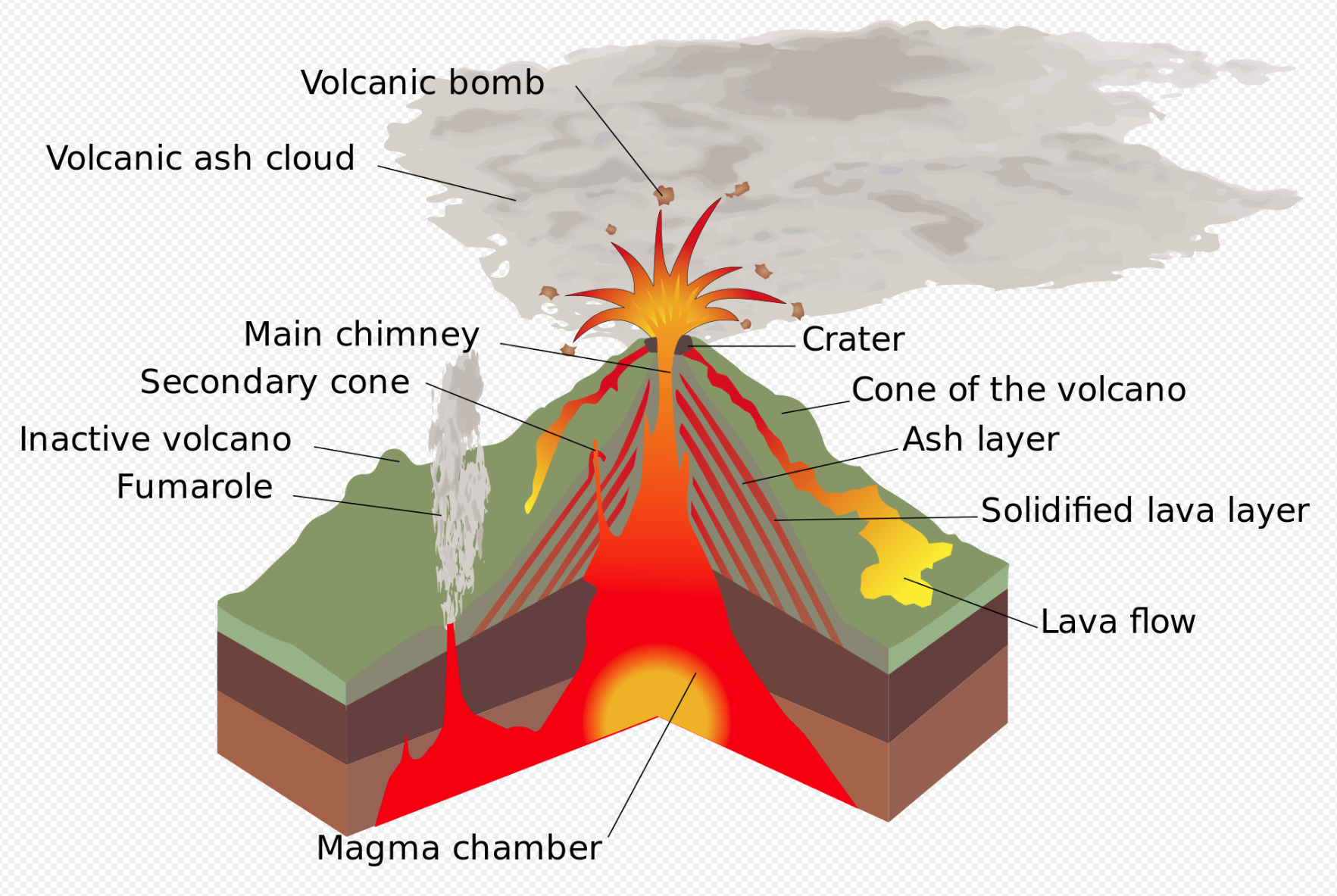
Answer: True
Review the vocabulary words in this module.
continent-continent convergence: two or more pieces of continental crust collide.
oceanic crust: an ocean plate that is denser than continental plate.
convergence: moving towards union or coming together.
divergence: going in different direction.
Quiz Five:
Question 1: Which of the following properties increase as you go deeper into the planet Earth?
color
size
currents
temperature
Answer: temperature
Question 2: Which of the following is a way the mantle can deform the crust directly through heat transfer?
continental-continental convergent mountain building
oceanic-oceanic convergent volcanism
continental-continental divergent rifting
oceanic-oceanic divergent crust recycling
Answer: continental-continental divergent rifting
Question 3: True or false: Scientists are able to predict earthquakes with great accuracy.
True
False
Answer: False
Question 4: A seismic station receives a P-wave and then an S-wave 30 seconds later. One minute after receiving the S-wave from the first earthquake, it receives a P-wave from a second earthquake. Three minutes after the P-wave from the second earthquake arrives at the seismic station, the S-wave from the second earthquake arrives at the seismic station. Which earthquake originated closer to the seismic station?
the first earthquake, because the P-wave arrival time and the S-wave arrival time were closer together
the second earthquake, because the P-wave arrival time and the S-wave arrival time were closer together
the first earthquake, because the P-wave arrival time and the S-wave arrival time were farther apart
the second earthquake, because the P-wave arrival time and the S-wave arrival time were farther apart
Answer: the first earthquake, because the P-wave arrival time and the S-wave arrival time were closer together
Question 5: True or false: Seafloor spreading is happening today, right now.
False
True
Answer: True
Question 6: Alfred Wegener had a theory about the continents and their history, but like any good scientist, he did not only base this theory on one fact. He had many observations that he based this theory on. Which of the following is NOT an observation that Wegener made?
Identical rocks, of the same type and age, are found in mountain ranges on both sides of the Atlantic Ocean.
The bottom of the ocean has ridges, and in the center of these ridges there is hot, young igneous rock. Farther away from the ridges there is colder, older igneous rock.
The continents appear to fit together.
Ancient fossils of the same species of extinct plants and animals are found in rocks of the same age but are on continents that are now widely separated.
Answer: The bottom of the ocean has ridges, and in the center of these ridges there is hot, young igneous rock. Farther away from the ridges there is colder, older igneous rock.
Question 7: What could be the reason for seeing exposed granite on a mountain?
A volcano recently erupted.
Volcanic activity was transforming the surface eons ago.
Earthquake activity exposed the rock.
Answer: Volcanic activity was transforming the surface eons ago.
Question 8: When we say that granite granite is felsic, what does that mean?
It is formed deep below the surface and is denser and darker in color.
It forms closer to the surface and is denser and darker in color.
It is formed deep below the surface and is less dense and lighter in color.
It forms closer to the surface and is less dense and lighter in color.
Answer: It is formed deep below the surface and is less dense and lighter in color.
Question 9: Why do convection currents rely on gravity?
Gravity causes hot and cold to swirl horizontally but not mix.
Gravity causes the cool material to sink while hot material rises.
Gravity is not needed in convection currents.
Answer: Gravity causes the cool material to sink while hot material rises.
Question 10: The following are several destructive forces/mechanisms. Which one is the fastest acting?
subduction
weathering
flooding
mass wasting
Answer: mass wasting
Question 11: Which of the following processes is considered the slowest and smallest-acting method of destroying surface features?
volcanic activity
convergence
erosion
flooding
Answer: erosion
Question 12: What is the main difference between weathering and erosion?
Weathering is the breaking down over time; erosion is the breaking down instantaneously.
Weathering and erosion are interchangeable and have no major differences.
Weathering is the breaking down over time; erosion is the breaking down over time and removing of particles through wind or water.
Answer: Weathering is the breaking down over time; erosion is the breaking down over time and removing of particles through wind or water.
Question 13: In what way has seismic tomography helped scientists?
Seismic tomography allows scientists to predict when earthquakes will cause more damage.
Seismic tomography allows scientists to use earthquakes to image small features inside of the earth.
Seismic tomography allows scientists to predict earthquakes.
Answer: Seismic tomography allows scientists to use earthquakes to image small features inside of the earth.
Question 14: What do we consider a relationship where increases in one counterpart encourage decreases in the other?
negative
positive
life rhythms
balanced
Answer: negative
Question 15: Glaciers are white and reflect solar radiation back into the atmosphere which keeps the earth cool. When a glacier melts, the land or sea that is left behind absorbs more solar energy as it is darker in color. This leads to warmer temperatures which then leads to more glacier melting and warmer temperatures.
Neutral feedback loop
Positive feedback loop
Negative feedback loop
A Positive and Negative feedback loop
Answer: Positive feedback loop
Module 15: Patterns in Earth’s History and Processees— Eons nad Disasters
Question: Drag the words into the correct boxes.
Due to these ______ processes, close to ______ of Earth’s species went extinct, most of which were from the ______ group that would eventually become ____.
word options ot fill in the blanks are:
mammals
3/4
synapsid
natural
Answer: Due to these natual processes, close to 3/4 of Earth’s species went extinct, most of which were from the synapsid group that would eventually become mammals.
Question: Inser the words into the correct blanks.
The ______ eon is the most recent in human history.
The ______ eon introduced life.
The ______ was a geological mess.
The ______ introduced continents to the discussion.
word options for the blanks are:
Proterozoic
Hadean
Phanerozoic
Archean
Answer:
The Phanerozoic eon is the most recent in human history.
The Proterozoic eon introduced life.
The Hadean was a geological mess.
The Archean introduced continents to the discussion.
Question: True or false: Natural disasters include all types of severe weather, which have the potential to pose a significant threat to human health and safety, property, critical infrastructure, and homeland security.
Answer: False
Question: Fill in the missing words.
Which sphere corresponds to each of these phenomena? (Type in each term.)
cyclone _______
avalanche ______
solar flare ______
landslide _____
wildfire _____
Answer:
cyclone atmosphere
avalanche hydrosphere
solar flare exosphere
landslide geosphere
wildfire biosphere
Question: Add the definiion to the words.
Shear stress: ________________
Confinding stress: _______________
Tension stress: _____________
Compression stress: _____________
definition options: ________________
A deeply buried rock is pushed down by the weight of all the material aboce it. Since the rock cannot move, it cannot deform.
Forces squeezes rocks together, causing rocks to fold or fracture. It is the most common stress at convergen plate boundaries.
Rocks that are pulled apart in two opposite directions. Rocks under this force lengthen or break apart. It is the major type of stress at divergent plate boundaries.
Forces are parallel but moving in opposite directions. This stress is the most common stress at transform plate boundaries.
Answer:
Shear stress: Forces are parallel but moving in opposite directions. This stress is the most common stress at transform plate boundaries.
Confining stress: A deeply buried rock is pushed down by the weight of all the material aboce it. Since the rock cannot move, it cannot deform.
Tension stress: Rocks that are pulled apart in two opposite directions. Rocks under this force lengthen or break apart. It is the major type of stress at divergent plate boundaries.
Compression stress: Forces squeezes rocks together, causing rocks to fold or fracture. It is the most common stress at convergen plate boundaries.
Question: Which of the following is not a factor in causing wildfires?
fuel
soil
temperature
humidity
Answer: soil
Question: True or false: Weather hazards are always easy to predict.
Answer: False
Question: Which of the following is NOT a solution engineers have created to help prevent buildings from being damaged during an earthquake?
tall buildings with large, heavy weights installed which help counterbalance the shaking caused by an earthquake
homes built on rigid legs which won't break when an earthquake hits
buildings that are more flexible so they will have a wider range of swaying motion they can tolerate in an earthquake
homes anchored to the bedrock below them with concrete and steel
Answer: homes built on rigid legs which won't break when an earthquake hits
Review the vocabulary words this module.
Siberian Traps: a large area of volcanic rock formed by a massive eruptive event.
natural disaster: a sudden catastrophe caused by nature.
natural hazard: the risk of a natural sudden catastrophe occurring.
hazard: something that puts something else at risk.
disaster: a sudden catastrophe.
Final Exam Practice Exam
Question 1: Which of the following statements best describes the earth's mantle?
It does not move.
It moves very slowly.
It moves very rapidly.
It moves in one direction.
Answer: It moves very slowly.
Question 2: Flooding is a natural hazard. How does flooding affect people living on the coast?
It affects a smaller area.
It affects a larger area.
It affects a higher area.
It affects a lower area.
Answer: It affects a larger area.
Question 3: Why would a change in the composition of gases in Earth's atmosphere impact the biosphere?
The atmosphere has not changed over time and any differences would cause extinction level events.
Human activities increase the amount of carbon in the atmosphere.
Organisms that photosynthesize produce the oxygen in the atmosphere.
Organsims are adapted to current conditions and may not survive changes to Earth's climate.
Answer: Organsims are adapted to current conditions and may not survive changes to Earth's climate.
Question 4: Which of the following is the best definition of a nebula?
a galactic dust storm
a cluster of galaxies
an interstellar cloud of dust and gas
a system of of tightly bound stars
Answer: an interstellar cloud of dust and gas
Question 5: Alfred Wegener used many fossils that were found on multiple continents as proof that they were once joined. Some creatures, like crocodiles, can swim huge distances in both fresh water and salt water as well as walk on land. Their fossils would not support the theory of continental drift.
Which organisms could Wegener use as evidence to prove the existence of an ancient supercontinent?
Mesosaurus was a swimming reptile, but could only swim in fresh water.
Cynognathus and Lystrosaurus were land reptiles and were unable to swim.
Fossils of the seed fern Glossopteris were too heavy to be carried so far by wind.
All of these could be used as evidence.
Answer: All of these could be used as evidence.
Question 6: There are many different forces that shape the earth. For which type is gravity the driving factor?
surface mechanisms
spatial mechanisms
constructive mechanisms
destructive mechanisms
Answer: destructive mechanisms
Question 7: When designing structures to assist with mitgating the damage done by natural disasters, which approach should engineers use?
Wait and gather more information by increasing data gathering stations.
Plan structures that are bigger in size that can withstand critical conditions.
Build two-stage systems that provide a backup in case the first system fails.
Consider the type of hazard as the approach will vary depending on the conditions.
Answer: Consider the type of hazard as the approach will vary depending on the conditions.
Question 8: A transform boundary’s plate movements could be described by the movements of which pair of arrows?
→←
←→
→→
⇄
Answer: ⇄
Question 9: Nuclear Fusion powers the sun and all other stars. Why is this process not currently being replicated on Earth to provide for society's energy needs?
Scientists cannot model the process preventing research on nuclear fusion.
It requires immense pressure and temperature that are challenging to reproduce on Earth.
There have not been any recent breakthoughs to advance the technology.
Researchers are not interested in developing materials needed to overcome the challenges.
Answer: It requires immense pressure and temperature that are challenging to reproduce on Earth.
Question 10: The sun creates energy and matter that travel to Earth. Of these forms of energy and matter, which of the following is unable to reach Earth?
light waves
sound waves
electromagnetic radiation
charged particles
Answer: sound waves
Question 11: In 1954, French seismologist J.P. Rothé published this map showing the concentration of earthquakes indicated by dots and cross-hatched areas. How did this data provide evidence supporting the hypothesis of sea-floor spreading?

The pattern shows evidence of historical supercontinents that once fit together.
The pattern shows the location of all of Earth's tectonic plates.
The pattern shows that earthquakes occur primarily on the ocean floor.
The pattern shows a concentration of earthquakes occurring where oceanic crust moves away from midocean ridges.
Answer: The pattern shows a concentration of earthquakes occurring where oceanic crust moves away from midocean ridges.
Question 12: The Hubble telescope captured this image of NGC 2336 in March 2021. What can scientists infer about the age of the galaxy based on its primarily blue color?
NGC 2336 is an old galaxy, with no new stars forming.
NGC 2336 is a young galaxy, with new stars forming.
The age cannot be determined, but it is moving toward Earth.
The age cannot be determined, but it is moving away from Earth.
Answer: NGC 2336 is a young galaxy, with new stars forming.
Question 13: Convection does not transfer thermal energy through which phase of matter?
gas
liquid
plasma
solid
Answer: solid
Question 14: NGC 2336 was discovered in 1876 by German astronomer Wilhelm Tempel, using a 0.28 meter (11 inch) telescope. Why do scientists today have a better view of this galaxy?
Most galaxies are moving toward Earth over time, making them more visible.
Light pollution has decreased, making celestial objects more visible in the night sky.
Scientists now spend more time observing celestial objects.
Technology has advanced, improving the telescope and provides more detailed images.
Answer: Technology has advanced, improving the telescope and provides more detailed images.
Question 15: How do scientists overcome the constraints of time, cost, and transportation when building space stations?
Countries work together to share the cost of building them.
Astronauts work in shifts and do not remain on the space station for long periods of time.
Missions to transport goods and people to the station are limited.
The design consists of repeated sections that are pre-built and then assembled.
Answer: The design consists of repeated sections that are pre-built and then assembled.
Question 16: The Paleozoic Era ended with the greatest mass extinction event found in the geologic record. The most successful surviving species was the Lystrosaurus. Fossils of this creature are found on almost every continent. Which of the following statements best explains why this particular species survived?
They had not evolved significantly over time and were able to remain stable as the environment went through changes.
They were most likely herbivores, and so they would not have been impacted by the rapidly changing climate.
They had the ability to adapt to many different environments, allowing them to better survive changes to their ecosystem.
They were semi-aquatic and limited to marine ecosystems, but water has always been present on the earth, allowing them to survive.
Question 17: Which of the following is a criteria for human space travel?
types of materials available for building spacecraft
high cost of materials to build the spacecraft
an environment suitable for human survival in the spacecraft
weight of fuel needed to travel large distances in a spacecraft
Answer: an environment suitable for human survival in the spacecraft
Question 18: You’re at an archeological site in South America investigating some ruins. The stonework is exquisitely carved and even with some weathering, you can easily make out all of the symbols and take pictures to send to a friend to have them translated. Unfortunately, some words meant different things depending on the time period, and your friend really needs to know how old these stones are before they start to translate them. Can you use radiocarbon dating to determine the age of the stone?
No, too much time has passed, so all of the carbon-14 has decayed away.
Yes, enough time has passed for carbon-14 to decay.
No, the object is non-living, so it is not made of carbon.
No, not enough time has passed for enough carbon-14 to have decayed for scientists to be able to measure it.
Answer: No, the object is non-living, so it is not made of carbon.
Question 19: What is the phase of matter in the sun?
solid
gas
plasma
liquid
Answer: plasma
Question 20: In 1943 Dioniso Pulido witnessed volcanic activity on his farm. He noticed a crack that was only half a meter deep. He felt the ground shake and turned to see the ground had risen 2 or 2.5 meters high and the crack began to fill with ash. Within 24 hours a volcanic cone had reached a height of 50 meters. How would this process be classified?
spatial mechanism
surface mechanism
destructive mechanism
constructive mechanism
Answer: constructive mechanism
Question 21: Which of the following layers of the Earth are liquid?
lithosphere
inner core
asthenosphere
outer core
Answer: outer core
Question 22: Our sun is almost entirely made of which two elements?
carbon and helium
hydrogen and nitrogen
oxygen and carbon
hydrogen and helium
Answer: hydrogen and helium
Question 23: How is the composition of distant stars measured?
by orbital patterns
by physical samples
by parallax
by emission spectra
Answer: by emission spectra
Question 24: How old is the oldest known sample of Earth?
1.9 billion years old
5.2 billion years old
2.7 billion years old
4.4 billion years old
Answer: 4.4 billion years old
Question 25: What challenges do astronomers face when classifying objects in our universe?
Classification systems cannot change, even when new discoveries are made.
Objects such as brown dwarfs can be similar to both stars and planets.
Different cultures and traditions may use alternate names for the same star.
There are too many stars in the universe to identify individually.
Answer: Objects such as brown dwarfs can be similar to both stars and planets.
Question 26: It is common to find fossils of marine animals and plants in the Himalayan mountains. What claim does this evidence support?
Continents were once joined allowing for the movement of organisms in locations that are separate today.
Life on Earth was once different from life found on Earth today.
Oceanic crust is constently recycled into Earth's mantle.
The movement of tectonic plates formed mountains from areas that were once under a deep ocean.
Answer: The movement of tectonic plates formed mountains from areas that were once under a deep ocean.
Question 27: Short-period comets, with periods of about 200 years or less, come from a region beyond the orbit of Neptune. This region contains not only comets, but asteroids and at least two dwarf planets. What is this region called?
Planetesimals
Oort Cloud
Kuiper Belt
Hale-Bopp comet
Answer: Kuiper Belt
Question 28: Which of the following is true about a Milankovitch cycle?
A Milankovitch cycle is the path our solar system takes in the Universe.
Only Earth has a Milankovitch cycle.
The Moon’s Milankovitch cycle is the best understood and documented.
A Milankovitch cycle is a path that is sometimes more circular and sometimes more elongated.
Answer:A Milankovitch cycle is the path our solar system takes in the Universe.
Question 29: Cosmic Background Radiation and the redshift of galaxies provide evidence of what?
The universe was once colder and smaller.
The universe was once warmer and smaller.
The universe was once warmer and bigger.
The universe was once colder and bigger.
Answer: The universe was once warmer and smaller.
Question 30: Which of the following natural hazards can be caused by earthquakes?
algal bloom
blizzard
liquefaction
drought
Answer: liquefaction
Question 31: Edwin Hubble discovered that almost every galaxy he observed was redshifted. The best explanation is that these galaxies are moving in what way?
parallel to each other
toward the earth
away from the earth
perpendicular to the earth
Answer: away from the earth
Question 32: Yellowstone National Park is an example of which type of volcanism?
Transform
Intraplate
Divergent
Convergent
Question 33: What observable pattern in the ocean floor provides evidence of plate tectonics?

The oceanic crust is similar in age to the continental crust.
The oceanic crust is youngest at mid-ocean ridges.
The oceanic crust can be millions of years old.
The oceanic crust is oldest at mid-ocean ridges.
Answer: The oceanic crust is youngest at mid-ocean ridges.
Question 34: What were some reasons the earth was so hot during the Hadean eon?
Atmospheric compositions were changing and more carbon was present, warming the earth.
Gravitational contractions were occurring, radioactive decay was prevalent, and the earth was bombarded with asteroids.
Polar ice caps were just forming, methane gas was present in the atmosphere, and there was lots of radioactive decay.
Tectonic plates were moving, solar winds were hitting the earth, and there was no atmosphere.
Answer: Gravitational contractions were occurring, radioactive decay was prevalent, and the earth was bombarded with asteroids.
Question 35: What would a newly formed star be made primarily of?
hydrogen
helium
carbon
iron
Answer: hydrogen
Question 36: How is the mass of distant stars measured?
by parallax
by orbital patterns
by emission spectra
by balanced scales
Answer: by orbital patterns
Question 37: Which change would result in an increased gravitational force between the sun and the earth?
decreasing the mass of the sun
decreasing the mass of the earth
increasing the distance between the sun and the earth
decreasing the distance between the sun and the earth
Answer: increasing the distance between the sun and the earth
Question 38: Which of Earth's spheres are directly responsible for natural hazards?
all of these
atmosphere
hydrosphere
geosphere
Answer: all of these
Question 39: Which of the following explanations best describes the lack of fire on the sun’s surface?
There is no oxygen on the sun to sustain the flame.
There is no physical matter to fuel the fire.
Nuclear fusion creates the sun’s energy.
Gases cannot ignite without gravity.
Answer: Nuclear fusion creates the sun’s energy.
Question 40: Scientists reason that liquid water was once present on the surface of Mars. What evidence best supports this claim?
The largest volcano in the solar system is located on Mars.
Satellites have detected magnetic anomalies in the Martian crust.
Surface features on Mars are geologically similar to Earth's landforms that were shaped by water.
Estimates of oxygen isotopes indicate Mars originally had a thick atmosphere.