UV-VIS application and infrared spectroscopy
UV-VIS application and infrared spectroscopy
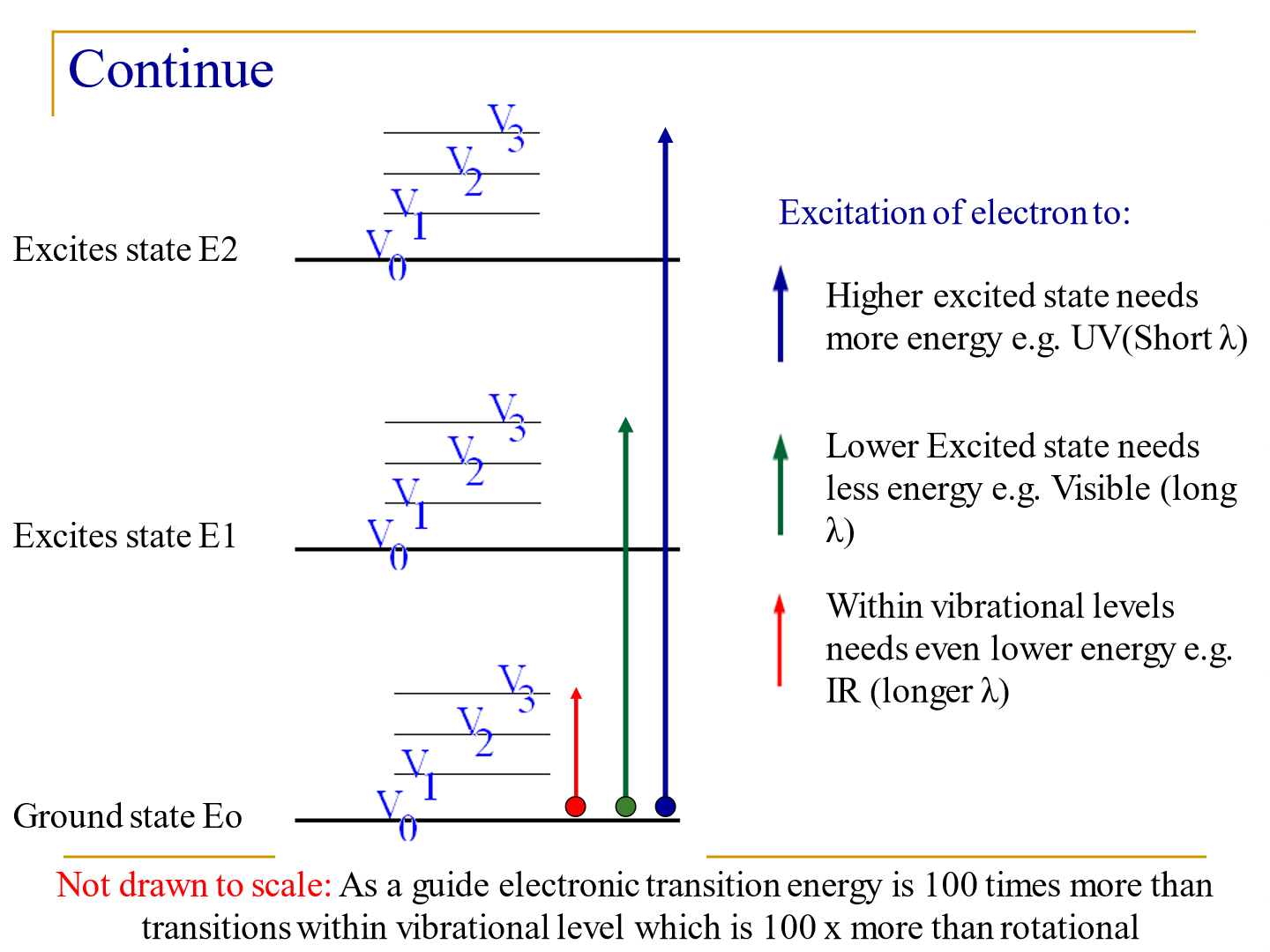
Absorption and emission of radiation:
UV-vis absorption is where electrons are excited
Fluorescence emission is when electrons return back
Infra-red is where vibrations are excited
BP drug content assay:
Beer lambert law: C= A/A1% 1cm
Tablets and capsules have specific dissolution profiles to make sure they dissolve in a certain amount of time to prevent passing though body without providing a therapeutic effect
Coated tablet >> coating dissolves>> tablet>> disintegration>> granules >> disaggregation>> powder>> dissolution >> solution
Capsule>> opening of capsule>> granules >> disaggregation>> powder>> dissolution >> solution
Acceptance criteria- Q value:
For immediate release produces that have a specification on the quantity of drug that should be released in a specified time
Q value is % of drug content released in given unit of time
Typical q specification for active ingredient ranges from 70-80%
Infrared spectroscopy (IR)
Near IR is 780-2500nm this used for physical properties
Middle IR is 2500-15000nm and is used for characterisation
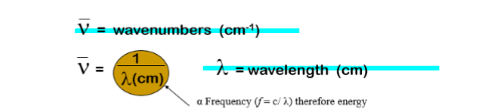
IR spectroscopy uses wavenumbers
Energy states:
IR causes vibrational and rotational excitations which have smaller energy gaps
Molecules are excited to high vibrational state
Absorption is quantized to match energy gap between vibrational states
Only frequencies corresponding to natural vibrational frequencies of bonds are absorbed
IR is absorbed and converted to molecular vibrations with higher amplitude
Vibrational levels have rotational levels which result in broader peaks
Vibration rules:
No fixed bond length
Frequent at which a given bond can vibrate is constant
Certain bonds can only absorb certain frequencies
In Mid IR region can only go from V0 to V1, V1 to V2 not directly from V0 to V2
Different bonds vibrate at different natural frequencies
Vibration is dependent on environment
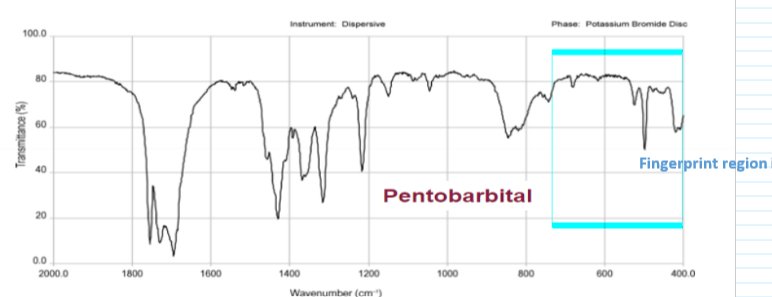
No two molecules will have the exact same fingerprint (region)
Types of vibration
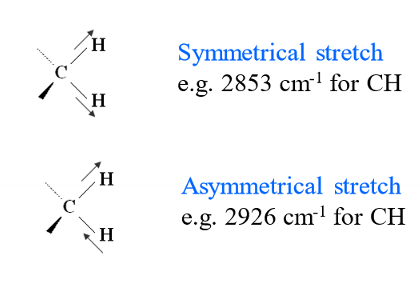
Stretch
Symmetrical stretch
Asymmetrical stretch
Bending
In plane bending:
Scissoring
Rocking
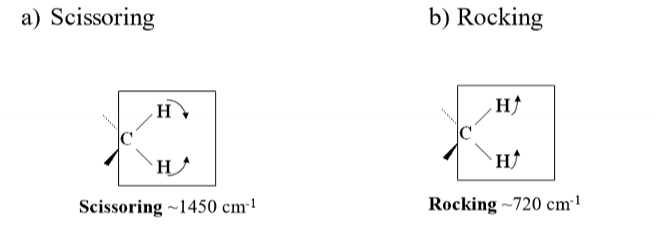
Out of plane bending
Wagging
Twisting
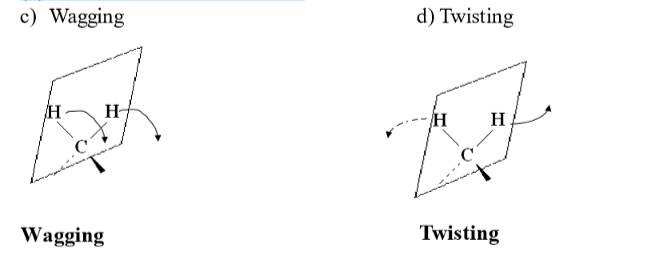
Stretching requires more energy than bending
Are all vibrations IR active?
Not all vibration are IR active
Only the vibration which result in a net change in polarity of a bond give rise to IR bands
Bigger the dipole moment change the stronger the absorption
Dipole moment must change during vibration otherwise no IR absorption - symmetrical stretches have no peaks
Dipole moment:
A dipole moment is where two atoms with different electronegativities connected by bond exhibit unequal sharing of electron density
Uses of IR spectroscopy:
Identify drugs by matching spectrum
Functional group analysis
Detect polymorph of drugs
Instrumentation
Dispersive instrument
Infrared radiation passes through the sample and a reference cell. The reference ensures peaks due to water/ carbon dioxide in air can be cancelled out
Frequencies are determined by passing through a rotating prism to focus frequency at a time on detector
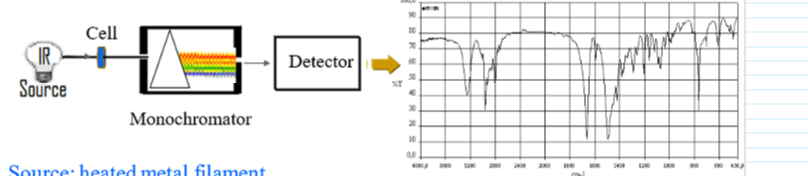
Fourier transform instrument:
Instead of monochromator a interferometer is used
Interferometer produces pattern of frequencies that are possible to resolve by mathematical transformation (Fourier transform)
High data acquisition speed
Sample preparation:
Can be any nature
Liquid:
Prepare liquid film between Nacl,Kcl or KBr
Solid can be grinded to form a paste between liquid paraffin
Drop of sample placed between two circular plates
Plates placed in a holder
Solids/disk prepartion
Use powdered sample with dry KBr and grind finely
Using spanner + nuts and bolts compress under high pressure
Forms a disk which can be placed in IR machine
Application of near IR:
Quality control
Particle size
Blend uniformity
Identification of polymorphic drugs
Determination of moisture