12 / lecture 3
finishing up the lecture slide 20 for lecture 2-
for a classic michealis meten type of reaction which is described by equation 6-10 the Km for the reaction is given by equation 6-27 .
a speicifc case where k2 is rate limiting, that means going form es to e plus P that is the slowest step of the three. now if that is the case that means that the numberical value for k2 is much smaller than k minus 1 . because k2 is the slowest step, numerical the rate cosnant would be the samlles.t in that case equaiton 6-27 , km reduces to k-1 over k1 and we ingnore k2 if its much smaller than k1.
k-/k1 is the disssoicaiton cosntnat for the ES complex. the smaller the disscoiation constatnt the tighter the binding the larger the cosnstnat the more loosely it binds. under this condition where k2 is rate limting , km represent the measure of hte affintiy of the enzyme for the structure. smaller Kd value means tight binding. So in thsi case smaller Km alsmo means that the affintiy of the enzyme for the substrate is create, only under that condition.
looking at Vmax. this is the maxiumum rate of that enzyem catlyzed reaction. now for a two step meichealis menten reaction represented by the equation 6-10. Vmax equal k2 times toatl enzyme concentraion. so we said k2 is the rate limitng step so the overall rate of the overall reaction is the same as the slowest step. therefore Vmax is k2 times , usually would be ES , the reactant concentrion fo rthat reactant but since we are talking about Vmax that measn when all of your enzyme is int he enzyme substrate complex form. so we can sub concentraion of ES for Et. that will give u Vmax.
This is the theoretical rate limit for that reaction. expand the equaiton 6-10 to 6-28. we started out witht he expression at the bottom and we simplfied it to the upper one when we deriving the michealis metnen equaiton.
going back ot the fonrial form where there is three steps.

for some. reactions the last step described by k3 is the slowest and now k2. if thats the case we cnat make the argument that Vmax is k2 times Et . but in nthis case we can say that Vmax is k3 times EP. so when we are trying to detmine vMAx we dont know if we should use k2 or k3. to solve thsi issues scientsist have agreed to use another rate constante called Kcat. that is why its written witha. smalelr letter K. Cat is cayaliss. so Kcat is going to describe the limting rate of any enzyme catalyzed reaction at saturation. so if u know the kcat value for ur reaciton u dont have to worry about if its k1-k2-k3. this applies to the overall reaction. if one step in a multi step process is clearly limting then kcat equals the rate constant for that particular step.
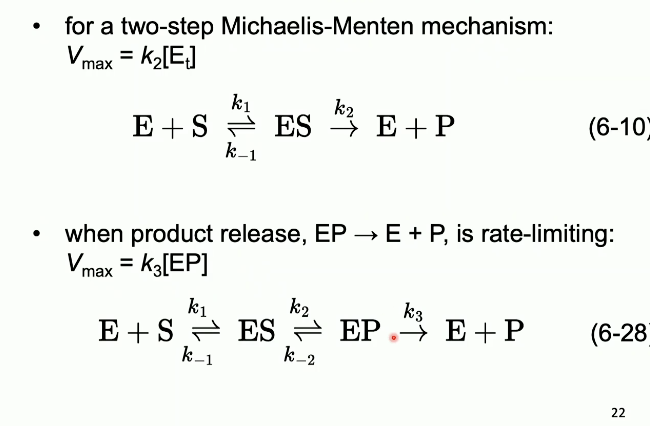
so in the top one kcat is k2, and in the bottom one kcat would equal to k3. however there are cases where we have 5,6,7 enzyme catalysis and multiple steps have similar rate limiting speeds. so it gets compelx. to avoid that issue we use Kcat which applies for the overall reaction. So for an overall reaciton kcat can be described like this. ..

the units would be per second. if u plug that expression into the orignal michealis menten equation u get 6-29. the general rate constant kcat: its complex when several steps are similarly rate limitng. kcat describes the limting rate of any enzyme catalyzed reaction at saturation. this is very improtnat u can only use that kcat if u know that in ur system ur enzyme is saturated with the susbtrate. because only then u assume that Vmax = kcat times total enzyme concetration. so we have a name for this constant thsi si the turnover number. it is the number of susbtrate mocluesl converted to product in a give unit of time ona. singel enzyme mocluel when the enzyem is saturated.
real life examples:
look at cabroni anhdyrage pg 25. carbonic annhydrase cataluzes hydration of CO2 to give bicarbonate but here they are listing bicarbonate as the substrate . enzymes can catlyze both foward and reversre reaction so teh cabronic nhydrase the substrates for the reverse reaction would bet hat bicarbonate so for that reaction Kcat is 400k per second. that means to conver one bicabronate molcule into CO2 it takes 400 thousandsths of a second very fast. u can say that in one seocn a singel enzyme can do the reaction 400k times.
lactamase is ane enzyme taht some bacteira have that can break down penicilin and it makes that bacteria resitatnt to penicilin. that enzyme has a kcat value of 2k. so a singel lactamase enzyme can break 2k pencicilim cmoluels per seond making it useless. that reaction is a bit slower compared to carbonic anhydrase. Reca protein its an atp so it hydrozlyes atp to adp and phosphate, the kcat is .5 per second. it means the enzyme hydrolyses two atp molcules in one second.
catalytic effiencty. when u do a kineteic study of an enzuyme the goal is to demtein the value of kcat and km for the raciton. those two constatns tell u something. if u look for a good enzyme u want an enzyme that has a high Kcat, bc u wnat it to carry out that tranformation many tiems per second u want a high Kcat value at the same time ur also looking for a low Km value. why? because again the deinfinto of the km is the concentrion at which the sysmte achives one half of vmax. so u want to reach half the vmax at lower substrate concentration than higher susbtrate concentrion. thatll reduce your production cost. bc u dont want to use so much substrate. but utmetlu what u want is an enzume that has a large value for Kcat over Km
back to equaiton 6-29
thats where Kcat over Km appearss. under this condition when the substrate concention is smaller than the Km value under that ocndition 6-29 reduces to 6-30 and under that ocndition u can see that the velocity of the reaciton dpeodns on kcat over Km. and its thsi kcat over Km we are talking about efficinetiy of an enzyme it taeks into accound both kcat over km and u watn that ration to be large as possible
real life examples cabronic anyhydrase and compare it a acetylcholinesterase . compare those two enzymes and see whicho ne is better. if we look at the k cat values of the twoo u look and see that carbonic anhdrase has the better kcat. looking at hte Km the acethylcholinesteras is the better enzyme. so now we have to look at hte ratio between them. thsi si why u cant just look at kcat or km to detmeine which is the better enzyme. if u do the ratio acetylcholinersterase is the more effienct enzyme than carbonic anhdyrase.
lecture 12 starting NOW.
this is about enzyme inhibirotrs . there are molecules that bind to hemoblgobin and modulate the activit of hemoglobin which. iso2 binding. we talked about engative modulators and psotive moducaltiors. when it comes to enzyme we usually dont use the word modulator we use the word inhibritor but its the same concept is the smae. it is a molecule that bind to the enzyme and attenuates the activity of that enzyme.
since we are talking. about enzyme inhibitors attenuate the catalytic activity of that protien, whereas before with ehmoglobin and myoglobin its just modulating the binding of o2 and not a chem reaction most of our drug molecules are enzyme inihibitors.
real like examples anitinflammatory drug. it binds to the enzyme that catalyzes the first step of a series of reaction that synthesizes a singlgingin molecul that causes inflamaation. so if u take asprin its going to bind to that enzyme lower the activitya nd therefore your body produces produces lower amooutn of that infalmattory fcuasing. molcuel. and so u dont feel so sick. ur not curing the sickness ur getting rid of the symtomps. acetazolamind is a a inhibitor of carbonin anhydrase so it will inhibit the carbon dioxide hydration to bicarbonate reaciton and it turns out that we all have cabronin anhydarase enzyme expressing in our eyes and for some people its hyperactive and this builds up h2co3 inside your eye it increases the osmotic pressure so water keeps coming into your eye increases the pressue inside your eye chamber and this is essentially what glaucoma is . so ir your diagnosed with glaucome this is what the doctor will prescieb acerazolamide it inhibits carboni anhydrase. u apply it direclty to ur eye and it will lower the catalic activiyt of carbonic anhdrase and that will lower the intraccular pressure and at least stop the progression of gluacoma.
it canr everse right but u can stop it from getting worse.
so these are the other drugs and they are all enzyme inhibitors. erythromycin is a natrual produc. it is a molecule that soil bactiera produce. if doc suspects u ahve.a throat bacterial infection erhtyomycin will be prescribes. so it binds to the bacteiral ribosome at the 50s subunit. and this stops hte ribsoome from doing what it needs to do which is syntheize new protien right so if bacteria can no longer synthesize new protine its evneutally going to die. this is the mechanism of action of erhtyomycin. erhymycoin only binds to the bacterial ribsoem and nor our own. we have our ribsome has 40s and 60s which is structuarlly differnet from the bacterial counter part. and erhtyomycin does not bind to our ribbosome i tbinds speicirfally to the bacterial ribosome and kills bacteiral specifically.
there are two types of inhibitors. reverisivel and non reviesrleb. and so reverisble inhibitor means that the molceule can bind and also dissociate from the ezyme. non reverisble means it forms a covalen tbond witht he enzyme and its permantely bound o the enzyme. so youre prentaly deactiviting that enzyme if you use a non reviersble inhibitor.
reverisble inihibiotrs - there are three types of these. firs is the compeptitive inihibitor, so inhibitors form this group compete with the substrate for the active site of the enzyme . remember active site is where the chemsitry takes placve and where substrate needs to bind to conver to product. compeotive inhibitor will bind ot that same site and if that happens it will slwo down the reaction because then the susbtrate has a smaller chance of being converted to produce . so inhibitor is going to bind. to the active site and form the inhibitor enzyme complex so the EI complex . in this form the enzyme cannot cover subtrate so u produce less product.
the equation E plus S equal ES and makes E plus P
but if the E bind to the I it form EI
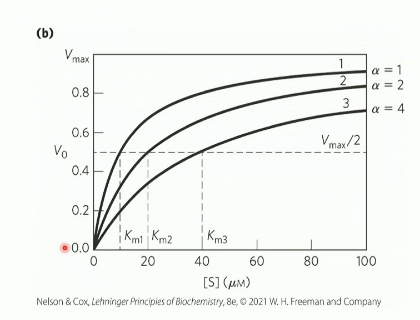
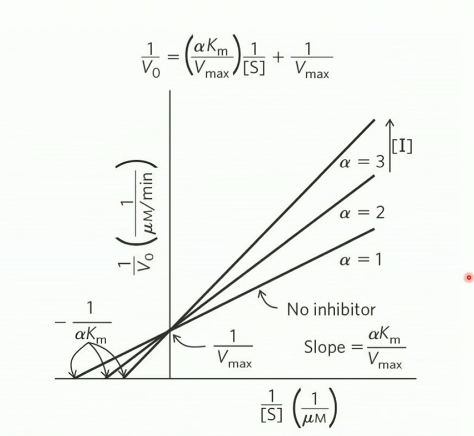
the bottom line is the uninhibited case. so the middle like has a bit of inhibitor and the thrid has a lot of inhibitor. the y intercept does not change it is 1/Vmax. and u can see that no matter how much. inhibitor u have the max value does not change. Km value does change bc 1/km is ur x intercept and tha tchanges dpeonging on which line u are looking at.
second case uncompetiitve inhibitiorn. the amin difference is that the inihbitor will bidn to the enzyme at a site that is different from the active site. before in the competitive inhibtiro case it will bidn ot the active site. this uncompetitive inhibitor binds only to the ES complex. so the substrate will bind first to the active site, u form the ES. and once this happens the inihibitor can bind ot hte inihibitor bidning site. so it meas the ESI. enzyme substrate inhibtor compelx. this does not happen if u dont have any substrate bound ot he enzyme. so the inihibtior only bind to the enzyme sustrate complex.
if u look at ht emichaelis meten curve it will look like this..
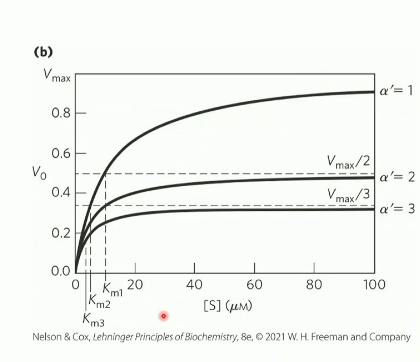
the measured vmax decreases. now the vamax itself is changing and km is also decreasing. this si smore appearent if u look a the line weaver berg plot so ur plotting the same data but now in the linear. equation and u can see Vmax and Km both chaning . so just by looking at these curves.
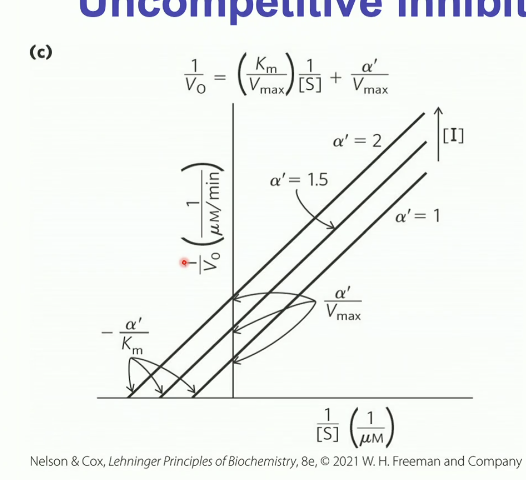
u can tell if its an competitive or uncompetitive inhibitor. if u compare both curves the difference is not obvious but if u look at the lineweaver berg plot the difference is obvious.
the third type of inibitor is called mixed inhibitor. just like the unpeittive inhibtior it will bind at a site that is distint. thsi. inhibitor is going to bind to either E or the ES complex. so before uncpeotitive inhibitor it would only bidn to the ES complex but this one can either bind to the free enzyme or the ES compelx. this is what the curve looks like.
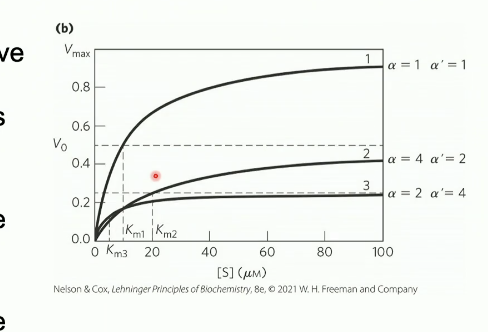
now looking at hte lineweaver berg plot
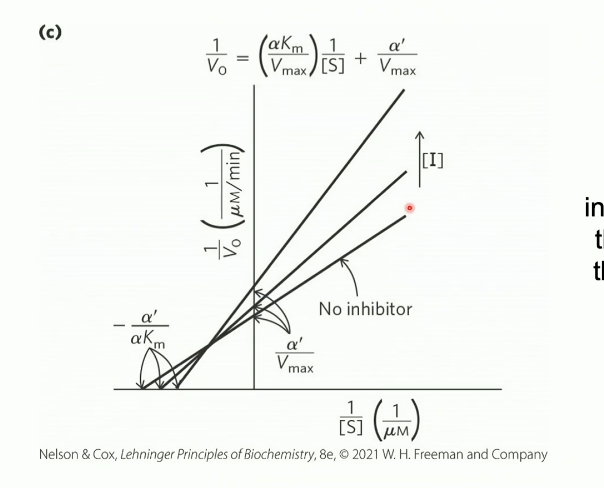
it looks different. both Km and Vmaxc are chaning but compared to the uncompetitive case the way it changes is different. we talked about three dif cases and u should e able to rec the linewer berrg plots what type of reverisble inhibtiro it is and say whether it binds to E or ES or both,.,,,
NON competitive inhibitors -
its a specail case where its a mixed inihibot , but the affintiy of the inihibitor fo rht efree enzyme and the affintity for the enzyme substrate compelx is the exactly the same. so itll bind witth the same affinitty to the free enzyme. those types of inihibtors are called non competitive inhibitorn. its not been discvoered yet.
irreverisble ihibitor is called covalent inhibitors they will bidn ot the active site permantely and will shut if down. irrevierbsle will bind. coveltnty or destroy a funcitonal groupd of an enzyme that is an essentail for enzyme activity. so this is DIFP is a nerve gas its a dangerous nerve gas. and it will forma. covaletn bond with many many enzyme in ur body that uses serin as the active site reside. and its dangerous it will kill u immeditaly and it is going to shut down thsi group of enzymes . serine protease and serine hydrolysis.