Phosphorus Dynamics
Background
Nutrient: any element that an organism must take in to live, grow, and reproduce
Ex. Phosphorus (P) is used in the synthesis of DNA, RNA, and ATP
Macronutrients: C, H, N, O, P, S
Hydrologic = C and H (water)
Gaseous = C and N (main nutrients in atmosphere)
Sedimentary = P and S (mostly in rocks and soil)
Liebig’s Law of Minimum
Composition of Phosphorus
Biosphere = 0.03
Lithosphere = 0.08
Hydrosphere = ~0
Atmosphere = ~0
Demand/Supply (in water) = 80000
Phosphorus
No other nutrient has been studied more intensively in limnology
In contrast to N (with is many forms), the most significant for of inorganic P is: orthophosphate (PO43-)
Forms of Phosphorus
Particulate Phosphorus (>95%) - fraction that would be found on a filter, when water is filtered
a) P in organisms
b) Mineral P
c) Detritus P
Soluble (colloidal) Phosphorus (<3%) - soluble high molecular with compounds
XP (<1%) - soluble low molecular with organic P compounds
Biological Available Phosphorus is the dissolved inorganic forms (DIP) (<1%) - chemically reactive forms (e.g. PO43-)
Although PO43- is the most important form of P, and the form that algae use, it is difficult to measure, and so most limnological surveys use total phosphorus (TP)
TP range is from <1 μg/L to > 200 μg/L
most lakes in Canada are from ~10 - 50 μg/L
Note: we are talking about very low concentrations of TP that can cause big changes in lake systems
Remember: 1 μg/L = 1ppb
1 ppb ~ ¼ tsp in an Olympic sized swimming pool
Lake Trophic State Classification
Oligotrophic = nutrient poor, low production
Mesotrophic = medium level of nutrients, medium production
Eutrophic = high level of nutrients, high production
Lake Productivity as a Function of TP
North American Lake Classification:
Ultra-oligotrophic, TP (μg/L) = <5
Olgio-mesotrophic, TP (μg/L) = 5 - 10
Mesoeutrophic, TP (μg/L) = 10 - 30
Eutrophic, TP (μg/L) = 30 - 100
Hypereutrophic, TP (μg/L) = >100
Regions in Ontario, that have many low nutrient lakes, tend to have lower TP boundaries for the 3 main lake categories:
Oligotrophic, TP (μg/L) = <10
Mesotrophic, TP (μg/L) = 10 - 20
Eutrophic, TP (μg/L) = >20
Eutrophication
Eutrophication: phenomenon of nutrient enrichment
Among limnologist, eutrophication is synonymous with increased growth of biota that is beyond what would have occurred in the absence of a perturbation
Cultural eutrophication: nutrient enrichment as a result of human activities, such as sewage inputs and/or agricultural run-off
Symptoms of Eutrophication:
Algal and cyanobacteria blooms
Excessive macrophyte growth
Deepwater oxygen depletions
Sources of Phosphorus
I. Allochthonous:
1) Runoff (i.e. diffuse sources)
2) Industry and municipalities (i.e. point sources like sewage)
3) Weathering (slow)
4) Precipitation
5) Groundwater
II. Autochthonous:
1) Fecal material from zooplankton and fish
2) Macrophytes - can act as P pumps, take up P from sediments & release it into water. During die-back (at end of growing season) can release huge amounts of P
3) From sediments (internal loading and the oxidized microzone)
Internal loading vs. External loading
Internal loading: the release of phosphorus from sediments into the water column, often due to processes like anoxic conditions
External loading: involves the influx of phosphorus from external sources such as agricultural runoff or wastewater discharges
Sediments
Sediments can be a significant source of P
closely related to the redox conditions (related to oxygen levels) at sediment-water interface
If you have oxidized microzone (i.e. oxygen at sediment-water interface), then you have a barrier to PO43- (orthophosphate) release from the sediments
If the sediment-water interface goes anoxic (reducing conditions), you lose the barrier of the oxidized microzone, and you get release of PO43- (orthophosphate) from sediments = internal loading
Iron
Iron (Fe) plays a key role
2 forms: the oxidized form of Fe+++ (ferric) and the reduced form of Fe++ (ferrous)
If the sediment-water interface has an oxidized microzone, then iron is in ferric (Fe+++) form
Fe+++ and PO4- - - bind under oxic conditions
If the sediment-water interface goes anoxic, and the barrier of the oxidized microzone disappears, then iron is in the ferrous (Fe++) form
Fe++ no longer binds to PO4- - - , and so PO4- - - is released from sediments = internal loading
Proving the case for P
I. Empirical studies
e.g. studying the relationship between primary production and lakewater P concentration
II. Experimental studies
1) Lab Studies
2) Mesocosms
3) Whole lake experiments
Luxury Consumption
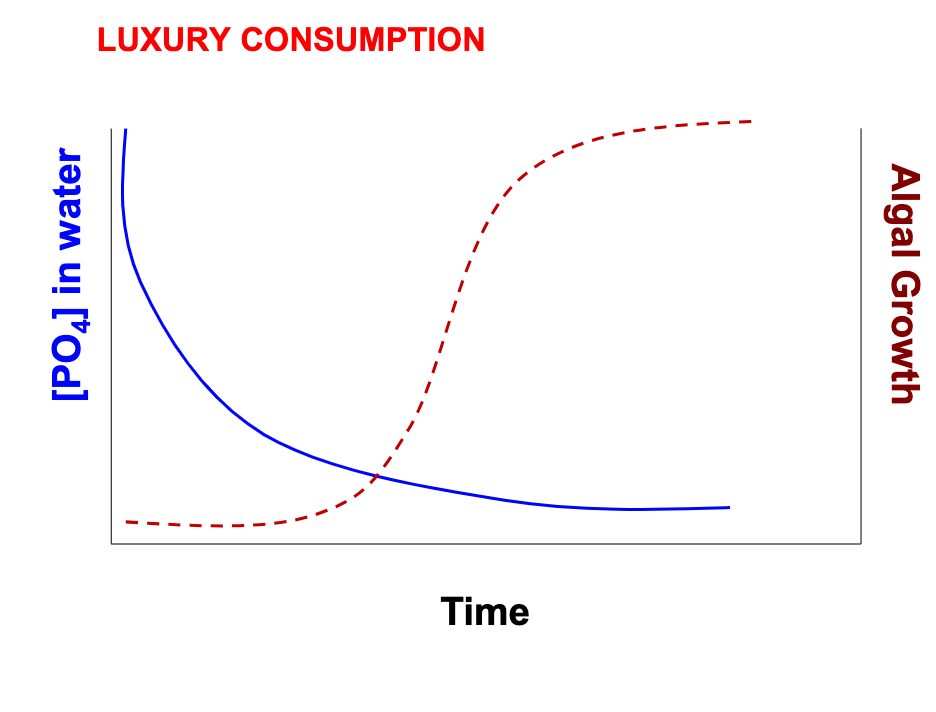
Luxury consumption of P by algae = taking up excess P and storing it
Blue-green algae
Blue-green algae can store P in polyphosphate bodies
This ability allows them to thrive in nutrient-rich environments, potentially leading to harmful algal blooms and creating “whiting”
Is P always limiting?
Often P is limiting nutrient, but as waters becoming increasingly nutrient-rich, N can become a limiting nutrient