Glycolysis Metabolism
: the process in which glucose is broken down to produce energy.
Glucose is converted to %%pyruvate%% under aerobic condition or converted to %%lactate%% under anaerobic condition.
: enzymes of glycolysis in the ==cytosol== of all cells
Two phases:
Phase I: Glucose to %%2 molecules of glyceraldehyde-3-phosphate%%
Phase II: 2 molecules of glyceraldehyde-3-phosphate converted into %%2 molecules of pyruvate (aerobic) or lactate (anaerobic)%%
Energy production aerobic and anaerobic
Aerobic condition
Glucose → 2 pyruvate + 8 ATP
Pyruvate transported into the ==mitochondria== and converted to %%two active acetate%% that are oxidized by citric acid cycle.
- two molecules of @@NADH@@ are produced by ^^glyceraldehyde-3-phosphate dehydrogenase^^
- 4 molecules of ATP formed by substrate level oxidative phosphorylation
* Two by phosphoglycerate kinase
* Two by pyruvate kinase - Net gain of ATP = @@8 molecules of ATP@@
Anaerobic condition
Glucose → 2 lactate + 2 ATP
- in severe exercise and red blood cells ( absence of mitochondria)
- NADH not oxidized
- Net gain of ATP = @@2 molecules ATP@@
- NADH is not oxidized by the ETC
- glycolysis is the only pathway that can function independent on the ETC and occur under anaerobic conditions
Importance of Glycolysis in Red Blood Cells
Energy production: only pathway that supplies red blood cells with ATP
Reduction of methemoglobin: glycolysis provides @@NADH for reduction of met-Hb@@ in red blood cells by the NADH-Cytb5 methemoglobin reductase system
Bisphosphoglycerate shunt (BPG shunt): in red blood cells 1,3-bisphosphogycerate is converted to 2,3-bisphosphogycerate (2,3BPG), which units with hemoglobin at @@low oxygen tension and helps release of oxygen to tissues@@. No net production of ATP
Hemolytic anemia due to deficiency of glycolysis enzymes: inherited deficiency of glycolytic enzymes %%produces hemolytic anemia%% because red blood cells are dependent on glycolysis for production of ATP. 95% of patients have deficiency of ==pyruvate kinase==, and 4% have deficiency of ==phosphohexose isomerase.==
Reversal of glycolysis (gluconeogenesis)
- during @@fasting@@ and @@low dietary carbohydrates@@ for synthesis of glucose from non-carbohydrate compounds ()
- Rate of glycolytic pathway regulated by activity of ^^3 irreversible enzymes (key enzymes^^): @@increases@@ during @@carbohydrate feeding@@ and %%decreases%% during %%fasting or carbohydrate deprivation%%
- Glucokinase reversed by glucose-6-phosphatase (present in the liver, kidney only)
- Phosphofructokinase-1 (PFK-1) reversed by fructose-1,6-bisphosphatase (present in the liver, kidney only)
- Pyruvate kinase (PK) reversed by dicarboxylic acid shuttle
Hexokinases and glucokinase:
- First step in metabolism of glucose and other sugars, after entering a cell, is @@phosphorylation@@.
- Phosphorylation prevents the leakage of sugar molecules from the cell, since phosphorylation sugars do not move across cell membranes.
- Also, phosphorylation of sugars facilities the binding of these substrates to the active sites of enzymes.
- Several hexokinases are found in the body.
- An isozyme is termed glucokinase (Hexokinase D)
Phosphofructokinase-1 (PFK-1):
- Inhibited by: glucagon, ATP, and citrate
- Activated by: insulin, AMP, fructose-6-phosphate and fructose-2,6-bisphosphate
Pyruvate kinase (PK)
- Inhibited by: glucagon and ATP
- Activated by: fructose-1,6-bisphosphate and insulin
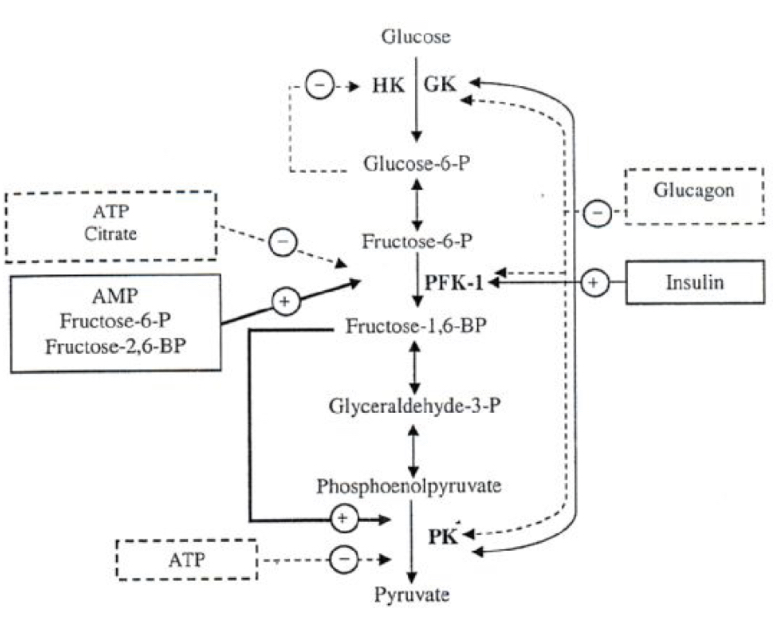
Regulation by the Energy State of the cell
- high level of AMP activates PFK-1 (activation of glycolysis)
- high level of ATP inhibits PFK-1 and pyruvate kinase (inhibition of glycolysis)
- fatty acid oxidation decreases the rate of glycolysis
* FA produces ATP, active acetate (which forms citrate)
Hormonal Regulation
- Glucagon: secreted during carbohydrate deficiency or in response to low blood glucose level (). It affects liver cells mainly as follows:
* acts as a ==repressor== of glycolytic key enzymes
* binds to specific cell membrane receptors and activates guanylate binding proteins. The activated G proteins produce a__ctivation of adenylyl cyclase__ and production of @@cAMP@@, which activates @@protein kinase A@@. The latter produces ==inactivation== of glycolytic enzymes. - Insulin: secreted after feeding of carbohydrates or in response to high blood glucose level (). Insulin generally stimulates all the pathways of glucose utilization. Insulin binds to specific cell membrane receptors and produces certain signal cascade resulting in the following:
* acts as an ==inducer== for the synthesis of glycolytic key enzymes
* produces activation of @@phosphodiesterase@@ (decreases cAMP which inhibits protein kinase A)
* produces activation of the protein phosphatase
Metabolism of Pyruvate and Oxaloacetate
Metabolism of Pyruvate
| Sources | Fate |
|---|---|
| All carbs through glycolysis | Active acetate by mitochondrial PDH |
| Glycerol fraction of fat by conversion to glycerol-3-P then DHAP | Oxaloacetate by mitochondrial PC |
| Alanine by ALT | Alanine by ALT |
| Lactate by LDH | Lactate by LDH (under anaerobic conditions) |
Metabolism of Oxaloacetate
| Sources | Fate |
|---|---|
| Pyruvate by PC | Citrate by citrate synthase |
| Aspartate by AST | Aspartate by AST |
| Malate by malate dehydrogenase | Malate by malate dehydrogenase |
| 2-PEP by PEPCK during gluconeogenesis |
Conversion of Pyruvate to Oxaloacetate
- by ==mitochondrial== enzyme %%pyruvate carboxylase%%
- important step during gluconeogenesis
Inducers of Pyruvate Carboxylase
- glucagon
- epinephrine
- glucocorticords
Repressors of Pyruvate Carboxylase
- insulin
Conversion of Pyruvate to Active Acetate
- aerobic condition
- pyruvate transported from cytosol to ==mitochondria==
- converted to active acetate by %%pyruvate dehydrogenase complex%% (requires 5 coenzymes):
* TPP
* lipoate
* FAD
* NAD+
* COA-SH - 2 pyruvate → 2 active acetate + 2 NADH,H+
- 6 ATP formed by oxidation of 2 NADH
- Deficiency of %%PDH%% or %%thiamine%% produces accumulation for pyruvate that is converted to lactate, so it leads to
Activators of PDH
- Pyruvate, NADH+, COA, ADP allosteric activators to PDH
- Insulin increases activity of PDH
- Ca ions
Inhibitors of PDH
- NADH, acetyl-CoA, ATP
- Fatty acid oxidation
Summary for Complete Oxidation of Glucose
Complete aerobic oxidation of one molecule of glucose in glycolysis, citric acid cycle and ETC produces: