7. Language acquisition
1.Introduction
Definitions
Language acquisition
concerned with acquisition of both first and second languages by monolingual/bilingual speakers and speakers showing both typical and atypical pathways of acquisition
how all aspects of language are acquired (sound segments, word choice, grammatical structures, interpreting implied meanings, constructing narratives)
First language acquisition (FLA)
acquisition of one’s native language(s) during first 6/7 years of life
Second language acquisition (SLA)
any language(s) acquired after first language
2.Approaches to language acquisition
Observational and logical
→ 2 basic approaches: observational and logical
Observational approach (social constructionist/emergentist research)
focus on what we can observe about how children learn language
theories based on observations
emerging models of language that children construct through social interaction → how they learn to interpret language around them
beyond sounds/words/grammar, also
Inference and circumstance-based language use
“Nurture”-based → What happens when we progress?
Questions like: What happens in language acquisition? Order? Variants? Intentions of variants? How successful?
Logical approach
seeks to understand language acquisition from the perspective of adult language (seen as destination) → focus on endpoint
Assumes that children are born with
an innate capacity to acquire any language → Language Acquisition Device (LAD)
innate knowledge about the structure of language, i.e. a set of rules for language associated with a corresponding set of linguistic categories → Universal Grammar
Generativist approach
what is possible in particular languages or language in a more general sense
“Nature”-based
questions like: What can people say? How varying betw. language? patterns matched/missed in children’s speech? When/How mistakes?
→fundamentally opposed, some say are complementary: explain different aspects of language
→ today: both ‘nature’ and ‘nurture’ play a role →“nature through nurture” (only happens in interaction but brain/body makeup faciliates language development)
3.Language acquisition pathways
Dynamic process of language acquisition
closely associated with brain development
Birth human’s brain is about 25% of the adult size, increasing to 80% during childhood
1/3 neural connections present lost by adulthood
brain creates new, more complicated connections
is highly dynamic
age is important factor, noted by the year, followed by a semicolon and the month
everything learned changes the context in which they will learn the next thing
best understood pathways is analytical
build up of sound repertoire → then words→then more complex combinations of words
Input
→ refers to language that babies/childre hear around them
especially “Child-directed speech” (CDS) (problematic, too fragmentary, need internal support? bc how access adult language through baby talk?)
modifications made in CDS generally skilfully attuned to needs of children →scaffolding
Recasts and expansions
Adults often use “recasts” to support acquisition by e.g. rephrasing with correct form
often occurs with an “expansion”, opportunity to elaborate further on what has been said
Segmentation
children need to learn how to segment words and phrases out of larger structures
can involve longer strings used in routinised ways
have to develop knowledge and skills to break down all types of input, including conventionalised units, into parts and recombine them in creative ways
Critical Period Hypothesis
claims that the extent to which we can acquire/learn a language is linked to brain development →Window of opportunity (a critical period) during childhood during which language must be acquired (~2-13 years)
evidence based on findings like
Full recovery of language skills becomes rarer if brain damage occurs after puberty
Socially isolated (abused) children found in their teens could not fully acquire language
Children with slower language development rates who do not acquire full fluency by puberty rarely acquire fully normal linguistic skills
Second language learners who begin after childhood, regardless of the exposure they receive, rarely sound like natives
4.Acquisition of phonology
The first year
0;0-0;3: Crying, cooing, smiling in response to sounds/voices
0;4-0;6: 1. vowel-like sounds, babbling
0;7-0;9: increasing variety sounds/syllables
0;10-1;0: 1. words, acquired speech patterns/intonations
The second year
extreme reduction of consonant clusters
Simplification of /tʃ/ to plosive
Intonation patterns
Retraction of /s/
Reduction of /bl-/ cluster
Deletion of /v/
The third year
Consonants now additionally include /p/, /ŋ/, /j/, /ʒ/, /f/
Consonant clusters are in evidence though not always consistent with adult forms
Frequent use of [w] in place of [ɹ] in second position
Vowel system approximately complete and pronounced accurately around 3;0
Increasingly complex syllable shapes
Monosyllabic words contain V, CV, VC, CVC, CCVC, CVCC, CCVCC, CCVCCC and CCCVC syllables
Polysyllabic words contain V, CV, VC, CVC and CCVC syllables
3;0+
3-4: liquids ma not be acquired until 5;0, lisps common until 7;0, uther than that consonant inventory acquired
4-5: awareness of syllable segmentation/rhyme
5-6: phonological awareness: syllable segmentation, rhyme, alltiteration, phoneme isolation, beginning letter knowledge
The ‘fis phenomenon’
→ children’s production lags behind their perception → fis phenomenon
can hear and mentally represent differences in sound sequences before they can produce them
5.Acquistion of vocabulary
Recognising words and phrases
Children recognise words and phrases from around 6 months (recognising name)
By 1;6 can point to body parts in response to questions like ‘Where’s your nose?’
Though: children typically understand many more words than they actively use and words they do use may not map clearly onto identifiable adult words
Ages and stages in vocabulary acquistion
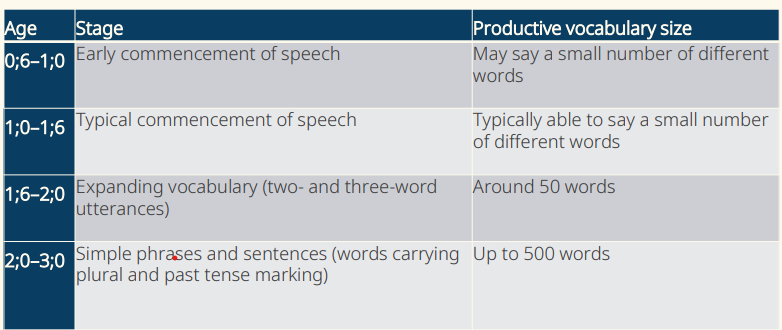
Extensions
tendency to overextend the meanings of words, especially when their vocabulary is limited e.g. swimming bird → duck
based on shape, function, or other kinds of semantic relations
also examples of underextensions (word referring to only one specific aspect)
6.Acquistion of grammar
Typical order
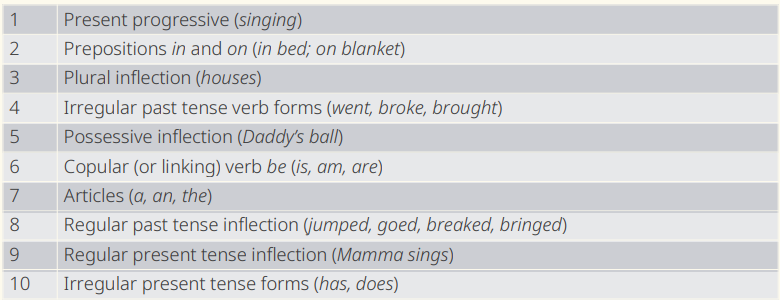
Analogy - importance of the wug
Jean Berko Gleason in 1958 wanted to test how children learn the plural forms of English (speaking not writing)→ Mophophonology {s} realised differently depending on final sound
Children know “Bug” → apply rule they acquired analogously: bug:bugs = wug:wugs
also works for other morphological patterns e.g. verb tense suffixes
7.Foundations of SLA
More detailed definition
refers both to the study of individuals and groups who are learning a language subsequent to learning their first one as young children, and to the process of learning that language
→ additional languages either reffered tp as second (L2), third (L3), … language or more broadly “target language”
how target language acquired can differ strongly
informal L2 learning → naturalistic context
Formal L2 learning → language taught in institutionalised setting
SLA highly interdisciplinary field (linguistics, psychology, pedagogy)
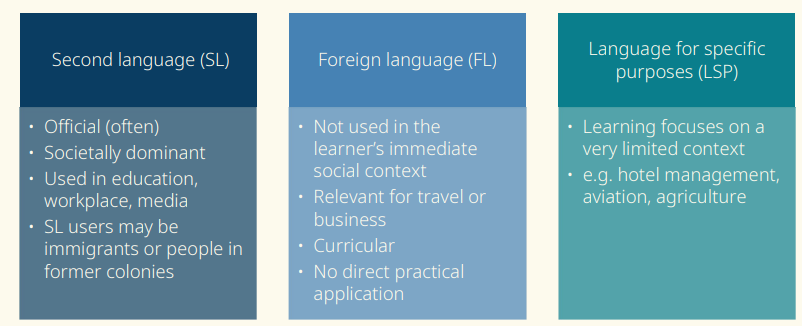
Different meanings of L2
8.FLA vs. SLA
Initial state
→L1
children born with innate capacity to acquire language
→L2
no consent whether there is innate capacity to learn 2. language+
prior knowledge of L1 major component of L2 learning
Real-world knowledge
General interactional functions
Intermediate state - Process
→ L1
largely systematic: predictable sequence of phenomena
Child grammar: relation cognitive abilities
→ L2
largely systematic
Interlanguage (IL, also learner language): Cognitive maturity has been achieved, can’t be good explanation
cross-linguistic influence (transfer) of L1 on L2
Positive transfer: L1 structure used in L2 utterance and is correct → faciliates learning
Intermediate state - Necessary conditions
→ L1
language input necessary
requires direct, reciprocal interaction with people
→ L2
language input necessary
face-to-face social interaction faciliates SLA, but not necessary
Intermediate state - Faciliating conditions
→ L1
language input necessary
requires direct, reciprocal interaction with people
→ L2
level of development can be faciliated/inhibited by social/individual factors
feedback
Aptitude (memory capacity, analytic ability)
Motivation/need and desire to learn
Instruction/explicit teaching
Final state
→ L1
native linguistic competence
basic phonological, grammatical and lexical and interactionsl skills acquisition completed by 6
Acquisition more complex features proceed into adulthood
→ L2
never totally native linguistic competence
maybe near-native competence
most learner’s progress ceases at some point
Fossilisation: L2 includes instances of L1 interference or “creative structures different from any that would be produced by a native speaker of the L2”
9.SLA Frameworks
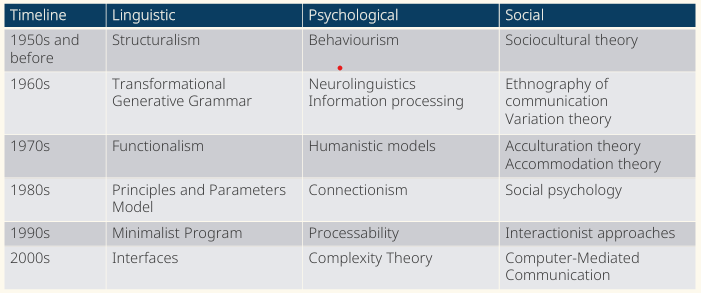
How different schools approached sla
Linguistic
→Internal focus
Chomsky and followers
Focus on competence (underlying knowledge of language)
Generative Grammar
Answer to behaviorism
Principles/Paramteters/Minimalist Program → Extension GG but more abstract
Linguistic interferences
some parts more problematic for L2 learners → maybe development delays
→ External focus
functionalism back to 1920s Prague School
Focus on performance (language as system of communication)
Functional typology
similarities L1 L2 ease learning, differences complicate
Function-to-form mapping
Grammaticalisation
Construction grammar (don’t learn things in isolation)
Functional approaches dominate in Europe
Psychological
→Languages and the brain
neurolinguistics → interface biology, psychology and linguistics
critical period with neurolinguistic basis
→Learning processes
not used in learner’s ommediate context
relevant for travel/business
curricular
no direct practical application
→Learner differences
Why some more succesful?
Emotional involvement
Attitude, motivation, anxiety
Biological differences
Age, sex
Social
→Microsocial
SLA in immediate social context
Variation in learner language (sociolinguistics)
Accomodation theory
native speakers may change speech when addressing L2 learner
Input and interaction: Comprehensible input, foreigner talk, scaffolding
→Macrosocial
Ethnography of communication
Social psychology
Status of L1 and L2
Circumstances of learning: informal vs. formal, naturalistic vs. instructed
Interlanguage
Def.: intermediate states/interim grammars of learner language as it moves toward target L2
Introduced by Larry Selinker 1972 IL as 3. language
Characteristics IL
Systematic: learner follows internalised rules
dynamic: system changes
Variable: differs depending on context/patterns of langauge use
reduced system: form: less complex grammar structures; function: smaller range communicative needs
Typical processes and differences to FLA
Language transfer (positive/negative)
Strategies of 2. language learning
Strategies of 2. language communication
Overgeneralization of target language linguistic material
Fossilization (the older the earlier)
Functional approaches
Functional typology
→ applied in accounting for development stages
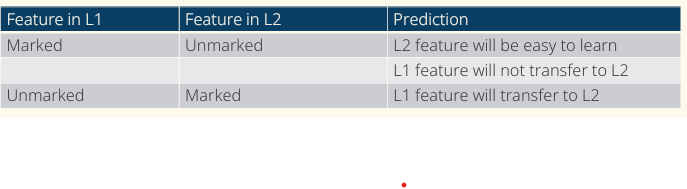
Markedness
feature unmarked if occuring more frequentlx than contrasting element in same category, if it’s less complex structurally/conceptually, or if it’s more normal/Expected
Examples:
Phonology: Syllables CV most common → complex syllables e.g. street are marked
Syntax: word order SVO in most languages → OSV (Haitian Creole) would be marked
Discourse: Different answer than fine after how are you marked
Markedness differential hypothesis
Usage-based approaches (construction grammar)
Tomasello, Wulff/Ellis: 3 assumptions
linguistic input learners receive is primary source for L2 learning
cognitive meachanisms learner employ in language learning not exclusive to language learning but general mechanisms
langauge is formulaic and based on constructions (form-function mappins)
→Construction on different levels
Morphology, Words, Idioms, syntactic frames
Construction grammar
→Constructions stored in multiple forms, differing in level of
Complexity
Abstraction (schematization) (depending on how lexicalised)