Lecture 1: Introducing Brand and Branding
Six Steps on How to Manage a Brand
Assess (How the brand is perceived in the market)
Plan (How the brand should be perceived)
Create (Relationship between the brand and consumers/customers)
Align (With the culture of the organization)
Link (to the business objectives and strategies)
Understand (the meaning of the brand)
A brand only has meaning if consumers recognise the brand. If not, the business has to employ strategies to create or reinforce brand awareness
What is a Brand
“A brand is a name, term, symbol, design or combination of these elements that should identify goods or services of a company and differentiate them from competitors (AMA)”
Other definitions
“A brand is the consumer perception and interpretation of a cluster of associated attributes, benefits, and values (Batey)"
“A brand is a bundle of meanings (McCraken)”
“Brand are units of social consumption (Zaltman)"
Difference Between Brand and Product
You buy a product for what it does, you buy a brand for what it means
A product sits on retailers’ shelves, a brand exists in consumers’ minds
A product can become outdated, a brand is timeless
A product can be copied buy a competitor, a brand is unique
“A product becomes a brand when the physical product is augmented by something else - images, symbols, perceptions, feelings - to produce an integral idea greater than the sum of its parts (Batey)”
What is Branding
“Branding means more than just giving a brand name and signalling to the outside world that such product or service has been stamped with the mark and imprint of an organization. branding, though is not about being on top of something, but within something (Kapferer).”
History of Branding
Branding was originally referred to as a piece of burning wood (Scandinavia)
Branding evolved to owners marking their livestock to identify them
Summarised Timeline of Branding
Time? | Where? | Meaning? |
Old Age (1300 BCE) | Arts - Chinese porcelain, handicrafts from Ancient Greece and Rome, products from India | Identification |
Middle Ages | Artisans - made products like shoes | Protection Buyer’s Safety |
Renaissance | Artists | Value |
Industrial Revolution | Growth of cities and first retail stores | Reliability and quality |
Post-Industrial Revolution | Mass-production to standardisation | Image differentiation |
The 80s | Worldwide | The brand |
The 90s | Worldwide | Trademark crises, supermarket brands, fusions and acquisitions |
What Led to Rise of brands
Mass Production
Expansion of Transportation
Mass-communication
consumer purchasing power
Intensified competition and market saturation
Three Stages of Branding
The commodity stage
Differentiation though branding
Brand as an icon: building a relationship with customers
What Distinguishes a Brand
“What distinguishes a brand from an unbranded commodity counterpart and gives it its equity is the sum total of consumers’ perception and feelings about the product’s attributes, about how it performs, about the brand name and about that company associated with producing it (Al Achenbum)”
Equity Defined
Equity is the sum of the consumers’ and feelings about the product’s attributes
Brand Associations & Brand Image
Each of these are concerned with perception
Brand Association
A brand association is anything linked in memory to a brand (Aaker)
Brand Image
A brand image is a set of associations, usually organized in some meaningful way (Aaker)
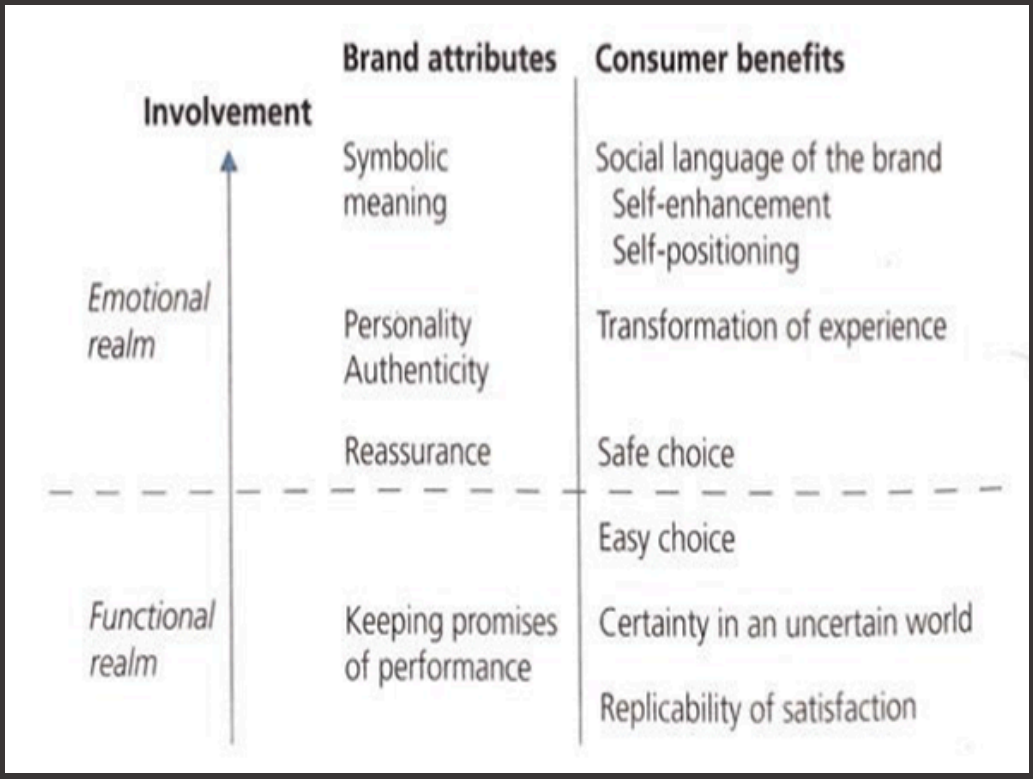
Why People Consume Brands
Based on symbolic representation, shared values, meanings
Based in our identities or the identity we wish to project or communicate to others
Brands can take a unique meaning that supports our daily lives or even enhances our lives
Meanings of Brands
“Consumers view a brand as an important part of the product, and branding can add value to a product. Customers attach meaning to brands and develop relationships. Brands have meanings well beyond a product’s physical attributes (Kotler).”
Social Psychology of Brands Diagram
Who Makes the Brand
Popular Culture
Company
Influencers
Consumers
Brand Dimensions
Brands as an asset
Brand as a strategy
Brand as a corporate culture
Brand as cultural phenomenon
Brand as consumer identity
Brand as A Strategy
Vision
Mission
Values
Personality
Logo & Visual Identity
Portfolio & Architecture
Brand as Consumer Identity
Extended self
Brand communities
Brand relationships
Brand love, brand loyalty
Two Facets of a Brand
For consumers
identification of product source
assignment responsibility to the product-maker
Risk-reducer
Search cost reducer
promise, bond or pact with product-maker
symbolic device
signal of quality
For manufacturers
means of identification to simplify handling or tracing
means of legally protecting unique features
signal of quality level
means of endowing products with unique associations
source of competitive advantage
source of financial return
aids communication
facilitates product extensions/licensing
Summary
What are brands for
a sign of quality
away to differentiate yourself in a crowded market
a sign of dependability in a global world
a sense of belonging
a financial instrument