Personality
Personality is… an individual’s characteristic pattern of:
→Thinking
→Feeling
→Acting
Psychodynamic Theory
Psychodynamic theories
Theories that view personality with a focus on the unconscious and the importance of childhood experiences
Psychoanalysis
Freud’s theory of personality that attributes thoughts and actions to unconscious motives and conflicts
Techniques used in treating psychological disorders by seeking to expose and interpret unconscious tensions
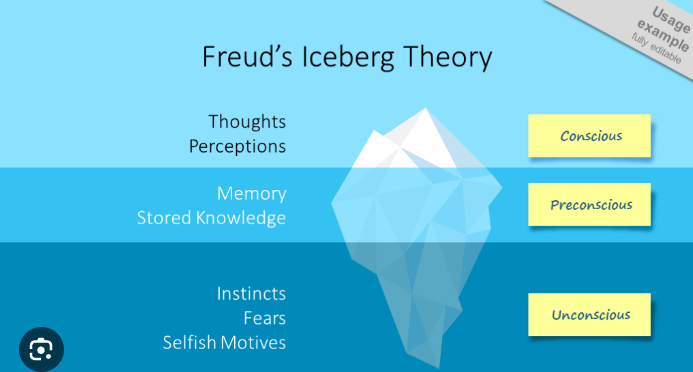
Freud’s psychoanalytic view
View personality with a focus on the unconscious and the importance of childhood experiences
Derived from Freud’s psychoanalysis
Freud’s Theory:
The mind contains a large unconscious region (mostly hidden) where feelings and ideas are repressed.
The unconscious seeps in disguised forms.
'Use of free association helps patients find and release forbidden thoughts.
Defense Mechanisms
The ego’s protective methods of reducing anxiety by unconsciously distorting reality
Operate indirectly and unconsciously
Regression
Reaction formation
Projection
Rationalization
Displacement
Denial
New-Freudians differed from Freud
Emphasized the role of the conscious mind
Collective unconscious (archetypes); Jung
Doubted that sex and aggression were all- consuming motivations
Social interactions and other motives emphasis
Today’s psychologists don’t speak of a collective unconscious, but assume shared evolutionary history shaped some universal disposition
Assume with Freud
Much Unconscious mental life
Struggle with inner conflicts among wishes, fears, values and defensive response
Personality and attachment to others shaped in childhood
Differ from Freud
Disagree that sex is the basis of personality
Do not talk about ids, and egos or classify patients as oral, anal or phallic
Reject the idea that experiences can be inherited
Assessing the Unconscious Processes
Projective tests
Thematic Apperception Test (TAT)
Rorschach inkblot test
Not reliable, but a good conversation starter
Humanistic Theory
Shifted the focus from disorders born out of conflict to focus on ways healthy people strive for self-determination and self-realization
Asked people to report their experiences and feelings
What positive psychology was born out of
Abraham Maslow’s self- actualizing person
Maslow proposed that human motivations form a pyramid-shaped hierarchy of needs.
Self transcendence (top of the pyramid)
Self-actualization
Self-esteem
Love and belonging
Safety needs
Physiological needs (bottom of the pyramid)
Characteristics of Self-Actualization Scale (CSAS)
Carl Rogers’ person-centered perspective
Humans are primed to reach their potential in a growth-promoting environment.
Nature + Nurture
Qualities that nurture growth:
Acceptance (unconditional positive regard)
Genuineness
Empathy
An individual’s self-concept (Who we think we are) is the central feature of personality.
Trait Theories
Characteristic patterns of behavior or tendency to feel and act in a certain ways, as assessed by self-report inventories and peer reports
More concerned with describing rather than defining traits
Trait theories define personality as a stable and enduring pattern of behavior.
Basic factors: Clusters of behavior tendencies that occur together; reflect a basic factor
Assessing Traits
Personality inventory
Questionnaire that covers a wide range of feelings and behaviors
Scoring is objective; does not guarantee validity
Self-report
Method of recording participants’ descriptions of their personality traits, often using surveys, questionnaires, or tests
Minnesota Multiphasic Personality Inventory (MMPI)
Most widely researched and clinically used of all personality tests
The “Big 5” Personality Traits
Practical, prefers | Openness | Imaginative, prefers |
Disorganized, | Conscientiousness | Organized, careful, |
Retiring, sober, | Extraversion | Sociable, fun-loving, |
Ruthless, suspicious, | Agreeableness | Soft-hearted, trusting, |
Calm, secure, | Neuroticism | Anxious, insecure, |
Social-Cognitive Theories
Views behavior as influenced by the interaction between persons (and their thinking) and their social contexts
Focuses on how our individual traits and thoughts interact with our social situations
Suggests the outside influences on behavior are the focus of social psychology, and the inner influences are the focus of personality psychology
Reciprocal determinism
Albert Bandura
Interacting influences of behavior, internal personal factors, and environment
All operate as interlocking determinants of each other
When people enter a social situation, they bring their:
Past learning
Self-efficacy
Ways of thinking about specific situations
Reciprocal Influences
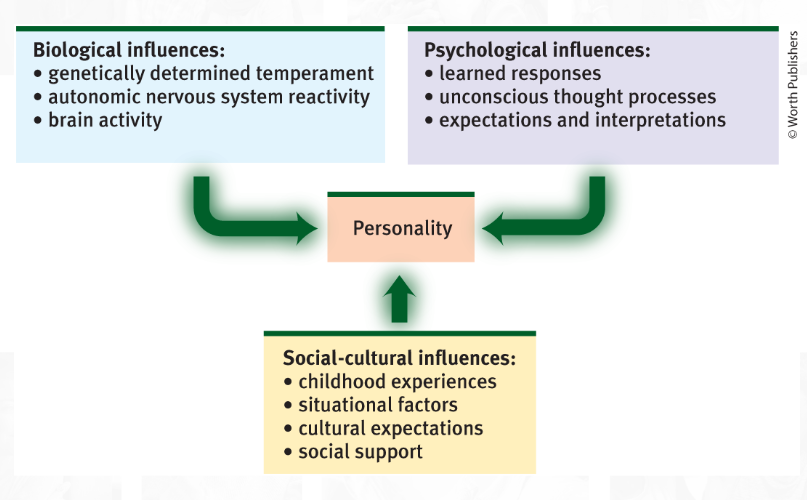
Individuals and environments interact in a variety of ways.
Different people choose different environments.
People’s personalities shape how they interpret and react to events.
People’s personalities help create situations to which they react.
People also experience gene–environment interaction.
Exploring the Self
Self: In modern psychology, viewed as the center of personality and organizer of our thoughts, feelings, and actions
The self is the center of personality.
It is the organizer of one’s thoughts, feelings, and actions.
Possible selves: Includes vision of the self you dream of becoming and the self you fear becoming
Motivates us to lay out specific goals that direct our energy effectively and efficiently
Allows change in personality
Spotlight effect: Overestimating others’ noticing and evaluating our appearance, performance, and (as if we presume a spotlight shines on us)
Can be minimized by:
Being aware of the effect
Taking the audience’s perspective
Benefits of Self-Esteem
People with high self-esteem
Tend to be outgoing, responsible, and open to new experiences
Communicate positively, causing others to like and include them more online and in-person
Feel less shy, anxious, and lonely, and, in the future, more successful and just plain happier
Effects of Low Self-Esteem
People with low self-esteem
Tend to behave negatively toward others
Inflated Self-Esteem
Narcissistic People
Tend to be less forgiving of others
Use a game-playing, sexually forceful approach to romantic relationships
Are often charismatic and ambitious and popular, until others tire of their arrogance
Become defensive or enraged when criticized
Self-Serving Bias
Readiness to perceive oneself favorably
Research findings:
People accept more responsibility for good deeds than for bad acts, and for successes than for failures; this discrepancy underlies conflicts.
Most people see themselves as better than average compared to most other people.
Self-service bias underlies, such as blaming
Separating Self-Esteem into 2 categories
Defense Self Esteem
Is fragile
Makes failures and criticism seem threatening
May cause response to threats with anger or aggression
Secure Self Esteem
Is sturdy
Relies less on other people’s evaluations; self-acceptance
Leads to greater quality of life
Individualism Vs Collectivism
Individualism
Giving priority to one’s own goals over group goals
Defining one’s identity in terms of personal traits rather than group membership
When individuals feel coerced, they often rebel, sometimes with devastating consequences
Collectivism
Giving priority to the goals of one’s group, often extended family or work group
Defining one’s identity accordingly
Have deeper, more stable attachments to their groups
Culture and Self
Meaning of self varies from culture to culture by where priority given to the independent self or to the interdependent self
Most Western countries, including the United States and Canada, lean toward individualism
In some collectivist cultures, disrespecting family elders violates the law.