Cell membrane
Membranes enclose the contents of a cell, separate intracellular from outside environment. Allows for homeostasis. Cell membranes are mainly composed of proteins and phospholipids.
Phospholipid—> -consist of polar head(glycerol and phosphate), has 2 non-polar tails, head = hydrophilic and tails = hydrophobic.
Arrangement in membranes —> Form a spontaneous bilayer structure, where the hydrophilic heads face outward towards the aqueous environment, while the hydrophobic tails are oriented inward, shielded from water.
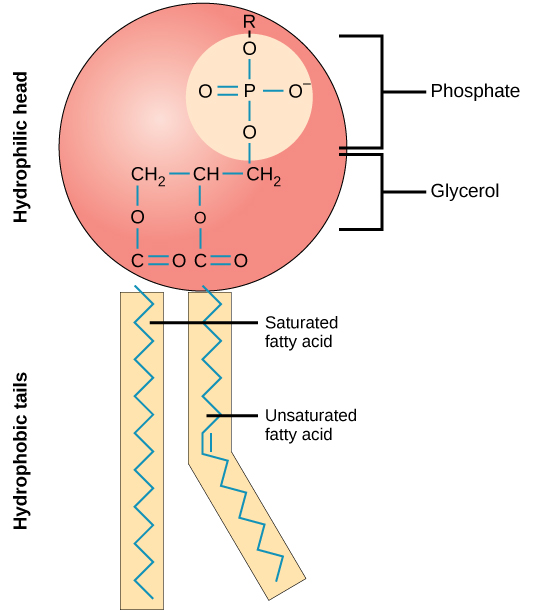
KEY QUALITIES OF CELL MEMBRANES
Semi-permeability: Some things go through without assistance, for example water and small non-polar molecules, while larger or charged substances require specific transport proteins to cross the membrane.
Selectivity: Cells can regulate the passage of certain materials.(Glucose)
PROPERTIES OF BILAYER
Bilayer = held together by weak hydrophobic associations between fatty acid tails.
Associations can be broken and reformed, allowing for fluidity and flexibility.
Structure of fatty acid tails affects fluidity: Sat fat increase viscosity and Unsat fat(with kinks) increase fluidity.
BILAYER MODELS
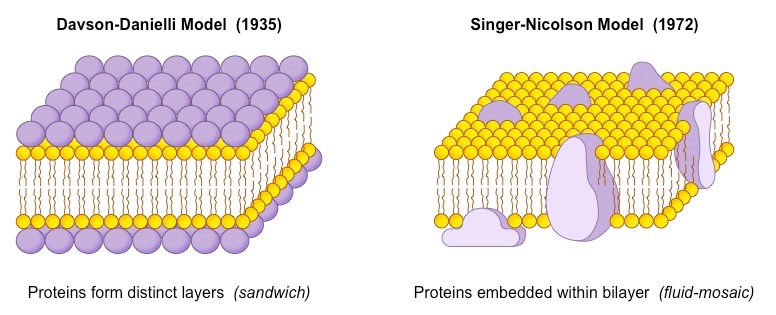
The Davson Danielli model was rejected and the Singer-Nicolson model was accepted.
Junctions(e.g tight junctions)
Enzymes(localises activity)
Transport(active and passive)
Recognition(e.g Glycoproteins)
Anchorage/attachment site
Transduction(peptide hormones)
Integral Proteins = Permanently attached to Plasma Membrane, requires detergents from bilayer.
Peripheral Proteins = Temporarily associated to membrane periphery, can be removed by salt or pH changes.
Cholesterol is a component of animal cell membranes(absent in plant cell membranes; supported by cell wall), functions to maintain integrity and mechanical stability.
Cholesterol is amphipathic (both polar and non-polar regions)

Cholesterol makes membrane less permeable to small, water soluble material, immobilises outer surface reducing fluidity, separates fatty acid tails to prevent crystallization at low temperatures, helps secure peripheral proteins by forming high density lipid rafts.
Cell walls are important in controlling hydrostatic pressure. Cell walls can be made if Cellulose(plant cells), peptidoglycan(bacterial cells), or chitin(fungal cells). Plant and Algal cells can be connected by small channels (plasmodesmata) that extend between cell walls.
Passive transport = Involves movement along a concentration gradient, does not involve the expenditure of energy(ATP)
Examples of Passive transport:
Simple Diffusion: Small and lipophilic molecules can freely cross the plasma membrane. Movement of particles from a region of high concentration to low concentration, until equilibrium is met. No energy needed.
Facilitated Diffusions: Large or charged molecules require transport via membrane proteins. Certain substances cannot freely cross a plasma membrane(e.g. ions, polar macromolecules). Membrane proteins(integral and peripheral) facilitate their transport. Substances travel down their concentration. No energy needed.
Protein Channels: Have hydrophilic pores to allow for ions to move.
Carrier proteins: Conformational change enables translocation.
Osmosis: Water movement is determined by relative solute concentrations. Net movement of free water molecules across semi-permeable membrane from region of low solute concentration to high solute concentration.(NO energy)
Osmolarity: Measure of solute concentration.(hypertonic, hypotonic, isotonic) Hypertonic(solution ex: vinegar): Higher relative solution concentration. Gain water via osmosis. Hypotonic(solution ex: distilled water): Lower relative solute concentration, lose water via osmosis. Isotonic: Same relative solute concentration, no overall net water movement.
If egg is put in water, the egg will get bigger and if an egg is put in vinegar it will get smaller, but if its put in an isotonic solution, it will stay the same.
Animal tissues are put in isotonic solutions to maintain cell viability
Active Transport = Involves movement against a concentration gradient, Involves the use of energy(ATP)
In active transport, energy is used to pump molecules against a concentration gradient.(low—>high)
Direct Active transport(Primary): ATP hydrolysis is used to mediate transport.
Indirect Active Transport(Secondary): Transport coupled to another molecule moving along an electrochemical gradient(co-transport)
Sodium-Potassium Pump: 3 Sodium ions attach to intracellular binding sites on the protein pump. ATP hydrolysis changes conformation, exposing extracellular binding sites. 2 potassium ions attach to these sites and ions are exchanged (anti-port)
Vesicular transport helps cells move important stuff(proteins, lipids, waste, nutrients) to the right place. Ribosomes make the protein that the vesicular transport will move around the cell. The ER membrane is the starting point for packaging and sending materials within the cell. The Golgi body acts as a post office, processing and directing where cell materials should go. Then the protein is transported to the Plasma Membrane.
Cytosis: A general term for processes that move materials in and out of cells via vesicles. This includes both exocytosis and endocytosis.
Exocytosis: A type of cytosis where vesicles fuse with the plasma membrane to expel materials from the cell, like waste or signaling molecules.
Endocytosis: Another type of cytosis where the cell membrane engulfs materials to form vesicles that bring substances into the cell, like nutrients or particles.
Phagocytosis: ingestion of solid substances ex: food particles, foreign pathogens
PinocytosisL Ingestion of liquids/solutions ex: mass intake of dissolved solutes.