Chapter 5
5.1- Introduction to Agriculture
Agriculture is influenced by the physical environment
- Plants need space, light, water, suitable temperatures, and nutrients
- Types of crops will vary based on climates
Agriculture is influenced by the physical environment
- Human modifications include clearing space, modifying land, providing artificial lights, irrigation of crops, use of fertilizers, and growing crops in greenhouses
- Modifications are examples of Environmental Possibilism
@@Some plants are constrained by the environment@@
Agriculture can be characterized as intensive or extensive
- Intensive agricultural systems
- requires a large amount of labor and capital
- use small plots of land usually located near large populations
- are characterized by high yield per acre
- ex. rice, milk, and truck farming
- Extensive
- low capital and labor inputs
- large plots of land that are away from population centers
- low yield per acre
- shifting, cultivation, livestock ranching
Agriculture is influenced by economic factors
Farmers must decide what and how to farm based on financial considerations
- cost of land
- cost of labor
- cost of machinery
Types of Intensive Agriculture
- Plantation Agriculture
- labor-intensive that exploits cheap labor
- Mixed Crop and Livestock
- labor-intensive system
- farmers grow crops to fatten livestock
- Market gardening
- fresh fruits and vegetables
- often using migrant labor'
Types of Extensive Agriculture
- Shifting cultivation
- farmers in the tropics control a large area and clear only part of it at a time to farm
- Rainforest is cleared and burned and many different crops are planted
- Loses fertility after a few years
- Nomadic Herding
- graze cattle, sheep, goats, and more arid and semi-arid climates
- mobile and movie animals from pastures to pastures
- Ranching
- own large areas of land for grazing cattle and sheep to sell on markets
- unsuitable for farming, so land is less expensive than farmland
5.2- Settlement Patterns and Survey Methods
Rural Settlement Patterns
- Clustered Settlement
- more connected to the community
- put resources together
- dispersed settlement
- more connected to resources
- Grid-like starts to develop
- Linear Settlement
- usually along a road
- access to the same transportation route
Rural Survey Methods
- Metes and Bounds
- Short distances
- landmarks
- Long Lot
- Relationship to river
- balance resources
- Township and Range
- Survey Methods vs Landmarks
- Grid System
- Land ordinance of 1785
5.3- Agricultural Origins and Diffusions
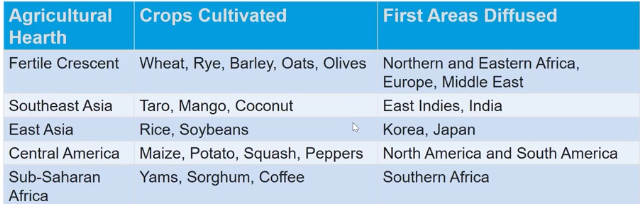
Agriculture diffused globally along trade roots
increasing patterns of globalization diffused agriculture around the world
- Trade routes across the eastern hemisphere diffused plants and animal
- The silk road brought plants and animals to the middle east, Asia, and Europe
- Indian ocean trade brought plants and animals to South Asia, the Middle East, Africa, and Europe
- Columbian Exchange
- crops were taken to Europe
- animals brought to America
Other forms of diffusion
- population migration brought different cuisines to new areas
- immigrants brought their food
- The green revolution spread high-yield varieties of crops across the world
- new varieties of plants replaced traditional crops
- these countries have seen a loss in the genetic variety of plants
- Increasing wealth has raised the demand for animal protein
- demand for beef, pork, and chicken has risen as LDCs get wealthier