Work Energy
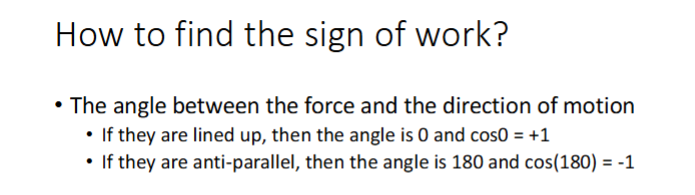
Work is a product of the applied force and the parallel distance (displacement)
through which the force acts. It lets us relate energy to applied force.
Formula: | since force and distance are parallel, you don’t have to factor the angle.
These are for the projection of force on distance
| For Dot product, easier to learn
| For Cross product, harder to learn
Units of work(and energy) are joules(J).
If the distance is zero, no work.
If the displacement is perpendicular to applied force, no work.
Work measures the energy transferred to or from an object by means of a force.
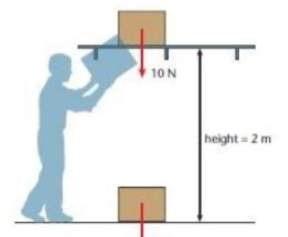

Like this example, you go from rest to 2 meters below it, using 10N of force ot move it, and hence, multiplying the newtons by meters, you get 20Joules.
Make sure when finding the dot product, it falls between the range, but not |since that is perpendicular, and that will be 0.
(What happens when you lift a bucket up, you don’t have equal force compared to the weight?)
If you don’t have equal force compared to the weight:
With greater force, you will have acceleraiton, meaning no constant velocity
With less force, you will have normal force being applied, since you aren’t moving it.
Work done by a force
| This is for work for area under the curve for it, it cna be a short interval, or the entire thing, which is Work.

For this problem, since force isn’t constant, since it isn’t lining up with the coefficient, you use the integral of the formula, from the bounds of 0 to x, so really just a normal integration of 6x², getting 2x³.
Work done by a Gravity
|h is the height displacement, between initial and final height.
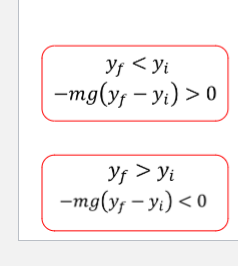
(first one)
If an object falls under the gravitational
force, then the work done is positive and
object gains kinetic energy (speeds up).
(second one)
If an object is launched upward, then the
work done is negative and the object
loses kinetic energy (slows down).
Gravitational Potential Energy
Def: the energy associated with an object in a gravitational field.
Var: Ug
Equation: | With mass as m, g as gravity affecting object, and h for height, which is relative, usually for sea level as h=0 m.

The normal force is zero, since between that and the displacement, the angle is 90 degrees, since it is perpendiuclar from each other, vector wise, and cos 90 = 0, so the work done by normal force is zero.
cos theta = sin (90 °- theta) and vise versa, so you can interchangeably work between the two.

Formula:
| Always associated with motion. m is for mass, and v is for velocity.
With the falling example, if the work done is positive, it will accelerate the kinetic energy, since the velocity would increase.
If the work done is negative, it can slow down the kinetic energy, since it will make the velocity decrease.
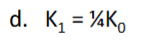
If you ½ an object’s velocity, the kinetic energy becomes ¼ of the original kinetic energy, when the velocity is normal.
Energy-Work Theorm:

Elastic Potential Energy

Formula: | With k being the spring constant and x being the distance from equilibrium position of spring.
Conservative Forces
Work from A to B is independent of the path, with the work depending only on the initial and final positions, so, when using it to calculate if it is conservative or not, only consider the initial and final(not max and min positions)
When the force isn’t conservative,then distance is taken into account.
Potential Energy
Convseration of total mechanical energy formula
| With K being kinetic energy, U being potential energy, and E being total mechnical energy.
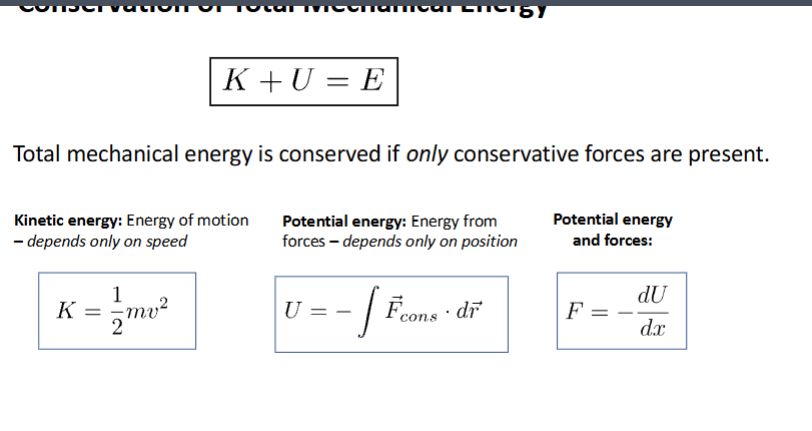
First one is for finding kinetic energy, using mass and velocity.
Second one is taking the integral of work.
Thrid one is the relationship between forces and potential energy, taking the negative derative of potential energy(probably best when potential energy is a formula, instead of a number)
(main one is the realtionship between kinetic, potnetial, and total energy.
