Dr Jekyll and Mr Hyde
Duality
Good versus Bad/Evil
Jekyll is supposed to represent good while Hyde is the evil → Jekyll partakes in lots of charity work and is friendly and portrayed as an intelligent and respectable man. Originally they are presented as different people until we find out that they are in fact conflicting personalities of the same person. This is the representation of who Jekyll is on the outside, versus his inner, hidden desires and between him being an upstanding member of society and his basal, primitive instincts. Also juxtaposition between the morals of each, Jekyll fights to keep his morals while Hyde clearly has no concern for them.
Victorian London is also presented as dichotomous (possibly a reflection of Scotland at the time). There is also conflict in how the buildings/setting is described which creates a background for the duality that we see within the play. RLS also heavily contrasts the old town with the new town, the new town being for wealthy aristocrats during the day to act as proper gentlemen, while they visit the poor, run-down old town by night to engage in drinking, gambling and prostitution.
The novel is written from a third person narrative, however through letters (epistolary form) we see that there are multiple ways to look at the situation.
Science versus Religion
At this time, lots of new scientific discoveries were being released, which were threatening the traditional scientific views of the time. For example, Charles Darwin had recently released his book on the theory of evolution, outright contradicting the creationist views which previously existed. This caused a lot of confusion and upset for many people about what this new world would be like and some believe Hyde was intended to be a reflection of people’s fears about science, psychology and medicine. It also sparked fears of ‘devolution’ which was reflected in the animalistic nature of Hyde. Shows how far science can be pushed to promote fear and tension for readers at the time. Some also believe that Lanyon and Jekyll represent the relationship and contrast between traditional medicinal views and practices versus newly emerging, modern scientific views. Utterson vs Jekyll - subversion → traditionally, lawyers were considered deceitful and doctors trustworthy however in the novel RLS uses the subversion of these ideas to heighten tension. Stevenson chooses to heighten fears around science by writing about how far science can go.
There are multiple references to religious symbolism, which serves to contrast the heinous, immoral acts that are taking place, as well as adding a serious tone which juxtaposes the fantastical elements of some of the book. This ensures the readers at the time would be forced to consider the
Uses a references to Cain’s Heresy to highlight the duality between Jekyll and Hyde. The story implies that evil is intrinsic to human nature and Jekyll cannot fix any of it or change himself as a person even through the creation of Hyde.
Appearance versus Reality
The Victorian society, which reflects in Enfield and other characters in the novel is a good example of this contrast between appearance versus reality, as their actions demonstrate the divide between their gentlemanly appearance during the day compared to their questionable behaviours during the cover of night. We see this emphasised within the structure of the book, the chapter titles are fairly simple while their contents are composed of mystery and fear.
Secrecy, Mystery, Reputation, Repression
Enfield is a good example of secrecy and repression in Victorian times because he is often seen going for walks with his cousin, Utterson, which helped to demonstrate your standing as a ‘proper gentleman’ in Victorian times; however in the play there are references to Mr Enfield having a secret hidden life, e.g. when he talks about being out late into the night. This was a reflection of the Victorian society at the time since it was the norm to put on a façade of a proper gentleman during the day, while going out in the night and participating in morally questionable activities.
Hyde is seen as the repressed evil side of Jekyll, hence the name ‘Hyde’ → aptronym. Possibly Hyde is the only character who doesn’t repress parts of himself. Maybe Stevenson is trying to make the point that Jekyll is an example of the results of such a repressive society because Jekyll admits in the final chapter that he had had ‘concealed pleasures’ (so he creates Hyde to relieve this repression) → as the reader we can only speculate on what these would be. Stevenson threatens to expose Hyde to the whole of London rather than harm him → emphasises how important reputation is to the society.
Silence → think about anything between characters which is not said to represent silence (can be seen as a product of the repressive Victorian society). A key theme of silence is the narration of the book, it is in the third person narrative meaning while we follow the characters it is rare that the characters actually tell us anything ourselves, more often we find things out through documents (letters → epistolary novel). Characters often refuse to talk about topics that are taboo or may be damaging. The characters do sometimes gossip however they chastise themselves for this habit.
It is clear that in the novel the characters fear their reputations being destroyed and are forced to keep secrets in the suspicious atmosphere. This allows the author to heighten tension and risk in the book making it more interesting and exciting for the reader. Secrecy is also used to heighten the plot because the reader becomes aware of events at the same time as Utterson.
Robert Louis Stevenson lets us as readers become detectives through the character of Utterson. The title of the novella starts with ‘strange case of’ and the first chapter is called ‘Story of the door’, this shows us from the very beginning Stevenson is inviting in his readers to the mystery of the story. The book focuses on repercussions of events and characters use dialogue to deduce what is happening this adds to our sense of mystery as readers.
Jekyll continuously represses his inner evil because that is the nature of Victorian society. Behind Jekyll’s reputable façade there is a monster and eventually due to being repressed for so long it is released (Freudian slip) → “my devil had long been caged and came out roaring”. Perhaps Stevenson is trying to critique the repressive and secret nature of Victorian society.
Women & Femininity
Within the text there is a distinct lack of female characters, except two. The first being the young girl who is trampled and the second being the woman who is hysterically crying. Both of these instances paint women as weak, pathetic and vulnerable because they are either a victim of a crime or unable to control their emotions. This is generally how women were viewed in Victorian society. Finally, before the murder of Carew he is described as ‘beautiful with white hair’ → something you would typically say about women in this time. This feminises him and again suggests feminine characters to be weak and victims.
Gothic & The Supernatural
The gothic is a style of writing which aims to induce fear in the reader. The supernatural is a common theme within the gothic, something could be described as supernatural if it defies human explanation → Hyde (often described as creature-like) and his act of violence. Furthermore, Stevenson makes the creature of Hyde even more terrifying by showing Hyde as both human and supernatural → suggesting humans have the capacity to behave like Hyde. Setting is used to present gothic aspects as well as language techniques such as sibilance to create a sinister effect.
Violence
The book is a piece of shocking, gothic fiction and contains lots of horrific violence → from Mr Hyde, often unprovoked (his victims are described as passive to make his crimes appear more shockingly unprovoked). Hyde commits crimes of both extreme anger, as well as calmly and detached due to passive disregard for human life. Hyde violates a lot of innocence when he kills without remorse, in front of children, nurses, etc.
Violation of innocence - the only female characters portrayed are the maid with ‘streaming tears’ who is reduced the stereotype of the irrational woman and the girl who is trampled → reduced to a pathetic object, however emphasises Hyde’s evil as he is harming a helpless, girl for no reason. On top of this, Carew is heavily feminised, some of the only female representation we see, however he is also violated and killed. Shows woman as innocent and pathetic (this is how they were viewed at the time, seen and not heard) while Hyde is violating and killing them.
At the time there were many decency laws for publishing which is why RLS uses simplistic, detached language when describing the heinous crimes. Ironically, even when writing this book about repression he had many strict guidelines preventing him from writing how he truly desired.
Friendship
Themes of friendship arguably drive the plot as Utterson’s relationship with Enfield is how he discovers the story of Hyde in the first place, but he keeps seeking the truth due to his friendship with Jekyll. Within the book there is a distinct lack of female characters, so Stevenson only presents friendships in the novel, however at points there are references to Jekyll having partaken in homosexual activities in his younger years. Poole has lived with and served Jekyll for twenty plus years and the pair have a strong relationship. Poole always had Jekyll’s best interests at heart, which suggests that Jekyll had treated him well. Although throughout their relationship it had been one of master and servant, towards the end of the book Poole and Utterson (vastly different social classes, master and servant relationship) collaborate to solve the case → possibly Stevenson is implying that more can be achieved through collaboration between different social classes.
Utterson, Jekyll and Lanyon had been friends for a long time, however Jekyll and Lanyon arguably did not have lots in common and Utterson acted as a ‘mediator’ during their friendship. Lanyon chooses to distance himself from Jekyll over his nefarious activities, however while Utterson also has his doubts he remains loyal to Jekyll. Utterson is also often seen with Enfield, in the beginning of the book they went on many walks together (Sunday mornings) → Utterson has strong relationships with lots of the characters, excluding Hyde.
Dr Jekyll
Jekyll was a highly respected doctor of the upper class, however throughout the play he finds himself experimenting with ‘concoctions’ until he finds himself transforming into the monster, Hyde. He was originally shown to be kind and generous with close connections to a lot of characters however throughout the play as he changes more often into Hyde, he becomes reclusive and displays very unusual behaviour. Throughout the story, Hyde takes over the body and starts taking over parts of Jekyll’s personality as well as appearing uninvited → decreasing lack of control once an individual decides to give in to temptation. He is highly intelligent and curious. When making the drugs he used to become Hyde he originally had good intentions to separate the bad parts of his personality out in order to become a better person. As we known, walking and being social was good for keeping up your appearance and maintaining a good reputation (we see this in Enfield and Utterson), this contrasts with Jekyll gradually becoming more reclusive as he decreases in reputation.
We know that in his past he had completed studies and religious work, and while he is a scientist over a religious figure, we see him turn once again to God for forgiveness once he realises his mistakes. Shows the encroachment of science on religious thought during the Victorian era.
Within Freud’s theory of the mind, Jekyll is thought to symbolise the conscious ‘superego’. He is a member of the upper class, even the bourgeoise. In the beginning of the novel he was friendly and social, having frequent dinner parties. The fact that Hyde has a key to Jekyll’s backdoor, as well as Jekyll persistently defending him could suggest that Hyde is always present in Jekyll’s subconscious → because they are one and the same or at least parts of the same person. Throughout the play, Jekyll starts to appear uninvited, the boundary between them becomes increasingly fluid, almost as if the two are becoming one again.
Dr Lanyon
Dr Lanyon is arguably the contrasting personality and views to Dr Jekyll, as Dr Jekyll demonstrates wild and experimental attitudes while Lanyon is often scientifically sceptical and serves the voice of tangible science. This contrast causes conflict between them because once Lanyon finds out about the experiments of Jekyll he sticks to his morals and distances himself → strong morals. He acts as a foil to Jekyll (device used to demonstrate specific qualities of a certain character by contrasting them with that of another character → in this sense demonstrating Jekyll’s wildness and experimentation. This could also represent the contrast in the world at that time between those who were trying to further understand human anatomy and those who resented this movement (time of the industrial revolution). Although Utterson, Lanyon, and Jekyll have been friends for a long time, arguably Utterson has served as the ‘mediator’ between the other two throughout their relationships.
Mr Hyde
The violent alter ego of Henry Jekyll, created through scientific experimentation. He embodies all of the evil parts of Jekyll. Hyde has a house bought for him by Jekyll, but also has access to Hyde’s house. He is displayed as much smaller, younger than Jekyll, as well as being pale, deformed and also frequently described as animalistic. These features present him as evil through physiognomy. He is thought to be the repressed, evil side of Jekyll (hence the name ‘Hyde’, this was particularly relevant in Victorian society as most ‘gentlemen’ tended to have a hidden and repressed dark side) and in Freud’s theory of the mind, he would represent the ‘id’.
Since Hyde is ‘part of’ Jekyll and they share the same body, arguably Hyde is also a member of the upper class. Therefore, his reckless trampling of the young girl demonstrates the power that the bourgeoise can easily exert over the working class, while the murder of Carew (whose body he left mangled) shows the disregard and lack of care or loyalty for one another within these upper class groups and also shows his violence and volatility. On the other hand, if we look at them as not intrinsically linked, Hyde could be seen as a member of the working class, meaning he is under less scrutiny and pressure than Jekyll, allowing him to act dangerously and violently. Furthermore, the murder of Carew could be seen as a violent uprising of the proletariat. He doesn’t have strong relationships with anyone other than Jekyll, and even this is not a true relationship, most characters have a hatred for Hyde.
Mr Enfield
Enfield appears fairly frequently throughout the novel, however he is a rather neutral character, and he only really has a strong relationship with Utterson, his cousin, as they went on walks together often → going for walks in Victorian times helped to demonstrate your standing as a ‘proper gentleman’, however in the play there are references to Mr Enfield having a secret hidden life. He is a key driving force prompting the plot to begin to develop by telling Utterson the story of Hyde → could be seen as having strong morals by repeating the story to Utterson however he could also be seen as gossiping. He has similar Victorian traits to his cousin however he is clearly not a curious character and in the novel we see Utterson desperate to find out more about Hyde, while Enfield doesn’t show the same curiosity.
he is a typical Victorian gentleman
Mr Utterson
He is a lawyer (as Stevenson was) & bachelor → main protagonist. He is displayed as the epitome of the Victorian gentleman → respectable, reputable, etc. He is also a central character within the book with strong links to every character, which makes it very suitable for him to be the main investigator in the case. He is a stable anchor point through whom we view most of the story. He references Cain’s Heresy, leading us to believe he is a moral and relatable character, however he also states that the law often makes him reflect on his past self, telling us that his past has not been entirely morally clean.
Utterson formulates his routine around the church bells near his house → rigid and religious schedule could point to strict morals. He is also portrayed as a typical and respectable Victorian gentleman (goes for walks), which also emphasises Hyde’s unreputable behaviour. Very loyal → keeps a friendship with Jekyll even when he has doubts about his private activities.
“drank gin when he was alone” - shows his repression and public façade
he is the driver of the story
Poole
Poole is the servant of Dr Jekyll who has lived in his household for 20 years, he’s very loyal to Jekyll, even caring about him, however he facilitates many of the discoveries that Utterson is able to make in the case. He is hesitant to inform Utterson of his worries for Jekyll, out of fear that it will cause problems for his master, he always has his best interests at heart → suggests that Jekyll treated him well.
Sir Danvers Carew
Sir Danvers Carew is an important member of parliament, RLS uses him to demonstrate the despicable acts of violence that Hyde is capable of committing, he is murdered in chapter four, demonstrating Hyde’s evil qualities which pray on goodness → demonstrates Hyde’s disregard for traditional authority. He is only really seen in the chapter regarding his death, however it is implied that Utterson knew him well enough to identify his body at the police station. Carew is a man but at points he is feminised as well as anglicised to present him as a vulnerable individual that Hyde took advantage of → emphasises Hyde’s evilness as well as presenting women in general as vulnerable and even pathetic.
Plot summary
On their weekly walk Mr Utterson listens as Enfield tells a gruesome tale of assault → Mr Hyde tramples a young girl, disappears into a door on the street, and remerges to pay off her relatives with a check signed by a respectable gentleman, Jekyll. Since both Utterson and Enfield disapprove of gossip, they agree to speak no further of the matter. Then we find out that Dr Jekyll has written a will transferring all of his property to this Hyde. Utterson begins having dreams in which a faceless figure stalks through a nightmarish version of London.
Utterson visits Jekyll and Lanyon to try to learn more. Lanyon reports that he no longer sees much of Jekyll, since they had a dispute over the course of Jekyll’s research, which Lanyon calls “unscientific balderdash.” Curious, Utterson stakes out a building that Hyde visits—which, it turns out, is a laboratory attached to the back of Jekyll’s home. Encountering Hyde, Utterson is amazed by how undefinably ugly the man seems, as if deformed, though Utterson cannot say exactly how. Much to Utterson’s surprise, Hyde willingly offers Utterson his address. Jekyll tells Utterson not to concern himself with the matter of Hyde.
A year passes uneventfully. Then, a servant girl witnesses Hyde brutally beat to death Sir Danvers Carew. The police contact Utterson, and Utterson suspects Hyde as the murderer. He leads the officers to Hyde’s apartment, feeling a sense of foreboding amid the eerie weather—the morning is dark and wreathed in fog. When they arrive at the apartment, the murderer has vanished, and police searches prove futile. Shortly thereafter, Utterson again visits Jekyll, who now claims to have ended all relations with Hyde; he shows Utterson a note, allegedly written to Jekyll by Hyde, apologizing for the trouble he has caused him and saying goodbye. That night, however, Utterson’s clerk points out that Hyde’s handwriting bears a remarkable similarity to Jekyll’s own.
For a few months, Jekyll acts especially friendly and sociable, but then he suddenly begins to refuse visitors, and Lanyon dies from some kind of shock he received in connection with Jekyll. Before he died Lanyon gave Utterson a letter, with instructions that he not open it until after Jekyll’s death. Meanwhile, Utterson goes out walking with Enfield, and they see Jekyll at a window of his laboratory; the three men begin to converse, but a look of horror comes over Jekyll’s face, and he slams the window and disappears. Soon afterward, Jekyll’s butler, Mr. Poole, visits Utterson in a state of desperation: Jekyll has secluded himself in his laboratory for several weeks, and now the voice that comes from the room sounds nothing like the doctor’s. Utterson and Poole travel to Jekyll’s house through empty, windswept, sinister streets; once there, they find the servants huddled together in fear. After arguing for a time, the two of them resolve to break into Jekyll’s laboratory. Inside, they find the body of Hyde, wearing Jekyll’s clothes and apparently dead by suicide—and a letter from Jekyll to Utterson promising to explain everything.
Utterson takes the document home, where first he reads Lanyon’s letter; it reveals that Lanyon’s deterioration and eventual death were caused by the shock of seeing Mr. Hyde take a potion and metamorphose into Dr. Jekyll. The second letter constitutes a testament by Jekyll. It explains how Jekyll, seeking to separate his good side from his darker impulses, discovered a way to transform himself periodically into a deformed monster free of conscience—Mr. Hyde. At first, Jekyll reports, he delighted in becoming Hyde and rejoiced in the moral freedom that the creature possessed. Eventually, however, he found that he was turning into Hyde involuntarily in his sleep, even without taking the potion. At this point, Jekyll resolved to cease becoming Hyde. One night, however, the urge gripped him too strongly, and after the transformation he immediately rushed out and violently killed Sir Danvers Carew. Horrified, Jekyll tried more adamantly to stop the transformations, and for a time he proved successful; one day, however, while sitting in a park, he suddenly turned into Hyde, the first time that an involuntary metamorphosis had happened while he was awake.
The letter continues describing Jekyll’s cry for help. Far from his laboratory and hunted by the police as a murderer, Hyde needed Lanyon’s help to get his potions and become Jekyll again—but when he undertook the transformation in Lanyon’s presence, the shock of the sight instigated Lanyon’s deterioration and death. Meanwhile, Jekyll returned to his home, only to find himself ever more helpless and trapped as the transformations increased in frequency and necessitated even larger doses of potion in order to reverse themselves. It was the onset of one of these spontaneous metamorphoses that caused Jekyll to slam his laboratory window shut in the middle of his conversation with Enfield and Utterson. Eventually, the potion began to run out, and Jekyll was unable to find a key ingredient to make more. His ability to change back from Hyde into Jekyll slowly vanished. Jekyll writes that even as he composes his letter he knows that he will soon become Hyde permanently, and he wonders if Hyde will face execution for his crimes or choose to kill himself. Jekyll notes that, in any case, the end of his letter marks the end of the life of Dr Jekyll. With these words, both the document and the novel come to a close.
Context
At the time, Edinburgh, where RLS was writing, was very much divided into two; the old town vs the new town. Wealthy aristocrats gravitated towards the grand, modern houses in the new town, leaving the old town to deteriorate. It was filled with crime and illicit activities and many gentlemen would go there by night to engage in gambling, prostitution and drinking (including Stevenson). While the book was set in London, many believe that we see reflections of Scotland within the book. This was at the time of the industrial revolution in London, meaning it was seen as being at the forefront of modern, urban life (also the British empire was at its peak having conquered 1/3 of the world. As well as being, smoggy, industrial and unhygienic, it had a massive overcrowding issue and major class disparities (intense hierarchical system). This meant that at the time it was a very popular setting for gothic novels.
The book has many references to religion, and given most people at the time would have been religious this adds a serious and powerful note to the text. He especially references Satan when referring to Hyde which for the audience at this time would carry very serious connotations and further emphasise the horror of the creature. This also emphasises the theme of science vs religion within the play. Furthermore, the bible states that only God has the power to perform change in society/being and it should only be used for positivity.
Thomas Huxley: at this time, Thomas had coined the term ‘agnostic’ and spread the belief that science and religion were mutually exclusive, given that most people would previously had been very religious, and now new science was being discovered this would have caused a lot of upset and confusion → for example Darwinism (Darwin had recently discovered the theory of evolution and it was thought to be at odds with creationism), this also raised fears ‘Devolution’, and fears around how far science could go, both of which Hyde served to represent. This also meant that people started to shift away from religion. Stevenson eventually announced that he did not believe it God, which we know damaged many of his personal and familial relationships around him. He felt it was hypocritical for morality to expect perfection when this is not possible for humans to achieve.
The novel was published in 1886; during the early 1800s art and literature was heavily influenced by romanticism, however towards the end of the century, closer to when the novel was written, people became much more interested in the darker side of humanity and psychology → reflected in Stevenson’s work.
Dr Jekyll and Mr Hyde is a work of gothic literature, which tends to have certain characteristics:
references to supernatural and the unknown
intense emotions (heightened by foreboding and tense atmosphere)
madness and insanity → provoked fear of something people did not understand at this time (mental illness) → we see lots of examples of possible mental illness within the book
evil - these factors link into evil, madness, supernatural, defying society, etc.
Lombroso’s theory of Atavism, published in 1876: the theory that some people are ‘born criminal’ and you can tell this based on appearance. He concluded these people were more primitive → Hyde is described as having many atavistic features.
Jekyll
“man is not truly one but truly two” - epitome of duality, believes human psyche can be split
“had fallen upon his knees and lifted his clasped hands to God” (versus “he was now no less distinguished for religion”) - has turned to God for redemption after his mistakes, not a religious man but has been forced to turn to him out of fear and guilt. could link to devolution, perhaps easier to believe in God than evolution and science after discovering the extent to which they can go
“charitable man” and “Smooth faced man of fifty” - image of generous person, external appearance doesn’t reflect the truth, in the beginning he was a social, respectable man
“I concealed my pleasures” - repressed his sinful side in order to gain social respect, Victorian society
“My devil had long been caged, he came out roaring” - shows the consequences of people in Victorian society repressing their ‘bad sides’. inner devil is a manifestation of his deeper desires, ‘devil’ suggests his desires are directly opposite to contemporary Christian ideology
“Had I approached my discovery in a more noble spirit…I had come forth an angel instead of a fiend” - he did not intend for this to happen however he accepts that he did not have a noble spirit prior to the experiment, he had supressed desires and a bad history
“This is the last time…that Henry Jekyll can think his own thoughts” - he eventually permanently loses control over himself, sad ending which attempts to create sympathy for Jekyll
Hyde
“strong feeling of deformity” and “Ape-like” - animalistic, devolution, through physiognomy and Lombroso’s atavism, his appearance would convict him as a criminal
“It wasn’t like a man” and “The creature” - animalistic, devolution
“So ugly that it brought out the sweat on me like running” - physical manifestation of evil, evokes disgust in all
“Damned juggernaut” - hugely overwhelming destructive force, ‘damned’
“His every act and thought centred on self” - selfish with no concern for others, could be a reflection of how Stevenson viewed society at the time
“In the ranks of mankind was pure evil” - Hyde has infiltrated society, superhuman, biblical imagery
Utterson
“the clock of the neighbouring church rang out […] when he would go soberly and gratefully to bed” - shows the impact religion has on his life, shows his morals. Biblical imagery is used throughout the play, however often ‘evil’ and ‘demonic’ language is used towards Hyde → Utterson acts as the opposite
“If he be Mr Hyde…I shall be Mr Seek” and “Besieged by questions” - shows his innate curiosity which propels the plot forwards as well as emphasising the theme of opposites throughout the novel. Warlike imagery → extent of his almost uncontrollable interest
“The last good influence in the lives of down-going men” - he is a man of significant morals
Enfield
“the more it looks like Queer street, the less I ask” - could be admirable, however he is inherently not curious and he even is uncaring. he acts as a foil to Utterson because had Utterson not defied social expectations by investigating, Jekyll would have been totally isolated.
“I was coming home from some place at the end of the world, about three o’clock” - shows that he may not be as morally strict as previously thought (coming home at this hour suggests he spent the night engaging in illicit activities) → theme of duality and also reflects Victorian society. Epitome of the Victorian gentle.
“I am ashamed of my long tongue” - informal language, also shows his hypocrisy and even duplicity as he previously states that he does not gossip.
Lanyon
“Jekyll became too fanciful for me” - he is traditional, acting as a foil to Jekyll highlighting the insanity of his experimentation (fricatives create a harsh tone)
“I wish to see or hear no more of Dr Jekyll” - soon will come true, irony. Also shows Lanyon’s more cruel side and demonstrates the significance of their falling out.
Poole
“doggedly disregarding the question” - wants to look after his master at all costs, shows he is loyal and kind and suggests that Jekyll has always treated him well
“that thing in the mask was never Dr Jekyll” - loyal and concerned for Jekyll, also shows his loyalty and how long he has been working for Jekyll because he knows Jekyll’s usual actions, however also could separate Jekyll from his actions as Hyde
Carew
“an aged and beautiful gentleman with white hair” - feminisation of Carew, very little femininity within the book, except for in cases of perceived ‘weakness’
“such an innocent and wild-world kindness” - emphasises Hyde’s cruelty as he preys on kind, innocent victims who have done no wrong
“high position of the victim” - shows Hyde’s disregard for the class system OR demonstrates the lack of loyalty for each other within the upper class
Society
Jekyll thinks that in separating his human nature, “life would be relieved of all that was unbearable” - society of repression and shame that eventually drives Jekyll to destruction as he feels it is necessary to separate himself from his human nature → consequences of such a repressive society
Duality
“the fellow had a key” - a door acts a barrier, Hyde has a key so is able to transcend the boundaries of appearance and reality, also in appearance J and H should have no connection and be in conflict but he had a key to Jekyll’s house
“man is not truly one, but truly two”
“about three o’clock”
“All human beings, as we meet them, are commingled out of good and evil”
“I incline to Cain’s heresy” - biblical imagery
“unscientific balderdash” and superhuman descriptions of Hyde - devolution, and shows that Lanyon strongly disagreed with Jekyll’s work and his work was unscientific and reckless
Supernatural
“trampled calmly over the child’s body” - juxtaposition of trampled vs calmly, lack of emotive language shows Hyde’s detachment from reality and humanity → portrays him as animalistic
Friendship
“a new life began for Dr Jekyll. He came out of his seclusion” - idea of him coming out of seclusion as Hyde ‘disappears’ → friendship is positive
Violence/Innocence
Carew = “aged beautiful gentleman with white hair” - see VIOLENCE → VIOLATION OF INNOCENCE
“All of a sudden he broke out in a great flame of anger” - metaphor to show volatility and unpredictability.
Mystery, Repression, Secrecy, Mystery
“make his name stink from one end of London to the other” - olfactory imagery in the metaphor shows the significance of Enfield threatening to ruin Hyde’s reputation
“concealed my pleasures” - see QUOTES → JEKYLL
Setting
“a fog rolled over the city” - pathetic fallacy for murder of Carew, fog personified to create sinister atmosphere, gothic literature
Setting
Stevenson uses the setting of London to expose different parts of the city, which represent different things – order versus chaos (Jekyll’s respectable London versus Hyde’s repugnant Soho). Descriptions of buildings and the weather are also used to heighten tension and add to the suspense and create a background for the duality occurring in the play → many of the novel’s key events involving Mr Hyde happen in the dark, which adds to the sense of mystery and intrigue and feelings of secrecy and unknown. Other settings – old buildings, Jekyll’s laboratory, for example, are all used to build up tension and suspense throughout the novella.
This was at the time of the industrial revolution in London, meaning it was seen as being at the forefront of modern, urban life (also the British empire was at its peak having conquered 1/3 of the world. As well as being, smoggy, industrial and unhygienic, it had a massive overcrowding issue and major class disparities (intense hierarchical system). This meant that at the time it was a very popular setting for gothic novels.
Structure
Robert Louis Stevenson lets us as readers become detectives through the character of Utterson. The title of the novella starts with ‘strange case of’ and the first chapter is called ‘Story of the door’, this shows us from the very beginning Stevenson is inviting in his readers to the mystery of the story. The book focuses on repercussions of events and characters use dialogue to deduce what is happening this adds to our sense of mystery as readers.
Most of the narration comes to us as readers through conversations had by the characters, rather than witnessing the events first hand. Letters are also used by Stevenson to allow us to piece together the events of the novella. Stevenson uses this epistolary style to re-establish and explain what has happened with Dr Lanyon’s letter and Dr Jekyll statement. The reader reads these letters alongside Utterson and we don’t get his reaction to the revelations so are left with our own impression of the events.
Writing essays
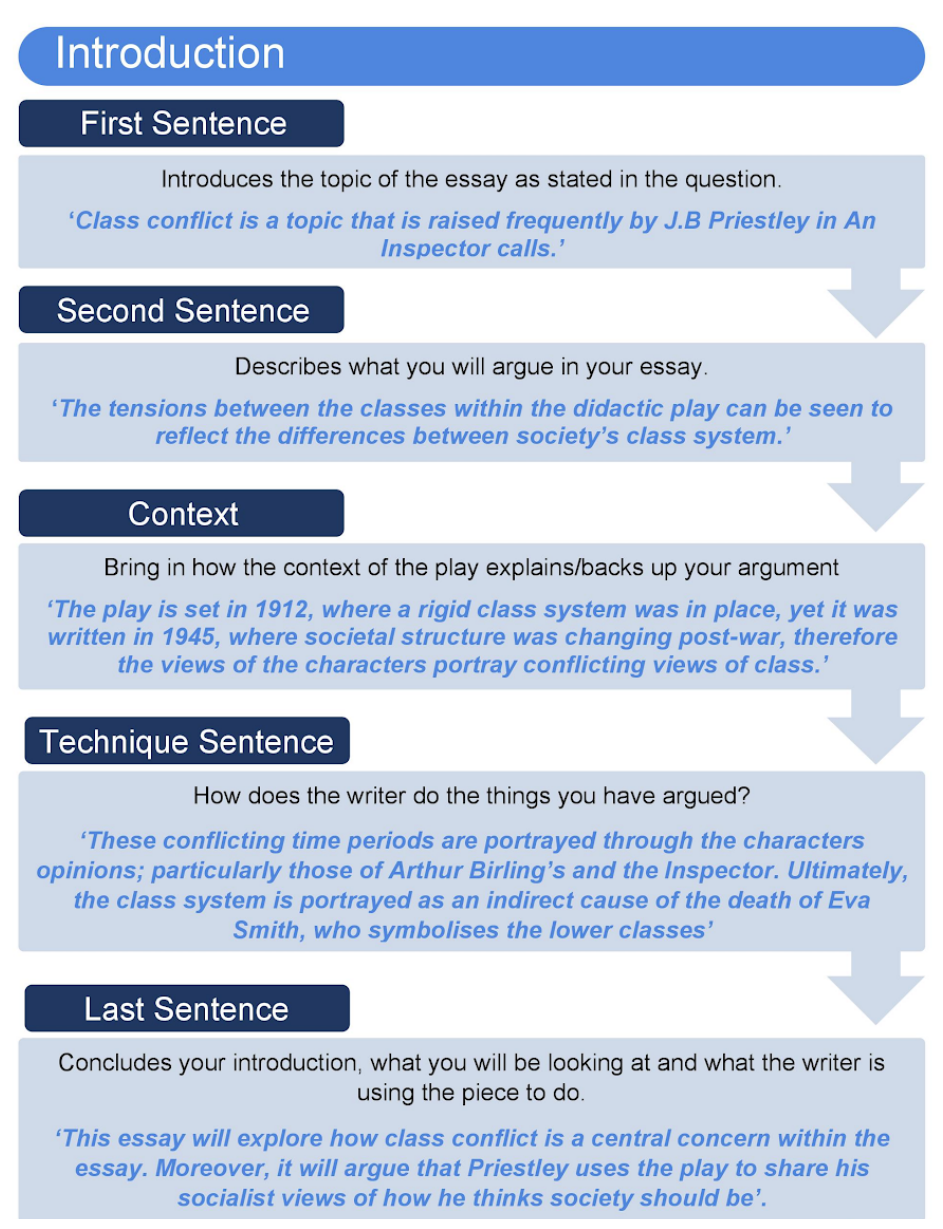
Introduction: briefly outline what you are going to talk about in the body of your essay, coherent and not overly complex → you should include; your overarching argument and where possible/natural: writers purpose/context/alternative argument/quote. Also make sure you refer to the wording of your question. ‘In the extract, and also the text as a whole…’
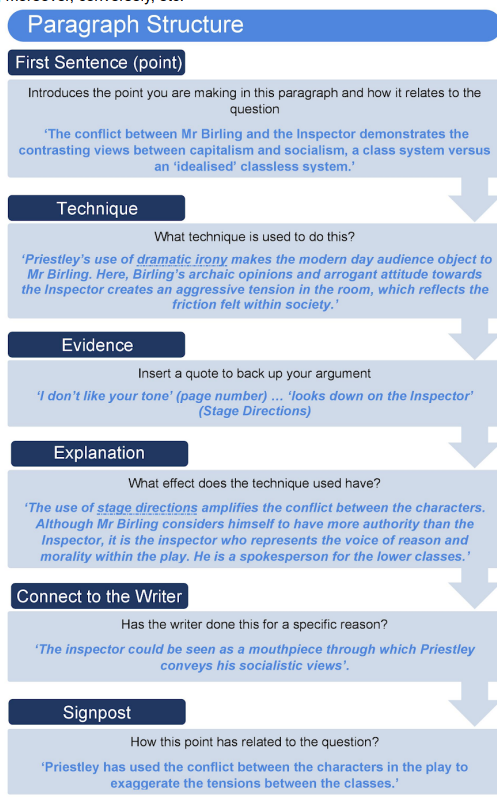
Main body: three or four paragraphs, including one on the extract. Start with a topic sentence, include quotes, context and analysis of language and structure. Where possible you should also include alternative evaluations (not forced) and consideration of the surrounding text/storyline.
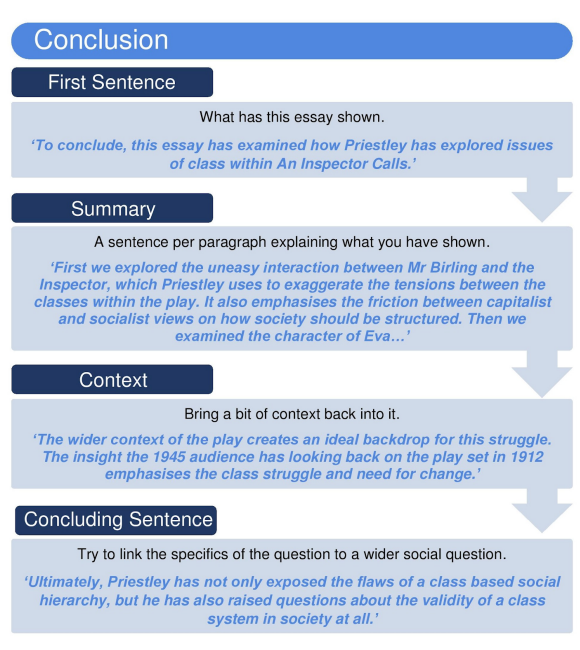
Conclusion: summarise and reinforce the rest of your essay. Can include context if it is very important, repeat your overarching argument with reference to the question.
Development - try to include development throughout your essay/the play of a character or theme in some way to develop your answer.