Describing Motion in Two Dimesions
Motion in Two Dimensions (Notes)
What is two-dimensional motion?
Two-dimensional motion means moving in two directions at the same time.
Usually involves:
Horizontal motion (forward/backward)
Vertical motion (up/down)
Examples
Snowboarder going downhill:
Moves forward and downward
Person walking up a ramp:
Moves forward and upward
Ball rolling down an incline:
Moves forward and down
All of these are examples of motion in two dimensions.
Breaking motion into components
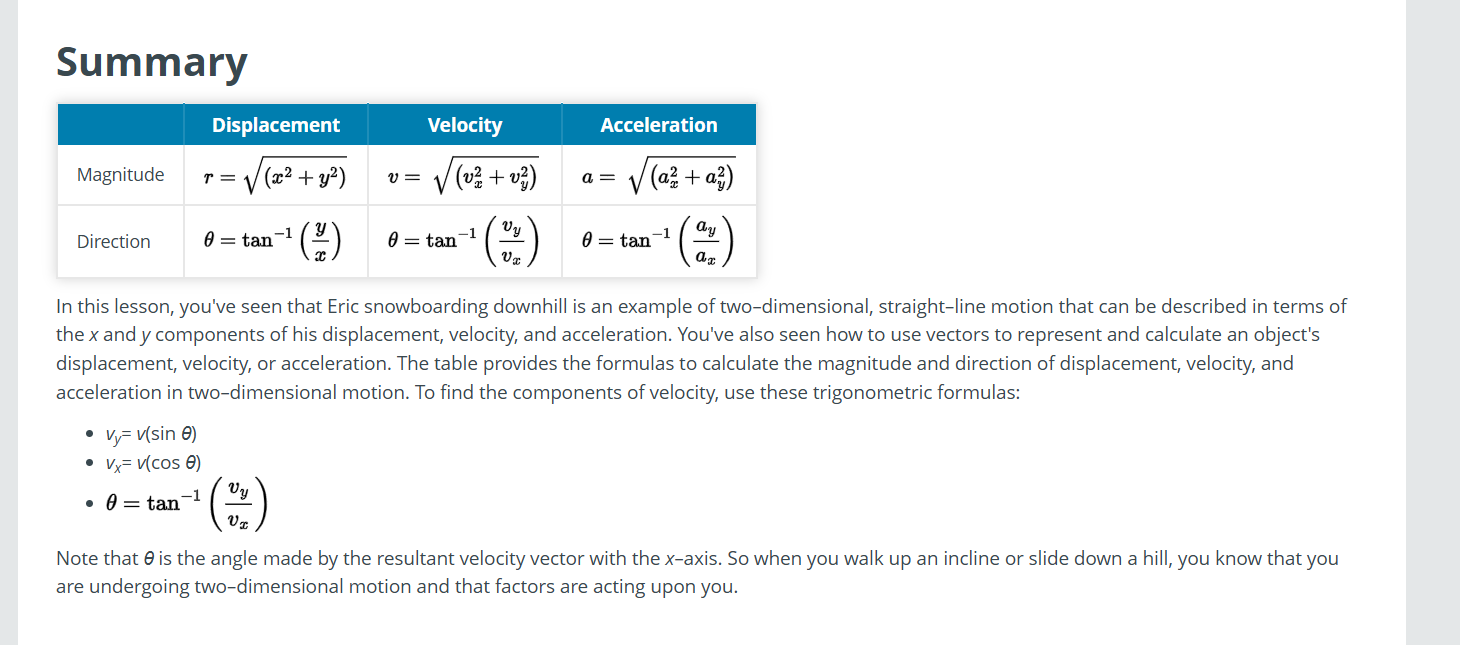
Any straight-line motion can be split into two components:
Horizontal component
Vertical component
These components are treated independently.
Use of vectors
Vectors are used to represent:
Position
Velocity
Acceleration
Vectors show both:
Magnitude (how much)
Direction (which way)
Motion of an Object in Two Dimensions (Notes)
Coordinate system
Motion is described using a Cartesian coordinate system:
x-axis → horizontal direction
y-axis → vertical direction
One-dimensional motion
Motion along only one axis:
Horizontal motion (x-axis) or
Vertical motion (y-axis)
Example:
A car moving straight forward
An object falling straight down
Two-dimensional motion
Motion that occurs at an angle to the x-axis and y-axis.
The object moves in both directions at the same time:
Horizontal (x)
Vertical (y)
Components of motion
An angled motion can be split into two components:
x-component (horizontal)
y-component (vertical)
The angle of motion determines how much of the motion is in each direction
Components of Two-Dimensional Motion (Notes)
x- and y-components
Motion can be broken into:
x-component → horizontal motion
y-component → vertical motion
Example (Eric downhill):
x-component = forward motion
y-component = downward motion
Sign conventions (very important)
x-axis:
Right of the origin → positive
Left of the origin → negative
y-axis:
Above the origin → positive
Below the origin → negative
Use of vectors
Vectors describe:
Position
Velocity
Acceleration
Vectors are useful because they:
Show magnitude and direction
Separate motion into x and y components
Independence of motion
The x and y components are independent.
A change in motion along one axis:
Does not affect motion along the other axis
Example:
Horizontal speed stays constant even if vertical motion changes due to gravity.
The MASTER MENTAL MAP (use this every time)
From x–y graph:
Straight line → constant direction
Curved line → changing direction
Longer stretch → larger displacement component
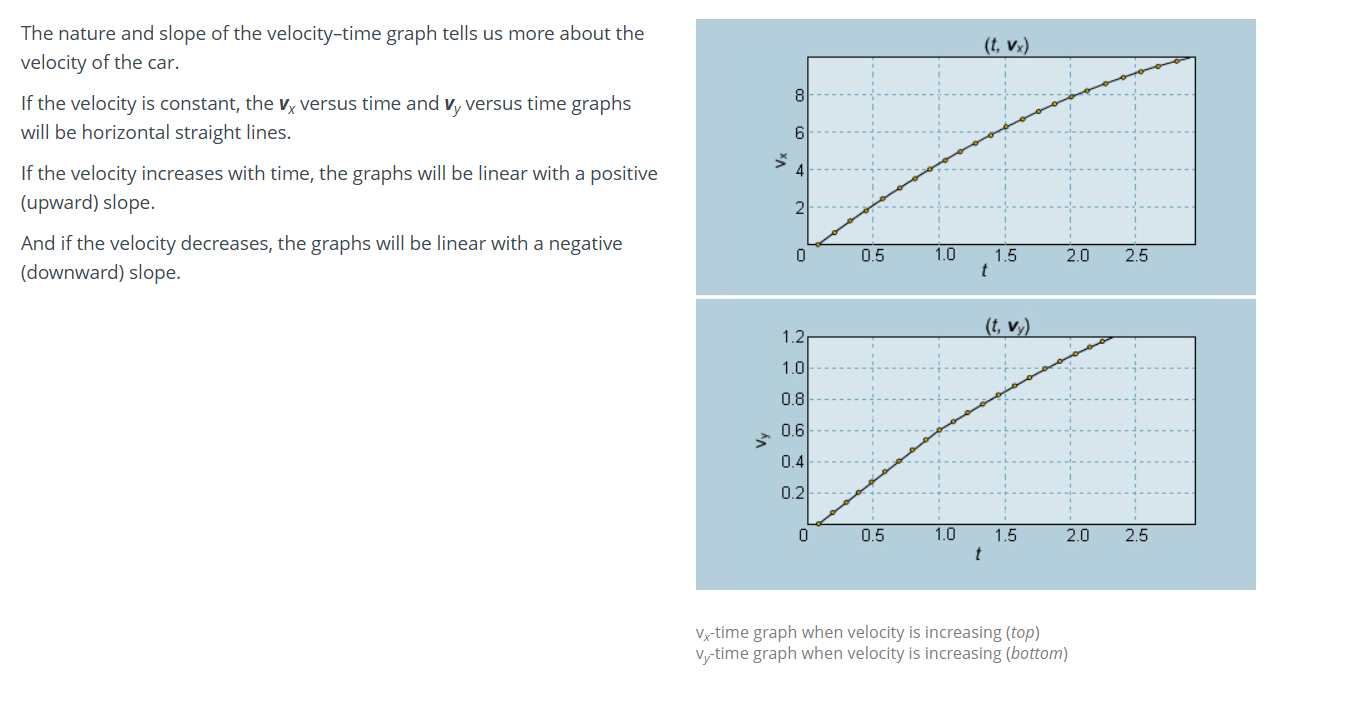
From x–t or y–t graph:
Straight line → constant velocity
Curved line → acceleration present
From velocity:
Constant → acceleration ≈ 0
Changing → acceleration ≠ 0
1⃣ Displacement as a vector (what x, y, and r mean)
Eric moves:
x forward (horizontal)
y downward (vertical)
These are the components of his displacement.
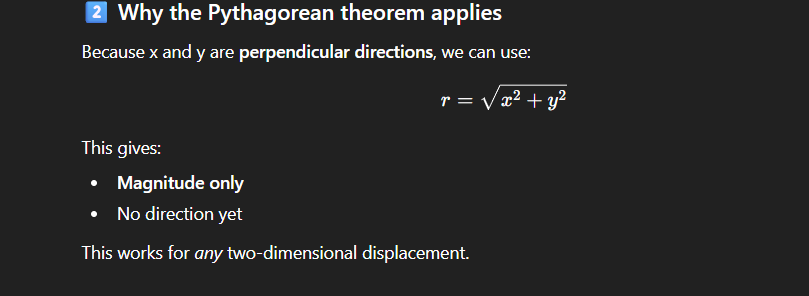
Together, they form a right triangle:
One leg = xxx
Other leg = yyy
Hypotenuse = rrr
👉 r is the total displacement, meaning:
the straight-line distance from where Eric started to where he ended.
That’s why:
r is the magnitude of his displacement
4⃣ What the x–t and y–t graphs are telling you
Linear x vs t graph (negative slope)
x changes by the same amount each second
Motion in x is constant velocity
Negative slope → moving left (or backward relative to origin)
Linear y vs t graph (negative slope)
y changes by the same amount each second
Motion in y is also constant velocity
Negative slope → moving downward
👉 Together this means:
Eric’s velocity is constant in both directions
He is sliding smoothly down a straight hill
Acceleration is approximately zero
5⃣ Why the slopes matter
The slopes of the x–t and y–t graphs determine:
How much of the motion is horizontal vs vertical
If:
∣slopex∣>∣slopey∣|\text{slope}_x| > |\text{slope}_y|∣slopex∣>∣slopey∣
Then:
More motion is along x than y
The hill is shallow, not steep
That’s why:
“The magnitude of the displacement in each direction depends on the slope of the hill.”
6⃣ The big picture (tie it all together)
Here’s the full logic chain:
Motion happens in x and y simultaneously
x and y form a right triangle
Pythagorean theorem gives total displacement rrr
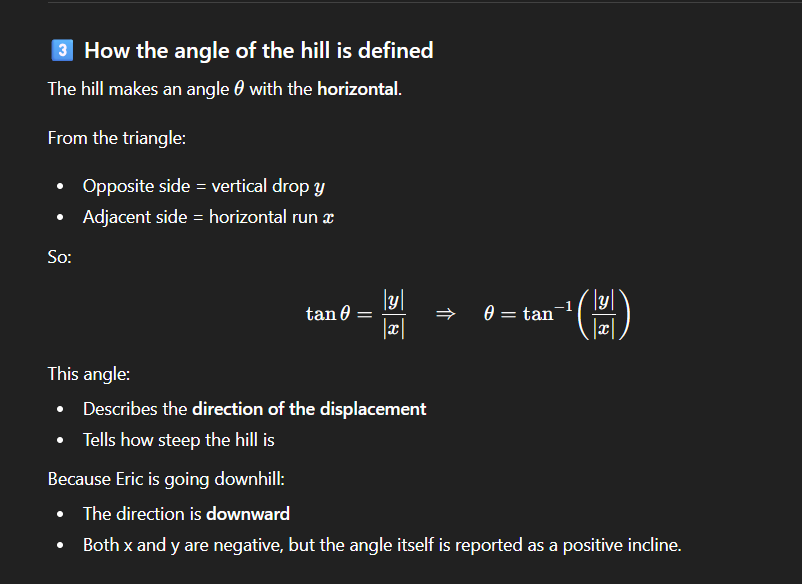
Tangent gives the incline angle θ\thetaθ
Linear x–t and y–t graphs → constant velocity
Constant velocity → acceleration ≈ 0
The hill’s slope controls how much motion is horizontal vs vertical
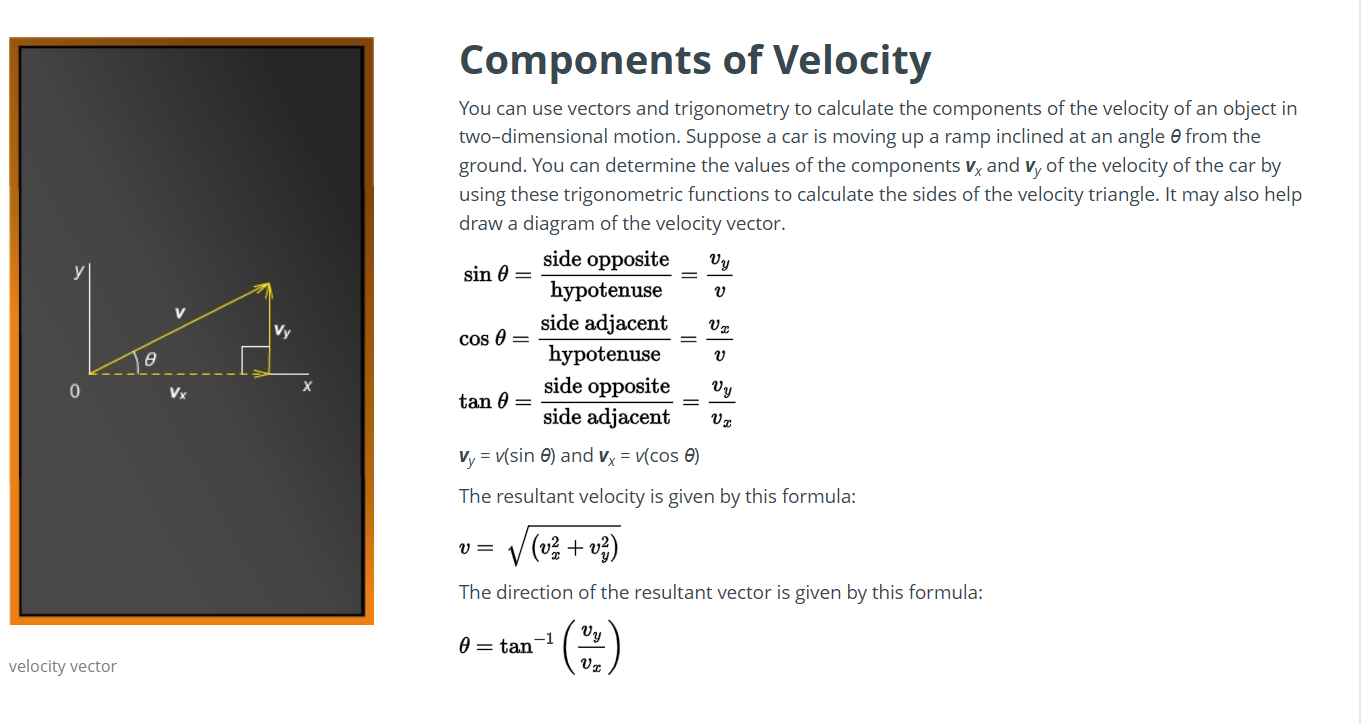
cosine hugs the angle and sine stands across it.