Unit 1 - Foundations of American Democracy
Big Ideas:
Why are there debates about the balance of power between the federal and state governments?
Is the Bill of Rights necessary? Why or why not?
How does the Constitution affect you and the choices you make?
Ideals of Democracy
US gov is based on ideals of
natural rights - all people have certain rights that cannot be taken away
John Locke
social contract - implicit agreement between society to give up some freedom to the government in order to maintain order
Thomas Hobbes
popular sovereignty - all government power comes from the consent of its people
limited government - governmental power is not absolute
republicanism - people elect leaders to represent them and create laws in teh public interest
These ideals are ensured by:
separation of powers
checks and balances
federalism
republicanism
Magna Carta
first attempt to limit the power of the British King
guaranteed all people certain rights
Declaration of Independence
drafted by Jefferson w/ Adams and Franklin
natural rights. foundation for popular sovereignty
formal declaration of war. list of grievances used to explain why colonies are declaring independence
U.S. Constitution
drafted by James Madison
example of social contract. establishes limited government.
Types of Democracy
Participatory democracy: broad participation in politics and civil society
ex. town halls, voting directly on state legislation
Pluralist democracy: group-based activism by nongovernmental interests striving for impact on political decision making
groups of people associate with interest groups who then compete to influence politics
gives a voice to ppl - not individually but in chunks
ex. NAACP, National Rifle Association
Elite democracy: limited participation in politics and civil society on the assumption that the government is complicated and the most educated people need to run it
ex. Electoral college
U.S. Constitution:
elite democracy: elected representatives legislate on behalf of their people
pluralist: 1st amendment freedom of assembly, allows political parties and interest groups
participatory: 1st amendment freedom of speech and press, ppl can express their political opinions
15th + 19th amendments that expanded who could vote
Government Power and Individual Rights
Brutus 1:
participatory model
feared the decrease of personal liberties in a larger republic like the U.S.
a large centralized government could not adequately represent the views of the people because it would be largely separated from them
advocated for a small, decentralized government w/ more power reserved for state governments
Federalist 10: James Madison
pluralist democracy
with so many competing factions in a large republic, liberty would be upheld by their competition
they all cancel each other out
concerned about factions (groups of people who believe their interests are more important than any other interest)
if majority always prevailed, then minority would never be heard
Madison said you can either take away the causes of factions (strips liberty) or manage their effects
manage mischiefs of factions, delegating authority to elected representatives
and dispersing power between the states and national government
there was a double protection against the tyranny of factions because of the separation of powers in the federal government and the sharing of power between the federal and state governments
Challenges of the Articles of Confederation
Lack of centralized military power to address Shay’s Rebellion
Shay’s Rebellion - farmers raided a federal arsenal to protest the foreclosure of farms
shows need for strong centralized government
No executive branch to enforce laws, including taxation
No national court system
No power to regulate interstate and foreign trade
Lack of power to coin money
national government was in debt from way with no way to pay it back
requested money from states, borrowed money from other governments, and sold lands in the West
no national currency
no national military
9/13 states had to approve legislation before it was passed
Needed unanimous votes to amend the Articles
accomplishments:
created federalism: interaction and sharing of power between the federal and state governments
ended revolutionary war
established the Northwest Ordinance - how states would enter U.S.
Ratification of the U.S. Constitution
Great Compromise (aka Connecticut Compromise)
combined James Madison’s Virginia plan with the New Jersey Plan
created a bicameral system of congress - House and Senate
electoral college - created system for electing president by electors from each state
this system was used instead of popular vote or congressional vote
presidential candidate who wins 270 electoral votes wins the election regardless of who wins popular vote
3/5 compromise - formula for calculating a state’s enslaved population for House representation and for taxation
postponed decision to bad importation of enslaved people until 1808
agreed to add bill of rights to address Anti-Federalist concerns
Article V - amendment process
2/3 vote in both houses or proposal from 2/3 of state legislatures with final ratification from 3/4 states
Present debates
role of national gov
powers of state gov
rights of individuals
9/11 —> debates about government surveillance
debates about role of government in public school education
Principles of American Government
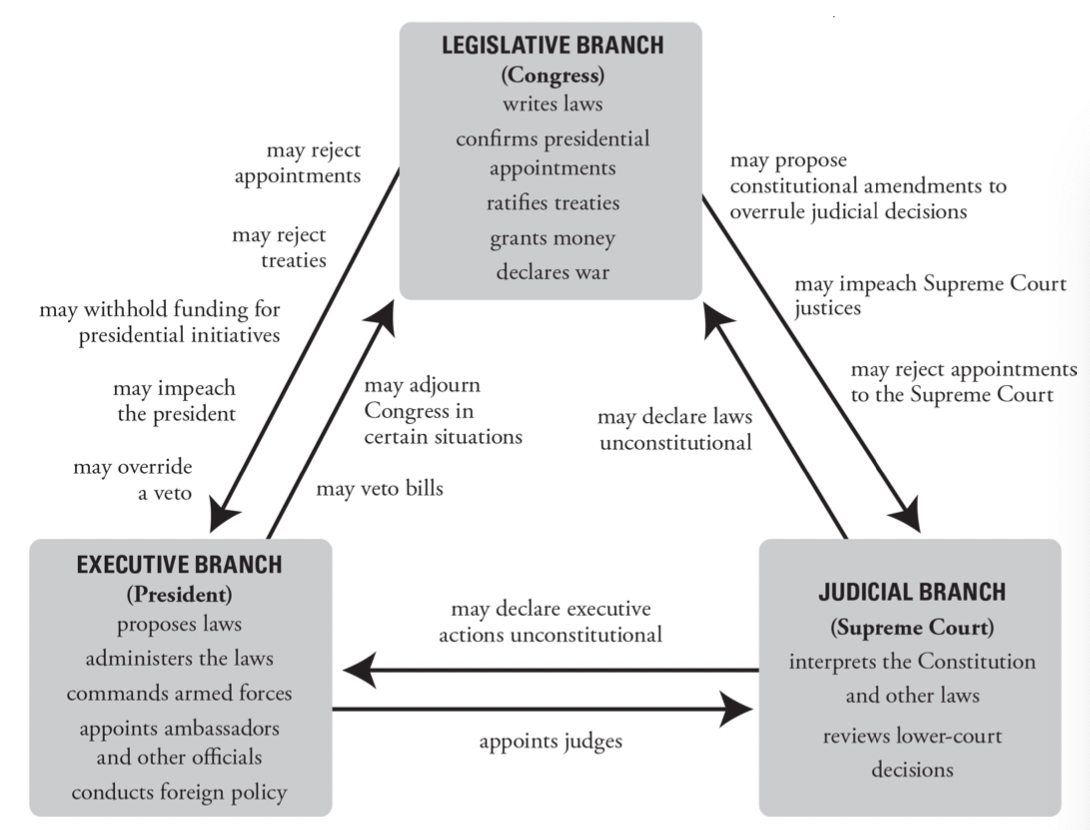
separation of powers & checks and balances
allow legal actions to be taken against public officials deemed to have abused their power
includes impeachment and removal from office
Federalist 51 - James Madison
explains how constitutional provisions of separation of powers and checks and balances control potential abuses by majorities
separation of powers would make the government efficient, dividing responsibilities and tasks
separation of powers and checks and balances creates multiple access point for stakeholders and institutions to influence public policy
Federalist 70 - Alexander Hamilton
executive branch should only have the president - used British monarchy as an example
proposed term limits as a way to limit presidential power
term limits not set until 1951
Relationship Between the States and National Government
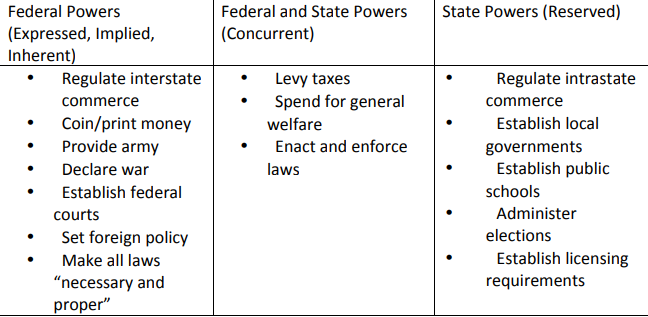
Federalism - a system where power is shared between national and state governments.
exclusive and concurrent powers explain ongoing debate over balance of power
exclusive power - held by only one level of gov.
includes enumerated powers in Constitution and implied powers (inferred from Necessary and Proper Clause)
Reserved powers - reserved to the states
10th amendment
Concurrent powers - shared between federal and state government
ex. collect taxes, make and enforce laws, build roads
Denied Powers:
federal government
suspended writ of habeas corpus except during a national crisis
protects against unlawful and indefinite imprisonment
Distribution of power is shows by Fiscal Federalism - government’s patterns of spending, taxing, and providing grants to influence state and local governments
revenue sharing - almost no restrictions to states. least used
Block grants - minimal restrictions to the states on its use. preferred by states
categorical grants - restricted to specific categories of spending. most common
mandates - requirements
Constitutional Interpretations of Federalism
14th amendment - Due process and equal protection clauses give national government the power to enforce protections for any person against the states but supreme court interpretations can influence extent of these protections
commerce cause gives national government power to regulate interstate commerce - supreme court interpretations influence the extent of this power
necessary and proper clause gives congress power to make laws related to carrying out its enumerated powers, but supreme court interpretations can influence the extent of these powers
supremacy clause gives the national government precedence over state laws
Federalism in Action
allocations of powers between national and state governments creates multiple access points for stakeholders and institutions to influence public policy
national policymaking is constrained by the sharing of concurrent powers with state governments
• Full Faith and Credit – states must honor laws and court rulings of other states
How do societal pressures and racial prejudice, explored in Everything I Never Told You, impact family dynamics and mental health in interracial families?