Biometrics
Individual physiological and/or behavioural characteristics
Two types of biometrics
- Physical biometrics (ex: DNA, fingerprints, iris, palmprint, etc.)
- Behavioural biometrics (ex: gait, keystrokes, signatures, multi-touch gestures, etc.)
Advantages of biometrics
- All the users of the system have an equal level of security (There's no password choice and doesn't require you to remember anything)
Disadvantages of biometrics
- Speed is perceived as the biggest problem
- FMR will increase when scaling up an identification application
- Irrevocability (Unlike passwords, you can't change leaked biometric data)
Biometric Hypothesis Testing
Hypothesis testing
- H0 (null hypothesis): The inputted biometric measurement doesn't match the biometric data template of the person that they're trying to authenticate themselves as
- H1 (alternative hypothesis): The inputted biometric measurement matches the biometric data template of the person that they're trying to authenticate themselves as
Decisions
- D0 (null decision): The user is not who they claim to be
- D1 (alternative decision): The user is who they claim to be
Hypothesis testing formulation errors types
- Type a - False Match (D1 when H0)
- Type b - False Non-Match (D0 when H1)
Biometric models
Unimodal biometrical systems
- A biometric system that uses a single biometric measurement to authenticate users
Multimodal biometrical systems
The fusion of multiple biometric features together to build a more complex template and make a more accurate and efficient biometric system
Data fusion levels \n
Fusion at the sensor level \n
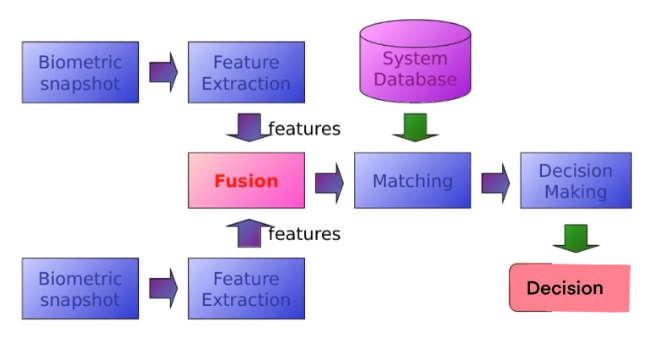
Fusion at the feature level
This combination strategy is usually done by a concatenation of the feature vectors extracted by each feature extractor
This yields an extended-size vector set
- Two drawbacks
- There is little control over the contribution of each vector component to the result
- Both feature extractors should provide identical vector rates
Although it is a common belief that the earlier the combination is done, the better result is achieved, state-of-the-art data fusion relies mainly on the opinion and decision level
Fusion at the opinion level
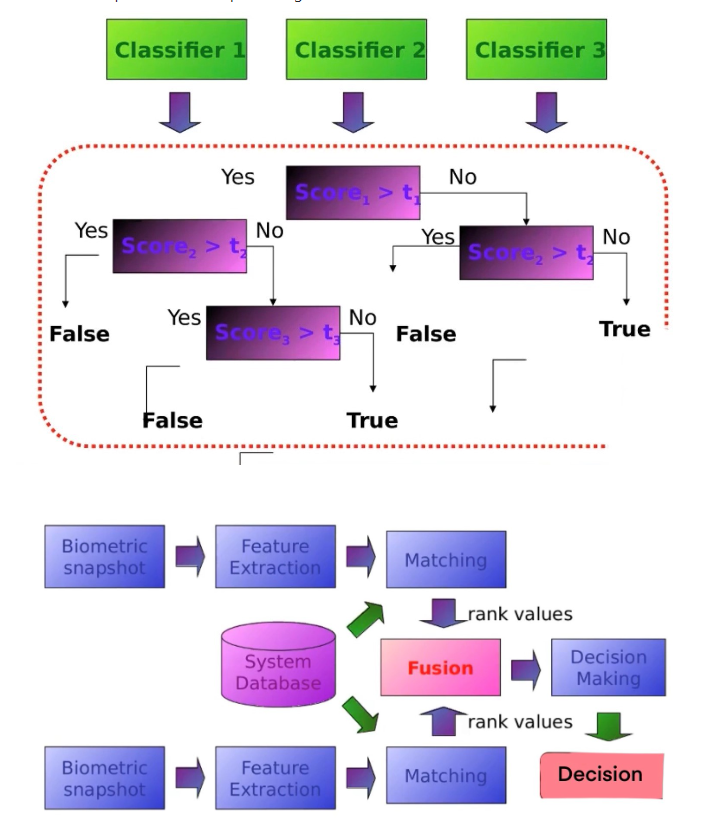
The score must be adjusted first (Normalization must be done):
- The similarity measures must be converted into distance measures
- The score generated by each classifier must have the same range
The combination strategies can be classified into three main groups
- Fixed rules / equal weight
- Trained rules / unequal weight
- Adaptive rules / adaptive weight
Fusion at the decision level
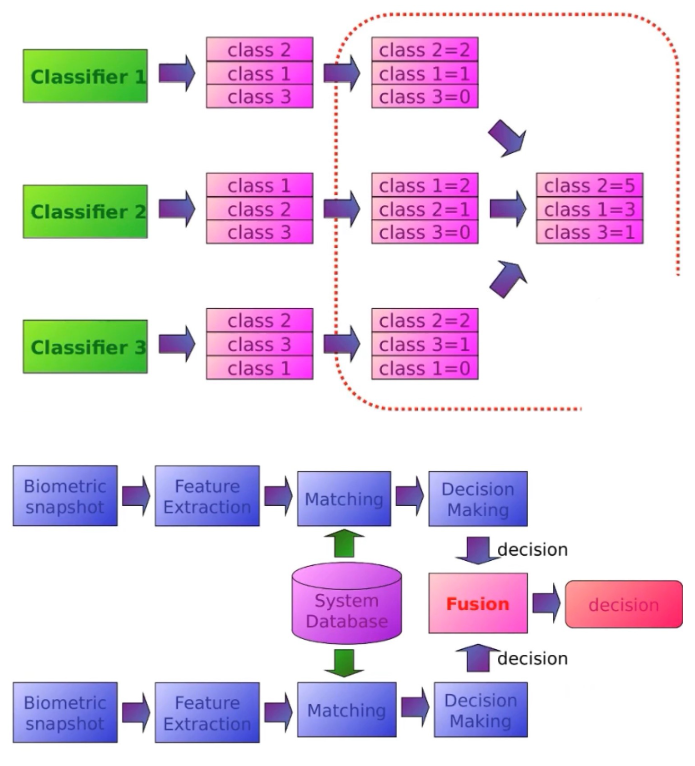
The Borda count method can be used for combining the classifiers' outputs (This approach overcomes the scores normalization that was mandatory for the opinion fusion level)
One problem that appears with decision-level fusion is the possibility of ties
For verification applications, at least three classifiers are needed
An important combination scheme at the decision level is the serial and parallel combination (AND and OR combination)
- the AND combination improves the False Acceptance Ratio
- the OR combination improves the False Rejection Ratio
Biometric system
A biometric system is essentially a pattern recognition system
What biological measurements/features qualify to be a biometric?
- Universality (Everyone must possess one)
- Distinctiveness (It should be only limited to you)
- Permanence (Should be the same all the time)
- Collectability (It should be collectable)
Other issues to consider when thinking of a biometric measurement/feature to use in your biometric system
- Performance (How fast is your system? etc.)
- Acceptability (How acceptable is your biometric? etc.)
- Circumvention (How circumventable is your system? etc.)
A biometric system is designed using four main modules
- Sensor module
- Feature module
- Matcher module
- System database module
A biometric system may operate either in
- Verification mode (Does this biometric data belong to this person?, etc.)
- Identification mode (Whose biometric data is this?, etc.)
Two types of biometric systems errors
- False Match - Mistaking biometric measurements from two different people to be from the same person
- False Non-Match - Mistaking two biometric measurements from the same person to be from two different people
Important specifications in a biometric system
- False Match Rate (FMR)
- False Non-Match Rate (FNMR)
- Failure to Capture (FTC) ex: faint fingerprints, etc.
- Failure to Enroll (FTE) ex: not long enough contact with the sensor, etc.
- etc.
Biometric protection templates
Template protection
- protects the privacy and security of biometric features
- revokes and re-issues biometric templates if any leaks were to occur
- prevents linking across databases
- allows matching in an encoded space
- etc.
Three categories of template protection
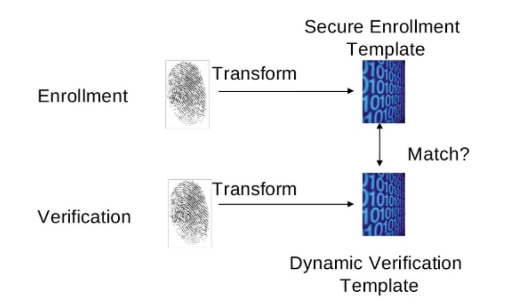
- Straight feature protection
- Protecting the original biometric features by using some one-way transformation to encrypt the data
- The matching is done in an encoded space
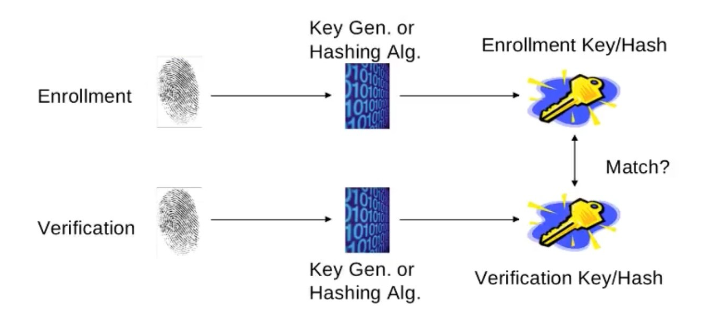
- Key-generating
- The biometric data goes into a key generation or hashing algorithm and then outputs a key
- Very difficult to do since the same biometric must output the same key, meaning that you have to ensure that your biometric systems are exact
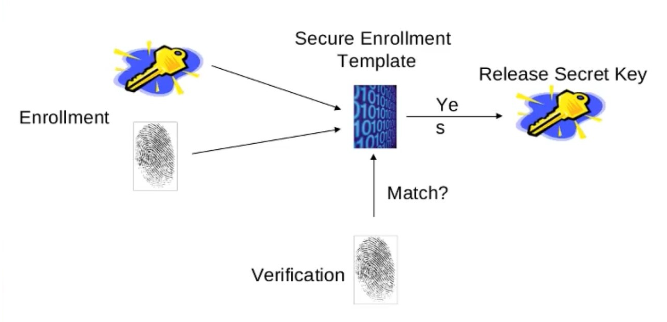
- Key-binding
- You generate a random key using an algorithm and you mix that key with your biometric
- The database stores a mixture of the template and the randomly generated key
- To authenticate yourself, you simply provide the biometric data that you used and the algorithm removes it from the data set, which should leave you with a key, and if you get the correct key, then you get authenticated and so on
- Irreversible
Template protection schemes
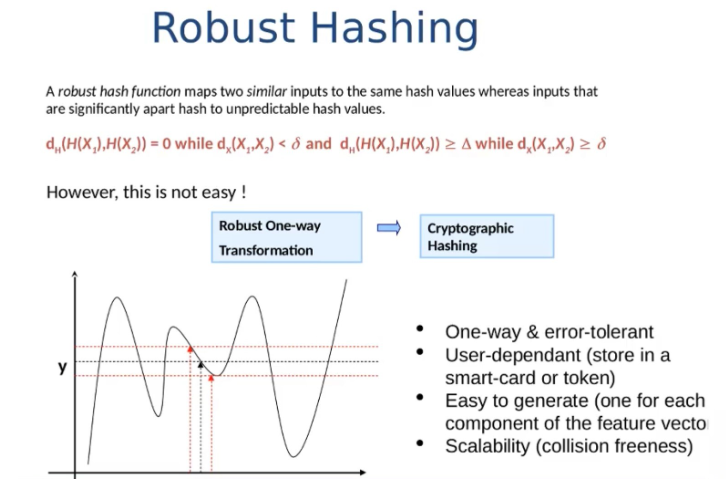
- Robust hashing
- A robust hash function maps two similar inputs to the same hash values whereas inputs that are significantly apart hash to unpredictable hash values
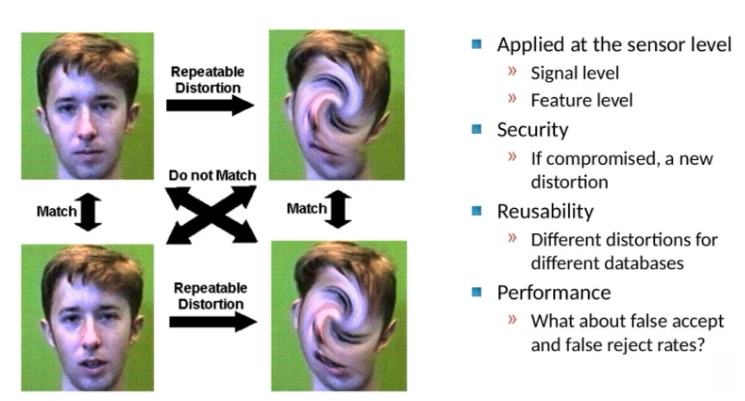
- Cancelable biometrics \n
- Fuzzy vaults
- Not specific to biometric data, but typically applied to minutiae-based fingerprint matches as a key binding biometric cryptosystem
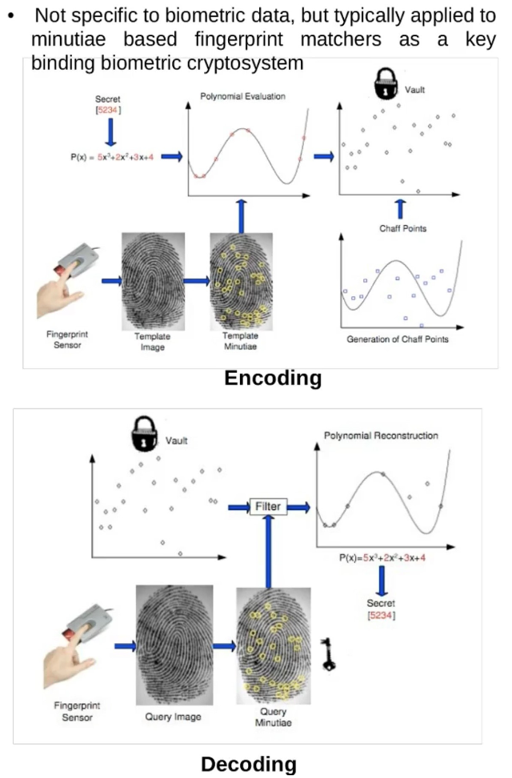
Fuzzy vaults vulnerabilities
- Chaff Point Identification
- Improved brute force attack
- Correlation attack / Key attack
- Hill Climbing
- etc.
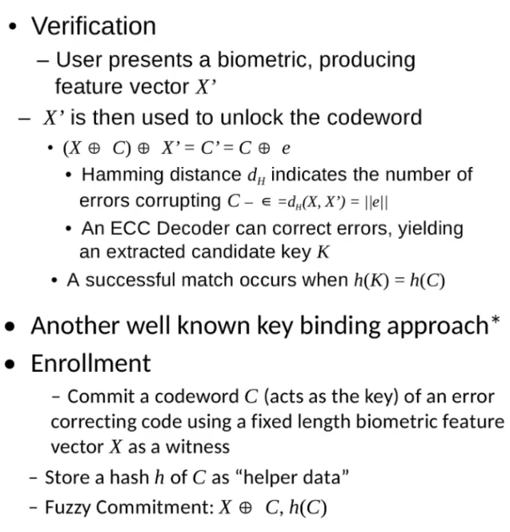
Fuzzy commitments (Another well-known key binding approach)
- Enrollment
- Commit a codeword (C), that'll act as the key, of an error-correcting code using a fixed-length biometric feature vector (X) as a witness
- Store a hash (h) of C as "helper data"
- Fuzzy commitment requires a fixed-length feature vector representation of a biometric modality
- Fuzzy extractors (A key binding cryptosystem)
- The goal is to extract a uniformly random string (R) from its input (w) in a noise-tolerant way (If the input changes in some way, but remains close, the string (R) can still be reproduced exactly)
- An attractive proposition, but difficult due to intra-user variability
\n