Energetics 2: Bond Enthalpy Study Notes
Essential Ideas and Nature of Science in Energetics
The Fundamental Principle of Energetics: Chemical reactions involve the exchange of energy. A central axiom of chemistry is that energy is absorbed when chemical bonds are broken and energy is released when chemical bonds are formed.
Role of Models and Theories:
Measured energy changes in chemical systems can be explained through models focusing on the breaking and forming of bonds.
Because these explanations are contingent on scientific models, the level of agreement with empirical (experimental) data depends on the sophistication of the model used.
Data obtained from experiments can be used to refine or modify existing theories when discrepancies occur between predicted and measured values.
The Mechanics of Breaking and Making Chemical Bonds
The Process Overview: Most chemical reactions follow a two-step energetic process:
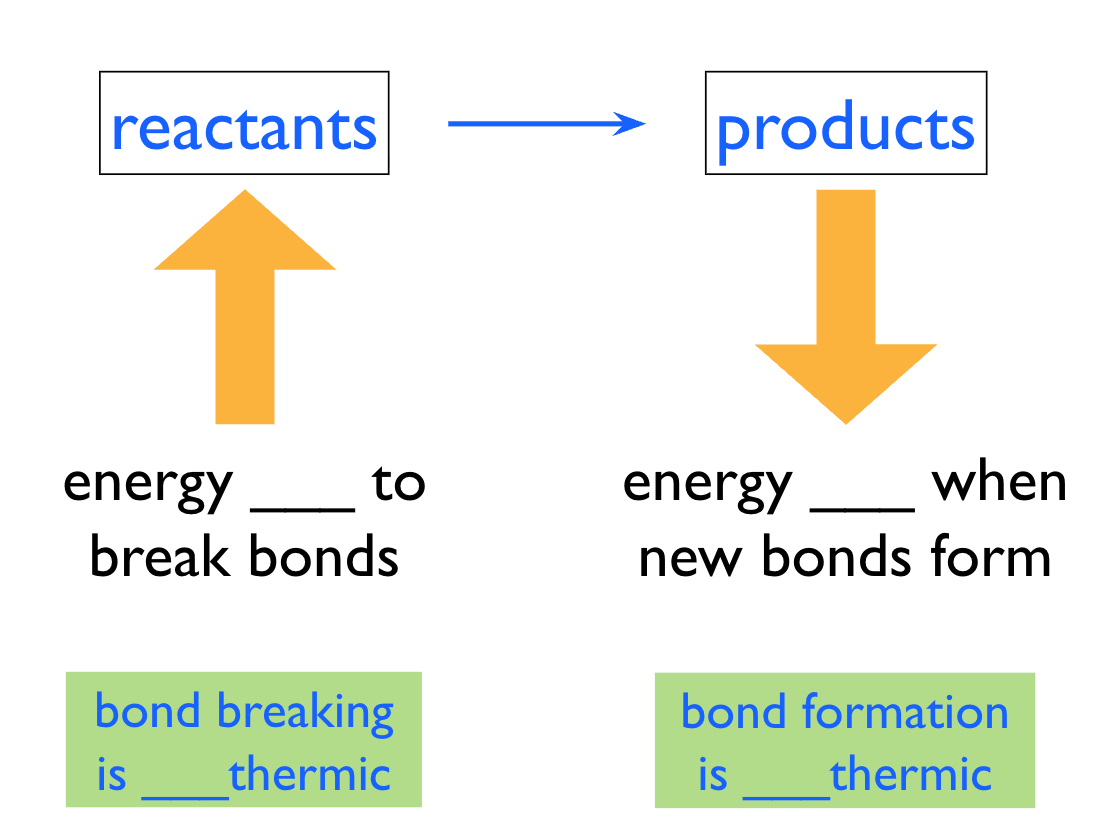
Bond Breaking: Energy must be supplied (absorbed) to the system to overcome the attractive forces between atoms in the reactants.
Bond Formation: Energy is released to the surroundings as new attractive forces establish stable bonds in the products.
Thermodynamic Classifications:
Bond Breaking: This is always an endothermic process (requires an input of energy).
More energy is put in than what you get from the reaction
Bond Formation: This is always an exothermic process (releases energy).
Getting out more energy than you put into the reaction
Case Study: Formation of Water:
Reaction: * Enthalpy Change (): * Analysis: For this reaction to occur, the bonds in the reactants ( and ) must be broken, which requires energy. New bonds () are formed in the products, which releases energy. Since is negative, more energy is released during formation than is absorbed during breaking.
Thermodynamics of Endothermic and Exothermic Reactions
Endothermic Reactions:
Energy Balance: Energy required to break bonds in reactants is greater than the energy released when new bonds form in the products (\text{Energy In} > \text{Energy Out}).
Net Result: Energy is absorbed overall from the surroundings.
Exothermic Reactions:
Energy Balance: Energy required to break bonds in reactants is less than the energy released when new bonds form in the products (\text{Energy In} < \text{Energy Out}).
Net Result: Energy is released overall to the surroundings.
Enthalpy Diagrams and Reaction Progress
Visualizing Endothermic Reactions:
The enthalpy of the products is higher than the enthalpy of the reactants.
A large arrow pointing upward represents the energy required to break bonds. * A smaller arrow pointing downward represents the energy released when new bonds form.
The net difference is the positive value.
Visualizing Exothermic Reactions: *
The enthalpy of the products is lower than the enthalpy of the reactants. *
A smaller arrow pointing upward represents the energy required to break bonds. *
A larger arrow pointing downward represents the energy released when new bonds form. *
The net difference is the negative value.
Defining Bond Enthalpy
Primary Definition: Bond enthalpy refers to the energy required to break one mole of a given covalent bond in a molecule under standard conditions.
Physical State Requirement: Both reactants and products must be in the gaseous state for the definition to apply.
Starting it as a solid would misrepresent the number as it would require more energy, therefore, messing up the calculations.
Example: with * Example: with
Average Bond Enthalpy (ABE): Because the strength of a specific bond (e.g., ) can vary depending on its chemical environment, scientists use average values derived from a range of different covalent molecules. *
Example: The Bond: *
The average value across many molecules is . *
In , breaking the first bond: requires . *
Breaking the second bond: requires . *
In Methanol: requires .
Comprehensive Data: Average Bond Enthalpy Values (kJ/mol)
Single Bonds: * : * : * : * : * : * : * : * : * : * : * : * : * : * : * : * :
Multiple Bonds: * : * : * : * : * : * : * : * : * : * :
Estimating Enthalpy Change ()
Mathematical Concept: Bond formation releases the exact same amount of energy used to break the bond, but with an opposite sign. * Breaking : has . * Forming : has .
Formula for Estimation: *
* This is conceptually: (Energy used to break bonds) - (Energy released when bonds form).
Calculation Examples:
* Example 1: Formation of Water (): *
Reactants: and . * Products: . * Example 2: Combustion of Propane (): * Reactants: , , . *
Products: , . *
Example 3: Combustion of Nitrogen (): *
Normally, combustion is exothermic. However, the combustion of Nitrogen is endothermic. *
Reason: The triple bond is extremely strong (). The energy required to break this bond is significantly higher than the energy released when the new bonds form.
Limitations of Bond Enthalpy Calculations
Estimation vs. Reality: Calculations using bond enthalpies are only estimates rather than precise experimental values for several reasons:
Gaseous State Assumption: Bond enthalpies are defined for substances in the gaseous state. If reactants or products are liquid or solid in reality ( rather than ), additional energy involves potential energy changes from intermolecular forces (e.g., hydrogen bonding), which bond enthalpies do not account for.
Average Values: Average bond enthalpies represent the mean value across a range of molecules. The actual bond strength in a specific molecule like propane may be slightly different from the average documented in tables.
Phase Changes: For liquid or solid reactants, energy is required to overcome intermolecular forces before the chemical bonds themselves can be broken, changing the total enthalpy profile of the reaction.