Movement across membrane ( Diffusion )
Movement across membrane are achieved by :
diffusion , Osmosis, Active Transport, Facilitated diffusion, Bulk Transport
The cell surface area is a barrier , must be permeable to some substance if the cell is to survive organic / mineral nutrients + respiratory gases + waste product.
Diffusion : The movement of molecules of a substance rom a region of. Higher concentration to a region of a lower concentration eventually the equilibrium is reached.
Factors that affect diffusion :
temperature
Surface Area
Concentrate Gradient
→ The steeper the con gradient ( more molecules ) - faster the diffusion.
Distance of diffusion paths
Nature of molecules or ions
Facilitated Diffusion
The hydrophobic Centre of the phospholipid bilayer prevents charged molecules and ions from passing through.
Metabolic energy not required for facilitated diffusion.
Example of facilitated diffusion :
Calcium pump
Sodium pump
Potassium pump
Any carrier & channel proteins
Smaller molecules can pass through easier such as
O2 → non-polar / small
CO2 → polar / small
H2O → Polar / small only water can pass through
Large polar molecule / ions can’t pass such as : Glucose + Amino acid Na+ / K+ ions
are too large and are repelled by the hydrophobic tails of the phospholipid.
Facilitated Diffusion - passive movement of substances along the concentration gradient (
Carrier Protein
Example ; sodium potassium pump
The solutes ‘ docks ‘ with the carrier protein, which changes its shape. The solute is transferred across the membrane during the shape change.
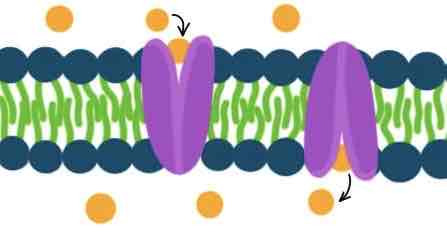
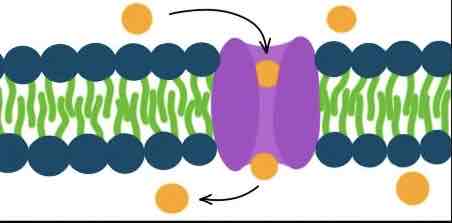
Facilitated Diffusion : Channel Protein
The channel protein shield the solute from the hydrophobic centre of the membrane, the channel may be gated and require a stimulus to open it.
How does channel protein work
Channel proteins span the membrane and make hydrophilic tunnels across it, allowing their target molecules to pass through by diffusion.
Fick’s Law - The rate of movement of a substance across an exchange surface is proportional to :
Surface Area x Concentration Difference
________________________________________
Diffusion path
Diffusion path / Distance :
Distance < = < the diffusion path.
Exchange surface are often very thin :
capillary endothelium 0.5 um
Alveolus wall 0.5 um
How the concentration gradient is maintained ?
Molecules enters the cell then pass into organelles and are used for metabolic reactions.
→ this helps maintain the con gradient.
O2 diffusing into cytoplasm of respiring cell then diffuses into mitochondria =) aerobic respiration.
CO2 diffusing into palisade mesophyll cells of a plant leaf then diffuses into chloroplasts =) photosynthesis