Lecture 14- Hydrostatics (slides)
Fluids
Definition: Fluids are substances that flow and can be classified as liquids or gases.
Density
Definition: Density p (in kg/m³) relates the mass and volume of a fluid.
Formulae:
Pressure
Definition: Pressure is defined as force per unit area.
SI Unit: Pascal (Pa)
Example Calculation:
A student with a mass of 83 kg has sneakers with a total surface area of 0.0290 m².
Pressure exerted:
Atmospheric Pressure
Standard Atmospheric Pressure:
Hydrostatic Equation
Principle:
Any pressure applied to a fluid is transmitted equally throughout the fluid as well as the walls of the container (Pascal’s Principle).
Hydrostatic Equation:
P atm is atmospheric pressure,
p is fluid density,
g is acceleration due to gravity,
h is height or depth in the fluid.
Describes how pressure changes with depth in a fluid.
Measuring Pressure
Absolute Pressure:
Measured using a barometer.
The formula is:
(where ( h ) is the height of the fluid).Can use to calculate the atmospheric pressure if you have height and vice versa.
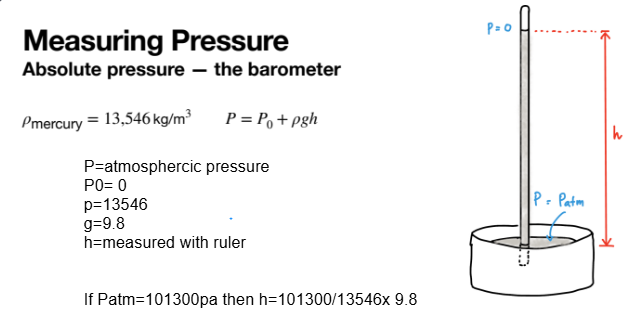
In theory it dosen’t have to be mercury used (but for practical reasons it is good to use so the barometers not 10 feet tall)
Gauge Pressure:
Measured using a manometer.
Defined relative to atmospheric pressure:
Looking at the difference in pressure - relative to atmosphere
Where:
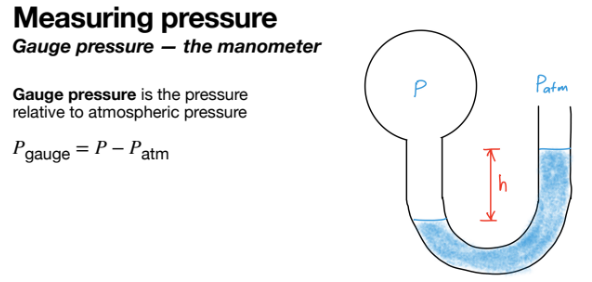
Measuring Blood pressure is a example of this.
The two numbers you measure (e.g. 120/ 70) represent the systolic and diastolic pressures, respectively, indicating the pressure in the arteries during heartbeats and between beats.
Buoyancy
Definition: The upward force exerted by a fluid on a submerged object.
Archimedes' Principle:
States the buoyant force is equal to the weight of the fluid displaced by the object:
Sinking & Floating Objects
To determine if an object will sink or float:
Compare the densities (p) of the object and the fluid.
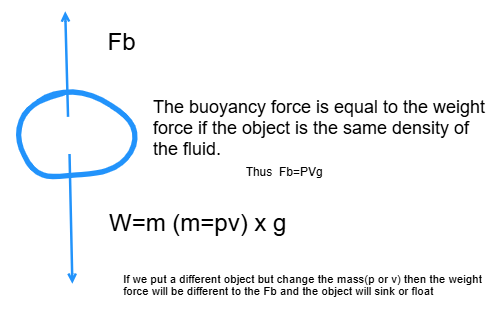
Example:
Iceberg's submerged volume in seawater:
Given densities:
Determine the proportion of the iceberg below water based on these densities.