Chapter 1
Chapter 1: Introduction to Law
1. The Nature and Meaning of Law
Definition of law: "The body of rules recognized and applied by the State in the administration of justice."
2. The Classification of Law
2.1 Criminal and Civil Law
Criminal Law: Deals with wrongdoing that is punishable by the State (e.g., murder, bribery).
The state will prosecute the wrongdoer if found guilty
Main purpose: punish the offender
Civil Law: Focuses on the rights and duties between individuals.
Example: John sues Shady Sam for defective software.
Main purpose: Compensate the injured party.
Branches of Civil Law
Contract Law: Deals with agreements between parties.
Law of Tort: Deals with cases where one person’s actions cause harm or loss to another person, allowing them to seek compensation(e.g., negligence, defamation).
Family Law: Issues related to family matters (e.g., divorce, custody).
2.2 Characteristics of Law
Criminal Law
Public Element: Enforced by the state, conduct is made if it threatens society’s well being, security and good order
Punishment: offenders can face death, imprisonment, fines etc
Civil Law
Private: Is usually between 2 parties, involves the plaintiff taking legal action to sue the defendant in court
Compensation: Monetary damages awarded to the plaintiff.
Overlap Between Criminal and Civil Law
Same action can lead to both civil and criminal liability (e.g., reckless driving).
3. Legal Change
Laws evolve in response to societal changes, technology, and moral beliefs, necessitating a stable environment for businesses.
4. Sources of Law
Main Sources
Legislation: Laws made by Parliament or person/body authorized by the parliament
Common Law: A judge must apply relevant legislations to a case if they exists to arrive at a decision
Doctrine of Precedence
Judges refer to prior cases (precedents) when legislation does not apply.
Precedents recorded in law reports form the basis of common law.
5. Legislation
Laws made by Parliament, documented as statutes, Acts of Parliament, legislation or statutory law
Statutes remain effective until repealed or amended.
5.1 The Making of Legislation
Government decides on new laws; legislative draftsmen prepare Bills.
Process includes three readings in Parliament:
First Reading: Introduction of the Bill.
Second Reading: Members debate; public input for significant Bills such as those that affect individual rights
Third Reading: Members vote on the Bill.
Assent by President to become law.
5.2 Subordinate Legislation
Made by individuals or bodies authorized by Parliament, has the same standing as an act of parliament.
They set out the details to be carried out under the act of parliament.
5.3 Precedent and Legislation
Statutes prevail in cases of conflict with judicial precedents.
6. The Relevance of English Law to Singapore
Singapore’s legal system is influenced by English law.
Identification of Singapore as a common law country.
Distinctions with civil law systems common in other regions.
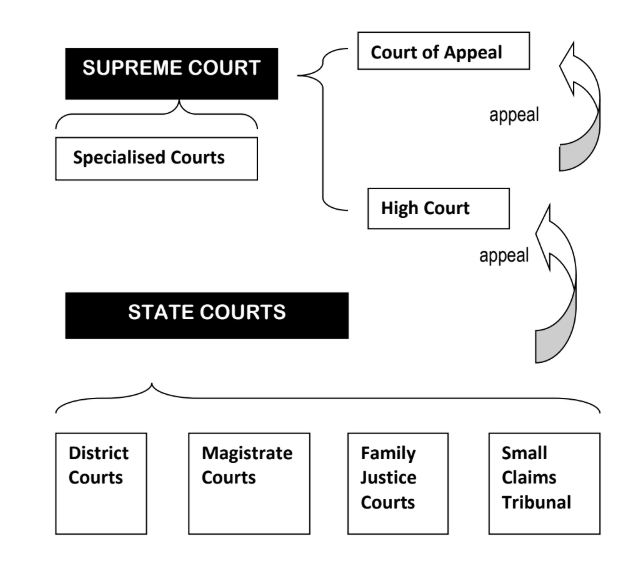
7. The Singapore Court System
Jurisdiction
Defines the authority to hear cases; Supreme Court consists of:
Court of Appeal (upper chamber): Highest court for appeals.
High Court(lower chamber): Original and appellate jurisdiction. Presided over a high court judge or judicial commissioner. Hears both civil and criminal cases
State Courts Structure
District Courts: Claims over $60,000 and up to $250,000.
Magistrates’ Courts: Claims up to $60,000.
Family Justice Courts: Addresses family-related matters.
Small Claims Tribunal: Handles small value claims. e.g. sale or purchase of goods. The value of the claims must not exceed $20000 but can be increased to $30000 if consented.
*if a person’s claim exceeds $20000, he can still file his claim in the court but has to limit his claim to $20000
8. Prosecutions and the Settlement of Disputes
8.1 Introduction
Overview of civil versus criminal law; focus on civil cases.
8.2 Prosecutions (Criminal Cases)
Conducted by the State for offenders.
For cases that are not very serious, the punishment is merely a fine or a very short prison term
In more serious cases, there could be an arrest where the accused may be detained in custody for investigations
When the criminal case goes to court, the accused will either plead guilty or claim trial. If he claim trial, he will go for a hearing where he will be freed if not guilty or sentenced if guilty
8.3 Settlements of Disputes (Civil Cases)
Disputes can be resolved between themselves or can choose to sue in a court of law or choose an alternative dispute resolution method.
8.4 Litigation Process
Involves the plaintiff suing the defendant.
The person who sues is the plaintiff while the person who is being sued is called the defendant
Must sue within specified time limits with necessary evidence.
Civil cases must be proven on a balance of probabilities and at the end of the trial, the judge will either deliver a judgement in favor of the plaintiff or dismiss the case
8.5 Court Dispute Resolution (CDR)
Processes alternative to litigation, available free of charge to resolve disputes.
Enable parties to attain a “win-win” situation through co-operation, mediation and negotiation
8.6 Alternative Dispute Resolution Methods (ADR)
Mediation
Third-party mediator facilitates resolution.
The mediator does not make a binding decision but facilitates discussions and negotiations
Arbitration
Third-party arbitrator resolves disputes; outcomes enforceable like court judgments.
The arbitrator hears evidence and arguments from both sides and makes a binding decision