Sun
Earth → Sun Relationship
Heliocentric View
The earth is almost spherical in shape and revolves around the sun in an epliptecal orbit
earth - sun distance is longest in July (152M km) and shortest in January (147M km)
The full revolution takes 365.24 days (365 days 5 h 48’ 46” to be precise)
and as the calendar year is 365 days, an adjustment is necessary: one
extra day every four years (the ‘leap year’). This would mean 0.25 days per
year, which is too much. The excess 0.01 day a year is compensated by a
one day adjustment per century
The plane of the earth's revolution is referred to as the ecliptic. The earth's
axis of rotation is tilted 23.45o from the normal to the plane of the ecliptic
(Fig.1). The angle between the plane of the earth's equator and the
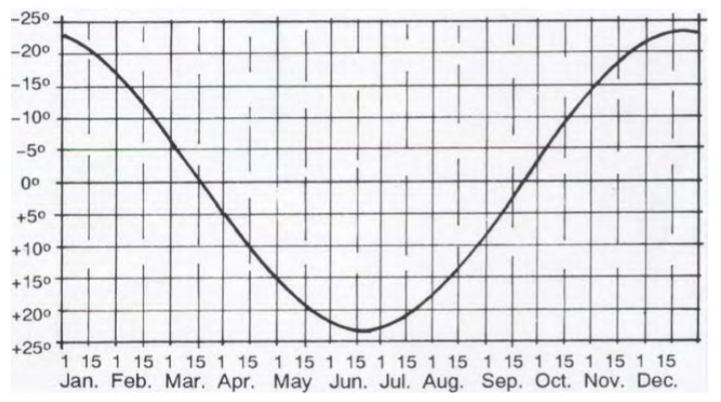
ecliptic (or the earth - sun line) is the declination (DEC) and it varies
between +23.45o on June 22 (northern solstice) and -23.45o on December
22 (southern solstice, Fig.2).
On equinox days (approximately March 22 and Sept.21) the earth - sun
line is within the plane of the equator, thus DEC = 0o. The variation of
declination shows a sinusoidal curve (Fig.3).
Geographical latitude (LAT) of a point on the earth's surface is the angle
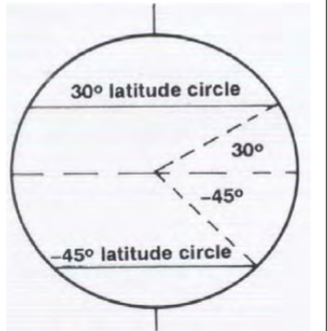
subtended between the plane of the equator and the line connecting the centre with the surface point considered.
Points having the same latitude form the latitude circle (Fig.4). The latitude
of the equator is LAT = 0o, the north pole is +90o and the south pole -90o.
By the convention adopted southern latitudes are taken as negative. The
extreme latitudes where the sun reaches the zenith at mid-summer are the
'tropics'
The arctic circles (at LAT = 66.5o) mark the extreme positions, where at
mid-summer the sun is above the horizon all day and at mid-winter the sun
does not rise at all
Time
In Solar work usually solar time is used
This is measured from the solar noon,
i.e. the time when the sun appears to cross the local meridian. This will be
the same as the local (clock-) time only at the reference longitude of the
local time zone.
E.g.: Australian eastern time is based on the 150o longitude, i.e. Greenwich
+ 10 hours. However, Queensland extends from 138o to 153o longitude, so
in Brisbane (long. 153o) solar noon will be earlier than clock noon. As 1
hour = 60 minutes, the sun's apparent movement is 60 / 15 = 4 minutes of
time per degree of longitude. In Brisbane the sun will cross the local
meridian 4 (150 - 153) = 4 3 = - 12, i.e. 12 minutes before noon, i.e. at
11:48 h local clock time. Conversely at the western boundary of
Queensland the solar noon will occur 4 * (150 - 138) = 48 minutes later, i.e.
at 12:48 h local clock time.
Due to the variation of the earth's speed in its revolution around the sun
(faster at perihelion but slowing down at aphelion) and minor irregularities
in its rotation, the time from noon - to - noon is not always exactly 24 hours
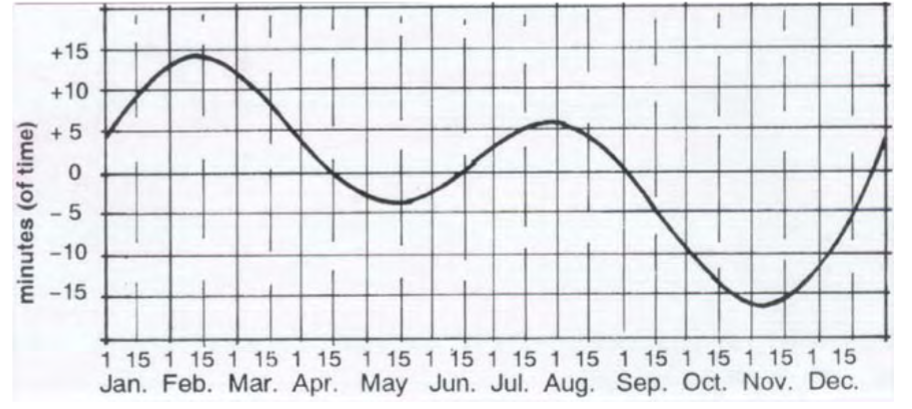
Clocks are set to the average length of day, which gives the mean time,
but on any reference longitude the local mean time deviates from solar
time of the day by up to -16 minutes in November and +14 minutes in
February
What we now call universal time (UT), used to be called Greenwich mean
time, is the mean time at longitude 0o (at Greenwich)
Then solar time + EQT = local mean time
Sun Paths
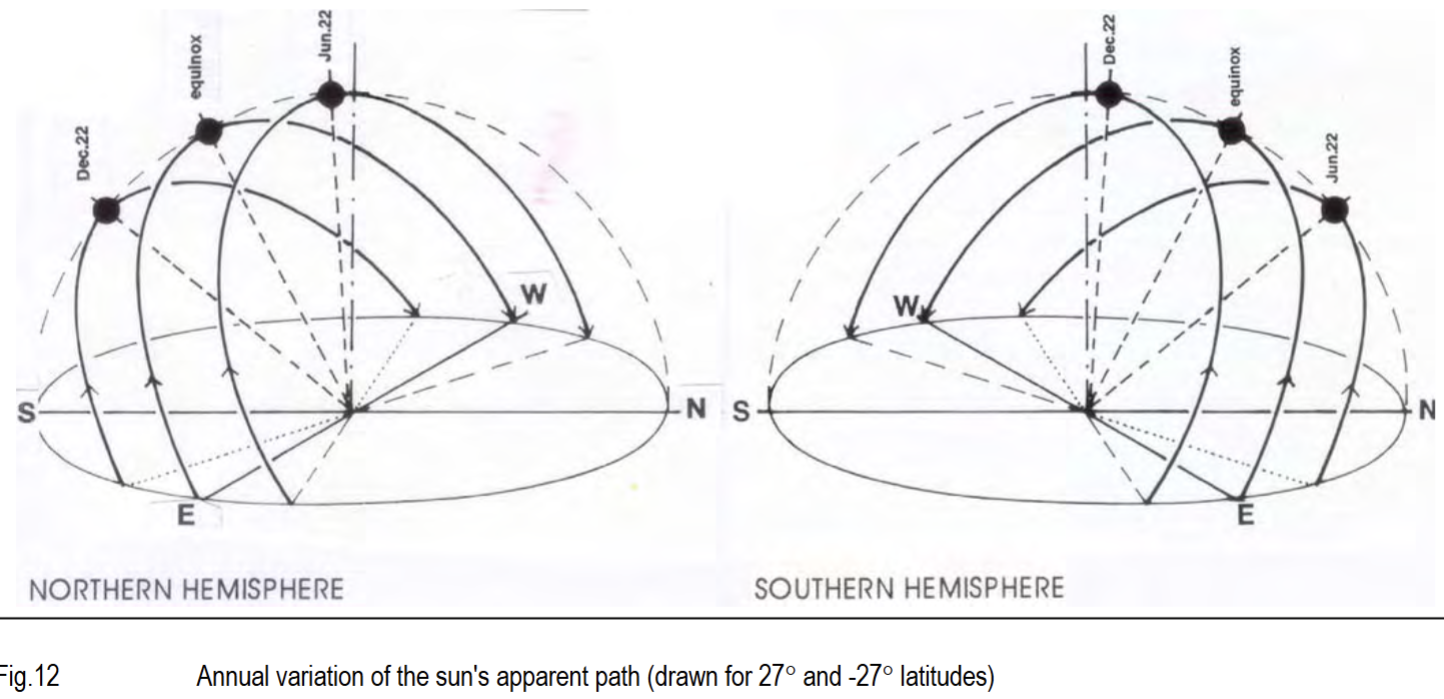
At mid-summer the sun would rise well north of east (in the northern
hemisphere (Fig.12)
At northern mid-winter the sun would rise south of east
and later (north of east for the southern winter). Both the azimuth
displacement and the time of sunrise depend on the latitude
The planes of mid-winter and mid-summer sun paths are parallel with the equinox path, but shifted north and south respectively.
The degree of tilt of these sun paths from the vertical is the same as the
latitude of the location.
At the equator the sun paths would be vertical and at the pole the equinox sun-path would match the horizon circle, for the winter half-year the sun would be below the horizon and for the summer half-year it would not set: it would spiral up to an altitude of 23.45o and then back to the horizon
Gnomonic Projections
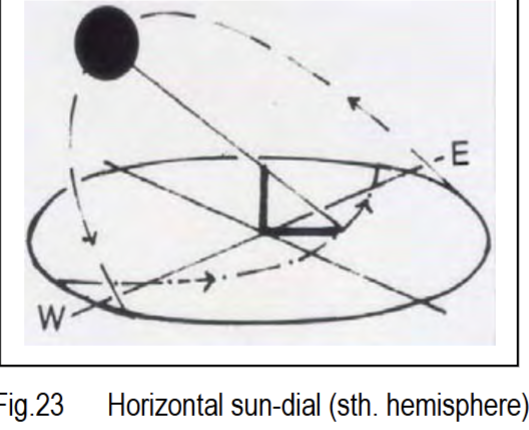
Aside from modern day sun diagrams Sun-clocks or sun-dials have been used for thousands of years. There are two basic types: horizontal and vertical. With a horizontal sun-dial the direction of the shadow cast by the gnomon (a rod or pin) indicates the time of day. Conversely, if the direction of this shadow for a particular hour is known, then the direction of the sun (its azimuth angle) for that hour can be predicted.
If the length of the gnomon is known, then the length of the shadow cast
will indicate the solar altitude angle. During the day the tip of the shadow
will describe a curved line, which can be adopted as the sun-path line for
that day
Algorithms
Declination and Equation of Times
Calendar dates are expressed as the number of day of the year (NDY),
starting with January 1. Thus March 22 would be: NDY = 31 + 28 + 22 = 81
and December 31: NDY = 365.
Declination is a sine function, which is zero at the equinoxes. To
synchronize the sine curve with the calendar, the distance from the March
equinox to the end of the year (284 days) is added to the NDY. As the year
(365 days) corresponds to the full circle (360o), the ratio 360/365 = 0.986
must be applied as a multiplier, thus
DEC = 23.45 sin [0.986 (284+NDY)]
A function more accurately fitted to the observed data is based on the
leap-year correction: 360/366 = 0.9836.
Using N = 0.9836 * NDY
DEC = 0.33281 - 22.984 cos N + 3.7872 sin N
- 0.3499 cos(2N) + 0.03205 sin(2N)
- 0.1398 cos(3N) + 0.07187 sin(3N)
Both equations use degrees as the angular measure. For a computer
program, where trigonometric functions use radians, eq.2 can be used
with N = NDY (2Pi/366). The result will still be in degrees.
A similar expression is available to obtain the equation of time values. This
is the equation of the graph given in Fig.8. If, as above, N = 0.9836 * NDY
then
EQT = - 0.00037 - 0.43177 cosN + 7.3764 sinN
+ 3.165 cos(2N) 9.3893 sin(2N)
- 0.07272 cos(3N) + 0.24498 sin(3N)