1a. Globalisation
The characteristics of globalisation
Globalisation, from an economic perspective, can be defined as the ever increasing integration of the world’s local, regional and national economies into a single international market.
Globalisation is a process by which economies and cultures have been drawn deeper together and have become more inter-connected through global networks of trade, capital flows, and the rapid spread of technology and global media.
Increased Interdependence
Increased Global Trade
Increased Levels of Migration
Outsourcing and Global Supply Chains
sending production to other countries where it’s cheaper to do it and the idea that components from products come from various different places
Global Capital Flows i.e. Hot Money
shift money to chase higher interest rates
Growth of Multinational Companies (MNCs)
High Levels of Foreign Direct Investment (FDI)
Causes of globalisation
Transportation Costs (Including Containerisation)
The design of bigger ships has made it more efficient and cheaper to move products over the world
Changes in technology e.g. communication and IT (the internet)
This makes it easier to sell abroad directly to consumers and cuts firms’ communication costs allowing outsourcing
Reduction of Trade Barriers / Trade Agreements (e.g. WTO)
Trading blocs such as NAFTA or the EU has meant more tariff-free areas. With lower tariffs the price of imports has decreased making them more competitive
Deregulation of financial markets
This makes it easier for firms to move money abroad in search of greater profit
Political Changes
The end of the Cold War and the opening up of China meant more countries adopting an open market economy for trading
Rank | Causes of Globalisation | Explanation | Policies and Details |
|---|---|---|---|
1 | Changes in technology | Technology, particularly communication and the internet, played a crucial role in enabling global trade and outsourcing in India. Policies supporting the growth of the IT sector, tax incentives, and investments in research and education contributed to this technological advancement. | |
2 | Reduction of trade barriers / Trade agreements | The liberalisation policies of 1991 dismantled the License Raj, reduced trade barriers, and allowed higher foreign direct investment (FDI) in India. Active participation in WTO agreements and regional trade pacts also contributed to increased global integration. | |
3 | Political changes (End of Cold War, China's opening) | The end of the Cold War and China's economic opening encouraged more countries, including India, to adopt open market economies. The policy shift towards economic liberalisation in response to changing global dynamics was a key factor. | |
4 | Deregulation of financial markets | Deregulation policies allowed for easier movement of money across borders, attracting foreign investments. Financial market reforms, such as relaxing restrictions on capital flows, contributed to India's increased economic ties with the global market. | |
5 | Transportation costs (Including containerisation) | While advancements in transportation, like larger ships and containerisation, are essential, specific policies related to transportation in the context of globalisation are not explicitly outlined in the article. It's likely that infrastructure development and trade facilitation policies played a role in reducing transportation costs. |
Aspect | Potential Benefits | Potential Drawbacks |
|---|---|---|
Government | Economic Growth: Globalisation, as seen in India post-1991, has contributed to significant economic growth. Policies like liberalisation attracted foreign investments, boosting GDP and government revenue. | Income Inequality: Despite economic growth, globalisation may exacerbate income inequality. Disparities between rural and urban areas may widen, posing challenges for inclusive growth. |
Producers | Market Access: Producers benefit from increased market access due to reduced trade barriers. Indian industries, especially in IT, pharmaceuticals, and manufacturing, expanded globally, creating more opportunities. | Competition Challenges: Local industries, especially in sectors like manufacturing, may face tough competition from global players. This could lead to job losses and economic strain. |
Consumers | Diverse Choices and Lower Prices: Consumers benefit from a wider range of choices and lower prices due to increased competition. Imported goods become more affordable, enhancing consumer welfare. | Cultural Homogenisation: Globalisation can lead to cultural homogenisation, potentially diluting unique cultural aspects as global brands and influences become dominant. |
Workers | Job Opportunities: Globalisation has led to job creation, particularly in sectors like IT and BPO. Skilled professionals find opportunities with multinational companies, reducing unemployment rates. | Job Insecurity: While globalisation creates jobs, it also brings job insecurity, especially in sectors where technology replaces labor. Workers may face challenges adapting to changing job landscapes. |
Environment | Technology Transfer for Sustainable Practices: Globalisation can facilitate the transfer of environmentally sustainable technologies. As companies adopt global standards, there's potential for improved environmental practices. | Environmental Degradation: Increased production and consumption may lead to environmental degradation. Unregulated global activities can contribute to issues like pollution and resource depletion. |
Countries | Economic Integration: Globalisation encourages economic integration, allowing countries to participate in global markets and benefit from increased trade. This integration can lead to enhanced economic resilience and diversified revenue sources. | Dependency Risks: Overreliance on global markets exposes countries to economic vulnerabilities. External shocks, global economic downturns, or trade disputes can impact national economies. |
Impact of globalisation
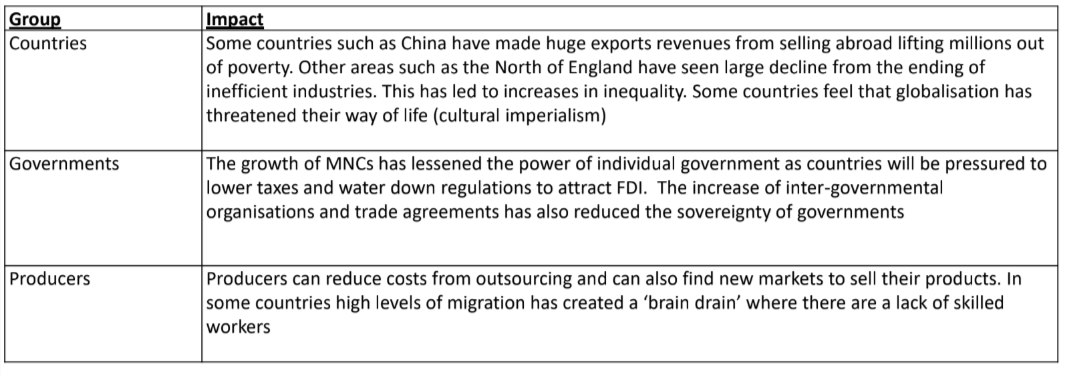
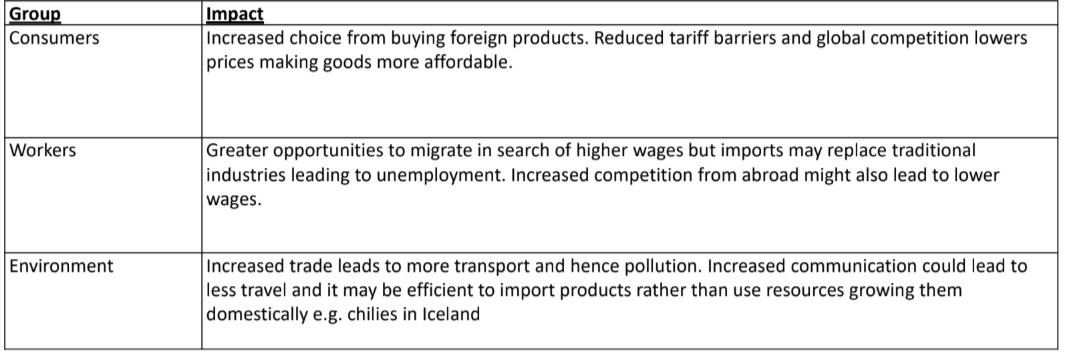
Deglobalisation
Is the retreat of globalisation, as countries become less interdependent.
Causes:
Since the Global Financial Crisis by many measures the world seems less globalised
There is a focus on bilateral or regional rather than international trade agreements
There has been a rise in economic nationalism seen in Brexit and other anti-EU/NAFTA
protests
There has been a greater use of protectionism
Is globalisation good for the world?
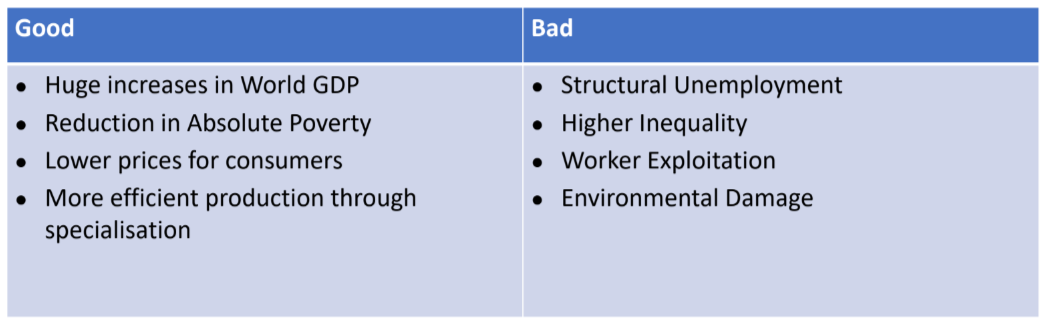
Non economic impact of globalisation
Impact on culture
Is the native culture of the country weakened by globalisation?
Impact on politics
Is the sovereignty of the country limited by international agreements?