𝙲𝚎𝚕𝚕𝚞𝚕𝚊𝚛 𝚁𝚎𝚜𝚙𝚒𝚛𝚊𝚝𝚒𝚘𝚗
Metabolism - the sum of all of the chemical reactions involved in catabolism and anabolism
- Catabolic – reactions break down large organic molecules into smaller molecules, releasing the energy contained in the chemical bonds.
- Ex: glucagon stimulates the breakdown of glycogen in the liver to increase blood glucose levels.
- Anabolic – reactions involve the joining of smaller molecules into larger ones.
- Ex: insulin promotes the uptake of glucose into body cells from the blood and store it in the liver and muscle as glycogen
- Ex: testosterone stimulates increase muscle & bone mass/strength
- Ex: estrogen increases metabolism and fat deposition
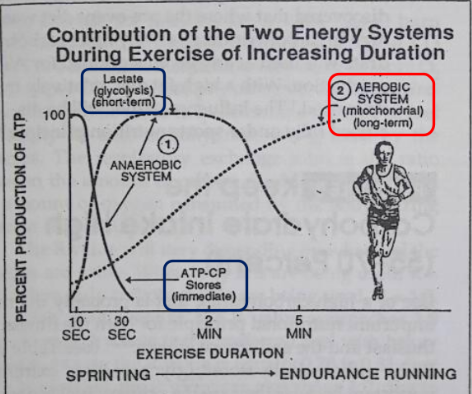
- Energy for muscle contraction produced through 2 pathways:
- Anaerobic Pathway
- Phosphagen / Phosphocreatine system (ATP-PC)
- Lactate System
- Aerobic Pathway
Endurance and Stamina
- Physical training increases VC by increasing the contractile power of the respiratory muscles. This results in deeper respiration per breath & consequently aids in establishing economy in the O2 requirement.
- The untrained individual attempts to compensate by increasing the rate of respiration (# breaths/min) & soon reaches a state of respiratory indebtedness which encumbers /halts performance.
- The ability to keep enough O2 available to cells is key to endurance / avoiding fatigue (there is no evidence that tissues become ischemic, however)
- As a muscle tires, it loses some of its ability to relax and thus increases possibility of tearing
- In fatigue, the reaction time slows and is accompanied by stiffening (inability of the muscle to reach relaxation) which is contributing factor to injury
- So, endurance training not only improves VO2 max but also is a key factor in injury prevention
Energy for muscle contraction
- Creatine Phosphate
- Immediate, Phosphagen System
- Anerobic glycolysis
- Short term, Lactic acid system
- Aerobic glycolysis
- Long term, Glucose, fatty acids, Amino acids
ATP
- ATP is the immediate energy source for muscular contraction
- ATP is present in a small amount, so must be constantly replenished
- There are 2 ways to produce ATP
- anaerobically without the use of oxygen
- ATP-PC system
- lactate system
- aerobically
- oxygen system
Phosphagen system

- The body stores a small amount of ATP & CP (Creatine Phosphate). Muscle can depend on these for most ATP up to 10 seconds
- A muscle cell has some amount of ATP floating around that it can use immediately, but not very much -- only enough to last for about three seconds.
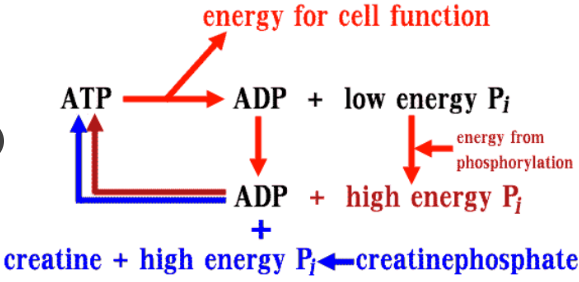
- To replenish the ATP levels quickly, muscle cells contain a high-energy phosphate compound called creatine phosphate.
- The phosphate group is removed from creatine phosphate by an enzyme called creatine kinase, and is transferred to ADP to form ATP. The cell turns ATP into ADP, and the phosphagen rapidly turns the ADP back into ATP.
- As the muscle continues to work, the creatine phosphate levels begin to decrease. Together, the ATP levels and creatine phosphate levels are called the phosphagen system.
- The phosphagen system can supply the energy needs of working muscle at a high rate, but only for 8 to 10 seconds.
Glycolysis
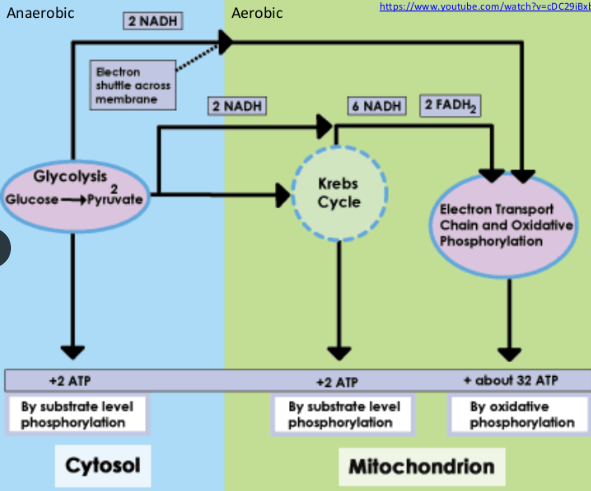
Step 1: breaks 1 molecule of glucose in half, producing 2 molecules of pyruvic acid (a 3-carbon compound)
Step 2: 2 NAD+ ;electron carrier accepts 4 high-energy electrons transfers them to 2 NADH molecules and 2 H+ thus passing the energy stored in the glucose
Step 3: 4 ADP added producing 4 ATP
Step 4: 2 remaining pyruvic acids enter Krebs Cycle in presence of oxygen; IF no oxygen another pathway is followed
NAD+ (nicotinamide adenine dinucleotide)
- Glycolysis is a fast process
- Cells produce thousands of ATP molecules in a few milliseconds
- Glycolysis alone DOES NOT require oxygen
- It can supply chemical energy to cells when oxygen is NOT available
- However, if a cell generates large amounts of ATP from
glycolysis it can run into problems
- a. the cell’s available NAD+ molecules become filled up with electrons
- b. glycolysis shuts down, cannot proceed without available NAD+ molecules
- c. ATP production stops
Anaerobic to Aerobic Respiration
- Glycolysis evolved before the other stages of cellular respiration; other stages need oxygen
- No oxygen in Earth’s atmosphere when life first evolved about 3.5 to 4 b.y.a.
- Without oxygen 🡪 anaerobic respiration
- 2 or 3 billion years ago, oxygen was gradually added to the atmosphere by early photosynthetic bacteria; period the “oxygen catastrophe” 🡪aerobic organisms
Lactic Acid Fermentation
- Many cells convert accumulated pyruvic acid from gycolysis to lactic acid; lactic acid fermentation regenerates NAD+ so glycolysis can continue
- Equation for lactic acid fermentation:
- pyruvic acid + NADH 🡪 lactic acid + NAD+
- When your body cannot supply enough oxygen to muscle tissues during exercise, this is produced
- Without oxygen the body is unable to produce all the ATP it requires, so lactic acid fermentation takes over
Running, swimming, or riding a bike as fast as you can = large muscles in your legs and arms that quickly run out of oxygen…muscles begin to rapidly produce ATP by lactic acid fermentation.
The buildup of lactic acid fermentation causes a painful burning sensation making your muscles burn…
How do you stop it?????
NEED TO INTAKE OXYGEN
Energy and Exercise
- Initially body uses ATP which is already available in muscles
- Then new ATP made by Lactic Acid Fermentation and Cellular Respiration
- Eventually energy supply runs out
- A. Quick Energy
- ATP in muscles only lasts a few seconds
- ATP from lactic acid fermentation lasts about 90 seconds
- this then creates a by-product (lactic acid) which the body must get rid of, the body releases it by panting heavily (intake of oxygen)
- B. Long-Term Energy
- exercise lasting longer than 90 seconds utilizes
cellular respiration to generate a continuous supply
of ATP
- cellular respiration releases energy slower than
fermentation, thus athletes can pace themselves
- body stores energy in muscles and tissues in the
form of glycogen (carbohydrate)
-- stores of glycogen usually lasts for 15-20 minutes
of activity, then the body starts to break down
other molecules like fat for energy