Greek Myth Midterm
The Midterm will have 4 sections:
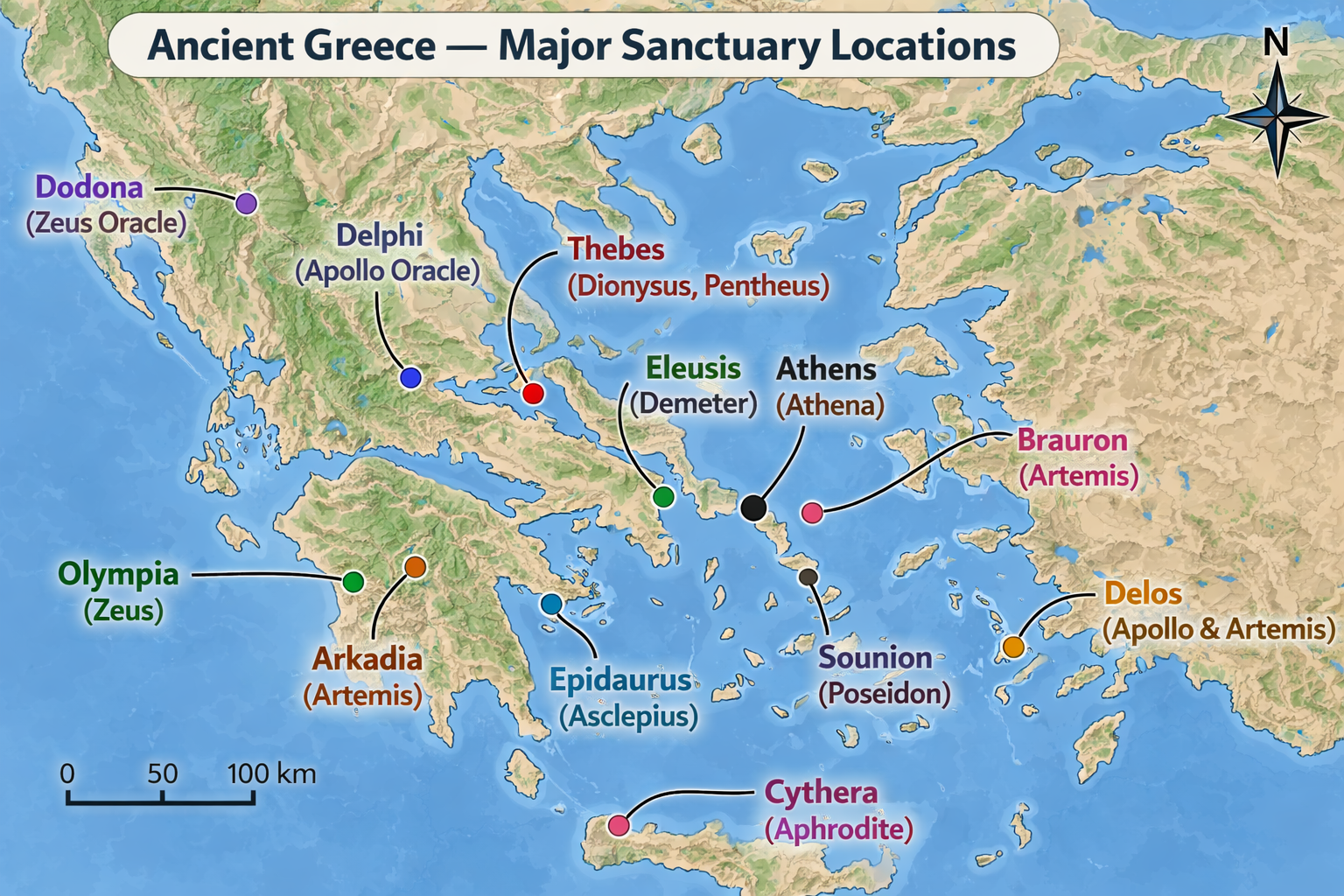
Section 1: LOCATION of Greek Sanctuaries. In the map below note which sites of worship you can detect and which gods were worshipped at each location. (10 points)
Section 2: IDs. Identify and explain 5 out of 6 figures/terms. (30 points)
Section 3: PASSAGE ANALYSIS. Choose 3 out 4 passages and explain where this passage comes from and what its importance is within the text it appears. Things to comment upon may include the following: themes and issues the passage brings to mind; characterization of a certain figure. (30 points)
Section 4: VISUAL ANALYSIS. Choose 3 out of 4 images and describe who/what is represented there and what is noteworthy about this representation. (30 points)
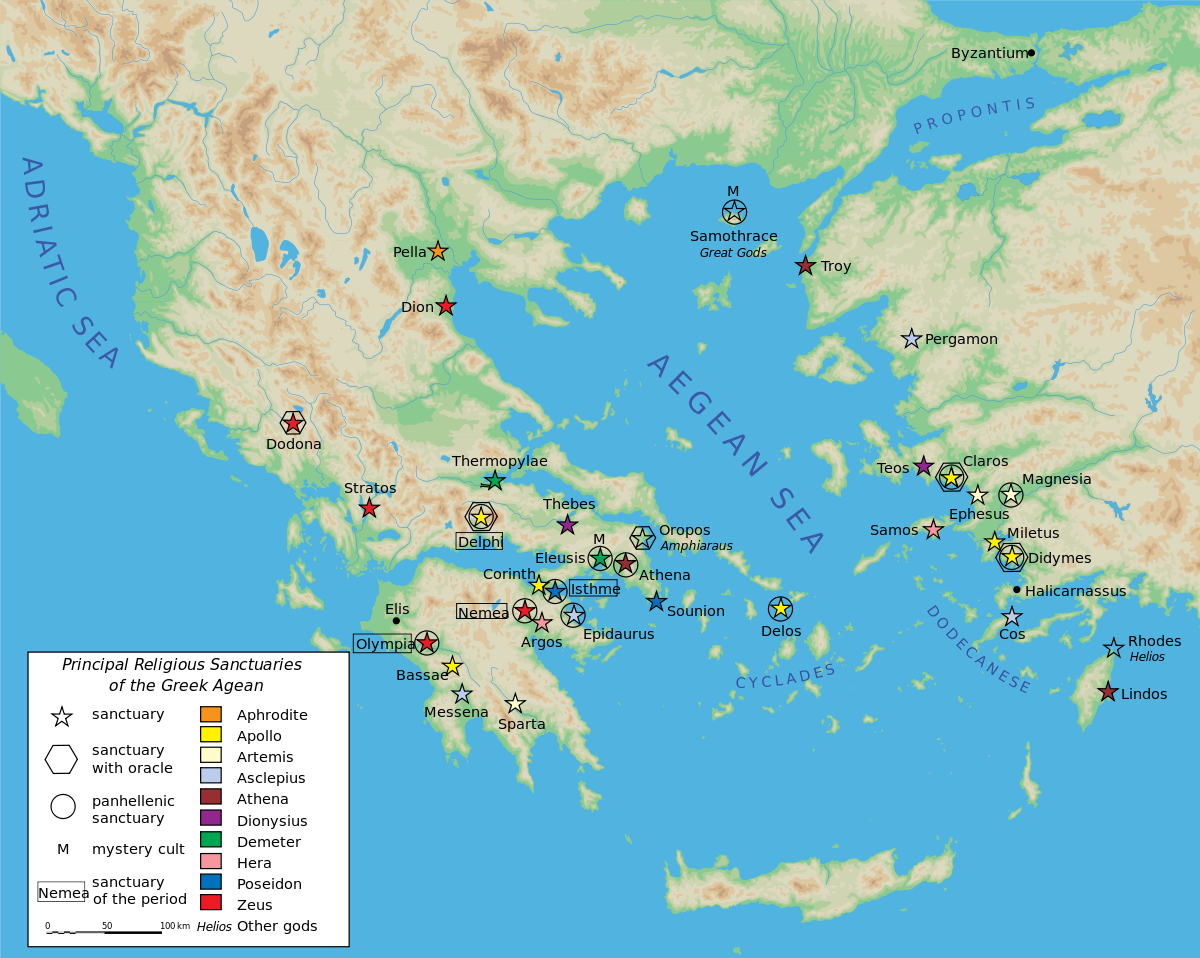
Sanctuary Locations in Greece
Athens:
Main sanctuary of Athena (Athena Parthenos) on the Acropolis. Athena is the patron goddess of the city, associated with wisdom, strategy in war, and civic order.
Eleusis:
Sanctuary of Demeter and Persephone. Site of the Eleusinian Mysteries, secret initiation rituals promising hope for a better afterlife.
Brauron:
Sanctuary of Artemis. Known for the Brauronia festival, where young girls dressed as bears in rituals marking the transition from childhood to adulthood.
Sounion:
Sanctuary of Poseidon, overlooking the sea. Sailors prayed here for safe travel.
Olympia:
Sanctuary of Zeus, site of the Olympic Games.
Delphi:
Sanctuary of Apollo. Home of the famous oracle, where the Pythia delivered prophetic messages.
Cythera:
Important sanctuary of Aphrodite, associated with love and sexuality.
Delos:
Sacred island and birthplace of Apollo and Artemis.
Thebes:
Important in myths of Dionysus, Cadmus, and Pentheus.
Dodona:
Sanctuary of Zeus, known for one of the oldest Greek oracles.
Arkadia:
Region associated with Artemis and wilderness cults.
Epidaurus:
Sanctuary of Asclepius, god of healing.
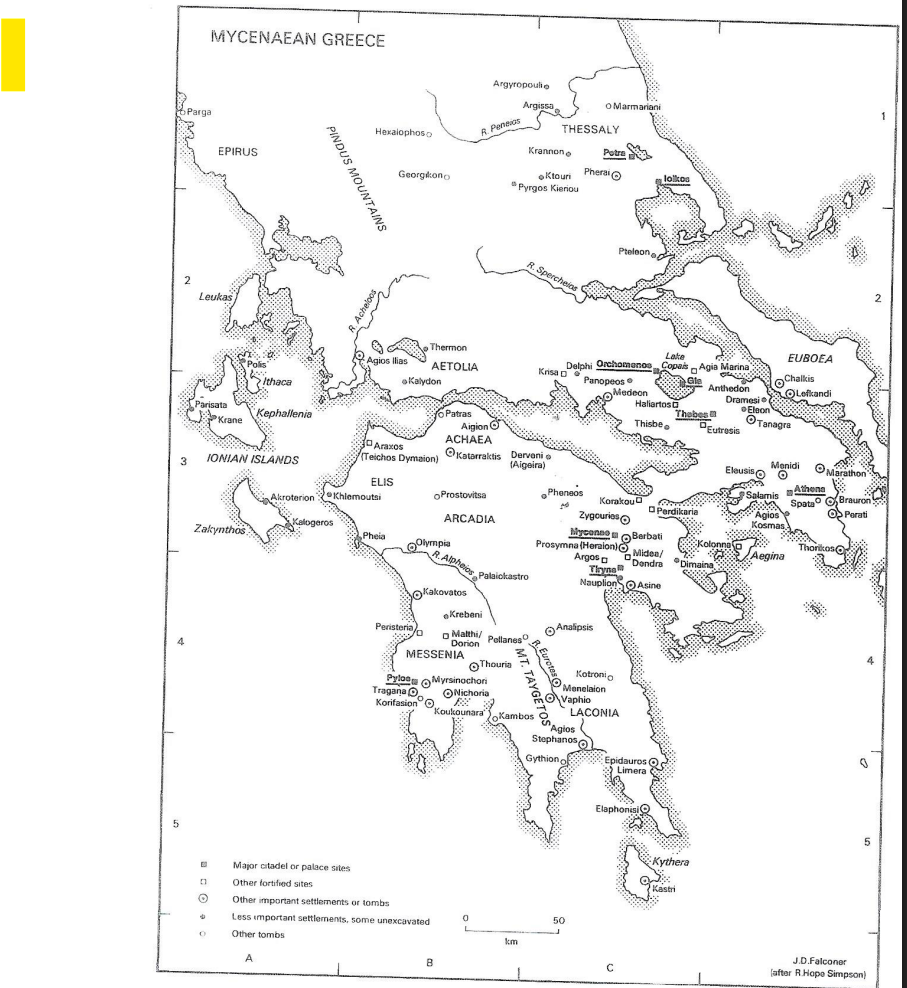
Names and Terms for Midterm Exam
Temenos (sanctuary):
A sacred space dedicated to a god. It was marked off from ordinary land and contained temples, altars, and ritual areas.
Ouranos/Heaven:
Primordial god of the sky and first ruler of the cosmos. Son and husband of Gaia. Overthrown by his son Cronus.
Gaia/Earth:
Primordial goddess representing Earth. Mother of many gods including the Titans.
Eros:
Primordial force of attraction and desire that brings beings together and enables creation.
Cronus:
Leader of the Titans who castrated his father Ouranos and ruled the cosmos before Zeus.
Rhea:
Titan goddess and wife of Cronus. Mother of the Olympian gods including Zeus.
Zeus:
King of the gods who overthrows Cronus. Associated with justice, divine order, and political authority.
Titans:
Earlier generation of gods defeated by Zeus and the Olympians during the Titanomachy.
Prometheus:
Champion of humanity who stole fire from the gods and gave it to humans. Punished by Zeus by being chained to a rock where an eagle eats his liver daily.
Metis:
First wife of Zeus and personification of wisdom. Zeus swallowed her to prevent their child from overthrowing him. Athena was later born from his head.
Sacrifice (thusia):
Central Greek religious ritual where animals were killed and offered to the gods. Humans ate the meat while gods received the bones and fat.
Ocean:
Primordial river surrounding the world.
Oceanids:
Daughters of Ocean, water nymphs associated with rivers and springs.
Epimetheus:
Brother of Prometheus who accepts Pandora as a gift from the gods.
Pandora:
First woman created by the gods as punishment for humanity. Opens a jar releasing hardships into the world.
Athena (Parthenos):
Virgin goddess of wisdom, strategy, and crafts. Patron deity of Athens.
Poseidon:
God of the sea, earthquakes, and horses. Brother of Zeus.
Hephaestus:
God of fire, metalworking, and craft. Often depicted as lame.
Hera:
Queen of the gods and wife of Zeus. Associated with marriage.
Demeter (Karpophoros):
Goddess of agriculture and grain. Mother of Persephone.
Persephone (Kore):
Daughter of Demeter who is abducted by Hades. Her seasonal return explains the cycle of the seasons.
Hades:
God of the underworld and ruler of the dead.
Metaneira:
Queen of Eleusis who hosts Demeter while she searches for Persephone.
Demophoon:
Son of Metaneira whom Demeter attempts to make immortal.
Eleusis:
Site of the Eleusinian Mysteries dedicated to Demeter and Persephone.
Mystes:
First-level initiate in the Eleusinian Mysteries.
Epoptes:
Higher-level initiate who has completed the full Eleusinian initiation.
Telesterion:
Large hall at Eleusis where the secret rituals of the Mysteries occurred.
Hiereis:
Priests responsible for performing religious rituals.
Manteis:
Seers who interpreted divine signs and prophecies.
Artemis (potnia theron):
Virgin goddess of the wilderness and animals. Protector of young girls.
Brauron:
Sanctuary of Artemis where girls participated in initiation rituals.
Actaeon:
Hunter torn apart by his own dogs after seeing Artemis bathing.
Orion:
Great hunter loved by Artemis; later placed in the stars.
Niobe:
Woman who boasted she was superior to Leto. Apollo and Artemis killed her children in punishment.
Callisto:
Follower of Artemis seduced by Zeus and transformed into a bear.
Aphrodite (Cypris, Cyprogenes, Cytherea):
Goddess of love, beauty, and sexual desire. Born from sea foam after Ouranos’ severed genitals fell into the ocean. Her epithets connect her to cult centers like Cyprus and Cythera.
Anchises:
A mortal shepherd loved by Aphrodite in the Homeric Hymn to Aphrodite. She disguises herself as a mortal woman and their union produces the hero Aeneas.
Aeneas:
Son of Aphrodite and Anchises. A Trojan hero and legendary ancestor of the Romans.
Leto:
Mother of Apollo and Artemis by Zeus. Because Hera was jealous, Leto wandered until she could give birth on the island of Delos.
Apollo (Delian, Pythian, Loxias):
God of prophecy, music, healing, and order. His epithets refer to his birth on Delos, his oracle at Delphi, and the ambiguous nature of his prophecies.
Delphi:
Major sanctuary of Apollo and location of the famous Greek oracle where the priestess Pythia delivered prophetic messages.
Hermes (Argeiphontes):
Messenger god associated with travel, trickery, and commerce. The epithet Argeiphontes refers to his killing of the giant Argus.
Mercury:
Roman equivalent of Hermes, serving as the messenger of the gods and protector of merchants and travelers.
Physchopompos:
An epithet of Hermes meaning “guide of souls,” referring to his role leading the dead to the underworld.
Dionysus (Lysios):
God of wine, theater, and ritual madness. Associated with freedom from social norms and ecstatic religious experiences.
Semele:
Mortal mother of Dionysus.
Teiresias:
Blind prophet of Thebes who recognizes Dionysus' divinity.
Pentheus:
King of Thebes who refuses to recognize Dionysus and is punished.
Cadmus:
Founder of Thebes and grandfather of Pentheus.
Agave:
Mother of Pentheus who kills him in a Dionysian frenzy.
Maenads:
Female followers of Dionysus who enter ecstatic states.
Bacchae:
Another name for Dionysus’ female worshippers.
Sparagmos:
Ritual tearing apart of animals during Dionysian frenzy.
Thebes:
An important mythological city associated with Dionysus. In Euripides’ Bacchae, Dionysus returns to Thebes to prove his divinity after King Pentheus refuses to recognize him.
Key Texts:
ZEUS AND DIVINE ORDER
Hesiod — Theogony (1–210)
Topic: Origins of the universe and the gods
Main idea: Explains how the cosmos and the first gods came into existence.
Key figures
Chaos – the first existence
Gaia – Earth
Ouranos – Sky
Titans – second generation of gods
Important details
Gaia and Ouranos produce the Titans
Kronos overthrows Ouranos
Establishes the pattern of sons overthrowing fathers
Key themes
Creation of the universe
Generational conflict among gods
Establishment of divine genealogy
Hesiod — Theogony (456–508)
Topic: Birth of Zeus
Main idea: Zeus escapes Kronos, who eats his children.
Key figures
Kronos
Rhea
Zeus
Important details
Kronos swallows his children to avoid being overthrown
Rhea hides Zeus in Crete
Zeus is secretly raised and later defeats Kronos
Key themes
Fate cannot be avoided
Rise of Zeus
Hesiod — Theogony (621–969)
Topic: Titanomachy (war of gods)
Main idea: Zeus and the Olympians defeat the Titans.
Key figures
Zeus
Titans
Cyclopes
Hundred-Handed Giants
Important details
Zeus frees the Cyclopes
Cyclopes give Zeus thunderbolt
Titans are imprisoned in Tartarus
Key themes
Establishment of Zeus as king of gods
Creation of cosmic order
ORIGINS OF HUMANS AND PROMETHEUS
Hesiod — Theogony (509–620)
Topic: Prometheus and the sacrifice trick
Main idea: Prometheus tricks Zeus in a sacrifice ritual.
Key figures
Prometheus
Zeus
Important details
Prometheus divides sacrifice into:
meat hidden in stomach
bones wrapped in fat
Zeus chooses bones → humans keep meat
Zeus punishes humans by withholding fire
Key themes
Origin of sacrifice
Conflict between gods and humans
Hesiod — Works and Days (1–234)
Topic: Why humans must suffer and work
Main idea: Explains human hardship.
Key figures
Prometheus
Pandora
Important details
Prometheus steals fire
Zeus creates Pandora
Pandora opens jar releasing evils
Only hope remains
Key themes
Justice of Zeus
Human suffering
Importance of labor
Aeschylus — Prometheus Bound (1–517)
Topic: Punishment of Prometheus
Main idea: Prometheus suffers for helping humanity.
Key figures
Prometheus
Zeus
Hephaestus
Oceanids
Important details
Prometheus chained to rock
Gave humans:
fire
technology
knowledge
Key themes
Conflict between tyranny and justice
Sympathy for Prometheus
ORIGINS OF WOMEN
Hesiod — Works and Days (58–128)
Topic: Creation of Pandora
Main idea: First woman created as punishment for men.
Key figures
Pandora
Zeus
Important details
Pandora made by the gods
She opens a jar releasing evils
Explains origin of suffering
Key themes
Misogyny in early Greek thought
Women as source of trouble
Hesiod — Theogony (573–620)
Topic: First woman
Main idea: Pandora as origin of women.
Important details
Women described as consuming men’s labor
Marriage portrayed as burden
Semonides — Fragment 7
Topic: Types of women
Main idea: Satirical classification of women.
Examples
Fox woman – cunning
Pig woman – dirty
Dog woman – loud
Bee woman – ideal wife
Theme
Greek misogyny and stereotypes
APHRODITE
Homeric Hymn to Aphrodite
Topic: Aphrodite’s power over love
Main idea: Zeus forces Aphrodite to fall in love with a mortal.
Key figures
Aphrodite
Anchises
Important details
Aphrodite disguises herself
Sleeps with Anchises
Their child is Aeneas
Key themes
Power of sexual desire
Even gods are vulnerable
APOLLO AND HERMES
Homeric Hymn to Hermes
Topic: Birth of Hermes
Main idea: Hermes proves his cleverness immediately after birth.
Key figures
Hermes
Apollo
Important details
Hermes steals Apollo’s cattle
Invents the lyre
Apollo becomes his ally
Key themes
Trickery
Intelligence
Establishing divine roles
Homeric Hymn to Apollo
Topic: Birth and power of Apollo
Key figures
Apollo
Leto
Hera
Important details
Leto searches for place to give birth
Apollo born on Delos
Apollo kills Python
Establishes oracle at Delphi
Themes
Prophecy
Divine authority
DEMETER AND PERSEPHONE
Homeric Hymn to Demeter
Topic: Origin of seasons and Eleusinian Mysteries
Key figures
Demeter
Persephone
Hades
Zeus
Important details
Hades abducts Persephone
Demeter causes famine
Compromise:
Persephone spends part of year in underworld
part with Demeter
Themes
Agricultural cycles
Mother–daughter relationship
Mystery cults
ATHENA
Homer — Iliad
Athena’s role
Important details
Supports the Greeks
Helps heroes in battle
Goddess of strategic warfare
Homer — Odyssey
Athena’s role
Important details
Protects Odysseus
Guides Telemachus
Helps restore order in Ithaca
Burkert (Athena)
Key ideas
Athena represents
wisdom
strategy
civic order
protector of cities
Main sanctuary: Athens Acropolis
ARTEMIS
Burkert — Artemis
Topics
goddess of wilderness
hunting
protector of young girls
Important details
associated with wild nature
transition to adulthood
Vikela (2008)
Focus
Artemis worship in Attica
Important details
sanctuary at Brauron
girls participate in bear rituals
DIONYSUS
Euripides — Bacchae
Topic: Dionysus and religious ecstasy
Key figures
Dionysus
Pentheus
Maenads
Important details
Pentheus denies Dionysus
women go into ecstatic frenzy
Pentheus is torn apart by his mother
Key themes
power of the god
danger of rejecting religion
ecstatic worship
Burkert — Dionysus
Key concepts
Ekstasis – trance state
Enthousiasmos – possession by god
Omophagia – eating raw flesh