Autonomy
Autonomy as an Adolescent Issue
Autonomy: the psychosocial domain concerning the development and expression of emotional, cognitive, and behavioral independence
Autonomy is more of a lifespan issue.
Why is it seen as an adolescent issue?
Physical changes
Physical changes associated with puberty lead to an interest in dating, but also change how individuals perceive themselves.
Cognitive changes
Teens are better able to consider the consequences of their behavior.
Further development of moral values.
They are better able to make their own decisions.
Changes in social roles.
Being able to drive, work, date, and (later) drink and get married.
Development of Emotional Autonomy
Emotional autonomy: the establishment of more adult-like and less childlike close relationships with family members and peers.
Transformations in the P-C relationship across the lifespan
These transformations may lead to changes, such as:
expression of affect
distribution of power
patterns of verbal interaction
By the end of adolescence:
Don’t rush to your parents when upset or in need of assistance
Do not see parents as all-knowing
Have strong relationships outside of family
Able to see parents as real people, not just as parents
Detachment
a process through which adolescents sever emotional attachments to their parents and other authority figures
Empirical support?
Most parents and teens get along quite well.
While there may be an increase in bickering over mundane issues, parents and teens remain close during this time period.
Are parent-teen relationships completely severed?
No.
Emotional autonomy involves transforming (not breaking off) relationships within the family, including those with parents.
Thus, teens can become emotionally autonomous without being completely detached from their parents.
Individuation
It involves a gradual sharpening of one’s sense of self as an autonomous and competent individual who is separate from one’s parents.
Connected to and involved in identity development.
Does not involve stress and turmoil in most families.
Being successful at individuation is accepting responsibility for one’s own choices and actions.
Steinberg & Silverberg's (1986) study found:
Increases in the extent to which teens de-idealize parents.
“My parents sometimes make mistakes.”
Increases in the extent to which teens depended on themselves.
“When I’m done something wrong, I don’t always depend on my parents to straighten things out.”
Increases in the degree to which teens felt individuated in relations with parents
“There are some things about me that my parents don’t know.”
De-idealization may be the first step of a longer process.
A 15-year-old may be less likely to have an idealized image of parents than a 10-year-old, but they are no more emotionally autonomous.
Some teens have trouble seeing their parents as individuals outside of parenting roles.
Thus, this part of emotional autonomy may not fully mature until the 20s, especially if the teen goes to college, which their parents pay for.
Importance of positive parent-teen relationship quality
The process of emotional autonomy is helped in the context of a positive and supportive parent-teen relationship.
Parents and teens need to maintain a positive relationship throughout adolescence.
What triggers the individuation process?
Puberty
Changes in physical appearance lead to changes in (A) how teens view themselves and (B) how parents view teens.
Advances in social cognition.
Young teens’ view of themselves is the same as their parents’ perspective.
Over time, teens begin to see that their parents’ view is one of many and may not always be accurate because their parents don’t always see different sides of them.
Teens can have a healthy life outside of their home life.
Parenting
Psychological control
Teens who have parents who are intrusive and overprotective may have trouble individuating from their parents.
This can lead to high levels of depression and anxiety and poor social competence.
Research by Stuart Hauser and Joseph Allen:
Parental enabling behavior: accept their teens while at the same time helping them to develop and state their own ideas with helpful and supportive conversations.
Parental constraining behavior: have difficulty accepting their teen’s individuality; react to the teen’s effort for autonomy by distracting, being judgmental, and devaluing the teen.
Results showed that teens whose parents used more enabling behavior were more individuated and scored higher on measures of identity development.
Parenting Styles and Emotional Autonomy
Better outcomes for authoritative parents (friendly, fair, firm) than authoritarian (excessively harsh), indulgent (excessively lenient), or indifferent (excessively neglectful) parents.
Why is this?
Authoritative families tend to be more flexible to the changes that occur during adolescence and are more likely to have open discussions regarding family issues.
Authoritarian homes are less flexible to developmental changes during adolescence and want to maintain the status quo by enforcing rules with little or no discussion.
Indulgent and indifferent families have established no standards, which leads to teens turning to less experienced peers.
Indifferent parents are also less warm and positive towards the teen, which exacerbates the lack of adequate parental teaching and socialization.
Development of Behavioral Autonomy
Behavioral Autonomy: the capacity to make independent decisions regarding one’s behavior and actions and follow through on them.
A behaviorally autonomous individual can:
turn to others for advice when appropriate
weigh alternative courses of action based on own opinion and the suggestions of others
can reach an independent conclusion on how to behave
Changes in decision-making abilities
Cognitive advances that help:
hold multiple viewpoints at the same time and compare them
consider the possible long-term consequences of choosing one course of action
consider the viewpoints and vested interests of others
Changes in susceptibility to influence
Views of authority changes
What do preadolescents believe?
Parents and teachers have authority over a wide range of issues.
Adults’ rules are important and legitimate.
Over time, adolescents begin to…
question adult authority
See some issues as personal and outside of parental authority
allow friends to influence their decisions.
Conformity to peers
tends to be higher during early and middle adolescence compared to preadolescence and late adolescence
Peers may serve as a temporary “way station”
parent-oriented → peer-oriented → behaviorally autonomous
Who do teens turn to for advice?
Turning to parents…
Long-term issues, such as educational or occupational plans.
Questions of values, religious beliefs, or ethics.
Turning to teachers or outside experts…
For objective information, such as where to go for college.
Turning to peers…
Short-term, day-to-day, and social matters, such as styles of dress, choice of music, and other leisure activities
Influence of parents:
Behavioral autonomy is stronger in authoritative homes than in other homes.
Authoritative parenting:
leads to decreased influence of antisocial peers
leads to increased influence of prosocial peers
Summary:
Detachment from parents, not attachment to peers, leads to negative outcomes.
Development of Value Autonomy
What is value autonomy?
Changes in teens’ conceptions of moral, political, ideological, and religious issues.
Three trends in value autonomy…
Teens become increasingly abstract in the way they think about issues and concepts.
Beliefs become increasingly rooted in broad and general principles that have some ideological basis.
Beliefs become increasingly founded in the young person’s own values and not merely because their parents and/or other authority figures believe it.
What sparks value autonomy?
Cognitive advances
Growing ability to think abstractly and reasoning abilities spark change.
Emotional and behavioral autonomy → value autonomy
As teens realize that parents aren’t experts on everything, they develop their own ideas.
Development of Moral Reasoning during Adolescence
Lawrence Kohlberg
Used hypothetical moral dilemmas about difficult, real-world situations.
Like Piaget, Kohlberg was interested not in what a child says but the reason behind answers.
Stages
Level 1: Pre-conventional Reasoning (no internalization)
Moral reasoning is controlled by external rewards and punishment
Level 2: Conventional Reasoning (intermediate internalization)
Individuals abide by standards, but they are the standards of others (ex., parents, society laws).
Level 3: Post-conventional Reasoning
An individual recognizes alternative moral courses, explores the options, and then decides on a personal code that guides their behavior.
Sex Differences
Carol Gilligan
Argued that Kohlberg’s theory puts abstract principles above relationships and concerns for others.
Gilligan’s research has found that girls interpret moral dilemmas in terms of human relationships and base their interpretations on listening and watching other people.
Justice Perspective vs. Care Perspective
Kohlberg emphasized the justice perspective, which focuses on the rights of the individual and how individuals independently make moral decisions.
Gilligan emphasized the care perspective: views people in terms of their connectedness with others and emphasizes interpersonal community, relationships with others, and concern for others.
Political Thinking during Adolescence
How does it change during adolescence?
It becomes more abstract.
It becomes less authoritarian and less rigid.
In late adolescence, the youth develops a personal ideology that guides their behavior.
Do political beliefs predict political behavior?
Yes, but it often depends on the local community and historical context (ex., 1960s peace movement, influence of 9/11, COVID-19).
Religious Beliefs during Adolescence
How do religious beliefs change during adolescence?
More abstract
more independent
more oriented toward spiritual and ideological matters
less oriented toward rituals, practices, and religious customs.
Compared to children, adolescents…
place greater emphasis on external aspects of religious commitment (ex., what one believes).
Place less emphasis on external manifestations (ex., going to church).
Teens are religious but aren’t tied to specific rituals.
Adolescent survey results…
87% of teens pray
95% believe in God
85% report a religious affiliation
38% attend church weekly
Church attendance and religious observation…
are more common among rural youth, especially from farm families.
Declines among older adolescents and college students.
Results from HDFS 3513 (Research Methods in HDFS) research project:
N = 1,476 participants
Note that this was a class project, so it isn’t publishable.
However, it can shed some light on the subject.
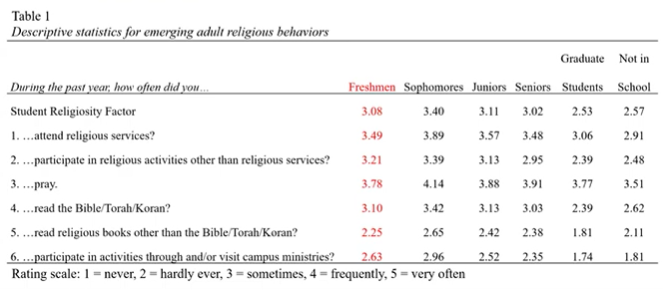
Religiosity tends to fluctuate during college years and is at its lowest during junior and senior years and graduate school.
Note that it is not eliminated.
Maybe a normative developmental change.
Adolescents begin to question beliefs.
Children and younger adolescents often engage in religious behaviors and rituals without question; they are less likely to question authority.
Over time, teens begin to question and reexamine the beliefs that they were raised in start to develop their own truly personal faith.
College can shake up students’ beliefs, but does not replace them.
Reexamining one’s religious beliefs strengthens one’s beliefs and is a sign of maturity.
Remembering who teens are to continue to comply with what their parents’ beliefs are without ever questioning them is associated with identity foreclosure and negative mental health outcomes.