ASTR 1020 Midterm 2
Main Sequence Fitting
Pitting clusters with known absolute magnitudes onto the main sequence before finding the line of best fit
Measuring distance
Comparing apparent magnitude of a far cluster to the absolute magnitude of a closer one will give the distance based on the difference
Why it works
All stars in a cluster are the same age and at the same distance
Every main sequence has the same shape, with the differences being the number of stars and where they appear on the sequence
Any differences in one sequence’s apparent magnitude to another’s absolute magnitude is due to distance
Comparing the vertical (relative apparent magnitude) placement of different main sequence’s tells us how many times farther one cluster is from another
The distance limit of main sequence fitting is the same as parallax, which is ~10 kpc
Main sequence fitting allows us to know the distance of any clusters within the Milky Way
Leavitt’s Law
Leavitt’s Law: if you measure the period of a Cepheid star, the relation tells you its absolute magnitude
Henrietta Leavitt compared Cepheids’ periods with the absolute magnitude they already had available and found that they were related
Variable stars
Reside in the instability strip on the HR diagram
Cannot achieve full hydrostatic equilibrium, and constantly vary in temperature, luminosity, and radius
Because of this, radiation pressure and gravity try to overpower each other
When gravity wins the star begins contracting, then pressure increases, temperature increases, and nuclear reactions increase
Eventually the star contracts enough where radiation pressure overpowers gravity- the star expands, pressure decreases, temperature decreases, and nuclear reactions decrease
Cepheids can be observed at very large distances due to their luminosity
The brightness of a Cepheid variable can produce a light curve, with the period of a Cepheid describing how long it takes to repeat its varying pattern
Standard candle: an object whose M is related to another observable trait which can determine its M no matter where it is for as long as it can be observed
Leavitt’s Law has a limit of ~40 Mpc, or 8 million light-years
Galaxies
Cosmology: the study of the structure and evolution of the universe
Observing galaxies at different distances tells us it’s state, age, and behavior whenever the photons left their source
Gravitational interactions between galaxies were more common in the early universe
Order of galaxy formation:
Gas uniformly filled space
Denser regions with higher gravity pulled gas inwards
Denser regions contracted forming protogalactic clouds, with the H and He in them forming the first stars
Leftover clouds with angular momentum settled into a disk, while clouds with little momentum became ellipticals
Spin and density of protogalactic clouds can determine the size of the disks on spirals or whether the galaxy is a spiral or elliptical
Gas cycles:
Start as blue star-forming systems
Mergers create larger and more luminous red galaxies with less star formation
Starburst galaxies produce new stars at extremely high rates (~100x as much as the Milky Way)
Spectra of starburst galaxies show lots of emission in the infrared
Supernovae explosions in starburst galaxies drive powerful galactic winds out, which can drive away most of its gas
Blue cloud: active star formation
Red sequence: less star formation due to age
Types of galaxies:
Spirals: spiral shape with newer star formation in the arms while older stars make up the disk. Younger than ellipticals and can turn into ellipticals due to disruption of disks
Ellipticals: all bulge, no disk, consist of only older stellar populations with a round shape caused by billions of stars on random elliptical orbits. Tend to be found where galaxies are closer together, with larger ones often being found at the centers of galaxy clusters. Older than spirals
Lenticular’s: galaxies with a disk but no spiral arms and not as much dust; intermediate between spirals and ellipticals. Have used up most gas in their ISM and consists mostly of old red stars
Irregulars: no defined shape or central bulge; mostly a collection of gas and dust with some ongoing star formation
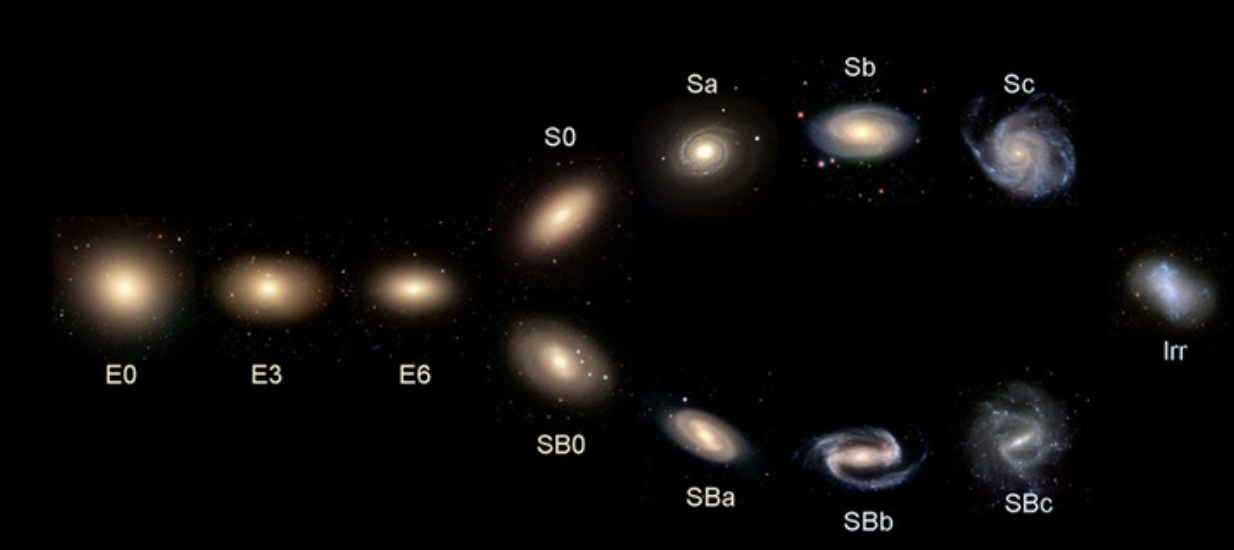
From left to right, old to young, less gas to more gas, more bulge to less bulge, tight arms to loose arms
Milky Way
Ionization nebulae are found around short-lived high mass stars and show active star formation
Reflection nebulae scatter light from stars housed inside and look bluer than the stars
There is star formation in the disk and arms but not the halo. Stars in the halo form before the disk
Spiral arms are over-dense regions of gas and stars
Because all gas and stars are orbiting the center of the Milky Way in ellipses, a lot of them overlap
Gas clouds get compressed, compression triggers star formation, young stars move out of arms in their orbit
Galaxy interaction can also induce a spiral arm pattern by disrupting a stars orbit
The Milky Way was formed from a huge cloud of intergalactic gas
Halo stars formed first as gravity contracted over-dense regions, then stopped
Disk stars formed later and kept forming
The remaining gas settled into a spinning disk
Stars continuously form in the disk as the galaxy gets older
Primary features:
Bulge: stars have random orbit orientations, causing the area to look spherical
Disk: stars mostly orbit in the same direction in elliptical orbits on the same plane as the disk
Halo: stars have random orbit orientations, causing the area to look spherical
Galactic recycling:
New stars
Bubbles from dying stars
Gas cools to atomic clouds
Atomic clouds form molecular clouds
Gravity makes stars
Where gas will end up
Electromagnetic Spectrum:
Radio: atomic H shows where gas has cooled and settled into the disk while carbon monoxide shows where molecular clouds are
Infrared: traces where stars are being formed and stars that are blocked by gas clouds through heat
X-Ray: reveals hot gas above and below the disk through high-powered photons emitted from supernovae remnants
Gamma Ray: highest powered photons; emitted from cosmic rays from where supernovae collided with atomic elements in gas clouds