4. Sociolinguistics
1.Introducing sociolinguistics
Definition:
Involvment in scoiolinguistic when
noticing accents/dialects
adjusting/imitating speech in different situations
….
How is it studied?
Quantitative
measurements of variables with numeric outcome
count data
descriptive/inferential statistics
Qualitative
evidence from what people say or write
What is purpose of using particualr linguistic feature?
Participant observation
2.Variation in language
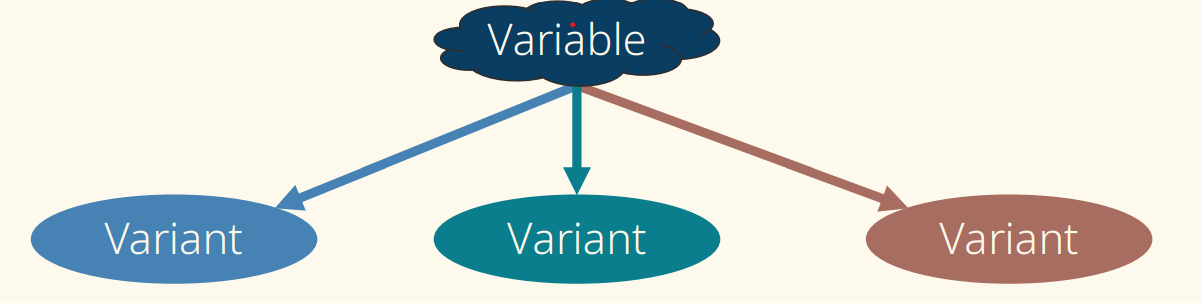
Variables and variants
Variable
abstract representation of source of variation
realised by two or more variants
written in brackets
Variant
actual realisation of variable
written according to convention of level of linguistics
Types of linguistic variables
-Phonetic-phonological variables
pronounciation
-Morphosyntactic variables
grammar (e.g. was/were levelling)
-Lexical variables
different vocabulary for same word
-Pragmatic variables
politeness strategies, terms of address
Internal and external factors
Internal (linguistic features)
→ Distribution of variants of variable determined by linguistic element
e.g. is subject pronoun or NP,which sounds precedes plural morpheme?…
External (non-linguistic) factors
→ factors not related to linguistics determine variation
e.g. formal/informal situation? where is speaker from?…
3.Norms and standards
Non-standard variation
Isoglosses: lines on map showing distribution of regional variants
occurence can be looked up with British National Corpus (BNC) → how many tokens
Definitions
Standard = variety of language which has been officically elevated to prestige status, is preferred in official settings
Norm
associated with education → social gatekeepers
Smakman: standard language in 7 countries
agreement: standard used to easily communicate with anybody, but differences
Poland: standard = correct
England/Netherlands = not regionally marked
Japan = associated with media
Standard English only refers to grammar and vocabulary (can be spoken in many accents)
Received Pronounciation (RP) ad accent counterpart in England (only spoken by 2-5%, based on court language)
General American (GA) as accent counterpart in US (majority accent, in TV/radio, no clue about geographical background)
4.The Labovian revolution
→ Labov’s “The social motivation of a sound change” = founding piece of modern linguistics
traditional dialectology forerunner of sociolinguistics → broke with it
Traditional mainly interested in
real dialect spoken in villagey by old white men living there forever, working in main industry → NORMs (Non-mobile older rural males)
Why Labov’s approach so different?
Others at the time
Language change as chaotic, variation as noise
competition between traditional/innovative norms
change determined after it happened
small sample
NORMs
short questions - short answers
Labov
variation not chaotic, patterns
large sample
different social backgrounds
“Sociolinguistic interview”
5.English in England
From standards and nonstandards (reprise)
→ no accent better suited to serve as standards
→ matter of historical/political/social factors (capital often)
Terminology
Accents
speakers differing at level of pronounciation only
grammar wholly/largely same
index regional origin ord social factors
Dialect
differ in more than just pronounciation
e.g. on morphosyntactic structure/semantic relations mapped
Variety
neutral term to refer to languages/dialects
avoiding problem of drawing distinction between 2 and negative attituted towards dialects
Language
dialect with army and navy
Received pronounciation RP
spoken by tiny minority
no traces regional origin
origin: court
more common in South
Also Sothern Standard British Enlish (SSBE)
Distinction traditional RP/modern RP
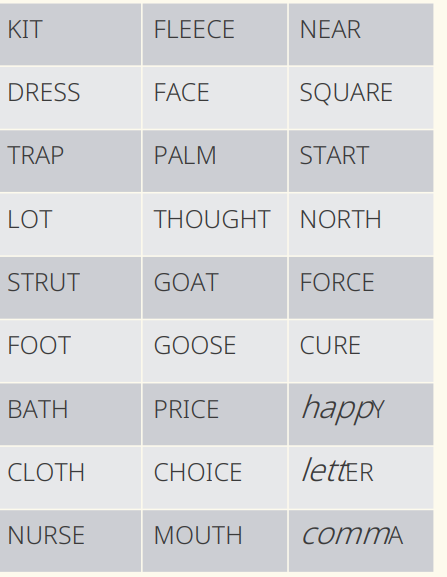
Accent areas
→ England divided in 8 major accent areas
Greater London
South East
West Country
Midlands
East Anglia
North
Merseyside
North East
→ 4 lexical sets helpful to place Englishperson
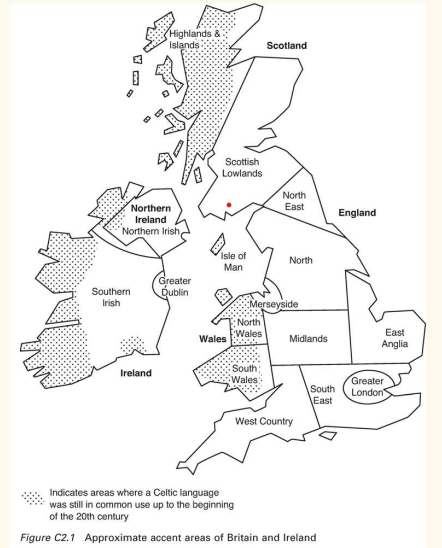
Wells’ lexical set
→ use of one vowel or antoher in particular words illustrated by tabulating occurence in set of keywords: each stands for words which behave same way in incidence of vowels in different accents
e.g. kit contains wish, drink, lift
Trap-bath split / merger
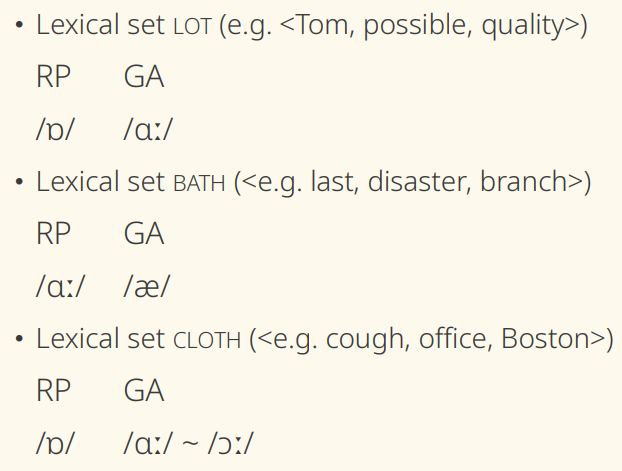
RP/south(-east): words lexical set bath (e.g. dance) phonemically long
Usually the vowel spelt found before fricatives and nasals
/ɑː/ merged with PALM
Other parts UK: vowel short low front
/a/ merged with trap
Foot-strut split
→ Separates England in South/North
North: older pronounciation [ʊ] in all words of lexical set STRUT (e.g. bus, love, touch) merging with FOOT (e.g. hood, bullet, woman, cushion)
South: foot and strut separated
Realisatio face / goat
→ most of UK: vowels in face & goar realised as monopthongs /e(ː)/, /o(ː)/
Cockney and Brummie: wide diphtongs: /æɪ/, /æʊ/
only in RP /eɪ/ and /əʊ/
Grammatical variations
demonstrative “them”
absence plural marker
what as subject relative pronoun
never as past tense negator
there was/there’s with plural subject
perfect participle sat/stood following BE
ain’t / in’t negotiation
non-standard “was”
6.English in the US
Introduction
one of oldest varieties outside Britain
smaller differentiation/variation
Schneider: 13 major distinct groups/varieties e.g.
Southern English
Northern Cities Shift
African American English
…
Accent areas
Labov: nine major accents in US
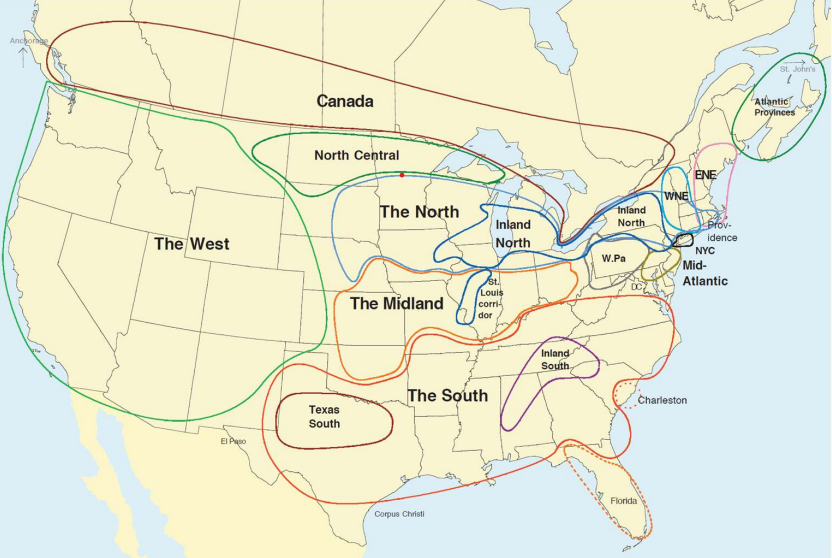
North
Eastern New England
Mid-Atlantic
Western Pennsylvania
South
Midland
Southeast
West
North Central
Common phonetic-phonological features
→ Rhoticity
<r> pronounced in all positions
but not all American accents
→ T-flapping
/t/ realized as flapped [t̬ ] in onset of unstressed syllable following vowel/sonorant consonant
→ T-deletion
deletion of /t/ in unstressed syllables when following /n/ e.g winter
Regional variation: Pin/Pen merger
→ stereotypical marker of South
phonetic merger between /e/ and /ɪ/ before nasals (strongly nasalised)
African American Vernacular English (AAVE)
not regionally restricted but mainly found in urban areas
phonetic-phonological, grammatical and lexical featues
Phonetic-phonological features:
consonant-cluster reduction (CCR) /hænd/ → [hæn]
Stopping of /θ/ and /ð/, e.g. /θɪn/ [tɪn], /ðɛn/ [dɛn]
No rhoticity, e.g. /ɑrm/ [ɑːm]
Metathesis, e.g. /æsk/ → [æks]
Monophthongisation (and lengthening) of diphthongs, e.g. /baɪ/ → [bɑː]
Grammar in US
Past tense: -ed vs. -t burned/burnt
Mandative subjunctive
Phrasal verbs
Simple past used as participle
inversion auxiliary verb and subject in indirect questions
multiple negation
double modals
preverbal a-
7.English English vs. American English
Accent
→ Differences in realisation of vowels
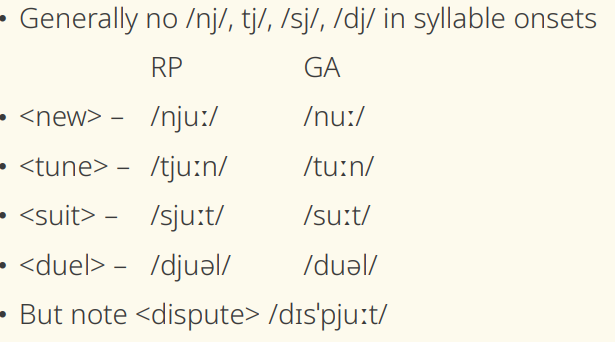
→ Phonotactics
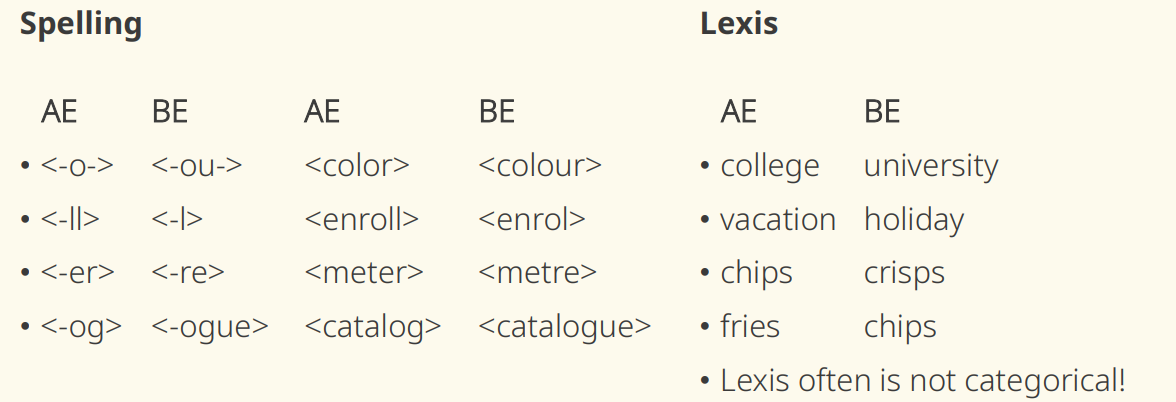
Spelling and lexis
8.The New York Dialect Survey
Introduction
→ Stereotypical features of New York English
non-rhotic
offglides in number of monophthongs (/æ/ → [æə~ɛə], e.g. in cat ; /ɔ/ [ɔə], e.g. in think)
th- and dh-stopping /θ, ð/ —> [t, d], e.g. in think, this
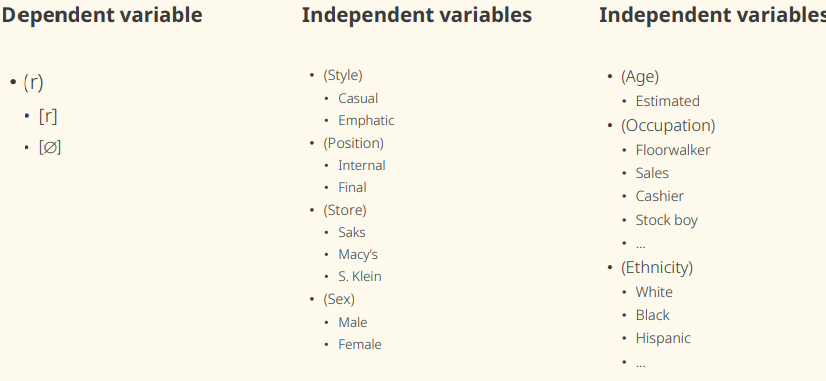
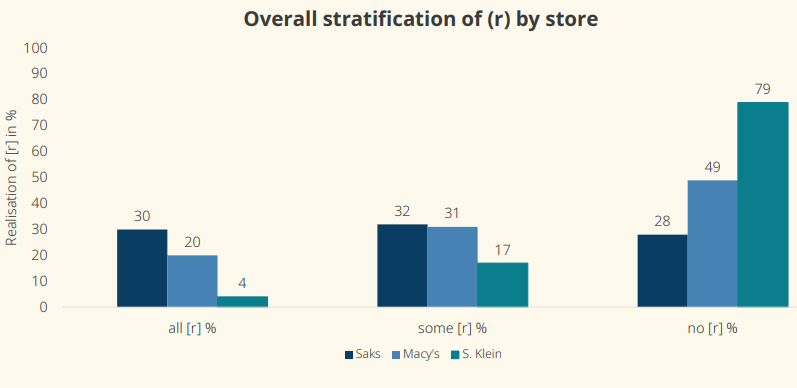
Method: Rapid anonymous survey
→ Sales person of large stores in Manhattan from top, middle, bottom of price/fashion scale
Hypothesis: sales person borrow prestige from costumers and therefore behave like them
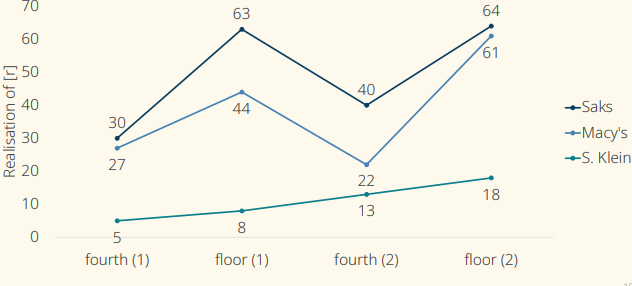
different realised /r/ dependent of shop
Shops: Saks fifth avenaue, Macy’s, S. Klein
Ranked by: Location, advertising, prices, floor space
Interviewer approached informant in role of costumer
Asking for location on 4th floor → Expectation answer, asking to repeat answer
1. instance: not much attention, 2. instance: more careful pronounciation
Notes
Results
9.Real time and apparent time
Real time
→ real time studies of variation/change also called diachronic studies
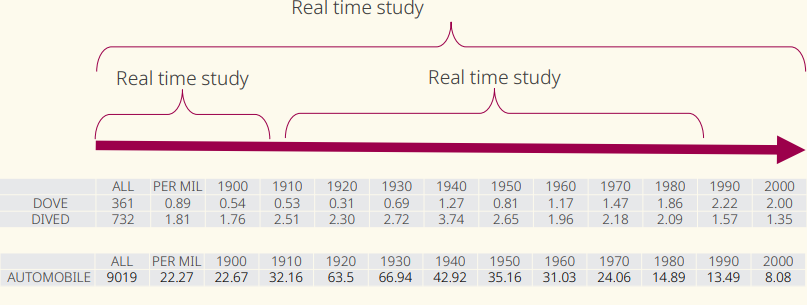
→ often comparioson of two or more snychronic studies
e.g. Labov: speakers born 1888-1991
→ older data usually not collected for linguistic purposes
oral history archives, newspapers, radio boradcasts
→ Corpora
Corpus of Historical American Englsih (COHA)
Apparent time
→ measured by comparing speakers of different ages in single speech community
if younger speakers behave differently: change took place within community
Assumption: speakers only minimally change way of speaking in adulthood (holds for phonology/morphosyntaxt, less for lexical)
→ most common approach in sociolinguistics
10.Multilingualism
Introduction
→ Multilingualism difficult concept
person able to speak more than one language, or situation in which speakers can/do speak more than one language
Difficult:
What makes person bilingual? Line language/dialect? What makes country bi-/multilingual?
Myths
Multilingualism exceptions to default monolingual norm
one needs equal command of all languages
childhood bilingualism has negative effects
better if children only acquire majority language
children confused with ability to speak 2 languages
bilinguals have smaller vocabularies
Diglossia
frequent phenomenon
situation where 2 closely related languages/dialects are used in speech community
1 for High (H) functions one for low (L)functions
stable situations, varieties remain distinct
e.g. Switzerland: Schwyzerdütsch - High German
Code Switching
→ people able to speak more languages know in which situation to use which language
more formal situations: use of standard (H) variety or official language
less formal situations: use of dialect or community (L) language
may be influenced by
Domain - where are you?
Situation- Who do you speak to?
Code mixing
→ Alternation between varieties/codes within clause or phrase, often negative evaluations than alternations/code switching
code switching = either / or
code mixing more interpersonal/affective functions
signalling proximity/distance
in-group/out-group
referring to concepts
11.English around the world
global language
Billions of users in different contexts, to different degrees
as only language
as one of two / more languages
an official language in your country
use because no common language
English as (co-)official language
ENglish official language in 68 sovereign states, 28 non-sovereign entities
also used as working language in eduaction/government without official status
History: America and Carribean
1607 Jamestown → 1. successful settlement of English outside British isles
1600s: lots of emigration, Carribean Islands come under British control
1763: english language in NA from Newfoundland to Georgia
1176 declaration of independence
1867 canada self-government
History Africa
17th century: british trading in West Africa
19th century: 1. settlements southern Africa, foundation Liberia, scramble for Africa
20th century: decolonisation
History Asia
17th century: east India company
18th century: british gain power over most of India
19th century: Hong Kong/Malaysia under British power, AMERICAN authority over Philippines
20th century: Decolonisation, handover Hong Kong to China
History Australia/Oceania
18th century: foundation British Australian penal colony of new South Wales, Pitcairn
19th century: Treaty of Waitangi, beginning settlement New Zealand
20th century: Australia, New Zealand independent, decolonisation
12.Modelling World Englishes
→ Time of decolonisation 1940s-1970s
English developed 1,500 years
spread beyond British Isles 350 years
→ was still viewed as monolithic entity despite emergence of new varieties (British ad American Englishes)
The three Circles Model (Kachru 1985)
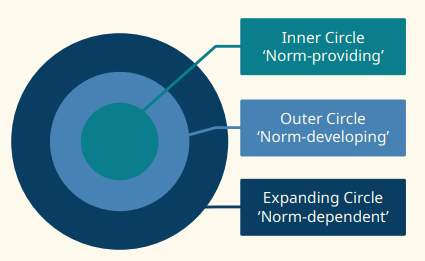
Norm providing: Standard varieties (British/American) used in teaching
Norm-developing: DIscussion norms: should they be endocentric or exocentric? e.g. what is error, what is innovation/deviation?
Norm-dependent: typically fully external norms
The dynamic model
→ most infuential model
varieties have same evolution
caused by social dynamics between 2 parties in colonisation process
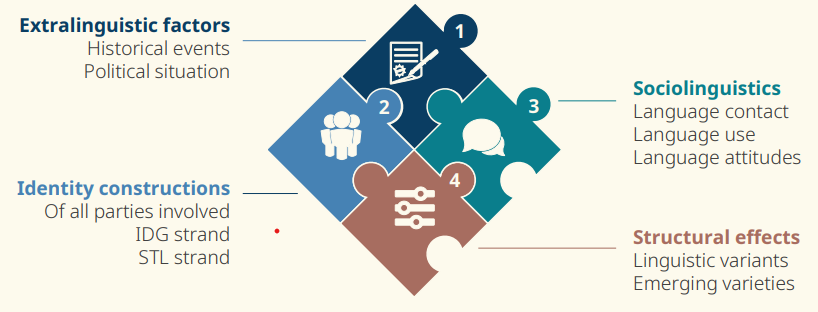
IDG (indigenous) strand
STL (settler) strand
strands at first completely separate then becoming more alike
→ linguistic consequences
gradual linguistic accomodation
set of shared features/norms
single speech community
Parameters:
Phases:
Foundation (e.g. contact via settlement)
Exonormative stabilisation (e.g. Fiji)
Nativisation (e.g. Kenya)
Endonormative stabilisation (→ 1 country, 1 language, e,g, South Africa)
Differentiation (social differences, e.g. Australia)
13. Pidgins and creoles
Languages in contact
langauges co-exist side-by-side → language contact
Languages in contact influence each other (borrowings, language transfer e.g. words taken from one language to another)
major role in history of English
Background
Pidgins/creoles languages emerging out of contact between speakers of at least 2 languages
usually marked in social conditions e.g. trade, work
Goal: basic communication
features of both languages
phonetically/grammatically simplified
English based pidgins/creoles concentrated in: West Africa, Caribbean, US/Central America, Pacific
Definitions
→ Pidgin
not very complex variety
used in restricted social domains for limited social functions
arises from language contact
seens as precursor/early stage to creole
has no native speakers
→ Creole
language variety arising out of situation of language contact
Distinguishable from pidgin:
is 1. language of some community
used for entire range of social functions that language can be used for
Superstrate and substrate
→ Lexifier (superstrate) language
super (above) and stratum (layer)
the language that provided most of vocabulary
often language of more powerful group
→ Substrate language(s)
sub (below) stratum (layer)
language(s) that provide underlying structure of pidgin/creole
Grammar/Semantics
West Africa
longest histpry of contact between English and local languages → several pidgins and creoles
Nigerian Pidgin: 75m speakers, most widely spoken language, more of a creole
Ghanaian Pidgin: 5m speakers, urban, uneducated/student pidgin
Cameroon Pidgin
Krio (sierra Leone, Gambia: 4m