Lecture 5
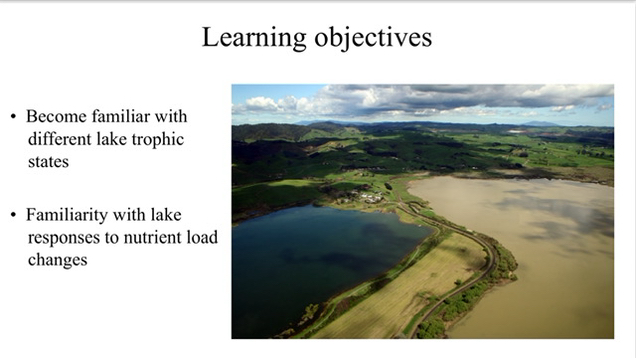
Answers to Your Two Learning Objectives
1. Become more familiar with different lake trophic states
Lake trophic states describe how nutrient-rich and productive a lake is. From your notes:
Oligotrophic lakes are low in nutrients (nitrogen and phosphorus), have low chlorophyll a, clear water, and high water quality.
Eutrophic lakes are high in nutrients, have high chlorophyll a, more algal growth, reduced water clarity, and lower water quality.
Lakes can also become hypertrophic, where nutrient levels and algal blooms are extremely high.
These states are measured using the Trophic Level Index (TLI), which uses indicators such as chlorophyll a, total nitrogen, total phosphorus, and water clarity.
2. Become familiar with lake responses to nutrient load changes
Lakes do not respond immediately when nutrient inputs change. From your notes:
Nutrients enter lakes from external sources (e.g. agriculture, urban runoff, forestry).
Lakes also store nutrients in sediments, creating internal loading, where nutrients are recycled back into the water.
Because of this, even if external nutrient inputs are reduced, recovery is often slow and delayed (lagged response).
Lakes can reach a threshold or tipping point, where a small increase in nutrients causes a sudden shift from clear to degraded conditions.
To restore a lake, nutrient levels often need to be reduced below the level that originally caused degradation.