GIBB'S FREE ENERGY
Learning Objective 1: Describe Gibbs Free Energy
What is Gibbs Free Energy?
Definition: The maximum available energy in a system that can perform useful work during a reaction.
Formula:

ΔH: Change in enthalpy (heat content).
T: Absolute temperature (Kelvin).
ΔS: Change in entropy (disorder).
Units: kJ/mol.
Key Points:
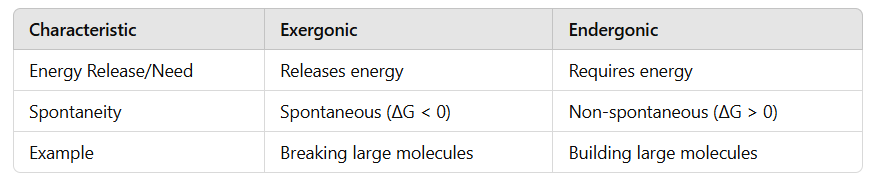
ΔG < 0: Reaction is spontaneous (releases energy, exergonic).
ΔG > 0: Reaction is non-spontaneous (requires energy, endergonic).
ΔG = 0: Reaction is at equilibrium (no net energy change).
Importance in Chemistry:
Helps predict the direction of a chemical reaction.
Determines if a reaction occurs spontaneously.
Provides insight into how reactions behave under different conditions (e.g., temperature, concentration).
Learning Objective 2: Describe Free Energy and the Roles of ATP
Free Energy in Reactions:
Standard Free Energy Change (ΔG°): Free energy under standard conditions (1M concentration, 25°C, pH 7.0).
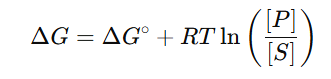
R: Ideal gas constant (8.314 J/mol·K).
[P] and [S]: Concentrations of products and reactants.
Exergonic vs. Endergonic Reactions:
Role of ATP in Energy Transfer:
ATP (Adenosine Triphosphate): Universal energy currency in cells.
Structure: Contains two high-energy phosphate bonds.
Hydrolysis of ATP:
Reaction:

Releases energy to drive endergonic reactions.
ATP-ADP Cycle:
