Netplus9e_PPT_Mod 02 - Tagged
Module Overview
Title: CompTIA Network+ Guide to Networks, 9th Edition
Focus: Infrastructure and Documentation
Module Objectives
By the end of this module, students should be able to:
Describe the roles of various network and cabling equipment in commercial buildings and work areas.
Maintain network documentation.
Manage changes made to a network.
Components of Structured Cabling
ANSI/TIA-568 Commercial Building Wiring Standard:
Known as structured cabling.
Describes optimal installation of networking media to maximize performance and minimize upkeep.
Applies to all media types, transmission technologies, and networking speeds.
Based on hierarchical design, assumes star topology.
From the Demarc to a Workstation
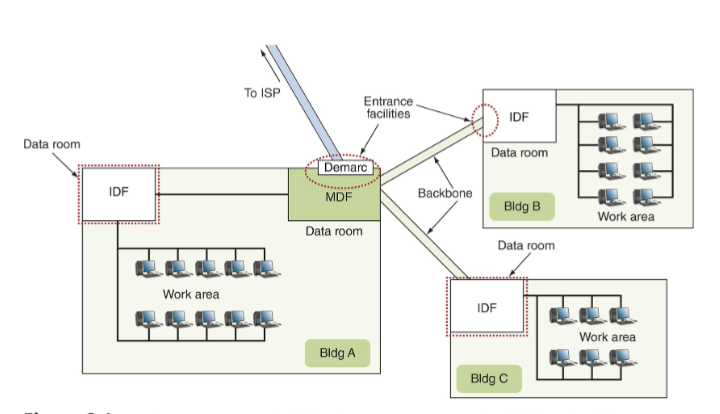
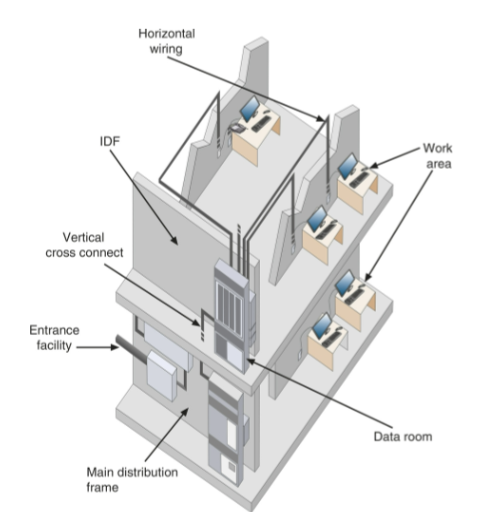
Key Concepts
Entrance Facility (EF):
Point of connection between incoming network and organization’s network.
Demarc (Demarcation Point):
Marks the boundary between telecommunications provider’s network and organization’s network.
MDF (Main Distribution Frame):
Centralized point of interconnection for LAN/WAN.
Also called MC (Main Cross Connect).
Data Room:
Enclosed space housing network equipment (e.g., data closet).
Rack:
Holds various network devices.
Patch Panel:
Provides a central termination point for multiple patch cables.
Building Layouts
Diagrams illustrate structured cabling within campus networks.
VoIP Equipment
VoIP (Voice over IP):
Utilizes TCP/IP protocols to carry voice signals across networks.
May include:
VoIP Gateway
VoIP PBX
VoIP Endpoints
Intermediate Distribution Frame (IDF):
Provides connection between MDF and end-user equipment.
Work Areas
Definition of work area includes workstations, printers, and other devices.
Wall Jacks:
Designated outlets must support voice and data connections.
Rack Systems
Types of Racks:
Available in two-post, four-post varieties; may also be wall-mounted, freestanding, or bolted.
Considerations:
Height measured in rack units (standard is 42U).
Width standard is 19 inches; depth varies.
Cooling Layout:
Hot aisle/cold aisle layout essential for data centers.
Cable Management
Key Practices
Termination:
Avoid overexposing twisted-pair cables beyond 1 inch before termination.
Bend Radius:
Maintain manufacturer's specified bend radius to preserve data integrity.
Continuity Testing:
Use cable testers to ensure segment reliability.
EMI Precautions:
Keep cables 3 feet away from fluorescent lights or EMI sources.
Best Practices for Documentation
Cable Plant Documentation:
Essential for efficient network management; includes labeling and inventory.
Grounding Requirements:
Vital for safe and effective cable management.
Security Measures for Data Rooms
Environment Monitoring:
Use specialized products to control temperature, humidity, and airflow.
Physical Security:
Lock data rooms; limited access for IT personnel, including security camera installation.
Network Documentation Importance
Benefits:
Efficient communication among coworkers.
Speeds up troubleshooting and information retrieval for future issues.
Network Diagrams
Provide visual representation of network structure, helping in planning and management.
Tools:
Nmap for device discovery; Cisco-standard symbols for diagrams.
Types of diagrams:
Wiring Schematics: Shows detailed wiring connections.
Rack Diagrams: Device arrangement in rack systems.
Change Management Principles
Types of Changes
Software Changes:
Installation, Patch, Upgrade, and Rollback (previous versions).
Hardware Changes:
Includes additions or upgrades of equipment like cameras or printers.
Documentation for Changes
Essential documentation practices include:
Change request documents, understanding approval processes, and documenting network configurations.
Essential Business Documents in Networking
RFP: Request for Proposal for purchasing proposals from vendors.
MOU: Memorandum of Understanding detailing agreements between parties.
SOW: Statement of Work detailing project tasks.
SLA: Service Level Agreement defining service criteria between provider and customer.
MSA: Master Service Agreement outlining future contract terms.
Conclusion
Knowledge of network and cabling equipment roles in commercial environments, network documentation maintenance, and effective change management is critical for success.