Chapter 8 - Momentum and Forces
8.1 Momentum and Conservation of Momentum
Momentum
Momentum - relates to its mass and velocity
p = mv
p is momentum (kg m s−1)
m is the mass of the object (kg)
v is the velocity of the object (m s−1)
Greater the mass/velocity, the larger the momentum
Vector quantity
Conservation of Momentum
Momentum is conserved in any interaction or collision between objects
∑pbefore = ∑pafter
where ∑p is the sum of the momentum of objects in a system.
Momentum in One dimensional collisions
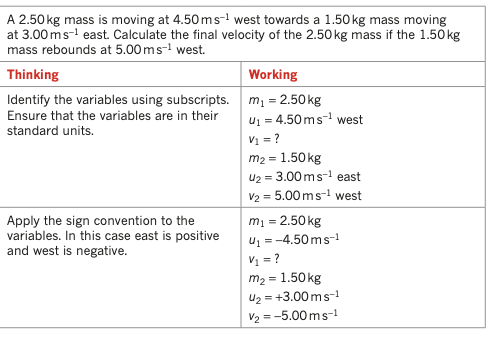
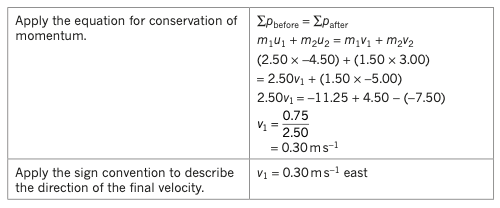
If two objects are colliding in 1D, this is the equation.
∑mvbefore = ∑mvafter
m1u1 + m2u2 = m1v1 + m2v2
m1 is the mass of object 1 (kg)
u1 is the initial velocity of object 1 (m s−1)
v1 is the final velocity of object 1 (m s−1)
m2 is the mass of object 2 (kg)
u2 is the initial velocity of object 2 (m s−1)
v2 is the final velocity of object 2 (m s−1).
Momentum When Masses Combine
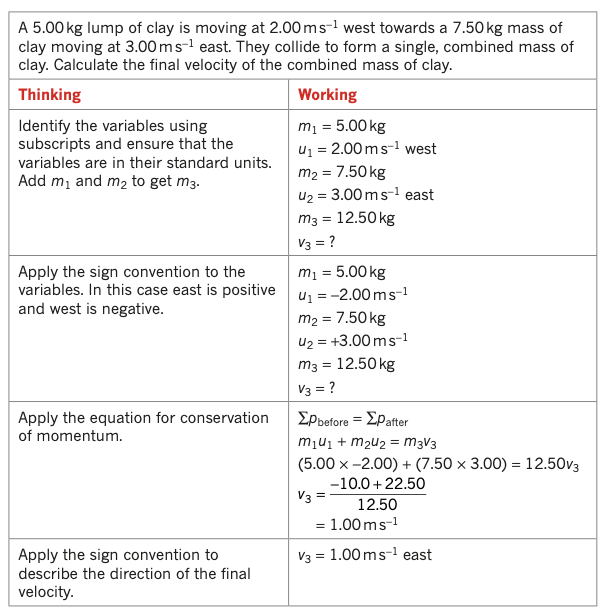
If two objects combine when they collide, the equation is.
∑pbefore = ∑pafter
∑mvbefore = ∑mvafter
m1u1 + m2u2 = m3v3
m1 is the mass of object 1 (kg)
u1 is the initial velocity of object 1 (m s−1)
m2 is the mass of object 2 (kg)
u2 is the initial velocity of object 2 (m s−1)
m3 is the combined mass of m1 and m2 (kg)
v3 is the final velocity of combined mass of m1 and m2 (m s−1).
Momentum in Explosive Collisions
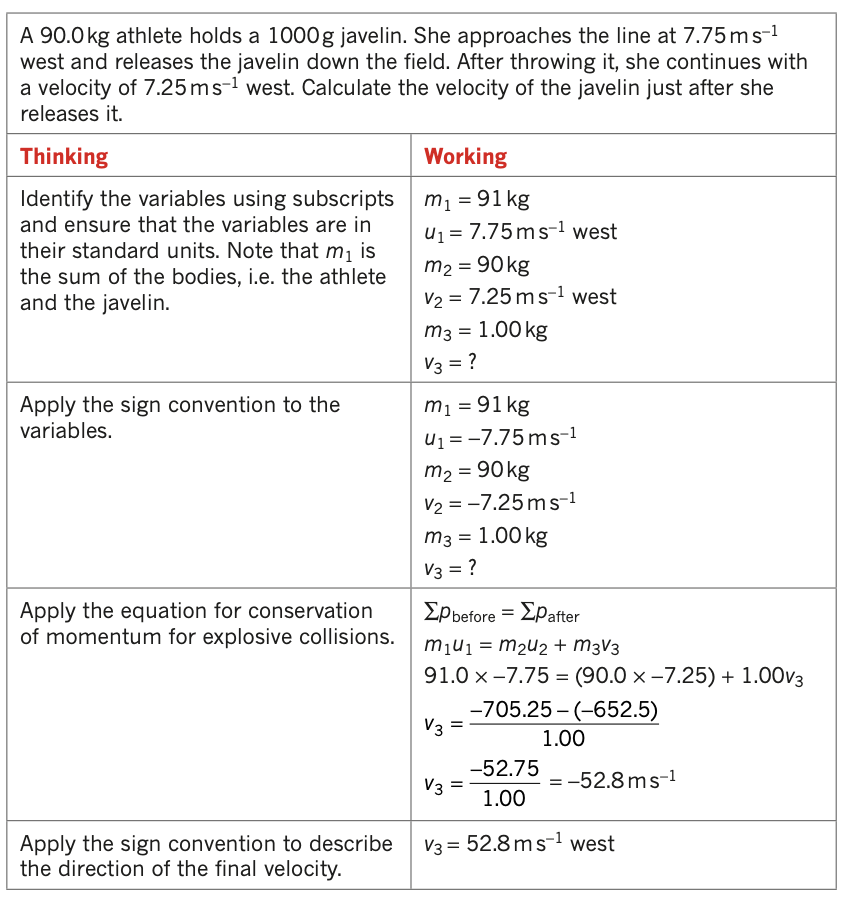
∑mvbefore = ∑mvafter
m1u1 = m2v2 + m3v3
m1 is the mass of object 1 (2 and 3 combined; kg)
u1 is the initial velocity of object 1 (m s−1)
m2 is the mass of object 2 (kg)
v2 is the final velocity of object 2 (m s−1)
m3 is the mass of object 3 (kg)
v3 is the final velocity of object 3 (m s−1).
8.2 Change in Momentum and Impulse
Increase in velocity = increase in momentum
Decrease in velocity = decrease in momentum
Change in momentum (Δp), is also called impulse (I)
p
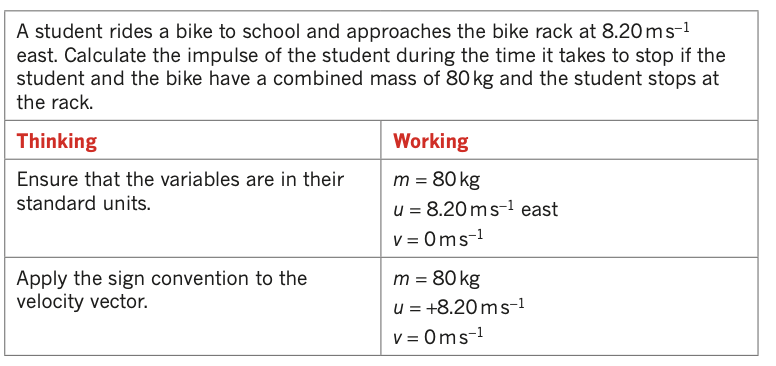
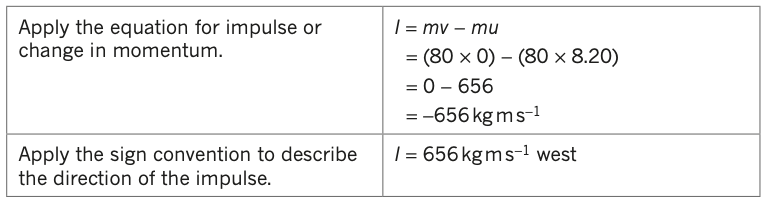
Change in Momentum in One Dimension
Impulse means change in momentum
I = Δp
= pfinal − pinitial
= mv − mu
I is the impulse (kg m s−1)
Δp is the change in momentum (kg m s−1)
m is the mass (kg)
v is the final velocity (m s−1)
u is the initial velocity (m s−1).
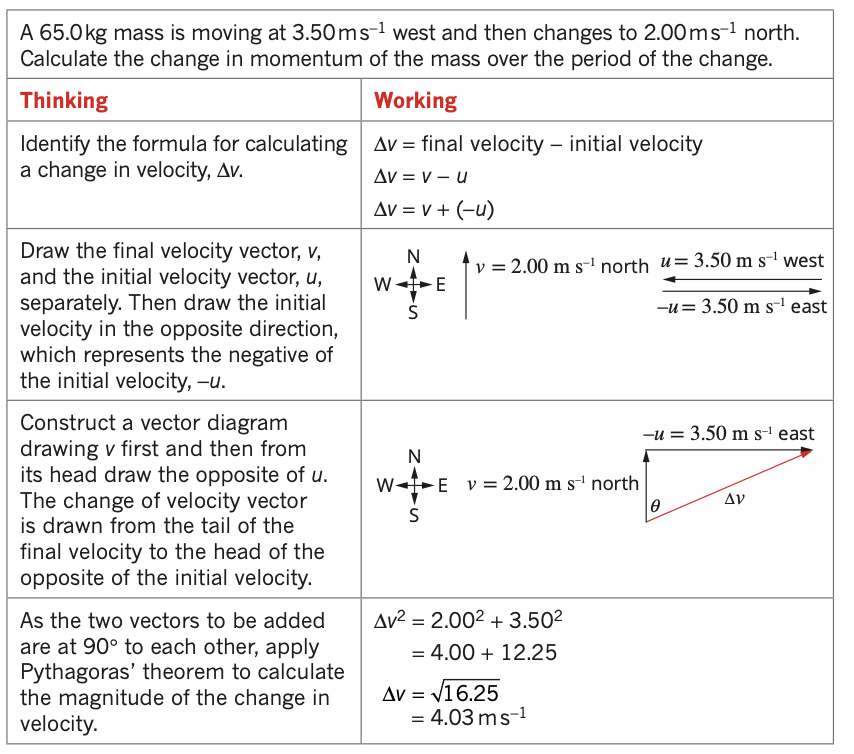
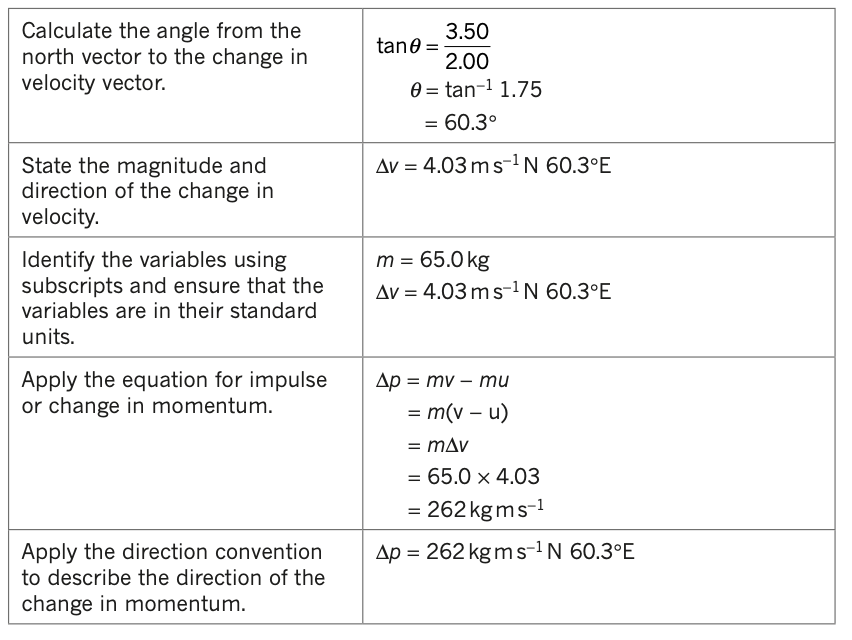
Change in Momentum in Two Dimensions
I = mv − mu
= m(v − u)
8.3 Newton’s First Law
Force
Force - push or pull, but exists in a variety of situations
Measured in Newtons
Vector quantity
Contact Forces - forces that act directly on a body (Friction + drag force)
Non-Contact Forces - forces that act on a body at a distance (Gravitation, magnetic and electric forces)
If more than one force acts on a body at a time, the body behaves as if only one force - vector sum of all forces - is acting. Called Net force.
The net force acting on a body experiencing a number of forces acting
simultaneously is given by the vector sum of all the individual forces:
Fnet = F1 + F2 + … + Fn/
Newton’s First Law
First law of inertia (the tendency of an object to maintain its velocity - related to the mass of an object)
Newton’s First Law → An object will maintain a constant velocity unless an unbalanced, external force acts on it
Therefore, an object will not maintain its velocity if an unbalanced, external force is applied.
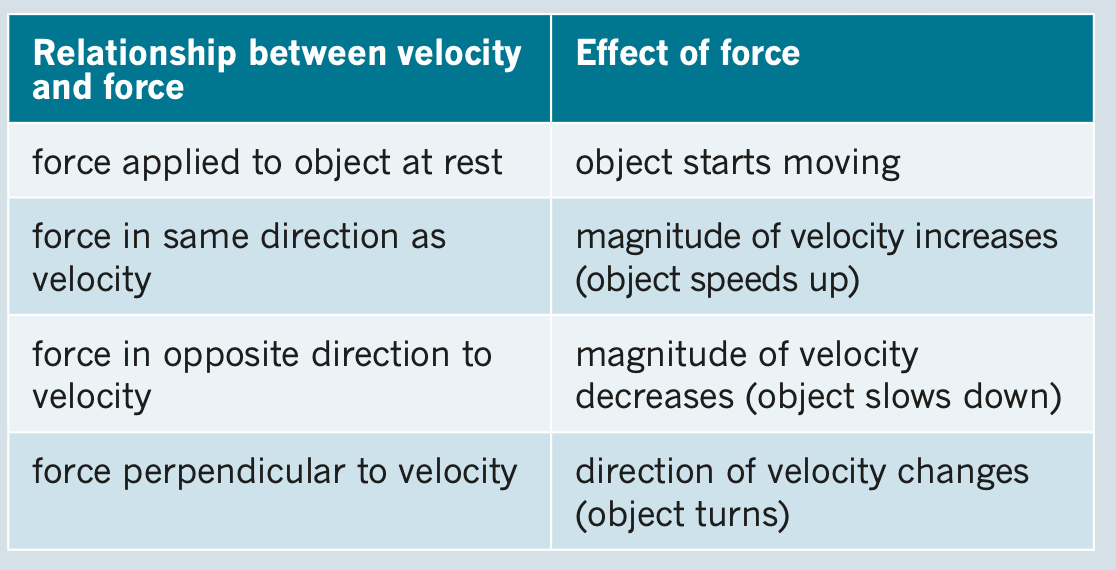
‘External’, in relation to forces, implies that the forces are not internal. (When internal they have no effect on the motion)
Inertia
Inertia - the resistance to change in motion of an object
As the mass increases, the inertia increases and therefore;
becomes harder to start moving of stationary
becomes harder to stop moving
becomes harder to change its direction of motion
Inertia effect is independent of gravity - since inertia depends on mass and weight force due to gravity also depends on mass
Newton’s First Law and Inertia
Due to inertia, an object will continue with its motion unless a net force acts on the object
8.4 Newton’s Second Law
Newton’s Second Law - The acceleration of an object is directly proportional to the net force on the object and inversely proportional to the mass of the object:
Fnet = ma
a is the acceleration of an object (in m s−2)
Fnet is the force applied to the object (in N)
m is the mass of the object (in kg).
Can also be;
= m(v - u) / Δt
= (mv - mu) / Δt
= Δp / Δt
8.5 Newton’s Third Law
Newton’s Third Law - For every action (force), there is an equal and opposite reaction (force)
when object A exerts a force F on object B, B will exert an equal and opposite force on A.
Applies to contact and non-contact forces
Newton’s Third Law and Motion
Is needed to explain all motion
Shown in this example, a component of the force acts down and another pushes backwards horizontally along the surface of the ground.
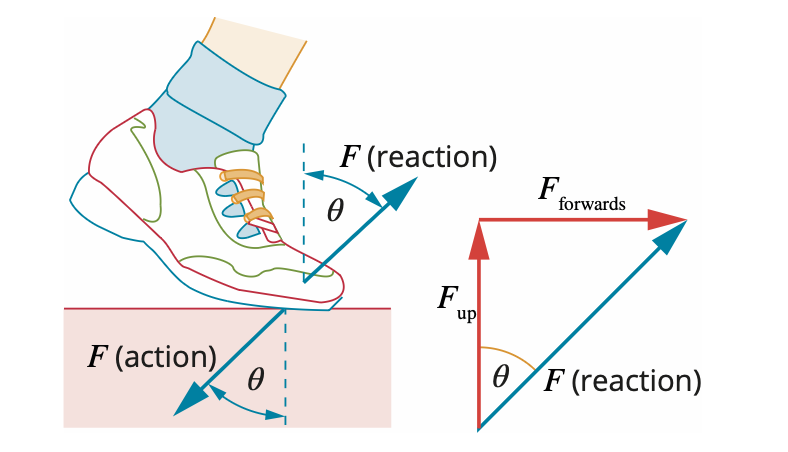
Force is transmitted because there is friction between the shoe and the ground
In response, the ground then pushes you forward via your foot
The Normal Force
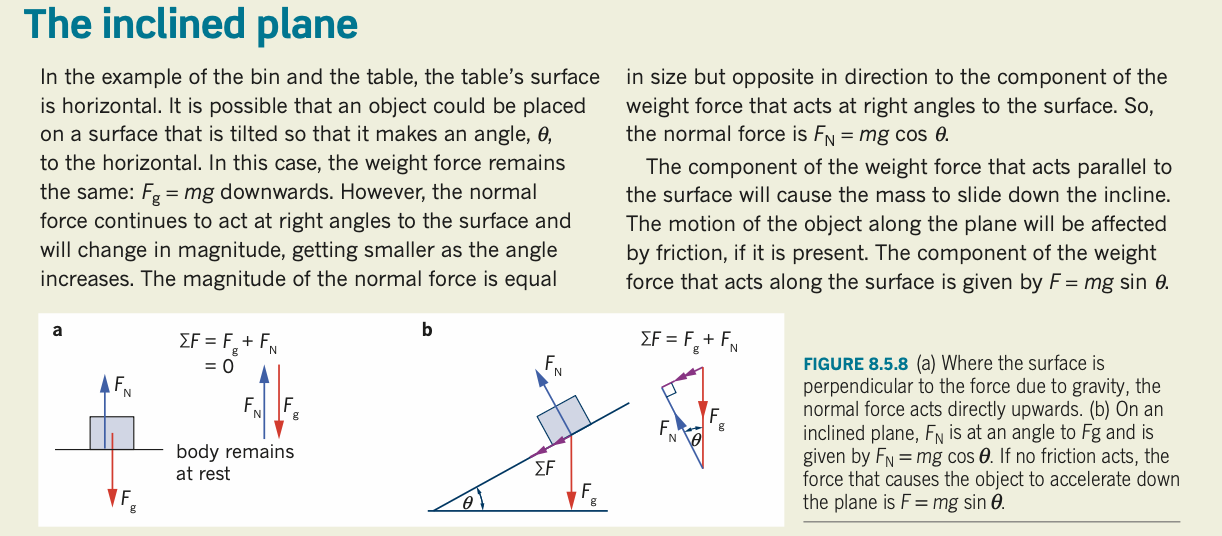
Action force is the force due to gravity of the Earth, Normal force is opposite that.
The Inclined Plane
8.6 Impulse and Force
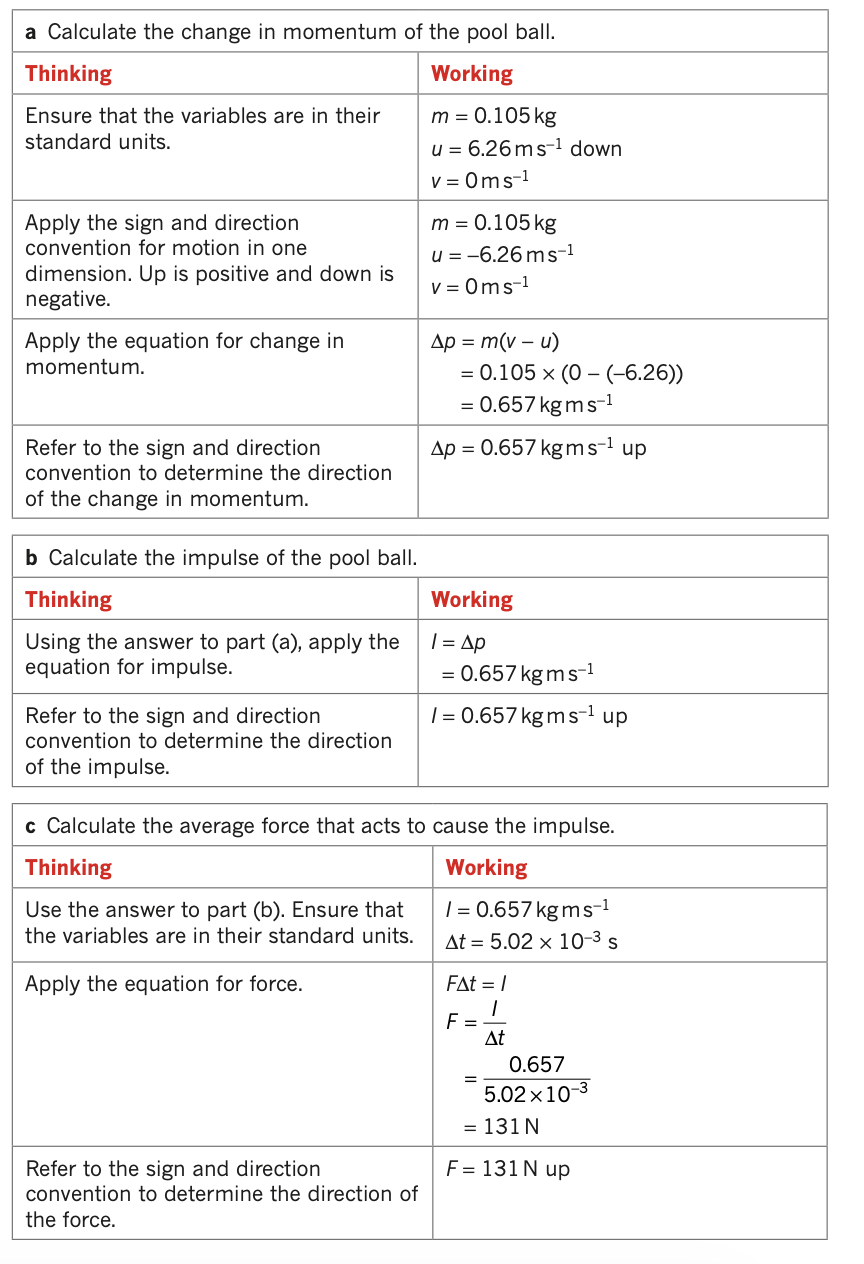
Change in Momentum (Impulse)
According to the 2nd law, a net force will cause a mass to accelerate
Larger net force will create a faster change in the velocity of the mass
The faster that occurs, the greater the net force that produced that change
Fnet = Δp / Δt
= m (v−u) / Δt
FnetΔt = m(v − u)
= I
I is the impulse (kg m s−1).
Determining Impulse from a Changing Force
Is not always the case that the force that acted to change impulse over a period of time was constant
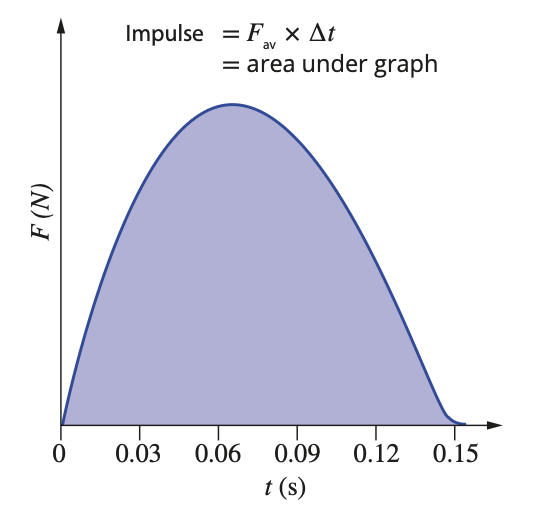
Example → tennis ball hit with racquet
Instant ball comes into contact, applied force is small
As strings distort and the ball compresses, force will increase until the ball has been stopped
Force will then decrease as the ball accelerates away from the racquet
The impulse will be I = FavΔt
I is impulse
Fav is average force applied during collision
Δt is total period of time
Concept of impulse is appropriate when dealing with forces during any collision since it links force and contact time
8.7 Mass and Weight
Weight is vector
Mass is scalar
Mass of a Body
Mass is measured in Kilograms (kg)
Kilogram is defined in terms of an amount of a standard material
An objects mass can be seen as a property by the amount of acceleration it undergoes for a given net force.
More mass an object has, the greater the force is required to make it accelerate
Gravitational Force
The force due to gravity is an attractive force that exists between all masses
Result from a mass creating a gravitational field that spreads throughout the space around the mass
Any other mass that is within this field will experience a force towards the mass creating this field.
Weight Force
Weight - the force on a body due to gravity (Fs) or (W)
Vector quantity
Measures in Newtons
Represented by a straight down arrow
The weight of a body Fg (in N) is defined as the force of attraction on a body due
to gravity and is calculated using the equation:
Fg = mg
Fg is the force of - gravity acting at the centre of mass of a body (in N)
m is the mass of the body (in kg)
g is the gravitational field strength (in N kg−1, which is 9.8 N kg−1 near the
surface of the Earth).
Your Mass and Weight on the Moon
In space the matter that makes up your body doesn’t change
Mass doesn’t change, because mass is a property of matter and is not affected by the environment
Weight force will be much less on the moon than Earth
Moons mass is 81 times smaller than Earth