Magnets and Magnetic Fields
Magnets
An iron ore called lodestone, we say it is magnetised.
Properties of Magnets
Attract ferromagnetic materials.
e.g. iron, steel, nickel, cobalt, and their alloys.
If a bar magnet is suspended by thread it will roughly line up North-South.
Magnetic poles exist in pairs (i.e. north-south) the strength of each pole in the pair is equal.
Like poles repel and unlike poles attract.
The force of attraction/ repulsion is proportional to the distance between them.
Ferromagnetic materials bought near/touching a magnet will become magnetised (induced magnetism).
Magnetic Fields
A magnetic field is any region of space where magnetic force can be felt.
The direction of the magnetic field at a point is the direction of the force on the north pole if it were placed at that point.
A compass should line up north-south but if another magnetic field nearby it will deflect the compass and, if strong enough, the compass will line up parallel to the nearby field instead.
Magnetic Field Lines
A line drawn in a magnetic field so that the tangent to it at any point shows the direction of the magnetic field at that point is called a magnetic field line.
Magnetic Effect of Electric Current
An current-carrying conductor has a magnetic field around it as long as the current is flowing.
Right Hand Grip Rule
The Right Hand Grip Rule states that if the right-hand clasps a conductor with the thumb pointing in the direction of the current, then the fingers give the direction of the magnetic field around the conductor.
Magnetic Field: Circular Loop/Coil
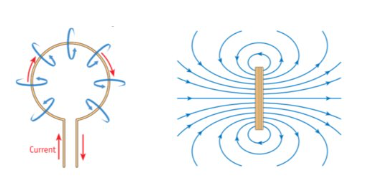
Magnetic Field: Solenoid
A coil whose length is much longer than its radius.
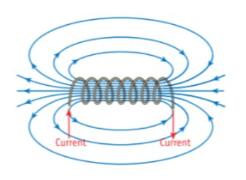
South vs North Pole of Coil/Loop/Solenoid
Clockwise Current = South facing you
Anti-clockwise Current = North facing you
Electromagnets
When a soft iron core is placed in a solenoid and current passed through it.
Uses:
Lifting scrap iron and steel
In electric motors
In electromagnetic relays
Earths Magnetic Field
Magnetic compasses do not point to true north, but to magnetic north.
The difference between the two is called magnetic declination or magnetic variation.
The size of the declination varies from place to place and also with time - marine maps need to be very detailed to allow travellers to allow for these variations.