ELECTROCHEMISTRY
Fundamental Definition and Scope of Electrochemistry
Definition of Electrochemistry: Electrochemistry is defined as the study of the relationship between chemical reactions and electricity.
Primary Interactions: There are two fundamental ways in which chemical reactions and electricity interact:
Chemical-to-Electrical: Specific chemical reactions possess the ability to generate electricity. This is the underlying principle behind the function of a battery, where internal chemicals react to produce an electrical current.
Electrical-to-Chemical: Electrical energy can be utilized to drive specific chemical reactions that would not occur under normal conditions.
Defining Electricity and Chemical Redox Reactions
Definition of Electricity: Electricity is the movement of electrons. Whether electrons move through a wire, a light bulb, or a battery, their movement constitutes electricity.
Definition of Electrolyte: An electrolyte is a substance that dissociates into ions when dissolved in a solvent, such as water, thereby conducting electricity. Electrolytes play a crucial role in electrochemical processes, facilitating the movement of electrons in batteries and biological systems.
Connection to Redox Reactions: Because electrochemistry focuses on the movement of electrons, the chemical reactions involved are typically oxidation-reduction (redox) reactions. These are reactions where electrons are transferred between atoms.
Anode and Cathode: In an electrochemical cell, the anode is the electrode where oxidation occurs (the site where electrons are lost), while the cathode is where reduction happens (the site where electrons are gained). Electrons move from the anode to the cathode through an external circuit, facilitating the flow of electricity.
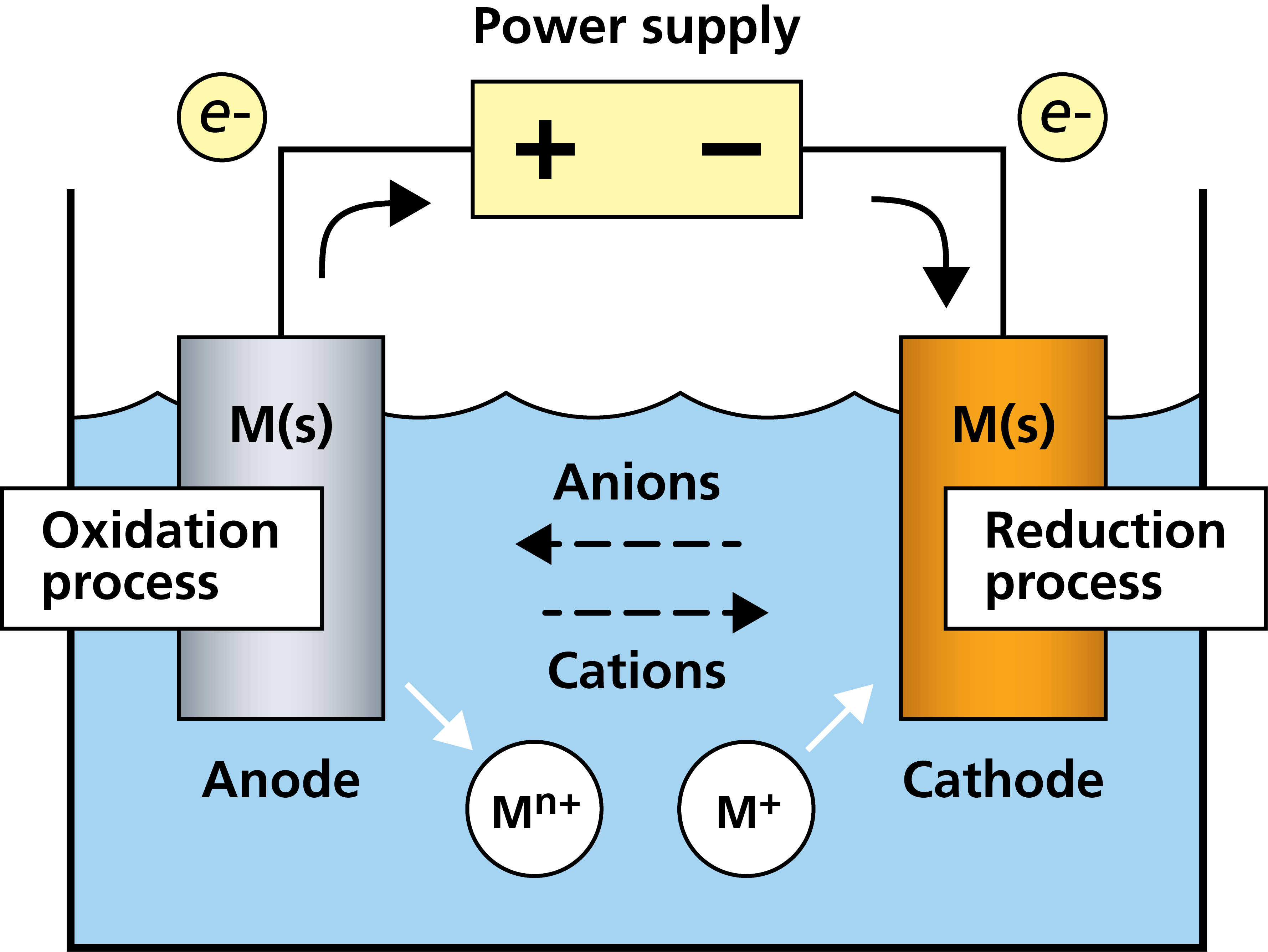
Scenario 1: Generating Current: If an oxidation-reduction reaction involves electrons naturally moving from substance A to substance B, separating these substances and connecting them with a wire forces the electrons to travel through that wire, thereby creating usable electricity.
Scenario 2: Driving Reactions: If a reaction where electrons transfer from C to D does not occur naturally (e.g., C does not want to lose electrons and D does not want to gain them), external electrical energy from a source like a battery can be used to "pull" electrons from C and "push" them to D.
The Galvanic and Voltaic Cell
Definition and Purpose: A galvanic or voltaic cell is a device used to create electricity through spontaneous chemical reactions.
Zinc-Copper Example:
Reaction Mechanism: When a neutral zinc atom () is placed near a copper ion (), electrons move from the zinc to the copper.
Result: The zinc becomes a ion (losing two electrons), and the copper ion becomes a neutral copper atom (gaining two electrons).

Electron Tug-of-War: The movement of electrons occurs because of the relative pulling strength of the atoms. has a strong pull for electrons, while has a weaker pull.
Redox Classification:
Oxidation: The zinc loses electrons, meaning it is oxidized.
Reduction: The copper ion gains electrons, meaning it is reduced.
Spontaneity: Because this reaction happens naturally on its own simply by bringing the elements into proximity, it is characterized as a spontaneous process.
Standard Reduction Potentials
Predicting Electron Flow: To determine which element will pull electrons from another, scientists use the "Standard Reduction Potentials" chart.
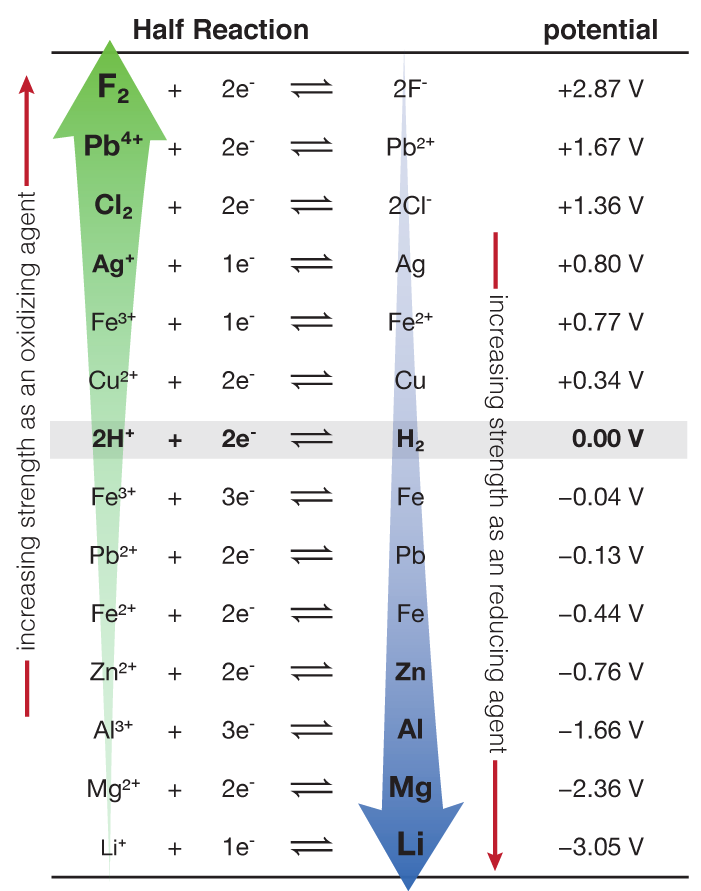
Chart Logic: The chart lists elements and compounds based on their electron affinity (the strength of their pull for electrons). The higher an element is on the chart, the stronger its pull.
Application: Because is located higher on the chart than , copper pulls electrons away from zinc naturally.
Anatomy of a Galvanic Cell/Voltaic Cell
Physical Separation: To harness electricity, the zinc and copper components must be physically separated into different containers so the electrons are forced to travel through an external wire.
Circuit Function: Electrons leave the zinc container, travel through the wire (where they can power devices like a light bulb), and enter the copper container to reach the ions.
Electrodes: The solid metal pieces (zinc and copper) serve as electrodes, which are the sites where electrons enter or leave the system.
Nomenclature:
Anode: The electrode where oxidation occurs (the site where electrons are lost). In the zinc-copper cell, the zinc piece is the anode.
Cathode: The electrode where reduction occurs (the site where electrons are gained). In the zinc-copper cell, the copper piece is the cathode.
Electrolysis and Electrolytic Cells
Electrolysis: This is the process of using electricity to force a non-spontaneous chemical reaction to occur.
The Electrolytic Cell: The device used to perform electrolysis is called an electrolytic cell.
Example: Splitting Water: Electrolysis can be used to decompose water () into hydrogen gas () and oxygen gas ().
Oxidation States: In this reaction, hydrogen's oxidation number decreases (gains electrons/reduction), and oxygen's oxidation number increases (loses electrons/oxidation).
The Problem of Bond Strength: Oxygen naturally has a much stronger pull for electrons than hydrogen (as shown by its higher position on the Standard Reduction Potentials chart). Thus, oxygen does not "want" to give electrons to hydrogen.
Non-Spontaneity: Because the transfer of electrons from oxygen to hydrogen goes against their natural affinities, the reaction is non-spontaneous and will not happen without external intervention.
Role of the Battery: In an electrolytic cell, a battery is connected to electrodes submerged in water. The battery provides sufficient electrical energy to:
Pull electrons away from Oxygen (site of oxidation/anode).
Push electrons into Hydrogen (site of reduction/cathode).
Summary of Electrolysis: By forcing electrons to move in the opposite direction of their natural tendency, the system successfully splits water molecules into elemental gases.