Lecture 18: The Republic of the Philippines (1946-1965)
After Japan invaded the Philippines in 1941–42, the Commonwealth government went into exile in the U.S. under President Quezon and later Sergio Osmeña.
The Japanese established a puppet government in 1943 called the Second Philippine Republic, headed by President Jose P. Laurel.
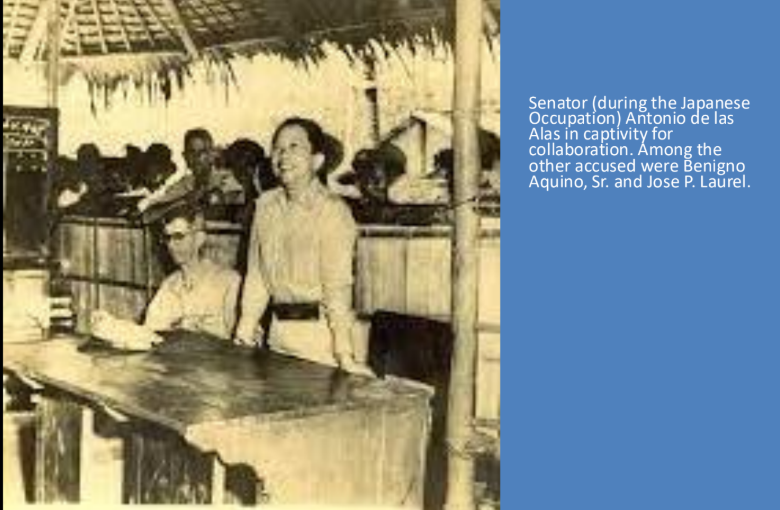
Many Filipino officials, including Senator Antonio de las Alas and Benigno Aquino Sr., held positions in this regime.
Why did they collaborate?
These leaders claimed that collaboration was necessary to:
Protect civilians from harsher Japanese rule
Preserve some Filipino authority
Maintain continuity of governance
Others, however, viewed their actions as treason, believing they had aided the enemy.
Post War Consequences: Collaboration Charges
After World War II (1945), the U.S. and Philippine governments:
Arrested and detained officials who had served under the Japanese.
Charged them with collaboration or treason.
Among the Accused:
Antonio de las Alas – Senator and cabinet official under Japanese rule.
Benigno Aquino Sr. – Held key posts including Director-General of the KALIBAPI (Japanese-backed political party) and Speaker of the National Assembly.
Jose P. Laurel – President of the Japanese-backed Philippine Republic.
They were held at the Iwahig Penal Colony in Palawan and other detention centers.
Institutional Reforms
New Constitution (1947 Constitution or “MacArthur Constitution”)
Japan’s Meiji Constitution was replaced with a democratic constitution.
It included major liberal democratic principles:
Article 9 renounced war as a sovereign right; Japan gave up the right to maintain military forces for war.
Guaranteed civil liberties (freedom of speech, religion, and assembly).
Women gained the right to vote.
Sovereignty shifted from the emperor to the people—making Japan a constitutional monarchy.
The Diet (parliament) became the supreme law-making body, reducing the power of the emperor to a symbolic role
Democratization of Governance
Local governments were empowered.
New political parties were encouraged.
The education system was reformed to promote civic education and democratic values.
Economic Reforms
Land Reform
Goal: Break up large landlord estates and redistribute land to tenant farmers.
Land previously rented by peasants was sold at low prices to them, turning many into landowners.
This weakened the feudal system and reduced the power of the traditional elite (landed aristocracy).
It improved rural livelihoods and lessened the appeal of communism in the countryside.
Labor Reforms
Trade unions were legalized and encouraged.
Workers gained rights to collective bargaining, strikes, and better working conditions.
This promoted the growth of a worker-friendly capitalist economy.
Dismantling of Zaibatsus (Economic Conglomerates)
Zaibatsus were powerful, family-controlled business empires (e.g., Mitsubishi, Mitsui).
The U.S. sought to break their monopoly on economic power to:
Promote economic democracy.
Prevent re-militarization through industrial control.
While the largest zaibatsus were dismantled, some restructured versions (keiretsu) eventually re-emerged.
Economic Growth as a Result
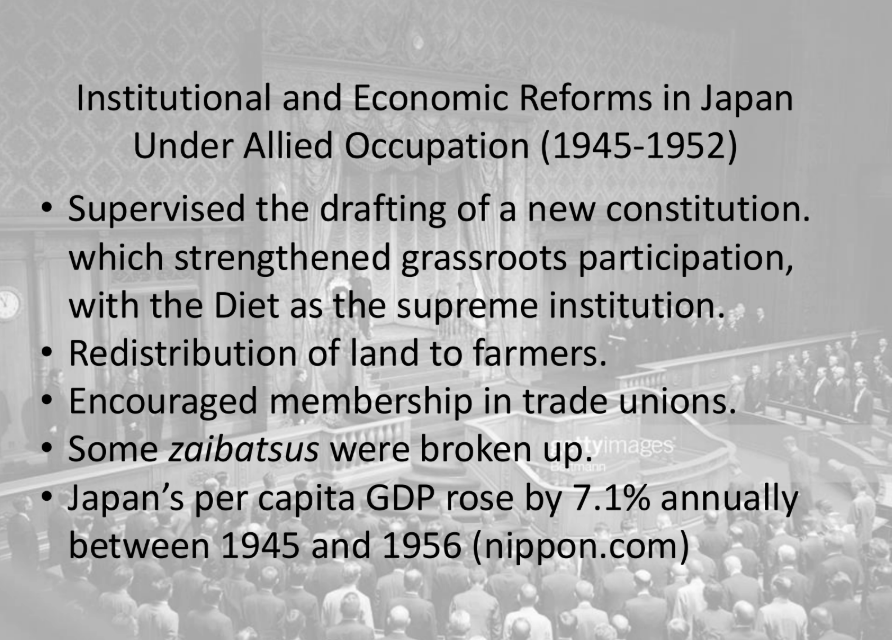
Japan's per capita GDP rose by 7.1% annually between 1945 and 1956.
This remarkable recovery became known as the Japanese economic miracle.
U.S. support (financial aid, access to U.S. markets, and favorable trade) helped Japan rebuild its industries and infrastructure quickly.
Why These Reforms Mattered?
Political Stability: Japan transitioned into a peaceful democracy.
Social Equality: Empowered peasants, workers, and women.
Economic Modernization: Japan shifted from a military economy to an industrial-export economy.
Cold War Strategy: The U.S. wanted a strong, capitalist Japan to serve as a bulwark against communism in Asia (especially after China fell to communism in 1949 and the Korean War broke out in 1950).
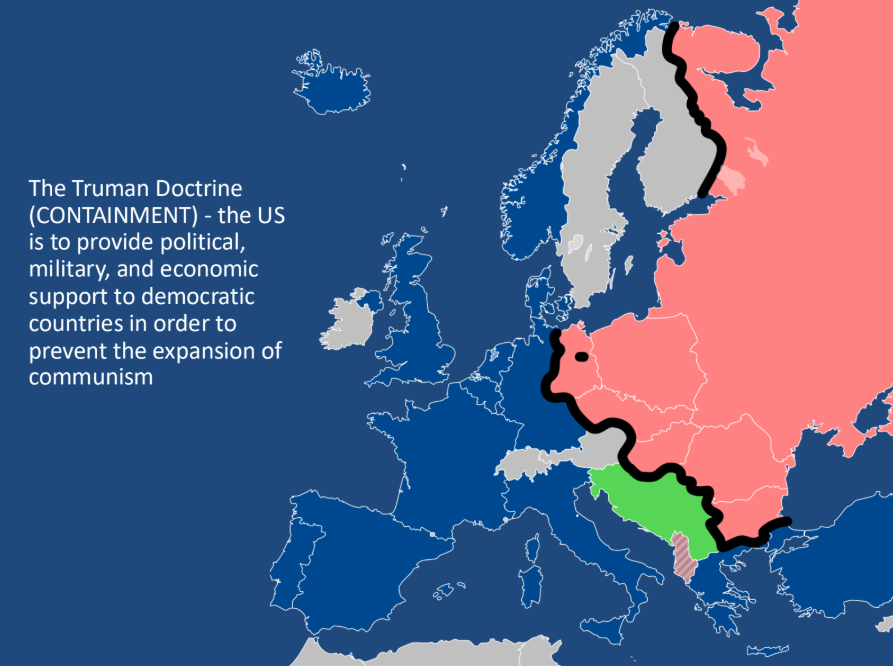
Truman Doctrine
Announced by U.S. President Harry S. Truman in March 1947, during a speech to Congress.
It was a direct response to Soviet expansion and the spread of communism in Europe, particularly in Greece and Turkey, where communist forces threatened to overthrow their governments.
The Bigger Picture: The Cold War Begins
After WWII, the U.S. and the Soviet Union became rival superpowers.
The Truman Doctrine marked the start of the Cold War policy of containment:
To "contain" communism and prevent it from spreading to other countries.
This led to:
U.S. involvement in Korea, Vietnam, Latin America, and Southeast Asia
Massive economic aid programs like the Marshall Plan and military alliances like NATO and SEATO
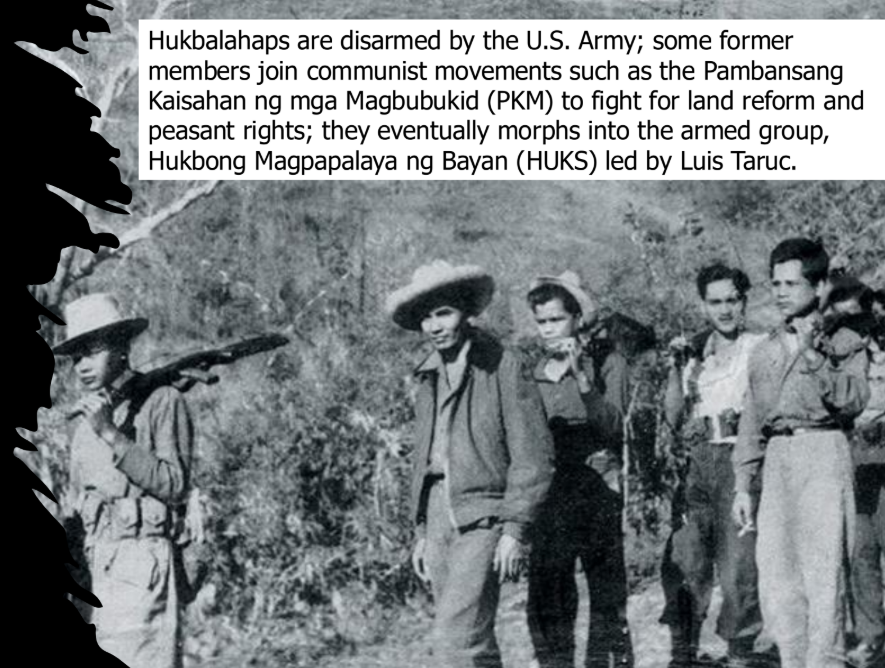
Hukbong Bayan Laban sa Hapon (Hukbalahaps)
What happened after the war?
Disarmament and Betrayal
After liberation in 1945, the U.S. Army ordered all guerrilla groups disarmed, including the Huks.
Unlike other recognized guerrillas, the Huks were denied benefits as veterans.
They were marginalized, persecuted, and some were branded as communists—despite being anti-Japanese freedom fighters.
Rising Peasant Discontent
Many Huks were from poor farming communities with long-standing land grievances.
After the war:
Landlords returned and evicted tenant farmers.
The government failed to implement land reform.
Former Huks were harassed, arrested, or killed by military and local police.
Pambansang Kaisahan ng mga Magbubukid (PKM)
The PKM was a peasant organization that pushed for:
Land redistribution
Tenancy reform
Peasant rights
Some former Huks joined PKM to push for change peacefully through political means, like running for Congress.
But...
In the 1946 elections, Luis Taruc and other PKM candidates won seats, but were disqualified by President Roxas' administration, accused of being subversive.
This confirmed for many that peaceful reform was impossible under the elite-dominated postwar system.
Formation of Hukbong Magpapalaya ng Bayan (HMB or HUKS)
The PKM’s failure to achieve reforms and government repression forced many peasant leaders back into armed resistance.
The Hukbalahap was reorganized as the Hukbong Magpapalaya ng Bayan (People’s Liberation Army).
Led again by Luis Taruc, the group waged a rural guerrilla war starting around 1946–1949 against:
The Philippine government
Landlords
U.S. military presence
They demanded:
Genuine land reform
Social justice
End to U.S. imperialism
US and Philippine Response
The Huk rebellion was seen as a communist threat aligned with global Cold War fears (see: Truman Doctrine).
The U.S. gave military aid, weapons, and intelligence to the Philippine government.
President Ramon Magsaysay, as Defense Secretary, led a successful counterinsurgency campaign, with help from the CIA.
He combined military action with limited land resettlement, rural development, and propaganda
Read slides…