Domain Bacteria and Unicellular Life
Unicellular Life: Domain Bacteria
Biological Diversity of Prokaryotes
Habitat of Bacteria
Ubiquitous Presence:
Bacteria inhabit various environments:
Extreme Conditions: Found from mountain peaks to deep ocean trenches, across arctic tundras to hot deserts.
Living Conditions: Existing both as free-living organisms and in symbiotic relationships, including parasitic forms.
Metabolic Diversity:
Bacteria exhibit a highly diverse range of metabolic processes and can adapt to the most varied conditions.
Structure of Bacteria
General Characteristics:
Mostly unicellular, showcasing various shapes:
Common Shapes: Cocci (spherical), bacilli (rod-shaped), helical, filamentous, and irregular forms.
Cell Membrane Composition:
Composed of a phospholipid bilayer, characteristic of normal cell membranes, which may include a wide variety of fatty acids.
Cell Wall Structure:
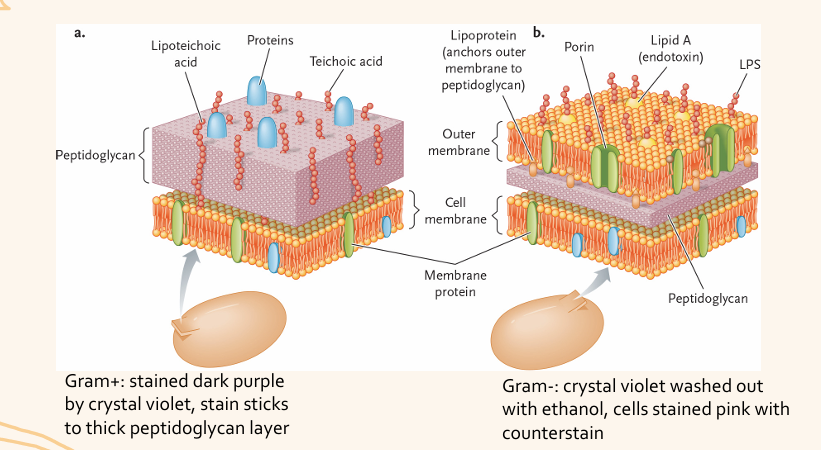
Made up of peptidoglycan, which provides rigidity to the cell.
Gram Staining Technique
Gram Positive (Gram+):
Bacteria stained dark purple by crystal violet.
The crystal violet stain adheres to a thick peptidoglycan layer.
Gram Negative (Gram-):
Crystal violet is washed out with ethanol during the staining process, leading to a pink coloration with a counterstain.This is due to the thin peptidoglycan layer and the outer membrane that is present in Gram-negative bacteria, which prevents the retention of the crystal violet stain.
Key Groups of Bacteria
Major Bacterial Groups:
Proteobacteria
Cyanobacteria
Gram-positive bacteria
Spirochetes
Chlamydias
Detailed Examination of Proteobacteria
Characteristics:
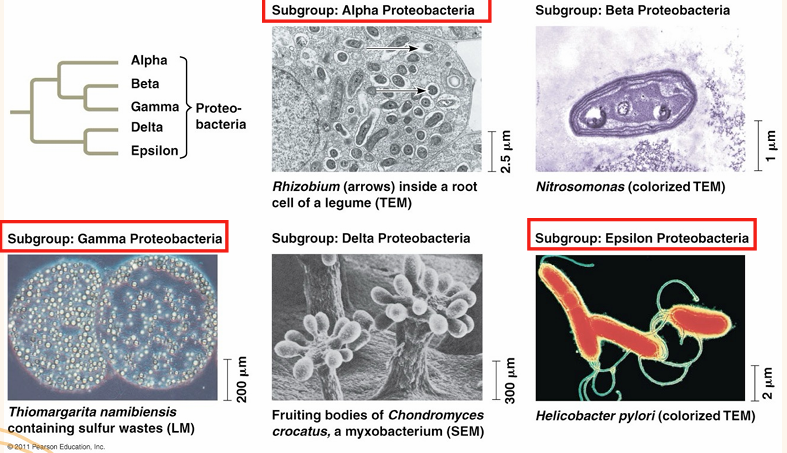
Generally gram-negative.
Exhibit both chemoautotrophic and photoautotrophic metabolic strategies, as well as photo- and chemoheterotrophs.
Subgroups of Proteobacteria:
Alpha Proteobacteria:
Often aerobic; related to mitochondria and associated with eukaryotic hosts.
Example: Rhizobium, which is involved in nitrogen fixation in plants.
Beta Proteobacteria:
Not extensively covered in the transcript but typically includes types adapted to host environments.
Gamma Proteobacteria:
Includes important bacteria like E. coli, along with various pathogens.
Delta Proteobacteria:
Includes species such as Thiomargarita namibiensis which contains sulfur wastes.
Epsilon Proteobacteria:
Most species within this subgroup are pathogenic, including Helicobacter pylori.
Exploring Spirochetes
Characteristics:
Gram negative with a distinct helical shape.
Possess varying metabolisms: some can be chemoautotrophic, while most are chemoheterotrophic.
Habitat and Behavior:
Mostly free-living in aquatic environments, exhibiting spiral movement by rotating internal flagella-like filaments.
Some spirochetes can form biofilms, an example being dental plaque.
Gram-Positive Bacteria
Group Characteristics:
Likely a monophyletic group, predominantly gram positive, recognized by a thick peptidoglycan layer.
Display a high level of metabolic diversity including:
Chemoheterotrophic
Chemoautotrophic
Photoheterotrophic
Aerobic to anaerobic metabolic capabilities.
Major Subdivisions:
Firmicutes:
Characterized by a strong cell wall and normally exhibit cocci or bacilli shapes.
Some important genera such as Lactobacillus (used in probiotics) and known pathogens like Streptococcus and Staphylococcus.
Actinobacteria:
Previously categorized as actinomycetes, largely found in soil where they act as saprophytes and decomposers of cellulose and chitin.
Features of Cyanobacteria
Characteristics:
Typically gram negative.
Function as photoautotrophs, containing chlorophyll a and various pigments.
Exhibit structural complexity:
May exist in colonies and produce resting spores known as akinetes.
Capable of nitrogen fixation via specialized cells called heterocysts.
Specialized Structures in Bacteria
Membrane Complexity:
Membranes may exhibit folds, an example being observed in cyanobacteria.
In aerobic bacteria, membranes can have infoldings that serve as sites for the electron transport chain (ETC).
Flagellum Structure:
Bacteria possess flagella that are analogous, yet structurally distinct from those found in eukaryotic cells.
Convention of Exaptation:
Defines how 19 out of 21 essential proteins found in flagella represent modified structures that have adopted new functions over evolutionary time, a phenomenon termed exaptation.
Key Points of Understanding
Diversity of Bacterial Nutrition:
Represents a wide array of nutritional modes showcasing adaptability.
Peptidoglycan Presence:
Unique to bacteria, crucial for cell wall integrity.
Differences in Cell Wall Structure:
Important distinctions between gram-positive and gram-negative bacteria.
Bacteria's Role in Human Benefit and Health:
Trend observation of bacteria like Lactobacillus in yogurt (beneficial) versus pathogenic strains like Helicobacter pylori (harmful).