Taxation
Now that we've talked about government spending, budgets, and debt, let's talk about everyone's favorite topic: taxes. Before continuing with the rest of the lesson, watch the video below, which gives a brief overview of taxation and talks about why raising taxes or cutting spending is such a difficult proposition.
This video again highlights why solving the national debt problem in America is so difficult. Nobody wants to pay more taxes, and nobody wants to reduce spending by cutting government programs. Citizens already feel like they pay more taxes than they should—they want to pay less, not more! Many people also think the government should have more programs (such as Medicare for All or Universal Basic Income), which would require more spending, not less. All these issues are important to keep in mind as you move forward in the course, but for the next few lessons we will move away from a direct discussion of the debt problem. Instead, we will focus on how the government raises money and what services and programs it funds with that money. As you work through the next few lessons, though, keep in mind that reducing the debt would require the nation to either increase the various taxes we discuss or decrease the government services we discuss.
Taxation Methods

Property Taxes

Income Taxes

Sales Taxes
All government spending must be done using tax dollars, but how exactly does the government collect taxes? This answer is different depending on which government you're looking at. In the United States, local, state, and federal governments all raise taxes in different ways.
Local Taxes
Local governments are primarily funded through property taxes. Some localities also receive grants from the federal government to pay for certain programs, and many have small sales taxes that get added on to the state's sales tax. (Sales taxes will be covered in the "State Taxes" section.)
Unless they receive a tax exemption, everyone who owns certain types of property has to pay an annual property tax to the local government. Real estate is the largest property tax, but many other types of personal property are taxed as well, including automobiles, boats, airplanes, and manufacturing equipment and tools. This tax is usually a percentage of that property's value. For example, the real estate tax in Lynchburg, Virginia, is $1.11 per $100 of assessed value (in other words, the real estate tax is 1.11%). That means if you own real estate worth $100,000, you'll receive an annual tax bill of $1,110. Property tax rates can vary widely. In Louisiana, the average tax on real estate is only 0.18%, while in New Jersey the average real estate tax is 1.89%.
Property taxes on vehicles are usually a higher percentage (in Lynchburg, this tax is 3.8%), but the overall bill is less expensive since vehicles have less value than real estate. Still, these property taxes can add up to a high total. A family in Lynchburg who owns a $200,000 house and two $20,000 cars will owe the city an annual property tax of $3,740.
State Taxes
State governments are funded mostly through sales taxes and income taxes. Not all states have an income tax, but those states will usually have a higher sales tax. Just like local governments, they also receive funds from federal grants that help them with specific programs.
If you've ever bought anything in the United States, you're familiar with sales taxes. These taxes are applied whenever you buy products from a store. In Virginia, the statewide sales tax is 5.3% (4.3% goes to the state government, and 1% goes to the local government). This means that if you buy a $100 pair of headphones, you'll pay $5.30 in sales tax. Some items, such as food and medicine, will have a reduced sales tax. In Virginia, eligible food products only have a 2.5% sales tax, and medicine products have no sales tax at all.
All but nine states have a state income tax, which taxes citizens based on the amount of income the citizens earn. A few states have a flat income tax, which means that all citizens are taxed the same percentage of money regardless of how much they make. Most states, however, have a progressive income tax, which means that the more money you make, the higher percentage you pay in taxes. In Virginia, for example, taxable income under $3,000 is taxed at a rate of 2%, but the percentage ramps up to 5.75% for people with higher incomes. A family in Virginia with $50,000 in taxable income would pay $2,617 in state income tax.
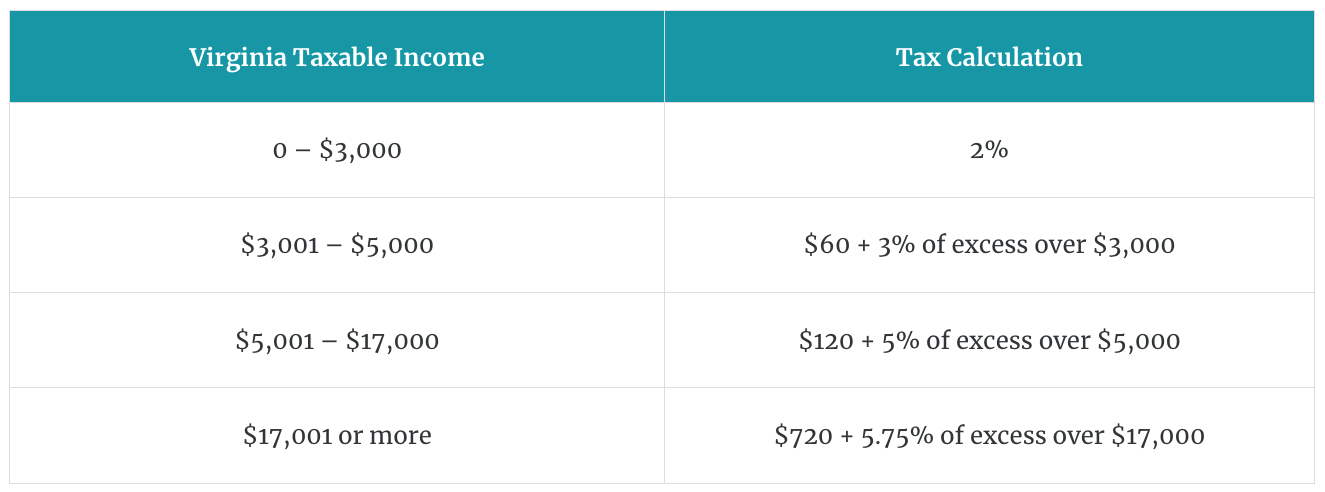
You may have noticed from the chart that if you are in the $3,001 to $5,000 bracket, you don't pay 3% on your entire income. Instead, you pay 2% for the first $3,000 (which is $60), and then pay 3% for anything that exceeds $3,000. It works similarly as you advance into higher brackets.
Federal Taxes
The federal government receives tax revenue in many different ways, but there are six primary sources: individual income taxes, payroll taxes, corporate income taxes, excise taxes, fees, and tariffs.
Individual Income Taxes
–
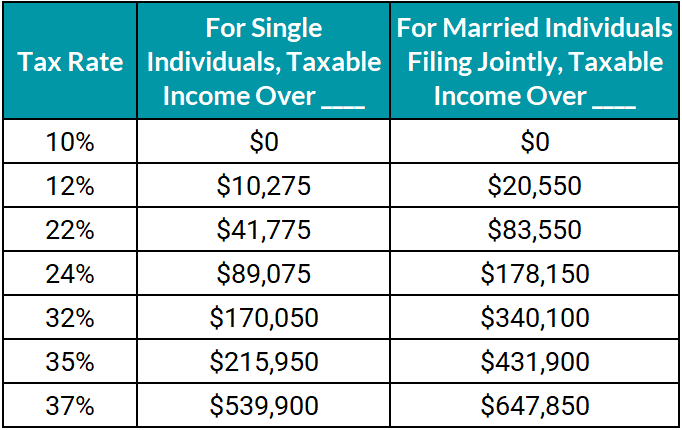
The main source of federal tax revenue comes from individual income taxes. The federal income tax works very similarly to state income taxes. Like most states, the federal income tax is progressive—the more money you make, the higher percentage you'll pay in taxes. Federal income tax rates are much higher, however. In 2022, the lowest tax bracket paid a rate of 10%, while the highest tax bracket paid a rate of 37%. The dollar amounts at which the brackets change is different depending on if you're filing as a single individual or as a married couple.
These brackets work the same as the state bracket above: if you're single and in the 12% bracket, you only pay a 12% tax on the amount that exceeds $10,275. The first $10,275 that you make only requires a 10% tax. So if you were a single individual with a taxable income of $30,000, you would pay $3,395 in federal income tax ($10,275 0.1 + $19,725 0.12 = $3,395).
A family with a taxable income of $50,000 would pay $5,589 in federal income tax ($20,550 0.1 + $29,450 0.12).
Payroll Taxes
–
Payroll taxes for Social Security and Medicare are another large source of tax revenue for the federal government. These payroll taxes are known as FICA tax, named after the Federal Insurance Contributions Act. Unlike individual income taxes, FICA payroll taxes are flat taxes. As an employee, this tax adds up to 7.65% of your wages (6.2% to Social Security and 1.45% to Medicare). In addition, your employer will have to match this tax, also paying a 7.65% tax on your wages. If you're self-employed, you'll have to pay the full 15.3% tax on your own. This 7.65% or 15.3% tax is above and beyond whatever you have to pay in federal income tax. (And don't forget you'll also be paying a state income tax in most areas of the country.) These taxes quickly add up to a large chunk of every paycheck.
Corporate Income Taxes
–
Like individuals, corporations also have to pay income taxes. Unlike individuals, corporations pay a simple flat income tax. This tax rate was recently 35% but was reduced to 21% by the Tax Cuts and Jobs Act of 2017.

Excise Taxes
–
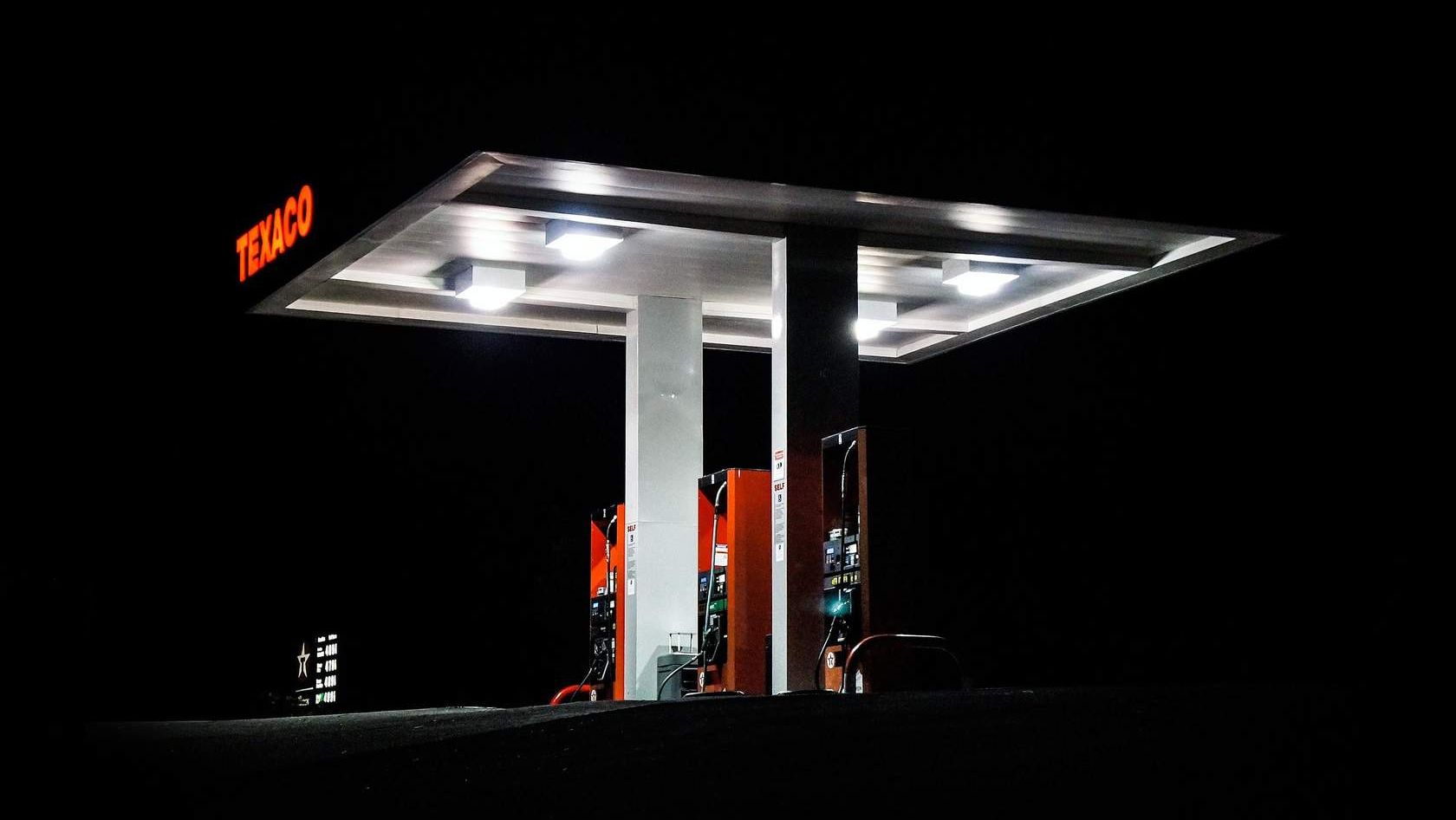
An excise tax is similar to a sales tax, except it is levied when an item is produced instead of when it's sold. The major excise taxes in the United States are on gasoline, tobacco, and alcohol. These taxes are paid by the manufacturers of these products, but the cost of the tax is usually passed on to consumers. For example, if there is an 18-cent excise tax on each gallon of gasoline, then producers will charge 18 cents more for each gallon they sell. Combined, excise taxes only make up about 2.5% of the federal government's total tax revenue.
Fees
–
The federal government charges fees for certain services, which also generate small amounts of tax revenue. These include fees for things like getting a passport or visa, as well as entrance fees for national parks.
Tariffs
–
Tariffs are taxes on goods imported from other countries. The government generates one to two percent of its annual revenue from tariffs. Like excise taxes, the cost of tariffs is usually passed on to consumers. The foreign companies will charge American consumers higher prices to make up for the tariffs that the companies paid to the government.

Primary Areas of Spending
The amount of taxes collected by American governments is measured in the trillions. What are all those tax dollars spent on? The bulk of spending by local and state governments goes to the following:




Public Education
Public Welfare
Road Construction and Repair
Public Safety
Federal spending is usually focused on different areas. The bulk of federal spending goes to the following:



National Defense
Social Security Payments
Goods and Services, Such As Medical Costs (Medicare, Medicaid)
Interest Payments on the National Debt
We've already talked about interest payments on the national debt, which already make up a sizable portion of the federal budget. Over the next couple of lessons, we'll dive deeper into the rest of these government expenditures and the services they provide.
Review of Key Terms
flat tax: a tax that applies the same tax rate regardless of income
progressive tax: a tax in which people with higher incomes pay a higher tax rate
sales tax: a tax that's levied when an item is sold
FICA tax: a payroll tax that funds Social Security and Medicare
excise tax: a tax that's levied when an item is produced
The American government has come up with a plethora of ways to raise taxes. From property, sales, and income taxes to excise taxes, fees, and tariffs, there are many sources of government revenue. There are even other types of taxes we didn't cover, such as estate taxes and capital gains taxes. With this in mind, it's easy to see why voters would vigorously oppose any tax increases, and why any politician that votes for an unpopular tax increase may find it difficult to get reelected. As we've already discussed, this is regrettably one of the main causes of America's burgeoning national debt.