The Nervous System
Enables humans to react to their surroundings and coordinate their behaviour
Electrical impulses is information sent through the nervous system
These are known as neurones if sent along nerve cells
A nerve is a bundle of neurones.
Key Terms
Stimulus: A detectable change in the internal or external environment of an organism
Receptor: A cell or organ which detects a stimulus
Sensory Neurone: Carries nerve impulses from receptors to CNS
Motor Neurone: Carries nerve impulses from CNS to effectors
Relay Neurone: Receive signals from sensory neurons and pass them on to motor neurons
Voluntary Response: Produces a conscious response to a stimulus
Reflex Response: Produces an automatic response to a stimulus
Synapse: Gap between two neurones
Axon: The fibre that transmits electrical impulses away from the cell body

Central Nervous System (CNS)
Coordinates the response by directing the electrical impulses to the correct effector
The CNS consists of the brain and spinal cord, acting as the body's main control and processing centre
The effector is either a muscle contraction or secretion from a glan
]=/[654
The Peripheral Nervous System (PNS) comprises all nerves outside the CNS that connect it to limbs and organs
The PNS is made up of all the nerves in the body (from the CNS)
The process:
A stimulus is detected
The receptor converts the stimulus into an electrical impulse
This is sent to the relay neurone in the CNS through a sensory neurone
The CNS coordinates a response and sends that electrical impulse along the motor neurone to the effector
The effector initiates a response
What Makes Up a Neurone?

An axon - the fibre that transmits electrical impulses away from the cell body
This is adapted to ensure fast transmission via:
a myelin sheath - a fatty layer which insulates the axon
long length (over a metre)
A dendrite - branched endings that create links with other neurones
A synapse - the gap between two neurones which blocks electrical impulses from travelling across

When an impulse arrives on the presynaptic neurone, neurotransmitters diffuse across the gap and bind with the receptors on the postsynaptic membrane.
This stimulates the postsynaptic neurone to generate an electrical impulse, which then travels along the axon.
The neurotransmitters are then destroyed to prevent continued stimulation of the second neurone.
Reflex Arcs
An involuntary response that doesn’t involve the brain as a coordinator
Responses are rapid to protect the body from harm
Process of a reflex arc:
A stimulus is detected by a receptor (pain/pressure)
The sensory neurone sends electrical impulses to the spinal cord, then the relay neurone
A relay neurone synapses with a motor neurone, which transports the impulses to the muscle in the effector (e.g. an arm/leg)
The effector initiates a response
The Eye
The eye is a sense organ
It contains two receptor cells: rod cells (sensitive to light) and cone cells (sensitive to colour)

Functions:
Cornea - Refracts light as it enters the eye
Iris - Controls how much light enters the eye
Lens - Changes shape to focus light onto the retina
Retina - Converts the light into electrical impulses
Pupil - Hole that allows light to enter the eye
Optic Nerve - Carries the electrical impulses away from the eye to the brain
When the eye focuses on a distant object:
Ciliary muscle relaxes
Suspensory ligaments contract
The lens is pulled thinner, so light is refracted less
When the eye focuses on a near object:
Ciliary muscle contracts
Suspensory ligaments slacken
The lens becomes fatter so light is refracted more
In dim light, your pupil dilates to allow more light into the eye.
In bright light, your pupil constricts to prevent too much light entering the eye & damaging the retina.
Both of this happens due to your radial muscles contracting/a reflex action.
Eye Defects
Short sightedness/myopia:
Cannot see distant objects
Focal point is before the retina
Treated with a concave lens
Long sightedness/hyperopia:
Cannot see close up objects
Focal point behind the retina
Treated with a convex lens
Colour blindness:
Cones in the retina are absent/don’t work
Genetically inherited
Tinted lenses emphasise colours more - no treatment
The Brain
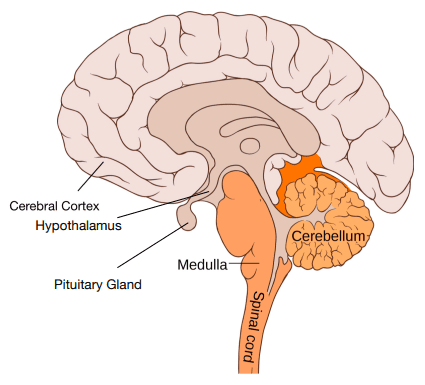
The brain is part of our CNS - along with the spinal cord
There are five structures in the brain:
Cerebrum - Responsible for memory, intelligence, language, and consciousness (personality)
Medulla - Controls unconscious activities e.g. heart and breathing rate
Hypothalamus - Regulates body temperature and produces hormones that control the pituitary gland
Cerebellum - Balance, muscles, and coordination
Pituitary Gland - Produces hormones, e.g. ones used in the menstrual cycle
It is extremely difficult to study the brain because:
The brain is complex and delicate
Ethical considerations (people with brain damage unable to provide informed consent)
Interpreting the results of MRI scans can be complicated, since patterns are not yet understood
There are many methods of studying the brain however, including MRI scans, studying the brains of dead people, and case studies of people with abnormal brain functions.