AP Biology Chapter 2.1 Atoms, Isotopes, Ions, and Molecules: The Building Blocks (Part 1)
*This Knowt covers topics from “The Structure of the Atom” to “Electron Orbitals”.
Preliminary Notes:
- Atoms are the that retain all their characteristics - they consist of protons, neutrons, and electrons.
- Isotopes are different forms of an element that have , while . Many isotopes are radioactive.
- Examples include carbon-14, carbon-13, and carbon-12.
- Matter is defined as any substance that occupies space and has mass.
- An example of a unique form of matter is the element - elements contain specific chemical and physical properties that CANNOT be broken down into smaller substances by ordinary chemical reactions.
- The four elements common to all living organisms are:
- Carbon
- Hydrogen
- Oxygen
- Nitrogen
The Structure of the Atom
As mentioned before, an atom is the smallest unit of matter that retains all of the chemical properties of an element.
- For example, one Gold (Au) atom contains all the properties of Gold.
- Gold atoms, like atoms of other elements, cannot be broken down any further while retaining the properties of Gold.
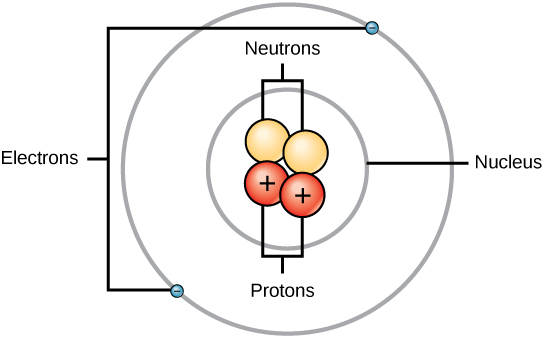
Atoms are composed of :
- Nucleus
- This is the of the atom.
- This region contains .
- Outermost region of the atom (Orbitals)
- Holds the atom’s in orbit around the nucleus
| Protons | Neutrons | Electrons | |
|---|---|---|---|
| Charge | Positive (+1) | Uncharged (Neutral) (0) | Negative (-1) |
| Mass | 1.67 × 10^-24 grams | 1.67 × 10^-24 grams | 9.11 × 10^-28 grams |
| Mass (amu) | 1 | 1 | 0 |
| Location | Nucleus | Nucleus | Orbitals |
- Scientists arbitrarily define the mass of protons as one atomic mass unit or one Dalton.
- Since , they only contribute to the mass of an atom, not to its charge.
- Since , they do not contribute much to an element’s overall atomic mass.
- Because of this, it is customary to ignore the mass of electrons when calculating atomic mass.
- Only protons and neutrons are used to calculate atomic mass.
- Electrons, unlike neutrons, contribute significantly to the atom’s overall charge, since
- In neutral (uncharged) atoms, the . This is because the positive and negative charges will cancel each other out, causing an atom to have no net charge.
- Example: If the nucleus of an atom has seven protons (+7), the number of electrons orbiting the nucleus will also be seven (-7). The sum of these charges will be zero, and have no net charge.
Atomic Number and Mass
The atoms of each element contain a characteristic number of protons and electrons.
The atomic number is determined by the
- Atomic number is used to distinguish elements from each other.
- The number of neutrons in an atom vary - this leads to the formation of isotopes.
- Isotopes are different forms of the same atom that vary in the number of neutrons.
The atomic mass of an element is determined by adding the number of protons of a given element to the number of neutrons of that same element. (Atomic mass = # of protons + # of neutrons)
- Rearranging this equation allows us to solve for the number of neutrons of a given element: Mass number of a given element - # of protons = # of neutrons
Since elements’ isotopes will have slightly different mass numbers, the average atomic mass of an element is determined by calculating the mean of the mass number for its naturally occurring isotopes.
- Example: Chlorine has multiple isotopes. Most of these isotopes have an atomic mass of 35, while some have an atomic mass of 37. When we take the average of all these isotopes, the atomic mass is measured at 35.45.
Periodic Table
The different elements are organized and displayed in the periodic table.
Facts about The Periodic Table:
- Devised by Russian chemist Dmitri Mendeleev in 1869
- Groups elements that share certain chemical properties with other elements
- Organized by atomic number
- Arranged in a series of rows (periods) and columns (groups) based on shared chemical and physical properties; they are also arranged based on the number of electrons and where these electrons are located
- Displays the atomic mass of various elements
Electron Shells and the Bohr Model
Know that there is a connection between the number of protons in an element and the number of electrons in an element.
- In electrically neutral atoms, the number of electrons is the same as the number of protons.
The Bohr Model:
- Early model of the atom developed in 1913 by Danish scientist Niels Bohr
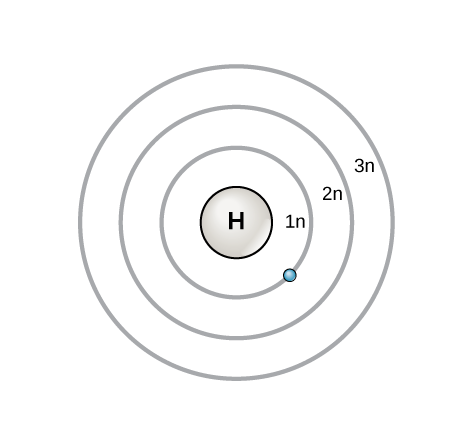
- Depicts (shows) the atom as a central nucleus containing protons and neutrons, with the electrons in circular orbitals at specific distances from the nucleus (as shown in the diagram below)
- The orbits form electron shells (energy levels):
- These are a way of visualizing the number of electrons in the outermost shells.
- Energy levels are designated by a number and the symbol “n”.
- For example, in the diagram below, “3n” represents the third energy level located furthest from the nucleus.
Electrons will fill orbitals in a consistent order - they fill the orbitals closest to the nucleus, then continue to fill orbitals of increasing energy further from the nucleus.
- If there are multiple orbitals with equal energy, they will be filled with one electron in each energy level before a second electron is added.
- (valence electrons) determine the stability of the atom and its tendency to form chemical bonds with other atoms to form molecules.
- The an atom has, the . In other words, the more valence electrons an atom has, the less reactive it is.
- Example: Neon, a non-reactive gas, which has eight valence electrons.
- Under standard conditions, electrons will fill the innermost shells first, before proceeding to fill the outer shells.
- The innermost shell is able to hold a maximum of two electrons, however, the next two electron shells can each hold no more than eight electrons.
- This results in a varied number of electrons in the outermost shell of different atoms. (This is because different atoms will have different numbers of electrons.)
The Octet Rule states (with the exception of the innermost shell) that atoms are more stable energetically when they have .
- Examples of elements that satisfy the octet rule include Helium, Neon, and Argon.
- Even though Helium only has two valence electrons, its outermost shell is full, therefore, it satisfies the octet rule.
- Since the atoms are highly stable, they have high degrees of non-reactivity. This has resulted in their being named the inert gases/noble gases.
Positively Charged Ion: occurs when an atom loses a negatively charged electron
Electron Orbitals
The Bohr model of the atom is useful when explaining the reactivity and chemical bonding of certain elements; however, this model does not accurately reflect how electrons are spatially distributed surrounding the nucleus.
- The electrons do NOT circle the nucleus; they are found in electron orbitals.
- Orbital: the area where an electron is most likely to be found