Comprehensive Legal Studies Note: Austrian Public Law, Constitutional Law, Administrative Law, and EU Law
Introduction to Law and Legal Science
Prevalence of Norms in Human Coexistence:
- Human daily life is regulated by a multitude of norms (commands and prohibitions).
- Examples of Norms:
- Greeting neighbors in the stairwell politely.
- Paying for a daily newspaper at the tobacconist (Trafik) rather than stealing it.
- Buying a tram ticket.
- Offering seats to elderly or infirm persons.
- Obeying traffic regulations while driving.
- Paying apartment rent on time.
- Refraining from injuring or killing anyone.
- Giving gifts to loved ones at Christmas.
- Refraining from shouting or lying in conversations.
- Refraining from smoking in public buildings.
- Wearing a smoking jacket or ball gown to a formal ball.
- Attending church on Sunday or abstaining from meat on Good Friday.
- Drinking wine from the correct glass.
- Eating with a knife and fork.
- Complying with orders from superiors at work.
Categorization and Classification of Norms:
- By Structure: Commands (Gebote) versus Prohibitions (Verbote).
- By Authority: State-issued versus private norms.
- By Sanctions:
- Norms enforced by state coercive measures or sanctions upon non-compliance.
- Norms enforced by social consequences (e.g., bad reputation, social exclusion, loss of prestige).
- By Origin:
- Legal Order (Rechtsordnung): Enforceable state rules.
- Religious Vorschriften: Norms derived from faith or religious texts.
- Sitte (Custom) & Moral (Morality): Social habits, conventions, and inner conscience.
- Overlapping Norms: Certain prohibitions—such as the prohibition against killing or stealing—exist simultaneously within the legal order, religious regulations, and moral value concepts.
Relationship Between Law and Value Concepts:
- Legal norms frequently mirror specific societal value judgments.
- Examples in Law:
- Fundamental Rights (Grundrechte): Right to life, right to education, right to respect for private and family life, right to data protection.
- Tax Law: Imposing higher taxation rates on higher incomes compared to lower incomes.
- Explicit Legal References to Customs: Section 879 of the General Civil Code (Allgemeines Bürgerliches Gesetzbuch,
ABGB) declares contracts void if they violate "good customs" (gute Sitten). - Strict Separation: Despite overlap, a strict conceptual line must be drawn between the legal order and rules arising from morality, custom, religion, habit, conscience, or abstract justice considerations.
Core Characteristics of Positive Law (Positives Recht):
- Enactment by State Authority: Norms are set/created by a recognized political/state authority (derived from Latin ponere, meaning "to lay" or "to set").
- Enforceability via State Coercion: Compliance is backed by state-organized coercive measures (staatliche Zwangsmaßnahmen).
- Terminology Clarification: "Positive law" does not signify "good" or "valuable" law; it strictly means human-made, enacted law.
- Definition of Legal Science (Rechtswissenschaft): Legal science deals exclusively with positive law—law enacted by state authorities whose enforcement is guaranteed through state coercion.

Law versus Justice: Theoretical Approaches:
- Antiquity & Roman Jurisprudence: Law was framed as the "art of the good and equitable" (ius est ars boni et aequi).
- Natural Law (Naturrecht): Attempts throughout history to derive an immutable legal framework directly from universal moral or justice principles. Problem: Human views on moral values vary widely across cultures and eras (ranging from the biblical talion principle "an eye for an eye, a tooth for a tooth" to contemporary debates on Western vs. Islamic values).
- The Pure Theory of Law (Reine Rechtslehre):
- Developed by the Austrian legal theoretical school, led by Hans Kelsen (1881–1973) and Adolf Julius Merkl.
- Posits that the sole object of legal science is human-created law, completely detached from moral judgments of "right" or "wrong," because objective highest moral values cannot be proven scientifically or logically.
- Dualism / Dichotomy of Is and Ought (Dichotomie Sein-Sollen):
- A strict separation exists between Sein (Is / factual reality) and Sollen (Ought / legal validity).
- The validity (Sollen) of a norm can only be derived from a higher legal norm, never from a mere factual occurrence (Sein).
- Ordering a specific behavior (Sollen) does not guarantee that a person will actually act that way (Sein).
- The Basic Norm (Grundnorm): At the apex of the legal order stands an assumed supreme basic norm from which the entire legal system derives validity. The Grundnorm is not created by humans but must be presupposed as existent to enable legal cognition.
- Ethical Normativism & Post-WWII Criticisms:
- The strict separation of law and morality faced severe backlash following the atrocities committed under the guise of statutory legality during the Third Reich.
- Herbert L.A. Hart (British legal philosopher) and Gustav Radbruch (German legal scholar and post-war Minister of Justice) modified legal positivism into ethical normativism.
- Radbruch's Formula (Radbruch'sche Formel): Positive statutory laws must be applied even if they are unjust and inexpedient. However, when the conflict between positive law and justice reaches an "unbearable degree" (unerträgliches Maß), the positive law must yield to justice. Statutes that intentionally do not even strive for justice lack legal character entirely.
Law and Politics / Social Conventions:
- Political science frequently views the legal order as "politics cast into paragraphs."
- Legal norms reflect evolving political demands and shifting social conventions over time.
- Historical Examples in Austrian Law:
- Abortion Law Reform (1975): Exemption from criminal punishment for abortions performed within the first three months (Fristenlösung) was passed in Parliament due to the absolute majority of the SPÖ, against fierce resistance from the ÖVP.
- Homosexuality Laws: Total ban repealed in 1971 and replaced by restricted prohibitions (e.g., prohibition of homosexual acts between adult males and male minors aged 14–19). This remaining partial ban was struck down in 2002 following pressure from the European Court of Human Rights (ECtHR).
- Socio-Economic Laws: Labor law, tenancy law, consumer protection law, and tax law contain numerous provisions directly reflecting specific political ideologies.
- The Supremacy of Law over Politics:
- A statement made by an FPÖ Interior Minister in January 2019 ("I believe that the law has to follow politics, and not politics the law") regarding an administrative instruction prior to amending statutory law is legally incorrect.
- While Parliament can amend simple laws or the Constitution with appropriate majorities (and referendums for major constitutional revisions), the legal order strictly binds the entire execution of laws by the administration until the law is formally changed.
- Principle of Legality (Legalitätsprinzip): Art 18 Abs 1 B-VG dictates that the entire state administration may only be exercised on the basis of the laws.
Functions, Structure, and Publication of Legal Norms
The Functions of Law:
- Ordnungsfunktion (Ordering Function): Regulates human coexistence through behavioral steering (information, incentives, or commands/prohibitions) to prevent social conflicts proactively (preventive character).
- Friedensfunktion (Peace-Keeping Function): Resolves existing conflicts without violence through structured, clear procedures before state bodies. The state holds the monopoly on force (Gewaltmonopol); vigilantism (Faustrecht) and lynch law (Lynchjustiz) are outlawed. Penalizes actions disrupting social peace (repressive character).
- Legitimationsfunktion / Verfassungsfunktion (Legitimating/Constitutional Function): Establishes authority and procedures for issuing legal norms, executing state authority, and imposing sanctions.
- Ausgleichsfunktion (Balancing/Compensatory Function): Balances competing interests between:
- (a) The weaker individual.
- (b) Stronger, larger groups or society as a whole.
- (c) State authorities.
- Two-Sided Balancing Example: Tenancy law (Mietrecht) or consumer protection law (Konsumentenschutzrecht), balancing the interests of weaker parties (tenants, consumers) against stronger parties (landlords, entrepreneurs).
- Three-Sided Balancing Example: Tax law (Steuerrecht), where individuals want minimal taxes, corporations want low corporate tax rates, and the state requires sufficient revenue and incentives to maintain public infrastructure and prevent capital flight.
- Gestaltungsfunktion (Structuring/Design Function): Actively shapes social living conditions through legal incentives, subsidies, and subjective rights.
- Erwartungssicherung (Securing Expectations): Provides legal certainty (Orientierungssicherheit) regarding legal contents and guarantees reliable, fast, accessible enforcement through courts and administrative authorities. Critical factor for corporate investments (Betriebsansiedlungspolitik).
- Rechtsgarantiefunktion (Guarantee Function): Guarantees an absolute sphere of individual liberty protected by fundamental constitutional rights (Grundrechte), into which the state may only intervene under exceptional, strictly regulated circumstances.
Structure of a Legal Norm:
- Legal norms typically comprise two structural elements:
- Gebotsteil (Command/Prohibition Part): Prescribes or forbids a specific conduct.
- Sanktionsteil (Sanction Part): Orders a coercive legal consequence (Rechtsfolge) if the command or prohibition is breached.
- Combined in a single statutory provision (rare):
- Section 75 StGB (Murder / Mord): "Whoever kills another person shall be punished with imprisonment of ten to twenty years or with imprisonment for life."
- Section 76 StGB (Manslaughter / Totschlag): "Whoever lets themselves be carried away to kill another person in a generally understandable severe emotional state shall be punished with imprisonment of five to ten years."
- Separated across different statutory provisions (typical):
- Section 16 Abs 1 ForstG (Forestry Act): "Any devastation of forests is prohibited. This prohibition is addressed to everyone."
- Section 174 Abs 1 lit a Z 3 ForstG: Establishes that non-compliance with Section 16 Abs 1 constitutes an administrative offense punishable by a fine of up to 7,270 Euros or arrest for up to four weeks.
- Subsumption (Subsumtion):
- A breach of a prohibition does not automatically trigger a sanction (e.g., offender remains unidentified or acts in self-defense).
- Subsumption is the process of comparing actual factual circumstances (Sachverhalt) against the abstract elements of a legal norm (Tatbestandselemente).
- The legal consequence applies only when every single statutory element is fulfilled by an act or omission.
- Comparison of § 75 and § 76 StGB: § 75 StGB contains one core element (the act of killing). § 76 StGB requires three cumulative elements: (1) the act of killing, (2) a generally understandable severe emotional state, and (3) being carried away by that emotional state.
- Types of Legal Consequences:
- Alternative Consequences: Administrative offenses typically allow either a fine OR imprisonment; administrative authorities cannot impose both simultaneously.
- Cumulative Consequences: Certain traffic offenses result in a fine AND mandatory revocation of the driver's license AND traffic psychological retraining.
Publication and Legal Research:
- Requirement of Publicity: Laws must be officially published to be legally effective. Ignorance of published law is no defense (Section 2 ABGB: "As soon as a law has been properly promulgated, no one can excuse themselves on the grounds that it was unknown to them.").
- Rechtsinformationssystem des Bundes (RIS):
- Official federal database accessible at
http://www.ris.bka.gv.at. - Since January 1, 2004, official publication of federal laws and key federal ordinances occurs authentically via RIS.
- Traditional hardcopy publication in the Federal Law Gazette (Bundesgesetzblatt,
BGBl) is divided into three parts since 1997:- Part I: Federal Laws (Gesetze).
- Part II: Federal Ordinances (Verordnungen).
- Part III: International Treaties (Staatsverträge).
- Commercial Legal Databases:
- RDB (Rechtsdatenbank by MANZ-Verlag) and Lexis360 (Verlag Österreich).
- Provide access to legal commentaries, specialized journal articles, and case law (excluding standard textbooks). Accessible free of charge for university students via university portals (e.g.,
http://uni.rdb.at/index.html). - State and EU Laws:
- State laws (Landesgesetze) are published in State Law Gazettes (Landesgesetzblätter) and indexed in RIS.
- European Union laws are published in the Official Journal of the EU, accessible via EUR-Lex (
http://eur-lex.europa.eu/de/index.htm).
Temporal Validity of Legal Norms:
- Entry into Force (Inkrafttreten): Norms generally enter into force on the day following their official publication, unless specified otherwise.
- Legisvakanz: Explicit statutory provision delaying entry into force to a specified future date.
- Retroactivity (Rückwirkung): Norm specifies that it applies to past dates prior to publication.
- Criminal Law Prohibition: Retroactivity is constitutionally prohibited in criminal law.
- General Constitutional Limits: Retroactive non-criminal laws are constitutionally questionable if lacking objective justification or severely undermining legitimate expectations.
- Novellierung (Amendment): The modification of an existing legal norm.
- Derogation (Repeal): The formal invalidation of an existing legal norm.
- Explicit Derogation: Text states specific provisions or entire acts are repealed on a given date.
- Tacit/Implied Derogation (Konkludente Derogation):
- Lex posterior derogat legi priori: A newer law overrides an older law.
- Lex specialis derogat legi generali: A specific law overrides a general law.
Excursus: Practical Research Step in RIS:
- RIS contains: All federal and state laws, BGBl from 1945 onwards (authentic since Jan 1, 2004), parliamentary materials (Begutachtungsentwürfe, Regierungsvorlagen) from 2002 onwards, historic gazettes (Reichsgesetzblatt 1849–1918, Staatsgesetzblatt 1918–1920, BGBl 1920–1938, Gesetzblatt für das Land Österreich 1938–1940, German Reichsgesetzblatt 1938–1945, Justizgesetzsammlung 1780–1848), selected municipal codes, EU legal links, decisions of courts (VfGH, VwGH, OGH, OLG, LG, BG, BVwG, LVwG, BFG, UVS until 2013, Datenschutzbehörde), and ministerial decrees (Erlässe).
- Granularity: Database entries are structured by individual paragraphs/articles, not full consolidated texts. To view an entire statute, open any paragraph and select "Display full legal provision" (Gesamte Rechtsvorschrift anzeigen).
- Searching Legislative Materials: Search Section 0 (
§ 0) of a statute in the search mask to locate statutory history, background documents, and parliamentary committee reports from 1990 onwards (with direct links from 1996 onwards). - Worked Example (Media Act Amendment 2007):
- Enter search terms: Title =
MedienG, Section =0under Bundesrecht. - Result shows
§ 0for Mediengesetz. - Decoded citation entry:
BGBl. I Nr. 112/2007 (NR: GP XXIII RV 299 AB 335 S. 41. BR: 7802 AB 7851 S. 751).- BGBl. I Nr. 112/2007: Published in Federal Law Gazette Part I, item 112 of year 2007.
- NR: GP XXIII: National Council, 23rd Legislative Period.
- RV 299: Government proposal (Regierungsvorlage), item 299 in the annexes to stenographic protocols.
- AB 335 S. 41: Committee report (Ausschussbericht), item 335; debated in 41st plenary session.
- BR: 7802: Federal Council resolution, item 7802 in annexes.
- AB 7851 S. 751: Federal Council committee report 7851; debated in 751st session.
Hierarchy of Norms and Methods of Legal Interpretation
- The Hierarchy of Law (Stufenbau der Rechtsordnung):
- Every legal act must be derived from and authorized by a higher-ranking legal norm; otherwise, the act is unlawful.
- Judicial judgments (Urteile) and administrative decisions (Bescheide) rely on statutory bases (einfache Gesetze), which in turn derive validity from constitutional enactment processes.
- Inner-State Hierarchy (Top to Bottom):
- Grundprinzipien ("Baugesetze") of the Federal Constitution.
- Constitutional Laws (Verfassungsgesetze) and Constitutional Provisions (Verfassungsbestimmungen).
- Simple Laws (einfache Gesetze).
- Ordinances (Verordnungen).
- Individual Acts (Bescheide, Urteile, Verträge).
- Execution / Enforcement (Zwangsvollstreckung / Exekution).
- Position of European Union Law (Post-1995 Accession):
- Supreme place: Fundamental principles of the Austrian Federal Constitution (Grundprinzipien).
- Second place: European Union Law (precedes standard Austrian constitutional law and simple statutory law).
- Third place: Standard Austrian constitutional law provisions.

Interpretation of Law:
- Higher legal norms are general-abstract; individual acts (decisions, contracts, sentences) are concrete-individual.
- Subsumption: Judges and administrative officials compare concrete factual situations against abstract norm elements.
- Uncertain Legal Terms (Unbestimmte Rechtsbegriffe): Concepts requiring interpretive determination, such as "public interest" (öffentliches Interesse), "slight negligence" (leichte Fahrlässigkeit), or "appropriate" (angemessen).
- Core Goal: To determine the precise content and objective intent of the lawgiver.
Five Main Methods of Interpretation:
- Wortinterpretation (Verbal / Grammatical Interpretation):
- Analyzes literal meaning according to general linguistic usage (allgemeiner Sprachgebrauch), dictionary definitions, or legal contexts.
- Multiplicity of Meaning Example: The German word Läufer has 24 distinct meanings (e.g., chess bishop, Wankel engine rotor, runner, football position, masonry stone, millstone, young pig, hallway carpet).
- Contextual Word Sense Example: "Child" (Kind) can denote a person of young age, or lineage/descendant regardless of age (e.g., a 50-year-old child of 80-year-old parents).
- Authentic Interpretation & Legal Definition (Legaldefinition):
- The legislator explicitly defines a statutory term within the statutory text itself.
- Example 1 (Section 1a Abs 1 ForstG): Defines "forest" as land covered with specified woody plants where the growth covers at least 1,000 m² and has an average width of at least 10 meters.
- Example 2 (Section 1 Abs 1 Z 1 MedienG): Defines "medium" as any means for disseminating communications or performances with mental content in words, writing, sound, or image to a larger circle of persons via mass production or mass dissemination.
- Logisch-grammatikalische Interpretation:
- Applies grammatical rules (e.g., singular vs. plural) and formal logic.
- Example: An older draft of Section 80 Abs 1 University Act 2002 used the plural "bachelor's theses" (Bachelorarbeiten), making degree programs prescribing only a single thesis legally impermissible.
- Systematische Interpretation:
- Interprets a norm in context with surrounding paragraphs, sections, or external statutes.
- Example: Section 10 AVG allows representation in administrative procedures, noting that power of attorney scope is governed by civil law—requiring reference to the General Civil Code (
ABGB).
- Historische Interpretation (Historical Interpretation):
- Researches the original intent of the legislator using legislative history materials (Gesetzgebungsmaterialien), such as explanatory notes (Erläuternde Bemerkungen) to government proposals and parliamentary committee reports (Ausschussberichte).
- Versteinerungstheorie (Petrification Theory):
- Used specifically to interpret constitutional distribution of powers (Kompetenzverteilung) between Federation and States.
- Terms are interpreted according to their legal meaning at the exact moment the competence rules entered into force—typically October 1, 1925.
- Example: When Art 10 Abs 1 Z 13 B-VG assigns "protection of monuments" (Denkmalschutz) to federal legislation and execution, the legal scope of what constitutes a "monument" is fixed to the legal definition existing on October 1, 1925.
- Teleologische Interpretation (Teleological Interpretation):
- Determines the objective purpose and intent (Greek telos = goal/end) of a statutory provision when historical intent fails to account for modern technological or social developments.
Interpretive Aids (Interpretationshilfsmittel):
- Restrictive Interpretation: Narrowing word scope (e.g., child seat mandates apply only to young children, not adult offspring driving cars).
- Extensive Interpretation: Broadening word scope (e.g., statutory share claims in inheritance law apply to adult children of a deceased parent).
- Argumentum a maiori ad minus: Conclusion from greater to smaller (e.g., if self-defense permits killing an attacker, it logically permits injuring them).
- Argumentum a minori ad maius: Conclusion from smaller to greater (e.g., if walking on a lawn is prohibited, driving a car on it is prohibited).
- E-contrario Conclusion: Argument from the opposite (e.g., if playing loud music is banned between 22:00 and 08:00, it is permitted between 08:00 and 22:00).
- Analogy (Analogie): Applying a similar rule to an unregulated situation. Allowed only if a genuine, unintended legal gap (echte Lücke / planwidrige Lücke) exists. Prohibited if the gap was intentionally created by the legislator (unechte Lücke).
- Teleological Reduction (Teleologische Reduktion): Restricting an overbroad statutory wording so it does not apply to a situation outside its intended purpose (e.g., a parking prohibition in front of a driveway does not apply to the homeowner's own car).
- Methodological Rank: All main interpretation methods are equal in rank; no single method holds statutory priority.
- Conformity Principles: Norms must be interpreted in alignment with the Austrian Federal Constitution (verfassungskonforme Interpretation) and EU law (gemeinschaftsrechtskonforme Interpretation).
Classifications of Law:
- Materielles vs. Formelles Recht:
- Materielles Recht (Substantive Law): Regulates rights, obligations, and offense definitions (e.g., Criminal Code /
StGBdefines murder, theft, fraud). - Formelles Recht (Formal / Procedural Law): Regulates enforcement procedures and judicial processes (e.g., Code of Criminal Procedure /
StPO). - Primäre vs. Sekundäre Normen:
- Primary Norms: Addressed to citizens, establishing commands and prohibitions (e.g., speed limits in built-up areas).
- Secondary Norms: Addressed to state organs, prescribing sanctions for primary norm violations (e.g., imposing fines for speeding).
- Objektives vs. Subjektives Recht:
- Objective Law: The sum total of all legal rules governing coexistence in a jurisdiction.
- Subjective Law: Specific individual claims or legal powers derived from objective law that can be legally enforced.
- Absolutes vs. Relatives Recht:
- Absolute Rights: Enforceable against anyone (erga omnes), such as property rights (Eigentumsrecht), personal rights (Persönlichkeitsrechte), and copyrights (Urheberrecht).
- Relative Rights: Enforceable only against specific individuals (e.g., damages claim against a specific tortfeasor). Includes Gestaltungsrechte (rights allowing an individual to unilaterally alter or create a legal relation, such as lease or employment termination rights).
Branches of Law:
- Public Law versus Private Law (Öffentliches Recht vs. Privatrecht):
- Historical theories defining the distinction:
- Interessentheorie (Roman Law): Public law serves state public interests; private law serves individual private interests.
- Subordinationstheorie: Public law regulates hierarchical relationships between superior state authorities and subordinate citizens; private law regulates equal-ranking relationships between private parties.
- Subjektstheorie: Public law applies whenever a state sovereign authority (Hoheitsträger) acts as a authorized or obligated party in its public capacity.
- Rechtsweg-Theorie: Public law applies if administrative authorities decide; private law applies if civil courts decide (reflected in Section 1 Jurisdiktionsnorm).
- Borderline cases exist (e.g., private sector administration, capital market law, insurance law, cartel law, unfair competition law).
- Sub-Branches of Public Law:
- Verfassungsrecht (Constitutional Law): State structure, fundamental principles, highest state organs, fundamental rights.
- Verwaltungsrecht (Administrative Law):
- General Administrative Law: Administrative principles, procedures, organizational structures.
- Special Administrative Law: Specific sectors (e.g., security police, trade, building, environmental, school, water, traffic, alien/asylum law).
- Finanzrecht / Steuerrecht (Financial & Tax Law): Assessment and collection of taxes/duties.
- Sozialrecht (Social Law): Cross-sectional branch covering social insurance (health, accident, pension, unemployment) and social benefits (family allowance, care allowance, social assistance).
- Strafrecht (Criminal Law): Substantive criminal offenses (
StGB) and criminal procedure (StPO). - Völkerrecht (Public International Law): Relations between sovereign states, International Organizations (UNO, OPEC, WTO, NATO), and traditional international entities (Holy See, Red Cross, Sovereign Military Order of Malta).
- Europarecht (European Union Law): Regulates EU institutions, relations with member states, and direct supranational legislation.
- Sub-Branches of Private Law:
- Bürgerliches Recht (Civil Law): General private relationships governed primarily by the General Civil Code of 1811 (
ABGB). Subdivided into Property Law (Sachenrecht), Law of Obligations (Schuldrecht), Family Law (Familienrecht), and Inheritance Law (Erbrecht). - Unternehmensrecht (Enterprise Law / formerly Commercial Law): Special private law for entrepreneurs governed by the
UGB(subsidiarily backed byABGB). - Gesellschaftsrecht (Company Law): Regulates partnerships (e.g.,
OG,KG) and corporations (e.g.,GmbH,AG). - Arbeitsrecht (Labor Law): Special private law governing employer-employee relationships, employment statutes (Angestelltengesetz), collective agreements (Kollektivverträge), and industrial relations (Arbeitsverfassungsrecht).
The Austrian Federal Constitution: General Overview and Principles
Structure and Fragmentation of the Federal Constitution:
- Characterized by extreme structural fragmentation (Zersplitterung) across approximately 500 constitutional provisions (down from ~1,300 prior to 2008).
- Core provisions reside in the Federal Constitutional Law (Bundes-Verfassungsgesetz,
B-VG). - Remaining provisions reside in ~50 standalone Federal Constitutional Laws (e.g., BVG über die Neutralität Österreichs, Finanz-Verfassungsgesetz), constitutional clauses embedded within simple statutes (Verfassungsbestimmungen), and international treaties in constitutional rank.
- Composed of multiple historical layers (ranging from the Basic Law on General Rights of Citizens of 1867 to the
B-VG, which has been amended ~130 times). - Comparative Context: Contrast with Germany (single consolidated constitutional document) or the USA (very concise 7 original articles plus 27 amendments passed over ~220 years).
- Verfassungsbereinigung (Constitutional Cleanup 2008):
- Historical practice during Grand Coalitions (1980s–1990s): Simple statutory provisions struck down by the Constitutional Court were re-enacted as constitutional provisions to shield them from judicial review.
- Landmark VfGH Decision G 12/00 (2001): The Constitutional Court declared a constitutional provision of the Federal Procurement Act unconstitutional because shielding legal sectors from judicial review violated the core constitutional principles.
- First Federal Constitutional Cleanup Act (2008): Repealed hundreds of obsolete constitutional provisions or downgraded them to simple federal statutes.
- B-VG Structure: Divided into Articles (Artikel), not sections (Paragraphen).
Historical Overview of the B-VG:
- 1920: Enacted following a two-year provisional constitution after the 1918 proclamation of the Republic. Chiefly drafted by Hans Kelsen (State Law Professor at the University of Vienna).
- 1925 & 1929 Novelles: Comprehensive amendments resolved provisional compromises regarding the Federal President, fundamental rights, school competencies, and financial competencies. The document became officially titled "Federal Constitutional Law 1920 as amended in 1929" (B-VG 1920 i.d.F. 1929).
- 1933–1938: Self-dissolution (Selbstausschaltung) of Parliament in March 1933 (procedural dilemma when all three National Council Presidents resigned), followed by civil war in Feb 1934 and the Corporate State May Constitution (Maiverfassung 1934–1938).
- 1945: Re-enactment of the
B-VG 1920 i.d.F. 1929. Post-1938 Nazi legislation remained valid only if not incompatible with an independent Austria, democratic principles, or Nazi ideology. - 1955: Austrian State Treaty (Staatsvertrag von Wien) enacted (prohibiting Anschluss, Nazi organizations, and mandating protection of Slovene/Croat minorities). Enactment of the Neutrality B-VG on October 26, 1955.
- 1958/1964: Accession to the European Convention on Human Rights (ECHR /
EMRK), elevated to full constitutional rank in 1964. - 1994/1995: Referendum on EU Accession (June 12, 1994); formal entry into the EU on January 1, 1995.
- 2014: Introduction of first-instance administrative courts (BVwG, BFG, 9 LVwG).
The Six Fundamental Principles (Baugesetze) of the Constitution:
- The Baugesetze represent supreme constitutional principles. Simple constitutional provisions violating a Baugesetz can be declared unconstitutional by the Constitutional Court (VfGH).
- Gesamtänderung (Total Revision): Any substantial intervention into a fundamental principle constitutes a total revision of the Constitution and mandatory requires a nationwide referendum (Volksabstimmung) under Art 44 Abs 3 B-VG. Only one total revision has occurred: the 1994 EU Accession referendum.
- Expressly anchored principles: Democratic, Republican, Federal (Art 1 & Art 2 B-VG).
- Derived principles: Constitutional / Rule of Law, Separation of Powers, Liberal.
- Das demokratische Prinzip (Democratic Principle):
- Implements a parliamentary-representative (indirect) democracy.
- Citizens elect representatives to legislative bodies (Nationalrat, Landtage) endowed with a free mandate (freies Mandat).
- Representatives vote according to conscience, bound by no compulsory instructions (though party discipline / Klubzwang dominates in practice).
- Parliament possesses extensive information, participation, and control rights over administrative executive bodies.
- Direct democracy mechanisms (Volksbegehren, Volksabstimmung, Volksbefragung) act strictly as supplementary elements.
- Das republikanische Prinzip (Republican Principle):
- Opposite of a monarchy. The Head of State (Bundespräsident) is elected by the people for a fixed term and is politically and legally accountable (removable via referendum; impeachable by the Bundesversammlung before the VfGH).
- Das bundesstaatliche Prinzip (Federal Principle):
- State legislative and executive powers are divided between the Federation (Bund) and nine States (Länder).
- Competence Allocation Framework (Art 10–15 B-VG):
- Art 10 B-VG: Legislation = Federation; Execution = Federation (covers foreign affairs, civil law, criminal law, trade, finance, police, military, forestry, health, etc.). Certain matters are executed by state organs acting functionally for the Federation (mittelbare Bundesverwaltung).
- Art 11 B-VG: Legislation = Federation; Execution = States (e.g., environmental impact assessment, animal protection, navigation).
- Art 12 B-VG: Framework Legislation (Grundsatzgesetzgebung) = Federation; Implementing Legislation (Ausführungsgesetzgebung) & Execution = States (e.g., poor relief, land reform, electricity).
- Art 15 B-VG: Catch-all clause (Generalklausel)—all matters not explicitly assigned to the Federation belong to the States (e.g., building law, nature conservation, hunting, fishing, sports).

- *Additional Federal Aspects:* States send representatives to the Federal Council (*Bundesrat*) to participate in federal legislation. Externally, Austria appears unified as a single subject of international law.
- Das rechtsstaatliche Prinzip (Rule of Law Principle):
- All state action must be rooted in the Constitution and laws.
- Principle of Legality (Legalitätsprinzip, Art 18 Abs 1 B-VG): The entire state administration may only be exercised on the basis of the laws.
- Guarantees comprehensive legal protection before independent courts.
- Mandates statutory clarity (Bestimmtheitsgebot). Vague mandates are unconstitutional unless classified as permissible "final programming" (finale Programmierung—setting target goals while leaving discretion, e.g., spatial planning or price regulation).
- Clarity Requirement (Denksport-Erkenntnis 1990, VfSlg 12.420): Laws violate the rule of law if they can only be comprehended with subtle expert knowledge, extraordinary methodical skills, and a desire to solve brain-teaser puzzles.
- Das gewaltenteilendes Prinzip (Separation of Powers):
- Distributes state authority across Legislative, Executive, and Judicial branches to prevent concentration of power.
- Strict Separation of Judiciary and Executive (Art 94 Abs 1 B-VG): "The judiciary is separated from the administration in all instances." Softened slightly by administrative court appeals and Art 94 Abs 2 B-VG (allowing appeals from administrative bodies directly to ordinary courts).
- Interlocking of Legislative and Executive: Cabinet members are drawn from political parties holding parliamentary majorities. Executive ministers issue ordinances based on statutory authorizations.
- Checks and Balances: Interconnected mutual control, appointment, and oversight rights (e.g., VfGH reviews laws passed by Parliament; VfGH members are appointed by the Federal President on proposals by Government, National Council, and Federal Council).

- Das liberale Prinzip (Liberal Principle):
- Guarantees fundamental individual freedoms (Grundrechte) that strictly limit state interference and ensure a free, open democratic society (e.g., freedom of speech, press, assembly).
- Excursus: State Goal Provisions (Staatszielbestimmungen):
- The Austrian Constitution is a procedural "rules-of-the-game constitution" (Spielregelverfassung), deliberately using neutral language without ideological preambles (contrast with preambles of Germany, Switzerland, or the USA).
- Staatsziele act as programmatic soft law / directives for legislation without creating direct subjective actionable claims for individual citizens.
- Key Constitutional State Goals:
- Prohibition of Nazism & Permanent Neutrality (1955).
- Independence, objectivity, and balance of public broadcasting (1974).
- Comprehensive National Defense (umfassende Landesverteidigung, Art 9a B-VG, 1975).
- Comprehensive Environmental Protection (1984 / 2013).
- Macroeconomic balance in budgeting (Art 13 Abs 2 B-VG, 1986).
- Equality of disabled persons (Art 7 Abs 1 B-VG, 1997) and gender equality (Art 7 Abs 2 B-VG, 1998).
- Anti-nuclear state (atomfreies Österreich, 1999).
- Protection of autochthonous ethnic minorities, languages, and cultures (Art 8 Abs 2 B-VG, 2005).
- Autonomy of Social Partners (Art 120a Abs 2 B-VG, 2008).
- Sustainability, animal protection, water/food supply security, and research (2013).
Electoral Law and Parliamentary System
Electoral Law Principles for the National Council (Nationalrat):
- The National Council consists of 183 MPs (Nationalratsabgeordnete) elected for a 5-year legislative period (Gesetzgebungsperiode).
- Seven Fundamental Electoral Principles:
- Allgemeines Wahlrecht (Universal Suffrage):
- Active Voting Right: Austrian citizens aged 16+ on election day.
- Passive Voting Right (Eligibility): Austrian citizens aged 18+ on election day.
- Disqualification applies only via specific judicial conviction for intentional criminal offenses resulting in >5 years unconditional imprisonment (or >1 year for political/anti-democratic offenses).
- Gleiches Wahlrecht (Equal Suffrage): Every vote carries identical counting value (Zählwert). Success values (Erfolgswert—votes per seat) vary slightly due to electoral mechanics:
- 2024 Election: FPÖ (24,711 votes/seat), ÖVP (25,151), SPÖ (25,176), NEOS (24,799), Grüne (25,132), Bierpartei (98,395 votes / 0 seats).
- 2019 Election: ÖVP (25,203), SPÖ (25,297), FPÖ (24,925), NEOS (25,808), Grüne (25,541), JETZT (89,169 votes / 0 seats).
- 2017 Election: ÖVP (25,734), SPÖ (26,187), FPÖ (25,812), NEOS (26,852), PILZ (27,942), Grüne (192,638 votes / 0 seats).
- Unmittelbares Wahlrecht (Direct Suffrage): Voters directly elect candidates without intermediate electors. Preferential votes (Vorzugsstimmen) allow voters to alter candidate rankings.
- Persönliches Wahlrecht (Personal Suffrage): Voting must occur in person (no proxy voting). Disabled voters may utilize trusted assistants; blind voters receive tactile voting templates (Schablonen). Postal voting (Briefwahl) via official voting card (Wahlkarte) requires an oath signed by the voter.
- Geheimes Wahlrecht (Secret Suffrage): Voting secrecy is guaranteed via booths, opaque envelopes, and sealed urns.
- Freies Wahlrecht (Free Suffrage): Voters must remain free from external coercion or illegal influence.
- Verhältniswahlrecht (Proportional Representation):
- Seats are allocated proportionally based on total party votes.
- Proportional vs. Majority System: Majority voting ("winner-takes-all") leads to stable single-party majorities but creates two-party systems and discards minority votes. Klaus Poier proposed a "minority-friendly majority system" granting the top party 50%+1 seats while distributing remaining seats proportionally.
- Threshold Requirement: Parties must secure at least 4% of nationwide votes OR win a direct seat (Grundmandat) in one of the 39 regional constituencies.
- Three-Stage Mandate Distribution: (1) Hare method across 39 regional constituencies, (2) 9 state constituencies, (3) D'Hondt method nationwide.
- Electoral legality is reviewed exclusively by the Constitutional Court (VfGH, Art 141 B-VG).
Parliamentary Structure:
- Federal legislature comprises two chambers: National Council (Nationalrat) and Federal Council (Bundesrat).
- National Council Leadership:
- Led by three Presidents chosen by tradition from the three largest parliamentary factions.
- Current Presidents (28th GP): First President Walter Rosenkranz (FPÖ), Second President Peter Haubner (ÖVP), Third President Doris Bures (SPÖ).
- First President heads the Parliamentary Directorate (~490 employees).
- Federal Council (Bundesrat):
- Represents the nine States. Total seats schwank around ~60 (reduced from 61 to 60 in 2023 following census; formerly 62 prior to 2013). Most populous state sends 12 members; smallest send at least 3.
- Entrusted with indirect democratic legitimacy (delegated by State Parliaments / Landtage).
- Operates under Partialerneuerung (partial renewal)—never fully dissolved; state delegations refresh whenever their respective Landtag is re-elected.
Federal Assembly (Bundesversammlung):
- Joint session of National Council and Federal Council sitting together in the historic chamber of the former House of Deputies.
- Convenes exclusively for five constitutional events:
- Swearing-in / inauguration of the Federal President.
- Deciding on a referendum to remove the Federal President from office.
- Consent to criminal prosecution of the Federal President.
- Impeachment of the Federal President before the VfGH for constitutional violations.
- Declaration of war.
Status of Members of Parliament:
- Free Mandate (Art 56 B-VG): MPs are bound by no instructions. Party discipline (Klubzwang) exists purely as a political practice.
- Parliamentary Clubs (Klubs): Require a minimum of 5 MPs from the same party. Clubs receive procedural rights (committee seats, Präsidialkonferenz representation) and funding under the Club Financing Act (Klubfinanzierungsgesetz).
- Immunity Protections:
- Professional Immunity: Absolute protection against legal prosecution for votes cast or oral/written statements made in parliamentary capacity.
- Extra-Professional Immunity: Protection against arrest, house searches, or prosecution for criminal offenses without parliamentary consent ("extradition" / Auslieferung), unless caught in the act (auf frischer Tat) or unrelated to political activity.
- Incompatibility & Conflict of Interest:
- Membership in NR or BR is incompatible with being Federal President, Court of Audit President, or Judge on OGH, VfGH, VwGH.
- Unvereinbarkeitsgesetz: Bans private gainful professions for top political officeholders (subject to Unvereinbarkeitsausschuss review) and mandates wealth disclosure.
Parliamentary Process and Control Mechanisms
The Federal Legislative Process (Weg der Bundesgesetzgebung):
- Four Legislative Initiatives (Art 41 B-VG):
- Government Proposal (Regierungsvorlage)—submitted by the Federal Cabinet.
- Initiative Motion (Initiativantrag)—submitted by at least 5 National Council MPs or an NR Committee.
- Motion by the Federal Council (majority vote or 1/3 of its members).
- Popular Petition (Volksbegehren).
- Public Review (Begutachtungsverfahren): Drafts are sent to interest groups, Social Partners, and public institutions for review (established practice, not constitutionally mandatory).
- Three Readings in the National Council:
- First Reading: General debate in plenary; assignment to a specialized committee (e.g., Budget, Judiciary, Science Committee—composed typically of 23 MPs mirroring plenary majorities).
- Second Reading: General and detail debates in plenary; amendments can be introduced.
- Third Reading: In-depth review, corrections of drafting errors, and final vote.
- Voting Quorums in National Council:
- Simple Federal Laws: Presence (Präsenzquorum) of total MPs; Majority (Konsensquorum) of votes cast.
- Constitutional Laws / Provisions: Presence of total MPs; Majority of votes cast. Must be explicitly designated as a constitutional law (Verfassungsgesetz).
- Federal Council Participation:
- Options: (1) Approve, (2) Pass a reasoned objection (Einspruch) within 8 weeks, (3) Allow deadline to expire.
- Suspensive Veto: An objection sends the bill back to the National Council. NR can override it via a Beharrungsbeschluss (requires presence quorum).
- Absolute Veto: FC has absolute veto power over laws restricting state competencies or Federal Council structure.
- No Participation: FC has no veto power over NR dissolution, federal budget laws, federal asset management, or state audit approvals.
- Certification and Publication:
- Authentication (Art 47 B-VG): Federal President certifies constitutional enactment (verfassungsmäßiges Zustandekommen). Checks formal legal process (Fischer refused signature in 2008 due to illegal retroactive penal clause in Trade Code; Van der Bellen refused signature in 2020 due to procedural amendment error).
- Countersignature: Federal Chancellor countersigns the authenticated bill.
- Promulgation: Published in BGBl via RIS.
Parliamentary Control Mechanisms over Executive Administration:
- Interpellation Right (Fragerecht): Written queries (by 5 MPs, answered within 2 months), oral queries (Fragestunde), or urgent queries (Dringliche Anfrage).
- Resolution Right (Resolutionsrecht): Motion passed by NR/BR requesting specific administrative actions (Entschließung); politically influential but non-binding legally.
- Enqueterecht (Investigative Committees):
- Investigates administrative actions or alleged grievances. Courts and authorities must surrender records.
- Since Jan 1, 2015, establishing an investigative committee is a minority right requiring a request by of National Council MPs (46 out of 183 MPs).
- Oversight of Intelligence & Police: Permanent sub-committees oversee internal security and defense intelligence.
- Vote of No Confidence (Misstrauensvotum, Art 74 B-VG):
- National Council can pass a vote of no confidence against the Government or individual Ministers, compelling immediate removal from office by the President.
- Historical Context: 185 no-confidence motions failed historically. On May 27, 2019, following the Ibiza scandal and dismissal of Interior Minister Kickl, Parliament passed a historic vote of no confidence against the entire Kurz cabinet.
Elements of Direct Democracy:
- Volksbegehren (Popular Petition):
- Requires initial application supported by 1 per mille of population (~8,400 signatures). Registration week allows signing in any municipality or online via digital ID.
- Mandates formal treatment in Parliament if signed by voters (or of voters in 3 states). Parliament is not obligated to enact the proposed law.
- Record Petitions: 1982 Vienna Conference Centre Petition (1.3 million signatures / 25.4%), 1964 ORF Broadcasting Independence Petition (800,000+ signatures).
- Volksabstimmung (Binding Referendum):
- Binding vote taking place after parliamentary passage but before presidential authentication.
- Mandatory for total constitutional revisions (EU Accession Referendum, June 12, 1994: 66.6% Yes).
- Optional for simple laws (Zwentendorf Nuclear Power Plant Referendum, Nov 5, 1978: 50.5% No).
- Volksbefragung (Non-Binding Consultation):
- Consultative, non-binding vote on issues of fundamental national importance.
- Sole Federal Example: Jan 20, 2013 Military Service Consultation (59.7% voted to retain general conscription and civil service over a professional army).
- European Citizens' Initiative (EBI):
- Established by Lisbon Treaty. Requires million signatures across EU member states (Austria minimum threshold: 14,400 signatures).
- Compels European Commission to examine proposal and hold parliamentary hearing, though not obligated to submit legislation.
The Federal President and Executive Organs
The Federal President (Bundespräsident):
- Elected by direct popular vote for a 6-year term (re-eligible once consecutively).
- Active voting age: 16+; Passive voting age: 35+ completed on election day. (The historical "Habsburg Paragraph" barring members of former ruling families was repealed in 2011).
- Enjoys professional/extra-professional immunity. Incompatible with holding other political offices or private professions.
- Absence / Disability: Chancellor acts as interim for up to 20 days; after 21 days or upon death, presidential duties transfer to the National Council Presidency (Präsidium des Nationalrates).
- Core Constitutional Powers:
- Represents the Republic internationally.
- Appoints the Federal Chancellor freely and appoints Ministers on Chancellor's proposal. (In May/June 2019, President Van der Bellen appointed Dr. Brigitte Bierlein to head Austria's first non-partisan expert cabinet / Beamtenkabinett).
- Dismisses the Chancellor or Government at free discretion.
- Serves as Commander-in-Chief of the Federal Armed Forces (Bundesheer).
- Can dissolve the National Council on proposal of the Government.
- Authenticates Federal Laws.
- Issues Emergency Ordinances (Notverordnungsrecht) upon Government proposal when Parliament is incapable of meeting (never used in Second Republic).
- Executes judgments of the Constitutional Court (VfGH) when ordinary courts lack authority (e.g., May 2021 order executing file production against the Finance Minister).
- Appoints judges, civil servants, grants professional titles, exercises pardon power (Begnadigungsrecht / Weihnachtsamnestie), legitimizes illegitimate children.
- Most presidential acts strictly require a formal proposal (Vorschlag) by the Federal Government.
Federal Government (Bundesregierung) and Ministers:
- Consists of the Federal Chancellor (Bundeskanzler), Vice-Chancellor, and Federal Ministers (Bundesminister).
- State Secretaries (Staatssekretäre): Subordinate to assigned Ministers, bound by instructions, lack voting rights in Cabinet (Ministerrat), though politically significant.
- Cabinet Decision-Making: Operates under the strict principle of unanimity (Einstimmigkeitsprinzip).
- Chancellor's Status: Head of the Federal Chancellery, chairman of Cabinet. Holds no direct right to issue instructions (Weisungsrecht) or binding guidelines (Richtlinienkompetenz) to other Ministers.
- Ministry Structure: Regulated by the Federal Ministries Act (Bundesministeriengesetz), adjusted upon new coalition formations.
- Administrative Framework:
- Direct Federal Administration (Unmittelbare Bundesverwaltung): Executed by dedicated federal agencies (e.g., tax offices, Asylum Federal Office /
BFA, police). - Indirect Federal Administration (Mittelbare Bundesverwaltung): Executed by State Governors (Landeshauptmann) and state authorities acting functionally as federal organs.
State Administration Organs (Landesverwaltung):
- Supreme state organ: State Government (Landesregierung), comprising the Governor (Landeshauptmann), deputies, and State Councilors (Landesräte), elected by the State Parliament (Landtag).
- Supported by the Office of the State Government (Amt der Landesregierung).
- District Authorities (Bezirksverwaltungsbehörden): 99 total authorities across Austria, comprising 84 District Commissions (Bezirkshauptmannschaften) and 15 Statutory Cities (Statutarstädte—where municipal bodies execute both town and district administrative tasks under the Mayor).
Self-Governance Bodies (Selbstverwaltung):
- Autonomous legal entities acting free from state instructions within their own defined sphere of action (eigener Wirkungsbereich), subject only to state legal oversight.
- Key Self-Governance Entities:
- Municipalities (Gemeinden): Led by Municipal Council (Gemeinderat), Board (Gemeindevorstand), and Mayor (Bürgermeister). Manage local planning, local building control, and economic enterprises. Also perform delegated federal/state tasks (übertragener Wirkungsbereich, e.g., civil registry, voter registration).
- Professional Chambers (Kammern): Mandatory legal interest representations (e.g., Economic Chamber
WKO, Chamber of LaborAK). - Social Insurance Carriers (Sozialversicherungsträger*).
- Universities and the Austrian Students' Association (
ÖH).
Judicial System and Constitutional / Administrative Courts
The Ordinary Judiciary (Ordentliche Gerichtsbarkeit):
- Jurisdictional authority in civil and criminal law is exclusively a Federal matter (Bundessache).
- Court Structure (Four Tiers):
- Supreme Court (Oberster Gerichtshof,
OGH)—Apex court. - Four Higher Regional Courts (Oberlandesgerichte,
OLG: Vienna, Graz, Linz, Innsbruck). - 20 Regional Courts (Landesgerichte,
LG). - 113 District Courts (Bezirksgerichte,
BG).
- Guarantees of Judicial Independence: Judges are independent (free from instructions), irremovable (unabsetzbar), and untransferable (unversetzbar).
- Rechtspfleger: Specially trained non-judicial civil servants handling specific non-contentious matters (e.g., enforcement, probate, guardianship).
- Lay Participation in Criminal Law:
- Geschworenengericht (Jury Court): Comprises 3 professional judges and 8 lay jurors (Geschworene). Tries political crimes and severe offenses carrying years minimum or years maximum sentences. Jurors decide guilt independently; penalty is decided jointly with judges.
- Schöffengericht (Assize Court): Comprises 1 or 2 professional judges and 2 lay assessors (Schöffen). Decides guilt and sentence jointly.
- Procedural Principles: Orality (Mündlichkeit), Publicity (Öffentlichkeit), Prosecution Principle (Anklageprozess—separating prosecutor from judge), Prohibition of Death Penalty (Art 85 B-VG, abolished 1968; last domestic execution March 24, 1950), Right to Fair Trial (Art 6 ECHR), Presumption of Innocence.
The Constitutional Court (Verfassungsgerichtshof,
VfGH):- Established in 1920 based on Hans Kelsen's model as the "Guardian of the Constitution."
- Composition: President (Christoph Grabenwarter), Vice-President (Verena Madner), 12 Members, and 6 Substitute Members.
- Appointment Mechanics (Checks & Balances): President, Vice-President, 6 Members, and 3 Substitutes proposed by Federal Government; 3 Members and 2 Substitutes proposed by National Council; 3 Members and 1 Substitute proposed by Federal Council. Mandatory retirement age is 70.
- Operates as a "negative legislator"—can invalidate unconstitutional laws or unlawful ordinances, but cannot draft replacement statutory text. Can suspend invalidations for up to 18 months for legislative repair.
- Core Competencies: Reviewing laws/ordinances for constitutionality/legality, reviewing administrative court rulings for fundamental rights violations, resolving competence conflicts, auditing elections, reviewing treaties, trying constitutional impeachments against high state officials.
The Administrative Court System (Verwaltungsgerichtsbarkeit):
- Two-Tier System (Since Jan 1, 2014):
- First Instance Administrative Courts: Two federal courts (Federal Administrative Court /
BVwGfor general federal matters; Federal Finance Court /BFGfor taxes) and 9 State Administrative Courts (LVwG). - Second Instance: Supreme Administrative Court (Verwaltungsgerichtshof,
VwGH—headed by President Albert Posch). - Revision Model (Art 133 Abs 4 B-VG): Appeals to the
VwGHare admissible only if the decision depends on solving a legal question of fundamental importance (Rechtsfrage von grundsätzlicher Bedeutung).

- Auxiliary Control Bodies:
- Volksanwaltschaft (Ombudsman Board):
- Audits complaints regarding administrative maladministration, court delays, and human rights enforcement in places of detention. Complaints are free of charge.
- Comprises 3 Ombudspersons elected for 6-year terms upon nomination by the top three parliamentary parties (Current: Gaby Schwarz, Bernhard Achitz, Walter Rosenkranz).
- Rechnungshof (Court of Audit):
- Independent supreme financial audit body auditing financial management of Federation, States, Municipalities, and state-owned entities.
- Audit Criteria: Numerical accuracy, economy, efficiency, expediency (ziffernmäßige Richtigkeit, Sparsamkeit, Wirtschaftlichkeit, Zweckmäßigkeit).
- President (Margit Kraker) elected by National Council for a single 12-year non-renewable term.
- Publishes state financial accounts, monitors party donations ( publication threshold), audits party funding, and conducts income surveys.
Fundamental Rights and Broadcasting Law
Constitutional Fundamental Rights (Grundrechte):
- Primary Constitutional Catalogs: Basic Law 1867 (
StGG), European Convention on Human Rights 1950 (EMRK, constitutional rank since 1964), EU Charter of Fundamental Rights (GRC, incorporated as constitutional benchmark byVfGHin 2012), Children's Rights BVG 2011. - Types of Beneficiaries: Human Rights (apply to everyone, e.g., personal liberty) vs. Citizen Rights (apply only to Austrian citizens, e.g., equal access to public office).
- Statutory Reservations (Gesetzesvorbehalte):
- Formal Reservation: Statute may restrict right, subject to
VfGHproportionality review and the Essence Theory (Wesengehaltstheorie—restriction cannot destroy the core essence of the right, e.g., Art 5 StGG property protection). - Material Reservation: Statutory restrictions are permissible only for specific enumerated public interests (e.g., Art 8 ECHR privacy protection).
- Fiskalgeltung: Fundamental rights strictly bind the state even when operating privately under private sector administration.
- Core Catalog: Equality before the law, right to life, prohibition of torture/slavery, respect for private/family life, telecommunications secrecy, data protection, personal liberty, property rights, freedom of enterprise, voting rights, freedom of assembly/association, freedom of expression/media, freedom of science/art, freedom of conscience/religion, fair trial.
- The Equality Principle (Gleichheitsgrundsatz, Art 7 B-VG):
- Prohibits arbitrary legal differentiations based on birth, gender, class, or creed.
- Derived Judicial Rules: (1) Ban on unsanctioned differentiation, (2) Mandate for differentiated regulations when situations are unequal, (3) General objectivity mandate (Sachlichkeitsgebot), (4) Protection of legitimate expectations (Vertrauensschutz) against sudden retroactive financial or pension burdens.
- Primary Constitutional Catalogs: Basic Law 1867 (
Constitutional Broadcasting Law (Rundfunkverfassungsrecht):
- ECHR Art 10 permits state licensing of broadcasting enterprises.
- 1964 Broadcasting Popular Petition (Rundfunkvolksbegehren led by Hugo Portisch with 800,000+ signatures) fought political party patronage over public radio and TV.
- Federal Constitutional Law on Broadcasting Independence (1974): Defines broadcasting as a public task (öffentliche Aufgabe) bound to principles of objectivity, impartiality, opinion diversity, program balance, and personal independence.
- Breakup of ORF Monopoly: ECtHR Judgment (Informationsverein Lentia vs. Austria, Nov 24, 1993) ruled Austria's state monopoly violated Art 10 ECHR. Prompted enactment of Regional Radio Act 1993, Private Radio Act 2001, Private Television Act 2001, and Audiovisual Media Services Act (
AMD-G2001).
Administrative Law and Administrative Procedure
Definitions and Organizational Forms:
- Administrative Law comprises organizational, substantive, and procedural rules enforced by instruction-bound or state-supervised administrative organs.
- Public Legal Persons (Juristische Personen öffentlichen Rechts):
- Körperschaften (Corporations): Territorial entities (Gebietskörperschaften: Federation, States, Municipalities) or Person entities (Personalkörperschaften: Chambers,
ÖH). - Anstalten (Institutions): Assets dedicated to public purposes (e.g.,
ORF). - Fonds & Stiftungen (Funds & Foundations): Dedicated asset pools (e.g.,
FWFResearch Fund). - Organs & Organ-Walters: An organ is an abstract legal functional bundle (monocratic e.g. Minister; collegial e.g. Cabinet). The physical human executing the function is the organ-walter (Organwalter).
Sovereign versus Private Sector Administration:
- Hoheitsverwaltung (Sovereign Administration): State acts authoritatively with legal power (imperium). Issues unilateral legal acts (Bescheide, Verordnungen). Reviewed by administrative courts.
- Verordnung (Ordinance): General-abstract normative act addressed externally, implementing statutory details.
- Bescheid (Decision): Concrete-individual normative act addressed externally.
- Akte unmittelbarer befehls- und zwangsgewalt: Immediate coercive command acts lacking formal procedure (e.g., arrest, identity check, vehicle towing).
- Erlass / Weisung: Internal normative directives issued by superiors to subordinate officials.
- Privatwirtschaftsverwaltung (Private Sector Administration): State operates on equal footing via private civil contracts (e.g., public transit, energy supply). Disputes reviewed by ordinary civil courts.
Outsourcing and Fulfillment of State Tasks:
- Ausgliederung (Outsourcing): Transferring state tasks to separate legal entities (e.g., Federal Theatres, Schönbrunn Zoo, Federal Forests,
AMS, Universities, Austro Control). - VfGH Constitutional Limits: Permissible only if meeting efficiency mandates, restricted to specific non-core tasks, retaining state oversight, and keeping core state functions (police, military, justice, criminal enforcement) strictly in state hands (2004 VfGH ruling struck down outsourcing civilian service administration to Red Cross).
- Private Fulfillment of Public Tasks:
- Beleihung (Investiture): Transferring sovereign authority to private entities obligated to execute them (e.g., § 57a motor vehicle inspection mechanics issuing "Pickerl" stickers, civil engineers issuing public documents, private hunting/fishing supervisors holding police powers).
- Inpflichtnahme: Obligating private parties to assist administrative tasks without granting sovereign authority (e.g., employers withholding wage tax).
- Ausgliederung (Outsourcing): Transferring state tasks to separate legal entities (e.g., Federal Theatres, Schönbrunn Zoo, Federal Forests,
General Administrative Procedure (Verwaltungsverfahren):
- Core Codifications: EGVG 2008, AVG 1991, VStG 1991, VVG 1991.
- Procedural Principles (AVG):
- Offizialmaxime: Authority investigates facts and directs proceedings ex officio.
- Material Truth: Obligation to establish actual factual truth.
- Unbeschränktheit der Beweismittel: Any suitable evidence is admissible (witnesses, documents, expert opinions, inspections).
- Freie Beweiswürdigung: Free evaluation of evidence based on thorough assessment.
- Parteiengehör: Absolute right of parties to inspect files, review evidence, and submit responses.
- Manuduktionspflicht: Duty to advise unrepresented parties on legal consequences.
- Decision Obligation: Authority must decide within 6 months.
The Administrative Decision (Der Bescheid):
- Classifications: Rights-Creating (Rechtsgestaltungsbescheid), Performance / Obligation (Leistungsbescheid), Declaratory (Feststellungsbescheid).
- Mandatory Structural Elements: (1) Spruch (Order/Ruling—the primary normative text), (2) Begründung (Reasoning), (3) Rechtsmittelbelehrung (Appeals Information), (4) Issuing Authority, (5) Addressee (Bescheidadressat), (6) Signature, (7) Date, (8) Designation as "Bescheid".
- Absolute Nullity: Missing authority, addressee, ruling, or signature renders a document an absolute legal non-entity (absolut nichtiger Akt).
Administrative Penal Law (
VStG) and Execution (VVG):- Administrative Penal Code (
VStG): Applies inquisitorial system (Inquisitionsprinzip), cumulative penalties for multiple offenses (Kumulationsprinzip), and presumes fault in regulatory offenses (Ungehorsamsdelikte). Maximum imprisonment limit is 6 weeks (or 3 months for UVS/LVwG). - Abbreviated Penal Procedures (No Formal Inquiry):
- Strafverfügung (Mandate Procedure): Issued upon official report/radar. Fine capped at €600.
- Anonymverfügung: Addressed to vehicle owner without identifying driver. Fine capped at €365. Unpaid notice becomes void, triggering formal inquiry.
- Organstrafverfügung (Organ Mandate): Issued on spot by authorized officers. Fine capped at €90.
- Administrative Execution Code (
VVG): Enforces performance decisions using proportional means (gelindestes Mittel): - Monetary claims: Court-ordered attachment (Pfändung).
- Substitute actions (vertretbare Leistungen): Executed by third parties at debtor's expense (Ersatzvornahme).
- Non-substitute personal actions (unvertretbare Leistungen): Enforced via coercive fines (Beugestrafen) or direct physical force.
- Administrative Penal Code (
Law of the European Union
- Historical Evolution of the European Union:
- Founding Communities: European Coal and Steel Community (
ECSC1951, expired 2002), European Atomic Energy Community (EURATOM1957), European Economic Community (EEC1957). - Maastricht Treaty (1992): Established the European Union built upon the historic Three-Pillar Structure:
- First Pillar: European Communities (
EC&EURATOM)—supranational integration. - Second Pillar: Common Foreign and Security Policy (
CFSP/GASP). - Third Pillar: Police and Judicial Cooperation in Criminal Matters (
PJZS).
- Founding Communities: European Coal and Steel Community (
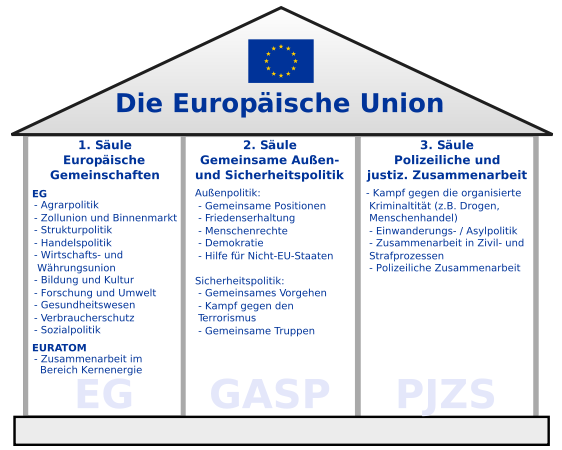
Subsequent Treaties: Amsterdam (1997), Nice (2001). The 2004 Constitutional Treaty draft failed due to negative referendums in France and the Netherlands (2005).
Treaty of Lisbon (Effective Dec 1, 2009): Dissolved the pillar structure, upgraded European Parliament powers, introduced the High Representative for Foreign Affairs and President of the European Council, formalized withdrawal procedures (Art 50 TEU), incorporated the EU Charter of Fundamental Rights, and instituted double majority voting in Council (55% of states representing 65% of population).
- Primary versus Secondary EU Law:
Primary Law (Primärrecht): Founding Treaties (TEU, TFEU, Lisbon), Accession Treaties, General Principles of EU Law, and the EU Charter of Fundamental Rights.
The Four Fundamental Freedoms of the Internal Market:
- Freedom of Movement of Goods (Warenverkehrsfreiheit).
- Freedom of Movement of Persons (Personenverkehrsfreiheit).
- Freedom to Provide Services (Dienstleistungsfreiheit).
- Freedom of Movement of Capital (Kapitalverkehrsfreiheit).
Secondary Law (Sekundärrecht):
Verordnungen (Regulations): General application, directly applicable and directly binding in all member states without national implementation.
Richtlinien (Directives): Binding as to result achieved; requires national transpose legislation by member states.
Entscheidungen (Decisions): Binding in their entirety upon specific addressees.
Empfehlungen & Stellungnahmen (Recommendations & Opinions): Non-binding legal acts.
Institutions of the European Union:
European Parliament: 720 MEPs elected directly every 5 years (seat: Strasbourg). Exercises legislative and budgetary functions jointly with the Council. Lacks direct legislative initiative.
European Council: Heads of State or Government plus Commission President. Defines overall political directions.
Council of the European Union (Ministerial Council): Representatives of member state governments at ministerial level (e.g., Finance, Environment). Core decision-making body.
European Commission: Executive arm ("Motor of the Union"). 27 Commissioners (including President Ursula von der Leyen). Holds sole legislative initiative right.
European Court of Justice (
EuGH, Luxembourg): Supreme judicial review. Enforces compliance via infringement proceedings and provides binding interpretations via the Preliminary Ruling Procedure (Vorabentscheidungsverfahren—mandatory for national courts of last instance).Additional Institutions: European Court of Auditors, European Central Bank (
ECB), European Investment Bank (EIB), Economic and Social Committee (EESC), Committee of the Regions (CoR—329 members; Austria sends 12 members).