Chemistry Past Paper Questions
AS Paper 2, June 2023 - Outline two ways that waste hydrocarbon polymers can be processed usefully, rather than being disposed of in landfill sites. [2 marks]
Recycled (to make other plastic materials)
Combustion to generate energy / electricity
As (organic) feedstock
AS Paper 2, June 2023 - [Context: Radical Substitution]. The yield of CH3CH2CHBrCH3 is only 30%. Suggest two reasons why the yield of CH3CH2CHBrCH3 is so low. [2 marks]
Further substitution
Substitution in a different position
AS Paper 2, June 2023 - The student mixes butan-2-ol, sodium bromide and sulfuric acid in a pear-shaped flask, and refluxes the mixture.
After 1 hour, the mixture in the flask has separated into two layers: an aqueous layer and an organic layer.
Describe the procedures the student would need to carry out to obtain a pure, dry sample of 2-bromobutane from this mixture.Separating funnel (to separate organic and aqueous layers)
Dry organic layer with anhydrous salt/drying agent (e.g.: CaCl2)
Distil and collect fraction at [boiling point of 2-bromobutane]
This question is about the oxidation of two alcohols that are structural isomers of C3H8O.
Compare the oxidation of these two structural isomers using different reaction conditions.
For each reaction include:
• the reaction conditions
• the functional group of any organic product
• a balanced equation.
In your equations, use [O] to represent the oxidising agent and show any organic compounds as structures.
CH3CH2CH2OH AND CH3CHOHCH3
Distillation for aldehyde AND reflux for carboxylic acid OR ketone
CH3CH2CH2OH → aldehyde OR → carboxylic acid
CH3CHOHCH3 → ketone
CH3CH2CH2OH + [O] → CH3CH2CHO + H2O
OR CH3CHOHCH3 + [O] → CH3COCH3 + H2O
OR CH3CH2CH2OH + 2[O] → CH3CH2
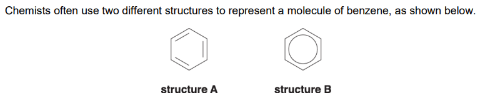
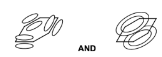
Describe, with the aid of suitable diagrams showing orbital overlap, the difference in bonding between structure A and structure B [4 marks]
p-orbitals overlap (to form pi / π-bonds)
π-bond(s) are delocalised in structure B
π-bonds are localised / between two carbons in structure A
June 2017 A-Level Paper 1: The reactivity of Group 2 elements Mg-Ba decreases down the group. Explain why. [3 marks]
Increasing size: Atomic radius increases OR more shells OR more (electron) shielding
Attraction: Nuclear attraction decreases OR (outer) electron(s) experience less
Ionisation energy: Ionisation energy decreases OR less energy needed to remove electron(s)
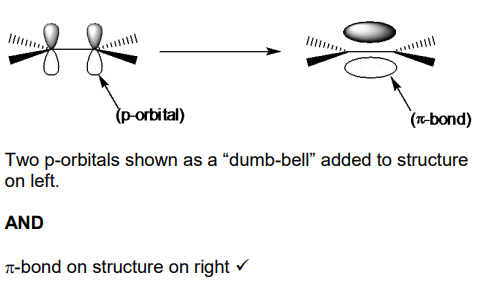
June 2017 A-level Paper 2: The C=C group in an alkene contains a π-bond. Complete the diagram below to show how p-orbitals are involved in the formation of a π-bond. [1 mark]
June 2017 A-level Paper 2: Describe a method to obtain a pure sample of [3-nitrobenzoic acid] from the impure solid and check its purify. [4? marks - I removed the calculation bit]
Purification
Recrystallisation
Dissolve impure solid in minimum volume of hot water/solvent
Cool solution and filter solid
Wash with cold water/solvent and dry
Checking purity
Obtain melting point
Compare to known values
Pure sample will have a (sharp) melting point very close to data book value
June 2017 A-level Paper 2:
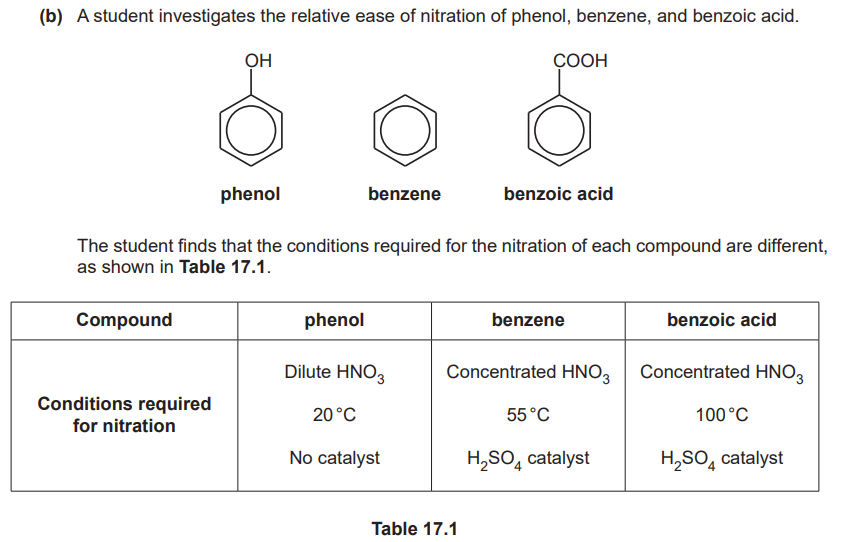
Apply your knowledge of the bonding in arenes to explain the trend in the relative ease of nitration. [3 marks]
Arenes = benzene
phenol: a (lone) pair of electrons on O is (partially) delocalised/donated into the -system / ring
benzoic acid: the –COOH group on benzoic acid is an electron withdrawing group
Links electron density in -bond to reactivity
In phenol electron density is higher AND The ring is more susceptible to attack
In benzoic acid electron density is lower AND The ring is less susceptible to attack
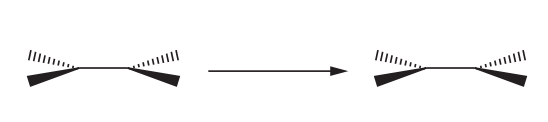
June 2017 - A-level Paper 3: The H–O–H bond angle in ice is about 109° but about 105° in gaseous H2O. Explain why there is this difference. [3 marks]
Ice has hydrogen bonds/bonding
H2O(g) 2 bonded pairs AND 2 lone pairs
Lone pairs repel more (than bonded pairs)
June 2017 - A-level Paper 3:The rate constant, k, for this reaction is determined at different temperatures, T. Explain how the student could determine the activation energy, Ea, for the reaction graphically using values of k and T. [3 marks]
Plot graph using ln k AND 1/T
(Measure) gradient
Ea = (–)R x gradient OR (–)8.314 x gradient
June 2018 - A-level Paper 1: Explain what is meant by the term enthalpy change of hydration. [2 marks]
(enthalpy change when)
1 mole of gaseous ions react OR 1 mole of hydrated/aqueous ions are formed
gaseous ions dissolve in water OR gaseous ions form aqueous/hydrated ions
June 2018 - A-level Paper 1: Predict how the enthalpy changes of hydration of F– and Cl – would differ. Explain your answer. [2 marks]
Correct comparison of ∆hyd linked to sizes: ∆hydH (F–) more negative/exothermic (than ∆hydH (Cl–)) AND F – has smaller size (than Cl– )
Comparison of attraction between ions and water F– OR smaller sized ion linked to greater attraction to H2O
June 2018 - A-level Paper 1: Explain what is meant by the term average bond enthalpy. [2 marks]
Breaking of one mole of bonds
In gaseous molecules
June 2018 - A-level Paper 1: The halogens show trends in their properties down the group. The boiling points of three halogens are shown below.
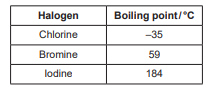
Explain why the halogens show this trend in boiling points. [3 marks]London forces increase OR induced dipole(–dipole) interactions increase
(Number of) electrons increases
More energy to break intermolecular forces OR to break London forces OR to break induced dipole(–dipole) interactions
June 2018 - A-level Paper 1: Describe and explain how the student should determine the end point of this titration accurately. (Na2O32--I2) [2 marks]
Add starch (near the end point)
Blue to colourless
June 2018 - A-level Paper 2: A solid organic compound can be purified by recrystallisation. Which statement(s) about recrystallisation is/are true? [1 mark - MCQ]
1 The organic compound is more soluble in hot solvent.
2 The hot solution is cooled before the purified organic compound is collected.
3 The melting point of the purified organic compound is lower than the impure compound.Answer: only 1 and 2
June 2018 - A-level Paper 2: Explain why phenol is nitrated more readily than benzene. [3 marks]
(In phenol) a (lone) pair of electrons on O is(partially) delocalised/donated into the system / ring
Electron density increases/is higher (than benzene)
(phenol) is more susceptible to electrophilic attack OR (phenol) attracts/accepts electrophile/HNO3 more OR (phenol) polarises electrophile/HNO3 more
June 2018 - A-level Paper 2: The rate of hydrolysis of a haloalkane depends on the halogen present. State and explain how the halogen in the haloalkane affects the rate of hydrolysis. [2 marks]
C–F bond is hydrolysed slowest OR C–I bond is hydrolysed faster than C–Br OR C–Br has shorter reaction time than C–Cl
C–I bond is the weakest OR C–I has lower bond enthalpy than C–Br OR C–Br is broken more easily/readily than C–Cl OR C–Hal bond strength decreases down group (7)
June 2018 - A-level Paper 2: Describe a chemical test to confirm that cinnamaldehyde and methylcinnamaldehyde contain a carbonyl group. How could the products of this test be used to distinguish between the two compounds? Your answer should not include spectroscopy. [3 marks]
(Add) 2,4-dinitrophenylhydrazine AND orange/yellow/red precipitate
Take melting point (of crystals)
Compare to known values/database
June 2018 - A-level Paper 2:

Explain the difference in the boiling points of the fuels. [4 marks]heptane (has a longer chain so) has more points of contact / more surface interaction (between molecules)
heptane has stronger/more induced dipole(–dipole) interactions
pentan-1-ol has hydrogen bonds that are strong(er than induced dipole–dipole interactions) OR (alcohols have) hydrogen bonds and induced dipole(-dipole) interactions/London forces
More energy is required to break induced dipole(–dipole) interactions in heptane than hexane OR More energy is required to break hydrogen bonds
June 2018 - A-level Paper 3:

Explain the properties shown in Table 1.1 in terms of bonding and structure. [5 marks]
NaCl OR MgCl2 - 2 marks
Giant ionic OR ionic lattice
Ions are mobile in liquid state
SiCl4 OR PCl3 OR SCl2 - 2 marks
(Simple) molecular OR simple covalent (lattice)
Induced dipole(–dipole) forces/interactions OR London forces
Comparison of bond strengths - 1 mark
Ionic bonds are stronger than London forces OR Ionic bonds need more energy to break than London forces
June 2018 - A-level Paper 3: Give details of the purification of solid paracetamol. [part of a 6 marker] - extra detail in bold
Dissolve impure solid in minimum volume of hot solvent
Cool solution and filter solid
Scratch with glass rod
Wash with cold solvent/solvent and dry
Red blood cells contain haemoglobin.
Explain using ligand substitutions:
• how haemoglobin transports oxygen around the body
• why carbon monoxide is toxic. [3 marks]
O2 (coordinately or datively) bonds with Fe2+/Fe(II)/Fe/Iron
(When required) O2 is replaced by H2O OR CO2 OR O2 is replaced by CO OR H2O OR CO2 is replaced by O2
CO forms strong(er) bonds (than O2)
June 2019 - A-level Paper 1: The first ionisation energy of sodium is more endothermic than that of potassium. Explain why. [2 marks]
Sodium has a smaller atomic radius/fewer shells
nuclear attraction increases/outer electrons experience more attraction
June 2019 - A-level Paper 1: The lattice enthalpy of sodium oxide is more exothermic than that of potassium oxide. Explain why. [2 marks]
ionic radius of sodium / Na+ is smaller
Na+ has stronger attraction to O2-
June 2019 - A-level Paper 2: Describe, in terms of orbital overlap, the similarities and differences between the bonding in the Kekule model and the delocalised model of benzene. [3 marks]
Similarities
Orbital overlap (sideways) overlap of p orbitals
π bond π bond/system/ring above and below (bonding (C) atoms/ring/plane)
Difference
Kekule has: alternating π bonds OR 3 π bonds / localised (π electrons) / overlap in one direction / 2 electrons in π bond
AND Delocalised has: π ring (system) / all p orbitals overlap OR (π electrons) spread around ring / overlap in both directions / 6 electrons in π bond
June 2019 - A-level Paper 2: Describe two pieces of evidence to support the delocalised model of benzene. [2 marks] - 2 of 3:
Bond length (C–C)
bond length is between single (C–C) and double bond (C=C) OR all (C–C) bond lengths are the same
ΔH hydrogenation
∆H hydrogenation less (exothermic) than expected
Resistance to reaction
Benzene is less reactive than alkenes
OR bromination of benzene requires a catalyst/halogen carrier
OR benzene does not react with/decolourise bromine (at room temperature)
OR benzene reacts by substitution
OR benzene does not (readily) react by addition
June 2019 - A-level Paper 3: Describe how the student can recrystallise the impure crystals to obtain pure (solid). [2 marks]
Dissolve in the minimum quantity of hot water/
Cool AND Filter AND (leave to) dry
June 2019 - A-level Paper 3: Suggest two modifications that the student could make to their method to be confident that all the oxygen had been removed (from lead oxide). Explain your reasoning. [2 marks]
Heat to constant mass (Ensures all lead oxide has reacted)
Spread/stir/break up lead oxide OR increase surface area OR use powder rather than lumps (Ensures all lead oxide has reacted)
Pass methane/inert gas/N2 through tube as it cools OR don’t pass cold air (Prevents O2 reacting with Pb)
Use excess methane OR more methane (Ensures all lead oxide has reacted)
Bubble (escaping) gas through lime water (Ensures all lead oxide has reacted OR ensures all CO2 has been produced)
June 2024 - A-level Paper 1:

Al (Giant metallic)
Giant metallic structure/lattice
Strong metallic bonding
Electrostatic attraction between (positive) metal ions/cations and delocalised electrons
A lot of energy needed to break bonds
Si (Giant covalent)
Each Si atom forms 4 bonds / bonds with 4 other Si atoms
Giant covalent structure/lattice
Strong covalent bonds between atoms
Between shared pair of electrons and adjacent nuclei
Most energy needed to break bonds
P, S (Simple covalent)
Simple covalent / molecular structure/lattice
Strong covalent bonds between atoms
Weak induced dipole–dipole interactions between molecules/London forces
Least energy to overcome the forces
Melting point of S8 > P4
More electrons
Stronger induced dipole–dipole interactions
June 2024 - A-level Paper 2: Describe two limitations of the synthesis of 2-bromo-2-methylpropane from an alkane and bromine. [2 marks]
Further substitution/s
OR Different termination products
OR More than one termination stepSubstitution at different positions along (carbon) chain
June 2024 - A-level Paper 3: Describe how the student would prepare 100.0 cm3 of this solution, giving quantities, apparatus and method. [3 marks out of original 5 marker with calculation part]
Dissolve solid in (distilled) water (less than 100 cm3 ) (in beaker)
Transfer (solution) to volumetric flask
AND Wash/rinse (from beaker to flask)Make up to mark/up to 100 cm3 with (distilled water)
AND Invert flask (several times to ensure mixing)
June 2024 - A-level Paper 3:
June 2024 - A-level Paper 3: