Mechanics
Acceleration
Change in velocity per unit time.
Newton's Laws of Motion
1st Law (Inertia):
An object will remain at a constant velocity unless acted upon by a resultant force.
Inertia is the resistance of a body to move or stop moving once it has stared.
2nd Law:
The resultant force is proportional to the rate of change of momentum.
The resultant force and acceleration act in the same direction
Note:
Two objects of unequal mass dropped from a height, assuming no air resistance, will fall at the same rate ( acceleration) of 9.81 so will hit the ground at the same time.
3rd Law:
An object A exerts a force on object B which means that object B will exert an equal and opposite fore on object A.
Note:
There is always a pair of forces.
The forces must be of the same type and act on different objects or they would cancel out.
Terminal Velocity
This is the maximum, constant velocity achieved by an object, and it occurs when the object has a zero resultant force , that is, no further acceleration
Vectors and Scale Diagrams
Scalar quantities have only magnitude.
Vector quantities have both magnitude and direction.
Scalars | Vectors |
Mass | Force |
Power | Current |
Distance | Displacement |
Speed | Velocity |
Energy | Acceleration |
Time | Momentum |
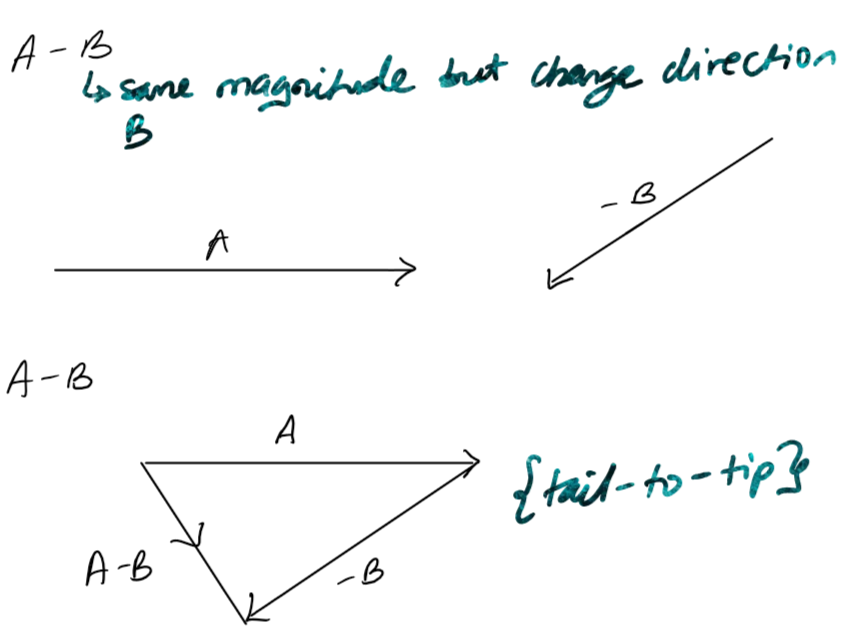
Vector Addition
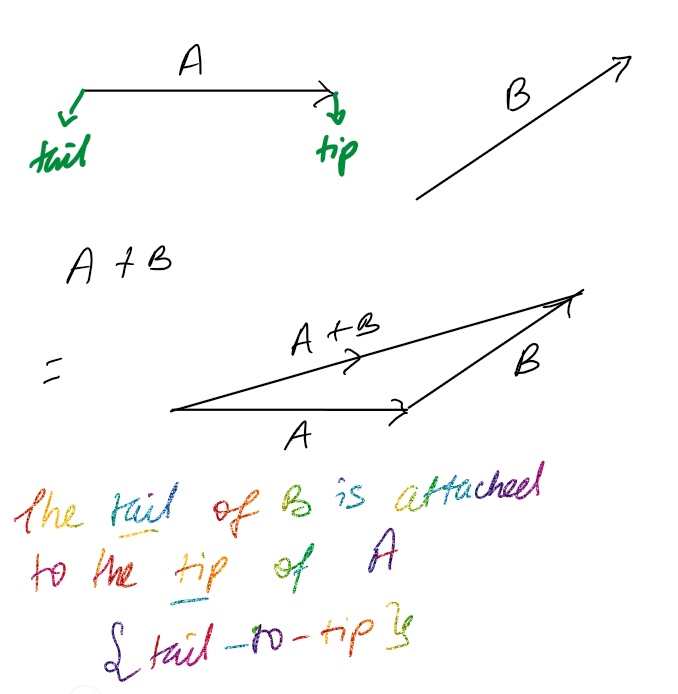
Vector Subtraction
Graphs of Motion
Type | Gradient | Area under curve | Scalar / Vector |
Distance - time | Speed | None | Scalar, so no direction |
Speed - time | Acceleration | Distance | Scalar, so no direction |
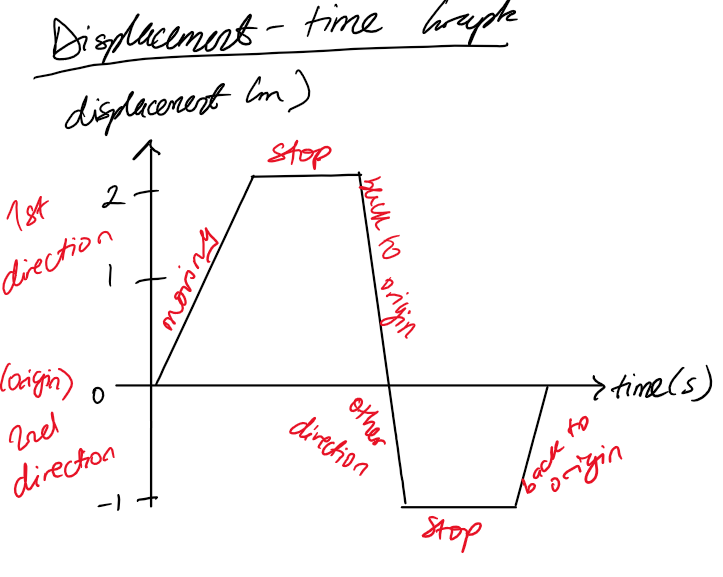
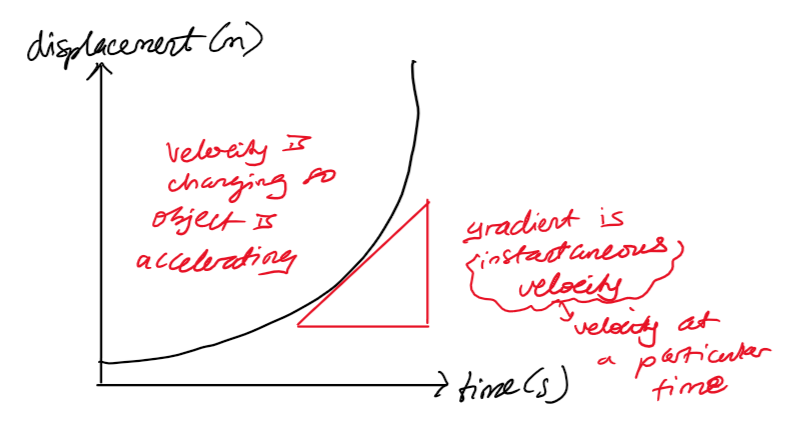
Displacement - time | Velocity | None | See below |
Velocity - time | Acceleration | Displacement | See below |
Acceleration - time | Rate of change of acceleration | Total change in acceleration | See below |
Displacement - time
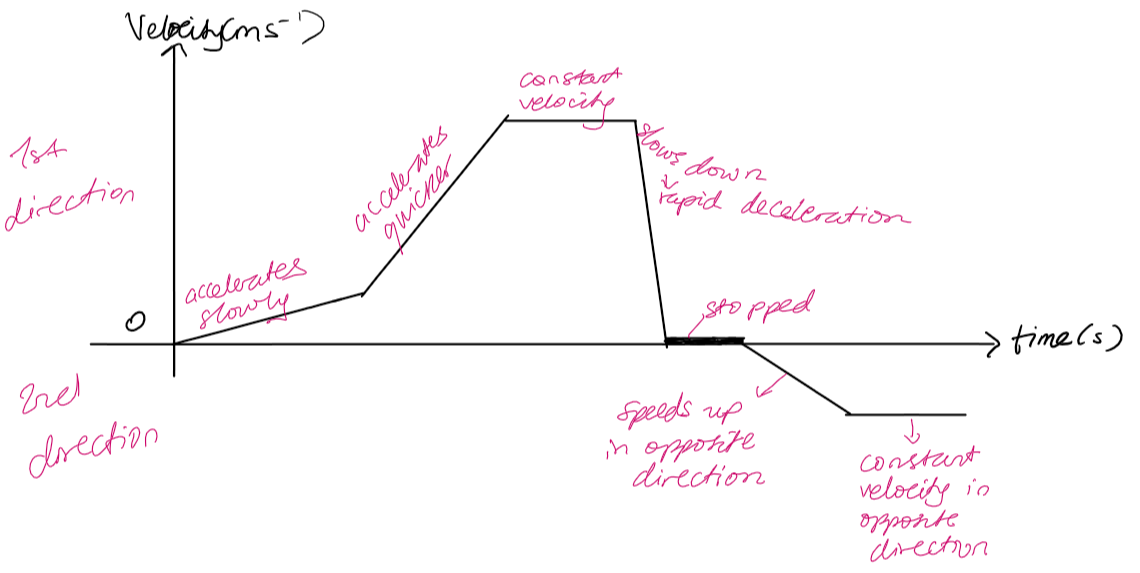
Velocity - time
Acceleration - time
Horizontal line above X-axis = constant acceleration
Horizontal line above y-axis = constant deceleration
Energy, work and mechanical power
The 9 Types of Energy
Kinetic |
Gravitational Potential |
Sound |
Light |
Thermal |
Nuclear |
Chemical |
Electrical |
Elastic Potential |
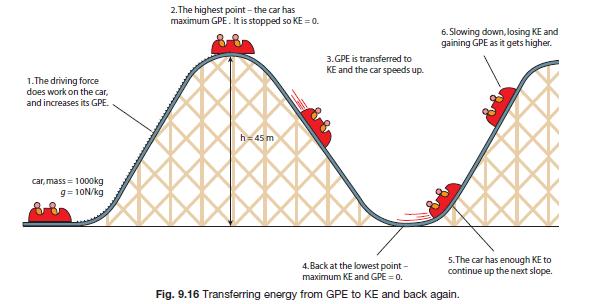
Gravitational Potential (Ep) =
kinetic energy (Ek) =
Law of conservation of energy
Energy can neither be created nor destroyed, but can be transferred into different types
Work (W)
(when distance moved is in same direction as force)
(when force is acting at an angle to the displacement)
Force - Displacement Graphs
The area under the graph is the work done / energy
Power
Power is the rate of transfer of energy.
Explosions
Momentum before the explosion is zero because object is stationary
For momentum to be conserved, momentum after must be equal zero
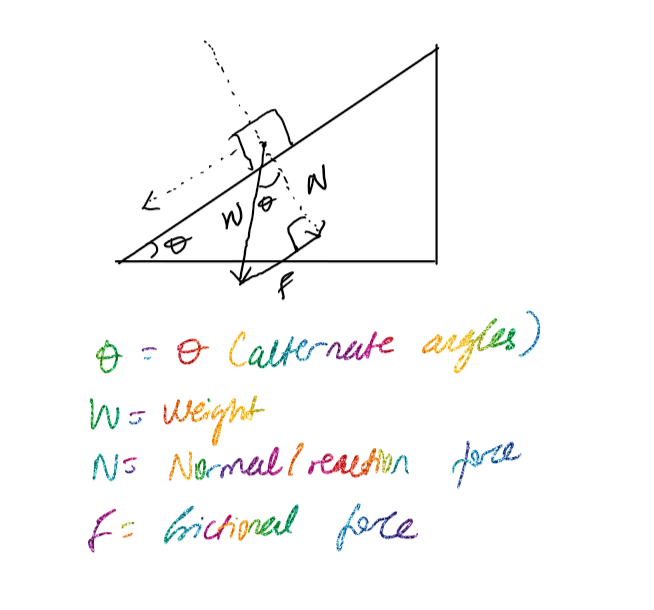
Forces at an angles
2 or 3 Forces in Equilibrium
No resultant force
Object could be at rest or moving with constant velocity
For 3 forces, we can form a closed loop (triangle) by joining tips to tail
For more complex resolutions:
Ensure the angle is to the horizontal
Resolve vertically or horizontally then find resultant force and direction
SUVAT: the equations of uniform acceleration
Freefall, a = -g
If an object falls to a lower position, s will be negative.
We assume no air resistance
Projectile Motion
Gravity is the only force acting and it acts in the vertical direction
Acceleration in the vertical direction
No horizontal force so no horizontal acceleration
We assume no air resistance
Separate horizontal and vertical components
Centre of Gravity
The point at which the entire weight of an object appears to act.
Moments
The product of force and perpendicular distance
Principle of Moments
The sum of all the clockwise moments is equal to the sum of all the anticlockwise moments