Axle
Types of Drive Axle Assembly
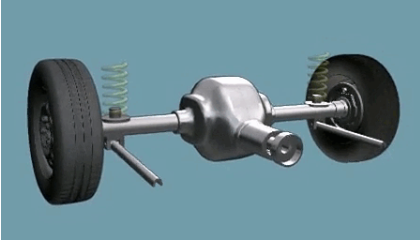
Rigid Axle
The axle housing holds the axle shafts.
It also supports the weight of the vehicle.
Brake and suspension parts attach to the axle housing.
The axle housing, differential, and axle shafts move together as one unit.
Common on trucks and heavy-duty vehicles.
Strong and durable, but gives a rougher ride than independent suspensions.
Independent Axle
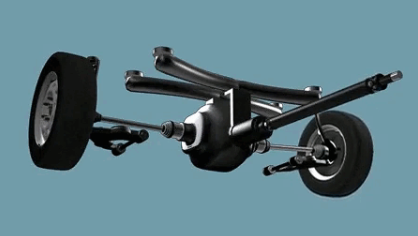
The axle housing is mounted solidly to the vehicle’s chassis.
Each wheel has its own drive axle shaft.
The axle shafts connect to the wheels using U-joints or CV joints.
Each wheel can move up and down independently.
This design gives better stability and a smoother ride on uneven roads.
Components of the Axle Assembly
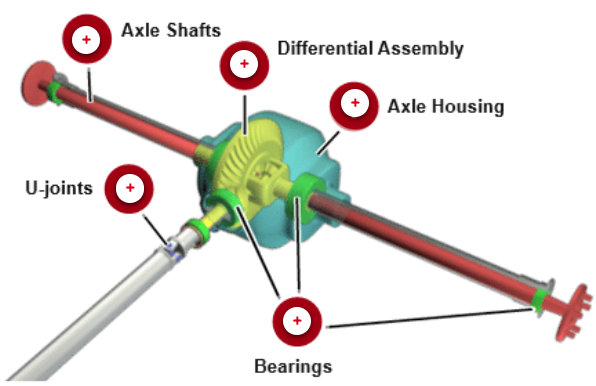
Axle Shafts
Found inside the horizontal tubes of the axle housing.
Transfer power from the differential to the drive wheels.
Rotate with the wheels to move the vehicle.
Key part of the driveline system that delivers engine torque to the road.
Differential Assembly
Contains the drive pinion and ring gear set along with the differential case
Includes two pinion gears and two side gears
Rotates the axle shafts at varying speeds during vehicle cornering
Axle Housing
A one-piece housing with two tubes extending from each end.
Houses and supports the components of the axle assembly.
Contains mounts or attachments for the axle bearings.
The center section is usually made of cast iron or aluminum.
The steel tubes on each side support the axle shafts.
Bearings
A typical axle assembly has:
Pinion bearings
Differential case side bearings
Axle bearings
Pinion Bearings:
Support the drive pinion gear.
Help keep the gear aligned with the ring gear.
Differential Case Side Bearings:
Support the differential case.
Allow the differential to rotate smoothly inside the axle housing.
Axle Bearings:
Support the axle shafts.
Help carry the weight of the vehicle.
U-joints
Double-hinged mechanical devices.
Located at both ends of the driveshaft.
Transmit power from one shaft to another at fixed or changing angles.
Allow the driveshaft to move with the suspension while still turning smoothly.
When greater angles are needed, the axle shafts use CV (constant velocity) joints instead of U-joints.
Types of Axle Housing
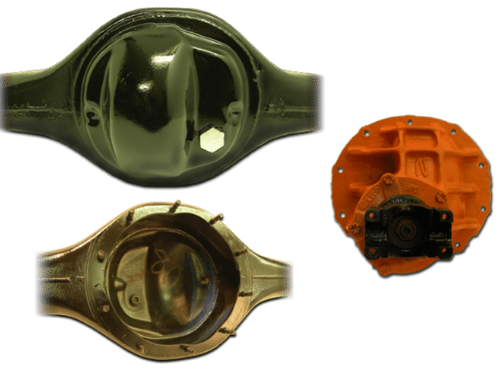
Integral Carrier Housing
Also called a Salisbury axle.
The differential assembly is accessed through a removable rear cover.
The ring gear and differential assembly can be removed as a unit from the housing.
The pinion gear, however, must be serviced inside the housing — it is not removable as part of the carrier.
Commonly used in modern rear axle designs due to simplicity and structural strength.
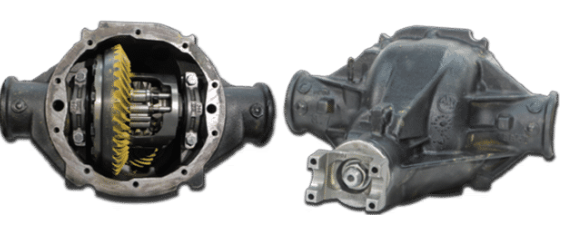
Removable Carrier Housing
Also called a Banjo-style housing or dropout carrier.
The ring and pinion gear set can be removed from the housing as a single unit.
The carrier assembly (often called the third member or pumpkin) bolts to the front of the axle housing.
The rear of the housing is solid, unlike the Salisbury type, which has a removable rear cover.
Commonly used in trucks and performance vehicles for easier servicing of internal gears.
Types of Axle Shafts
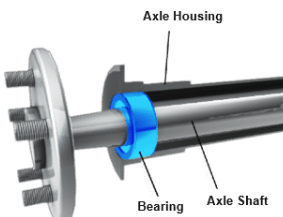
Semi-Floating
The bearing is located just inside the axle housing.
The axle shaft supports the vehicle’s weight in addition to transmitting torque.
The axle shaft itself connects directly to the wheel hub and carries both driving torque and vehicle load.
Commonly used in light trucks and rear-wheel-drive (RWD) passenger cars.
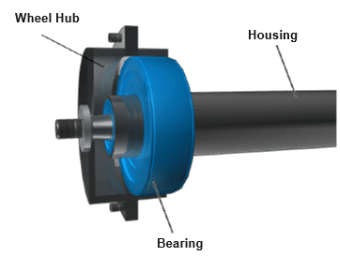
Three-quarter Floating
The bearing is mounted on the outside of the axle housing.
The bearing supports the wheel hub, which is bolted to the end of the axle shaft.
The axle shaft supports part of the vehicle’s weight, while the rest is transferred through the wheel hub and bearing to the axle housing.
Provides a balance between strength and simplicity but does not completely isolate the axle shaft from vehicle load.
Commonly found on older passenger cars and trucks before more advanced designs became standard.
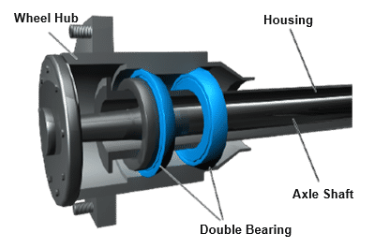
Full-floating
Two bearings are mounted on the outside of the axle housing to support the wheel hub.
The wheel hub, not the axle shaft, supports the vehicle’s weight.
The axle shaft’s sole purpose is to transfer torque from the differential to the wheel hub.
Commonly used in medium and heavy-duty trucks due to high strength and durability.
This design prevents axle shaft failure from causing wheel separation.
Fluid Level Check
When checking the fluid level, check if:
The axle is level
The fluid is even with the bottom of the filler plug opening
Maintenance Procedure of the Drive Axle Assembly
Step 1
First, place the drain pan under the differential.
Step 2
Next, remove all the bolts, leaving the top cover bolt loose.
Step 3
Gently pry away the lower area of the cover and drain the fluid.
Step 4
Once the fluid is drained, remove the differential cover and clean the gasket material from the housing and cover.
Step 5
Use a shop towel to remove the metal debris stuck to the magnet
Check the areas around the bolt holes for dimples
Use a ball peen hammer to straighten the areas around the holes, if needed
Step 6
Apply the sealant to the sealing surface of the differential cover.
Step 7
Reinstall the differential cover and then torque all the bolts.
Step 8
Finally, add new fluid through the fill plug and then reinstall the fill plug.