6. Plant Nutrition
Photosynthesis Process
Definition: Photosynthesis is the process by which green plants synthesize carbohydrates using carbon dioxide (CO₂) and water (H₂O) with sunlight as the energy source.
Word Equation: CO₂ + H₂O → Glucose + O₂ (in the presence of light and chlorophyll).
Balanced Chemical Equation:
Shows that oxygen is released as a byproduct.
Role of Chlorophyll:
Green pigment in chloroplasts that absorbs light energy and converts it into chemical energy for carbohydrate synthesis.
Role of Glucose and Carbohydrate Storage
Transport: Glucose is soluble and cannot be transported directly; hence, it is converted into complex carbohydrates.
Respiration: Used in respiration to release energy for essential reactions like protein synthesis.
Storage:
Excess glucose is converted into starch for energy storage.
Can be transformed into cellulose for building cell walls or sucrose for transport through the phloem.
Used as nectar to attract pollinators.
Nutritional Requirements of Plants
Essential Minerals:
Nitrate Ions: Crucial for amino acid production. Deficiency leads to stunted growth and yellowing leaves.
Magnesium Ions: Important for chlorophyll production. Deficiency results in yellow leaves from the bottom and reduced growth due to decreased photosynthesis.
Factors Influencing Photosynthesis
Key Factors:
Chlorophyll for light absorption
Sufficient light
Carbon Dioxide for sugar conversion
Impact: These factors are essential for the overall rate and efficiency of photosynthesis.
Testing for Starch
Importance: Starch testing is a reliable indicator of photosynthesis, as glucose is used quickly by plants.
Procedure:
Destarch plants by placing in the dark for 48 hours.
Boil the leaf to make it permeable.
Treat it with ethanol to remove chlorophyll.
Rinse to soften and perform iodine test.
Result: Only areas with chlorophyll turn blue-black, indicating photosynthesis.
Investigating Chlorophyll's Role
Use of Variegated Leaf:
Boil leaf to kill it, then treat with hot ethanol to remove chlorophyll. Softened in boiling water followed by iodine application.
Outcome: Only green areas turn blue-black, confirming the role of chlorophyll in photosynthesis.
Investigating Light's Role
Procedure:
Start by destarching the plant.
Cover part of the leaf with aluminum foil and expose to sunlight.
Test for starch afterward.
Outcome: Exposed areas will stain blue-black; covered areas will not, proving the necessity of light for photosynthesis.
Investigating Carbon Dioxide's Role
Experiment Design:
Two plants in bell jars: one with NaOH (to absorb CO₂) and one with water (control).
Expose both to bright light and test for starch.
Result: The plant with water turns blue-black; the NaOH plant does not, confirming CO₂ necessity.
Factors Affecting the Rate of Photosynthesis
Influential Factors: Light intensity, CO₂ concentration, and temperature.
Oxygen Bubble Count: Use an aquatic plant to count bubbles as an indicator of photosynthesis rate.
Investigating Light Intensity
Setup: Aquatic plant in sodium hydrogen carbonate solution, varying lamp distance to change light intensity.
Observation: Initially, higher light intensity increases the rate but plateaus, indicating another limiting factor (e.g., CO₂ or temperature).
Investigating Carbon Dioxide Concentration
Examine: Similar to light intensity, varying sodium hydrogen carbonate changes CO₂ levels.
Outcome: Increasing CO₂ boosts photosynthesis until another factor limits it (e.g., temperature, light).
Investigating Temperature
Testing Method: The temperature's effect on photosynthesis is tested using a setup similar to previous experiments, where the solution temperature is altered using a hot plate.
The rate of photosynthesis initially increases with temperature until reaching an optimum, beyond which it declines due to enzyme denaturation, demonstrating the importance of optimal temperature conditions.
Photosynthesis and respiration
Plants perform respiration both during daylight and at night, exchanging oxygen and carbon dioxide continually. During the day, they photosynthesize, uptake carbon dioxide, and release oxygen. At night, they cease photosynthesis but continue to respire, leading to carbon dioxide intake and oxygen release.
A net intake of carbon dioxide and output of oxygen occurs during the day due to increased rates of photosynthesis compared to respiration, particularly when light intensity is high.
Investigating Gas Exchange
The effect of light on gas exchange can be demonstrated using a hydrogen carbonate indicator, which changes color based on carbon dioxide concentration.
The indicator turns yellow in high carbon dioxide conditions, red when in equilibrium with atmospheric levels, and purple in low carbon dioxide concentrations.
Experimental results show that light exposure causes the indicator to turn purple (high carbon dioxide absorption), while darkness turns it yellow (high carbon dioxide release). In the absence of leaves, the indicator remains red, indicating atmosphere-equilibrium levels.
Limiting Factors of Photosynthesis
Limiting factors are environmental elements that are present in limited quantities and thus restrict biological processes.
The main limiting factors for photosynthesis include temperature, light intensity, and carbon dioxide concentration.
Leaf Structure Adaptations
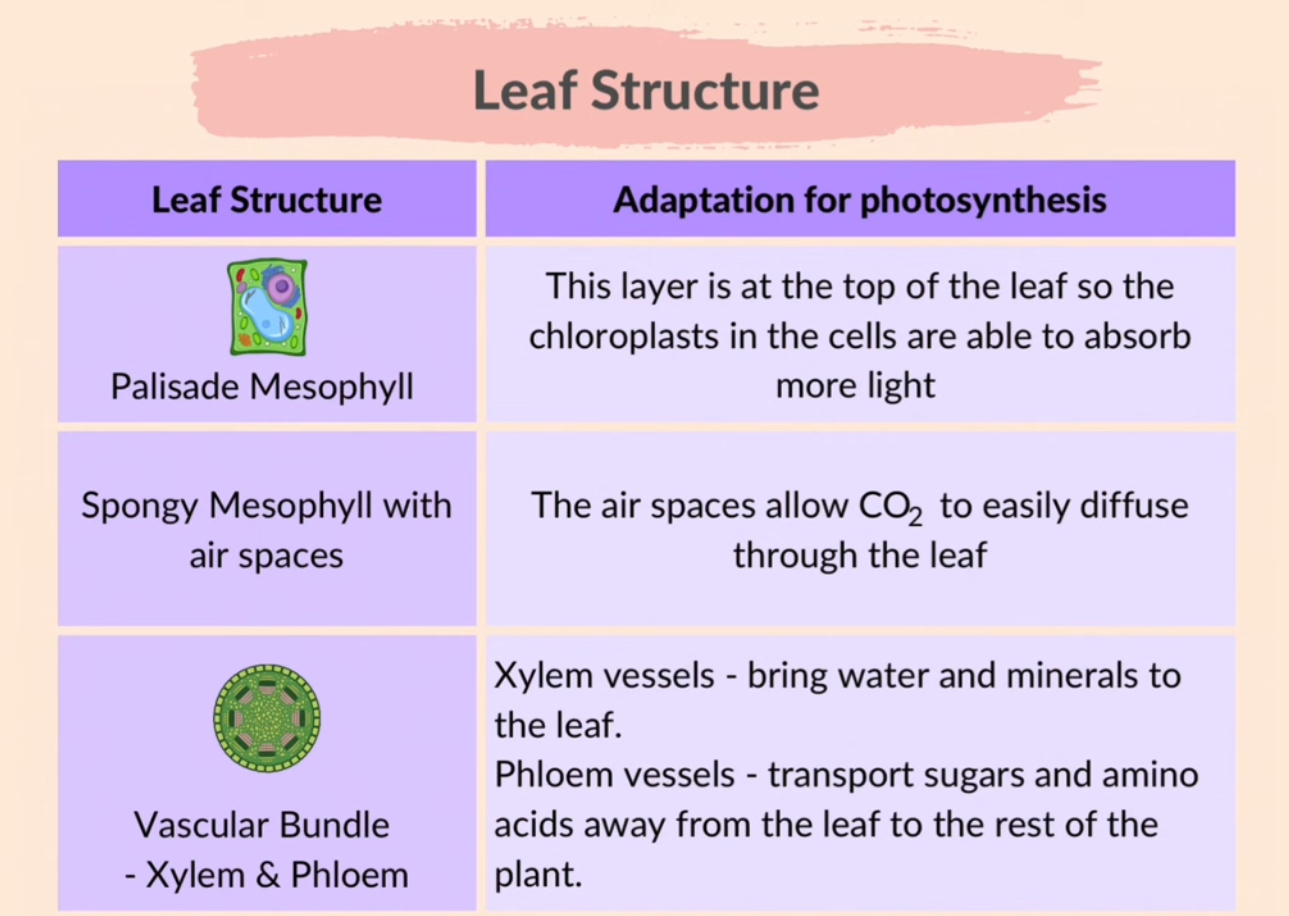
Leaf structures are adapted for photosynthesis with traits such as a large surface area and thinness to enhance gas exchange and light absorption.
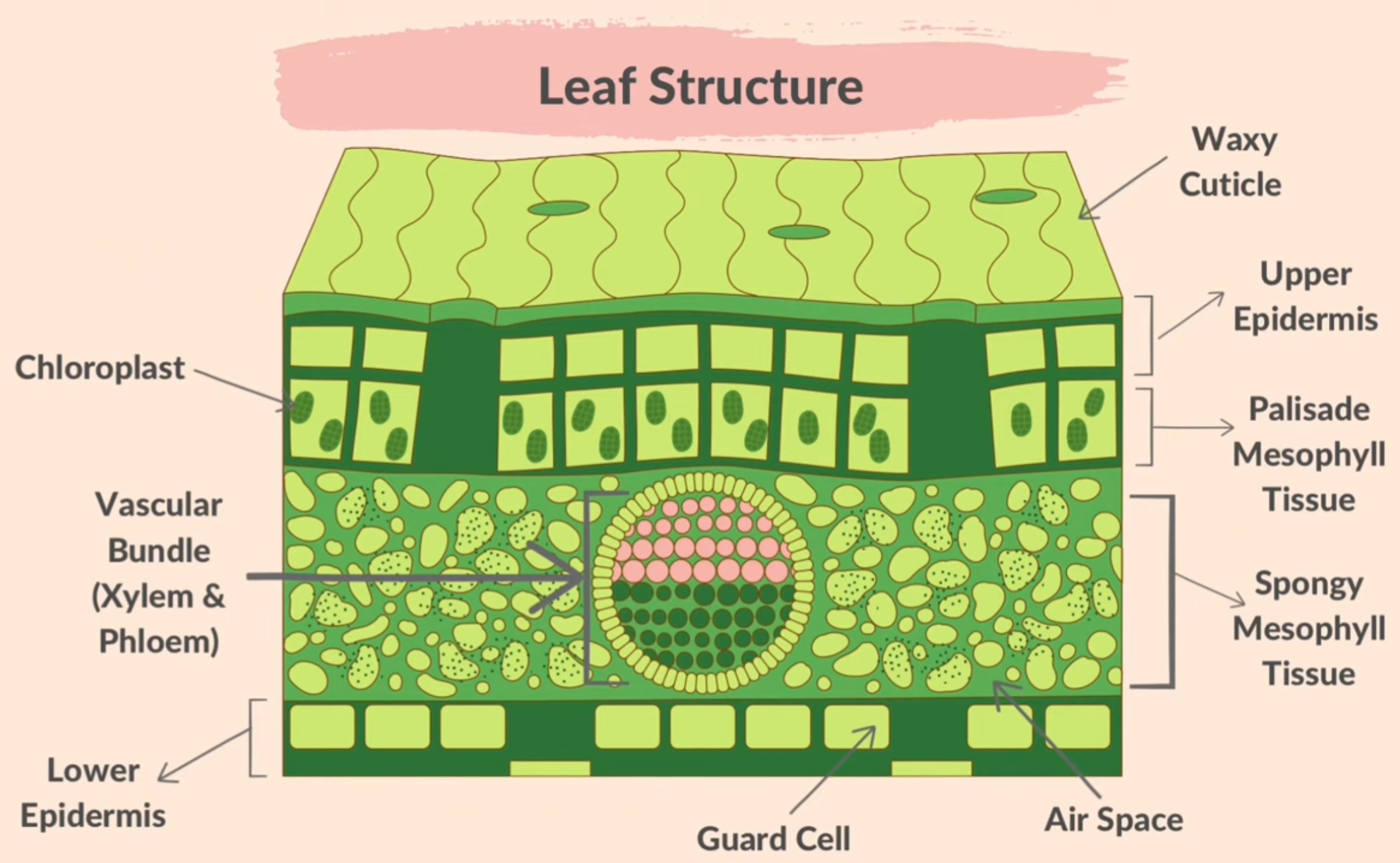
The key parts of a dicotyledonous leaf include: the waxy cuticle, upper epidermis, palisade mesophyll (with chloroplasts), spongy mesophyll (with air spaces), guard cells, stomata, lower epidermis, and vascular bundles (containing xylem and phloem).
The chloroplasts in palisade cells capture light energy, while the thin transparent upper epidermis facilitates light penetration. Guard cells regulate stomatal openings for gas exchange.
The vascular system supports the leaf: xylem transports water and minerals, while phloem distributes sugars and amino acids to the plant.