Ionisation Energy Topic 1
First Ionisation Energy: The energy required to remove one mole of electrons from one mole of gaseous atoms to form one mole of 1+ ions in the gaseous state.
The first electron removed from an atom comes from the highest filled quantum shell. The electron is removed from the atom completely.

Second Ionisation Energy: the energy required to remove one mole of electrons from one mole of gaseous 1+ ions to form one mole of 2+ ions in the gaseous state.
NASA:
Nuclear charge: more protons = more attraction Atomic radius: closer outer electron = more attraction Shielding: fewer inner shells = less shielding = more
Nuclear charge:
What happens to the number of protons across a period? Increase
What happens to the attraction felt by the outer shell electron? Increases
What happens to the amount of energy required to remove the outer shell electron?
Increases Nuclear charge is associated with the positive charge (number of protons) in the nucleus
Atomic radii: (Periods) Atomic radius is the distance between the nucleus and the outer electrons of an atom.
What happens to the number of protons across a period? Increase
What happens to the attraction felt by the outer shell electron? Increases
This attaction pulls the outershell electron inwards, decreasing atomic radii, increasing ionisation energy.
Atomic radii: (Groups)
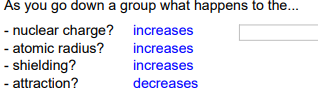
What happens to the number of shells down the group? Increases
What happens to the attraction felt by the outer shell electron? Decreases
Despite nuclear charge increasing, additional shells and shielding results in an increasing atomic radii, decreasing ionisation energy.
Shielding:
Shielding is when repulsion due to inner electrons shield the nucleus from the outer electrons. It increases with increasing number of occupied shells.
Trends in Ionisation Energy:
Ionisation down the group:
Ionisation Energies: Across a Period

Explaining Dips
Between 2-3
Between 5-6
Dip 1:
The outer electron of aluminum is in a higher energy 3p subshell than magnesium's electron (which is in a 3s subshell). Less energy is required to remove an electron from 3p than 3s.
Dip 2:
The electron is removed from a spin paired orbital; there is added repulsion (of the likecharged electrons) This is caused as the 6th group has a 2 electrons with opposite charges on an orbital but the 5th does not causing a dip in ionastion energy as there is repulsion- easier to remove.
Successive Ionisation Energies
The number of ionisations before the first big jump tells us how many electrons are in the outer shell and therefore the group number.
e.g:
There is a big jump between 5th and 6th I.E, therefore has 5 electrons in outer shell and is in group 5 e.g. nitrogen or phosphorus
Summary: Explaining increasing ionsation energies
For successive ionisation energies focus on:
1. Electron being closer to nucleus
2. Increasing proton:electron ratio
Trend:
As electrons are successively removed, the proton:electron ratio increases. Distance between nucleus and OSE decreases and therefore attraction between them increases. Energy required to remove OSE increases.