Features of Glacial and Meltwater Deposition
Drumlins
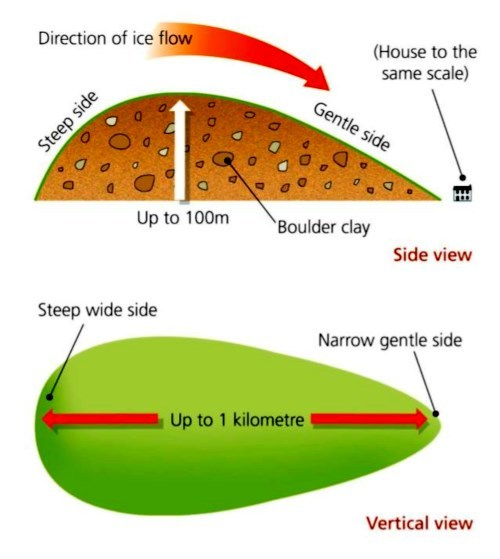
- A drumlin is an oval hill made of boulder clay.
- They are formed when a melting glacier deposits large, uneven lumps of boulder clay underneath the glacier.
- As the glacier moved forward, it smoothed and rounded the lump of clay to form a drumlin.
- One side of the drumlin, the stoss end is steep. This shows us the direction the glacier came in.
- As the glacier moved forward, it created a more gentle incline on the other side, called the lee side. This-shows us the direction the glacier was travelling in.
- Drumlins usually occur in groups/swarms called “basket of eggs topography”.
- Drumlins along the coast were submerged when the water level rose at the end of the last ice age. They can now be seen as small flattened islands.
- Eg: Clew Bay, Mayo.
Moraine
- Material (soil and rock) deposited by a glacier.
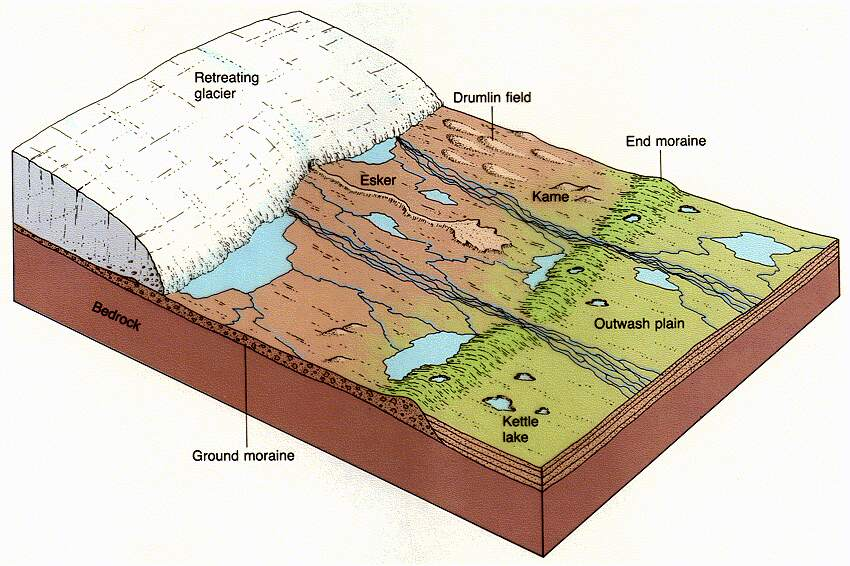
- Can be lateral (deposited at the sides), medial (middle), recessional (when glacier stops and starts) and terminal (last material deposited).
Outwash Plain
- These are large areas of infertile sands and gravel.
- They were deposited by large amounts of meltwater that flowed through the terminal moraine
- Eg: Curragh, Co. Kildare.
Eskers
An esker (meaning ridge) is a long narrow ridge of sand and gravel.
As a glacier melted, tunnels formed under the ice. Large streams of meltwater flowed through these tunnels carrying sand and gravel.
If the load became too much, some of it was deposited on the beds of the meltwater streams.
As the water escaped the tunnels, it lost most of its energy and deposited the rest of its load.
This material built up in a ridge shape, forming an esker.
Eg: Esker Riada which stretches from Galway to Dublin.
Erratics
- An erratic is a large boulder that has been transported a long distance by a glacier and deposited.
- Because the erratic is a different rock type to where it was deposited, it looks out of place.
- This can tell us where the glacier came from and how far it travelled.
- Eg: Granite erratics from the North of Ireland were deposited in the limestone area of the Burren, Co. Clare.