Genetics Notes
Amoeba Sisters Notes
heredity - how traits are passed from parents to offspring
genes can be influenced by environment sometimes
DNA code is in most of your cells
Deoxyribonucleic Acid - DNA
Nucleic Acids are made of Nucleotides
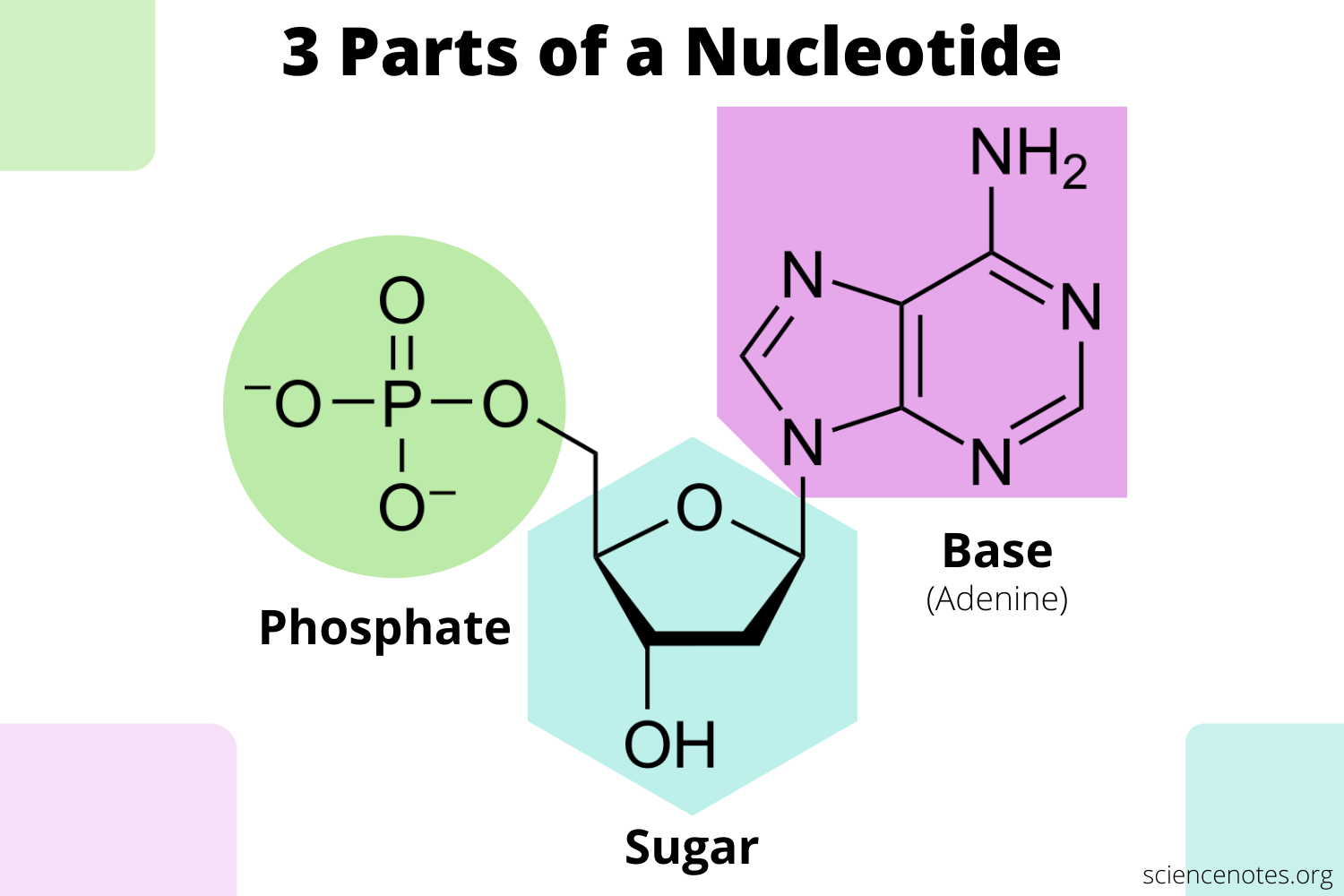
- The only area where parts change in the Nucleotide is the base **__most important__
- Adenine (A)
- Guanine (G)
- Cytosine (C)
- Thymine (T)
- A__pples in the Tree, Car in the G__arage
- amount of bases and the combo of bases change
- bases are held together in hydrogen bonds
DNA held together in a double helix
Genes - specific portion of DNA that gives you a certain trait
DNA is the cookbook - Genes are the recipe
Genes can be turned on and off - gene regulation
Week 24 Notebook Check: Genetics and Meiosis
Key Words
- reproduction - making one or more organisms from 2 parents
- gametogenesis - a process producing gametes (meiosis)
- %%somatic cell - any cell that is not a sex cell%%
- %%germ cell - the cell that is made when egg is fertilized by sperm%%
- zygote - fertilized eggs w/ a set of chromosomes from each parent
Environment Affects Reproduction
- sexual reproduction is better in changing environments
- asexual reproduction is optimal for stagnant conditions
3 Types of Mitotic Reproduction (for Eukaryotes)
- Budding - forms a new organism from a small projection growing on the surface
- Fragmentation - splitting the parent to both grow into a new organisms
- Vegetative Reproduction - forms a new plants from the modification of a stem or underground structure on the parent plant
Diploid vs. Haploid
Diploid
- somatic cell (liver, skin, heart cells)
- diploid cells come from mitosis
Haploid
- gametes
- one chromosome copy
- haploid cells come from meiosis
- chromosome numbers have to be maintained in animals.
Autosomes & Sex Chromosomes
- body has 23 pairs of chromosomes
- chromosome pairs 1-22 are autosomes
- pair 23 determines gender (XX, XY) (sex chromosomes)
- unfertilized egg - X
- sperm - X or Y
- homologous pairs - pairs of chromosomes are the same size/shape
- during meiosis, there are two divisions that end up with 4 haploid cells
- germ cell - the cell that is made when egg is fertilized by sperm
Meiosis 1
- happens after DNA has been replicated (synthesis)
Prophase 1
- double the amount of chromosomes
Metaphase 1
- mom and dad’s cells line up on the cell equator separately
Anaphase 1
- mom and dad chromosomes move away from each other
Telophase 1
- spindle fibers fade away; cytokinesis occurs forming 2 diploid cells
Meiosis 2
- this takes the cells split in Meiosis 1 in half
- same cycle happens, but happens in 2 different cells (diploid) - ending up with 4 cells (diploid)
2/10 Class Notes
- The mother can pass on genetic diseases through her gametes.
- nondisjunction - not able to split
Additions for Weeks 25-27 (Notebook Check)
Crossing Over/Genetic Variation
- homologous chromosomes are attached together by a protein called the synaptonemal complex
- mutations create different versions of genes called alleles
- moving around alleles during reproduction causes genetic variation
- how chromosomes act during meiosis and fertilization determines a lot of mutations/variations
- 3 factors in genetic variation
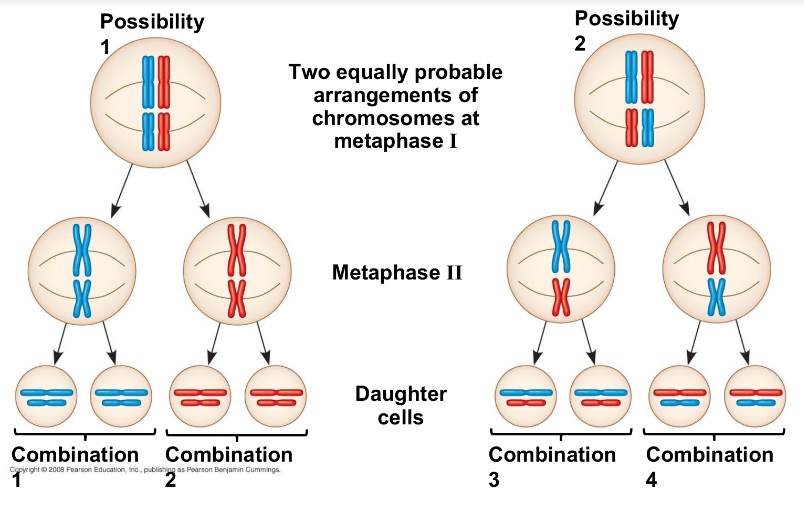
- independent assortment of chromosomes
- homologous chromosomes align randomly in metaphase as shown below
- during independent assortment - chromosomes are sorted between maternal and paternal homologues into daughter cells independently of the other pairs
- crossing over
- crossing over is how genetic mutation occurs, basically two chromosomes change parts
- crossing over makes recombinant chromosomes - combining genes received from each parent
- happens in prophase 1
- contributes to variation because genes from each parent are combined into one chromosome
- random fertilization
- contributes to variation because any sperm could fuse with any ovum
---
Week 26 Notebook Check: Mendelian Genetics
- Body ⬇
- Cells ⬇
- Chromosomes ⬇
- DNA ⬇
- Genes
Vocab for the Chapter
NOTE: (some of these were hard to rewrite - so I sometimes added on to the terms or copy-and-pasted from the slideshow and are further explained later)
- gene - a unit of heredity; a section of DNA sequence encoding a single protein
- genome - the entire set of genes in an organism
- alleles - two genes that occupy the same position on homologous chromosomes and that cover the same trait (like ‘flavors’ of a trait). [ex. eye color or hair type]
- locus - a fixed location on a strand of DNA where a gene or one of its alleles is located
- homozygous - having the same genes for one trait for each parent
- heterozygous - having 2 different genes for a single trait (ex. having a green eye gene and a blue eye gene)
- dominant - masks recessive genes / will show in heterozygous and homozygous conditions (GG, Gg)
- recessive - will be covered by dominant genes / shows only in homozygous conditions (gg)
- hybridization - mating 2 organisms with different genes for a trait
- genotype - genetic makeup of organisms
- phenotype - physical appearance of an organism (genotype + environment)
- monohybrid cross - a genetic cross involving a single pair of genes (one trait); parents differ by a single trait
- dihybrid cross - a genetic cross where parents have two traits that are different
- test cross - cross with a homozygous recessive individual
Mendel / his Pea Plants & findings
Pea Plants
- Looked at 7 characteristics for his experiments
- Round vs. Wrinkled
- Yellow vs. Green
- Purple vs. White Petals
- Inflated vs. Pinched Pods
- Green vs. Yellow Pods
- Axial vs. Terminal Flowers
- Long vs. Short Stems
Mendelian Crosses
- used hybridization (see vocab section for anything in bold) / this involved putting pollen within another plant’s stigma
Monohybrid Cross
- parents only have one trait that is different (same species)
- P = parental generation
- F₁ = first filial generation from genetic cross
- F₂ = second filial generation - offspring of F₁
- ex: tall vs short stems
- T (tall) + t (short) = Tt
- Punnett square for F₁
- 100% heterozygous
- 100% dominant
| T | T | |
|---|---|---|
| t | Tt | Tt |
| t | Tt | Tt |
- Example of the F₂ generation
- 50% homozygous / 50% heterozygous
- 75% dominant / 25% recessive
| T | t | |
|---|---|---|
| T | TT | Tt |
| t | Tt | tt |
Dihybrid Cross
- parents have two traits that are different
- ex. flower color and stem length
- P (purple flower) / p (white flower)
- T (tall) / t (short)
- TT + PP (tall, purple) x tt + pp (short, white)
- F₁ will be tall and purple
| tp | tp | tp | tp | |
|---|---|---|---|---|
| TP | TtPp | TtPp | TtPp | TtPp |
| TP | TtPp | TtPp | TtPp | TtPp |
| TP | TtPp | TtPp | TtPp | TtPp |
| TP | TtPp | TtPp | TtPp | TtPp |
- F₂ Punnett Square (TP, Tp, tP, tp)
- Tall, purple (9); Tall, white (3); Short, purple (3); Short, white (1)
| TP | Tp | tP | tp | |
|---|---|---|---|---|
| TP | TTPP | TTPp | TtPP | TtPp |
| Tp | TTPp | TTpp | TtPp | Ttpp |
| tP | TtPP | TtPp | ttPP | ttPp |
| tp | TtPp | Ttpp | ttPp | ttpp |
Test Cross
- when you cross with with a homozygous recessive individual to figure out the genotype of the other thing
- 100% purple means the genotype of the unknown flower is PP
| [[P[[ | [[P[[ | |
|---|---|---|
| p | Pp | Pp |
| p | Pp | Pp |
- 50% purple means genotype is Pp
| [[P[[ | [[p[[ | |
|---|---|---|
| p | Pp | pp |
| p | Pp | pp |
Mendel’s Principles
- Principle of Dominance - one allele masked another, one allele was dominant over the other in the F1 generation
- Principle of Segregation - when gametes are formed, the pairs of hereditary factors (genes) become separated, so that each sex cell (egg/sperm) receives only one kind of gene.
- Principle of Independent Assortment - “Members of one gene pair segregate independently from other gene pairs during gamete formation”
- genes get switched around - a benefit to sexual reproduction