Boolean Algebra
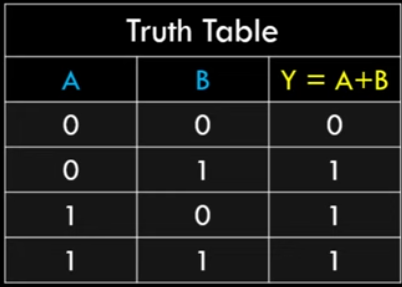
Logical OR operation
OR: A + B
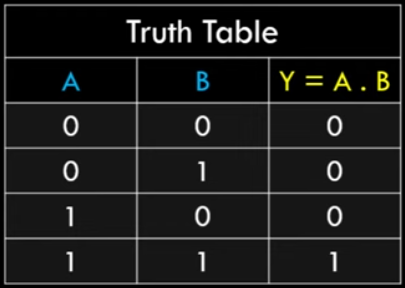
Logical AND operation
AND: A * B
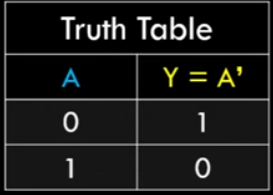
Logical NOT operation
NOT: A = A’ (Compliment)
Laws of Boolean Algebra:
Identity Law:
A + 0 = A
A * 1 = A
Idempotent Law:
A + A = A
A * A = A
Dominance Law:
A + 1 = 1
A * 0 = 0
Involution/Double negation Law
A’’ = A
Negation/Complement Law:
A + A’ = 1
A * A’ = 0
Commutative Law:
A * B = B * A
A + B = B + A
Associative Law:
A + (B + C) = (A + B) + C
A(BC) = (AB)C
Distributive Law:
A + (AC) = (A+B) * (A+C)
A(A + C) = (AB) + (AC)
Absorption Law:
A(A + B) = A
A + (AB) = A
De Morgan’s Theorem
(A + B) = A’ + B’
(AB) = A’ + B’
Buffer
Has an In and Output. If the input is 1 then the output is 1. If the input is 0 then the output is 0.
Not
it turns the input into its complimentary state like A to A’. When powered the transistor is the path of least resistance and the led is on the longer path. So when turned on it will go thru the transistor and not the LED since its easier for it to go thru the transistor. When it is off it cannot go thru the transistor because it is off therefore it has no choice but to go thru where the led is therefore when off the LED is powered on.
And
there are 2 transistors. When one of them is on the voltage cannot reach the other one therefore the LED cannot be turned on. Only when both are on can the voltage completely go thru and light the LED.
Or
the 2 transistors are connected together therefore when either is on the current can flow thru either one to turn on the LED. When both are on it will def turn on because it can either go thru A or B.
Nand
it outputs the compliment of the output of and. So it gives the opposite of what you will get if you input it to and gate.